Acne Studios Advertising That Built a $285M Brand — Marketing Explained
Acne Studios advertising is unlike almost anything else you’ll find in the fashion industry (and that’s exactly the point.) Not powerful in the Gucci or Louis Vuitton sense (splashed across every billboard, worn by every A-lister) but powerful in...
 JaneWalter
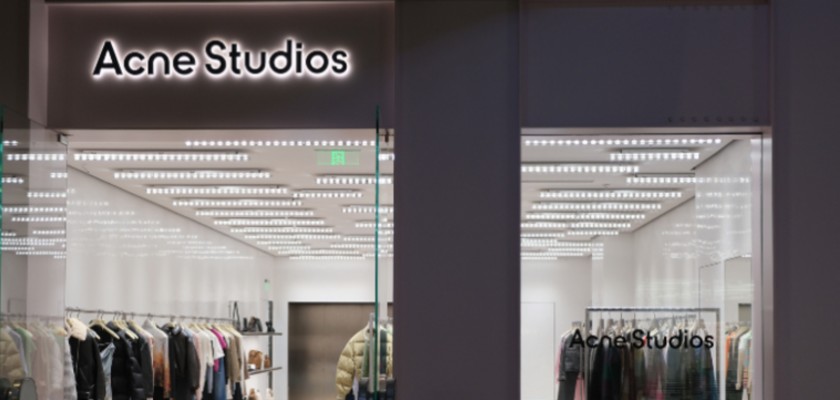
Acne Studios advertising is unlike almost anything else you’ll find in the fashion industry (and that’s exactly the point.)
Not powerful in the Gucci or Louis Vuitton sense (splashed across every billboard, worn by every A-lister) but powerful in a more subtle way.
The kind of brand that earns its cultural position; in other words, the kind of brand that designers, artists, architects, and filmmakers actually choose to wear because it genuinely represents something they believe in.
So, is Acne Studios one of the most quietly powerful brands in contemporary fashion?
The answer, if you look at the numbers: $285 million+ in estimated annual revenue, 80+ stores worldwide, a 135% surge in net income just in 2024, is a resounding yes.
But here’s what makes the brand genuinely fascinating to study: how did it get there without doing what every other brand does? How did a Swedish label that its own CEO admitted “most people barely know exists” build that kind of global financial muscle? And now that they ARE stepping into more traditional advertising, what does that mean for everything that made them special in the first place?
In this blog, I’m inviting you to explore the Acne Studios advertising strategy in all its unconventional glory.
Ready? Let’s get into it.
Inside Acne Studios Marketing
Acne Studios Market Position: The Strategic Sweet Spot The Acne Studios Marketing Mix: The Full 4P Framework Acne Studios Target Market SWOT Analysis of Acne Studios Acne Studios Advertising Strategy: From Non-Advertising to Global Spotlight Acne Studios Marketing Campaigns: Real-World Examples Acne Studios Digital Marketing Management Acne Studios Social Media Management: The Art of Cool on Screen FAQ about Acne Studios Advertising StrategyAcne Studios Market Position: The Strategic Sweet Spot
Where exactly does Acne Studios sit in the fashion universe? No doubt in between, and that in-between is one of the most valuable and defensible positions in the entire market.
The fashion industry broadly splits into three tiers:
Mass market like H&M, Zara, Contemporary like COS, & Other Stories, True luxury like Gucci, Bottega Veneta, Celine or LOEWE.Acne Studios lives at the premium end of contemporary, sometimes called “accessible luxury.” In other words, the brand’s market position can be summarized as: luxury quality and cultural prestige, at a price that excludes the mass market but doesn’t require a heritage luxury budget.
That positioning is strategic of course. It allows the brand to compete in luxury while remaining accessible to the creative class: young professionals, architects, fashion editors, filmmakers, and designers who care deeply about quality and aesthetics but aren’t yet spending Hermès money (we’ll talk about it in details later.)
The Acne Studios market position is also defined by cultural authority, something no amount of paid media can manufacture.
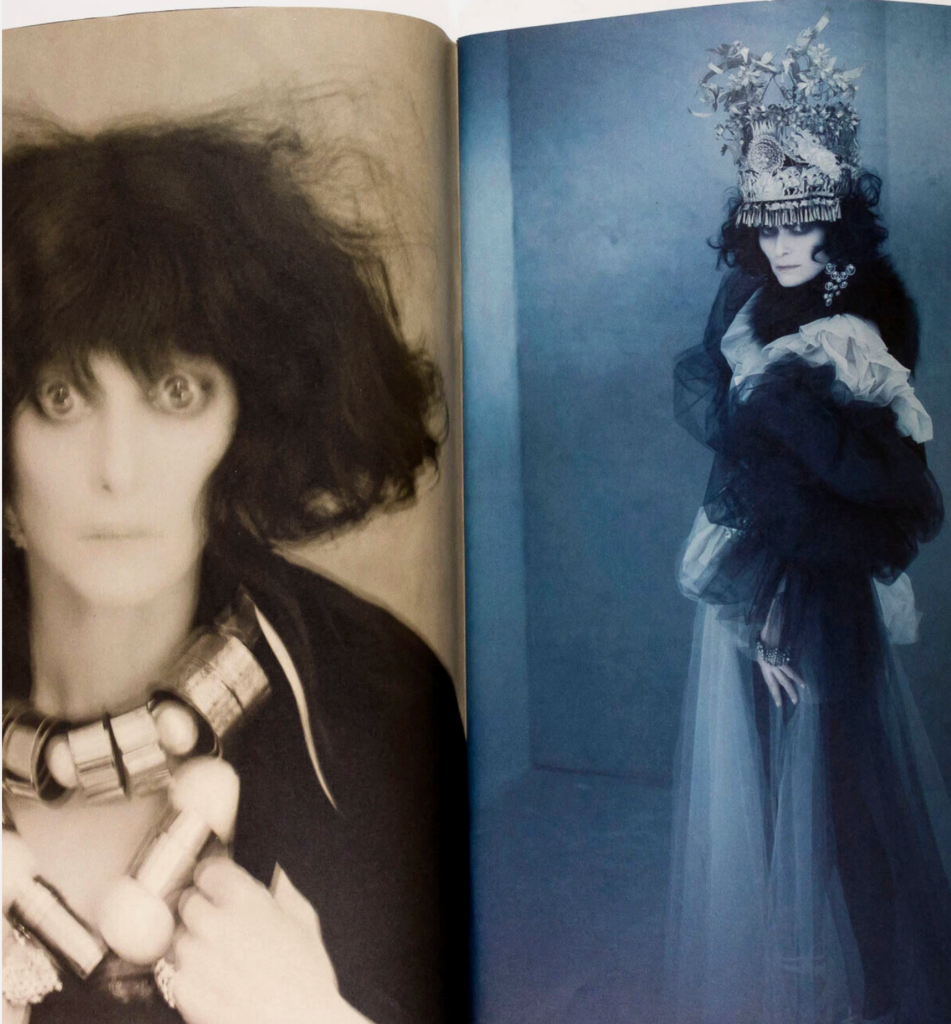
The brand’s genuine alignment with art, contemporary architecture, independent publishing, and creative culture is what separates it from competitors who imitate the aesthetic without having the substance. The Acne Paper magazine features Tilda Swinton, Isabelle Huppert, Azzedine Alaïa and David Lynch not because it boosts sales (though it does), but because that’s authentically what the people at this company care about.
Consumers can tell the difference.
The Acne Studios Marketing Mix: The Full 4P Framework
Let’s put a proper strategic framework Acne Studios advertising.
The classic 4P model gives us a clean lens for understanding how the Acne Studios marketing mix is structured, and how each element supports all the others.
| PRODUCT | Ready-to-wear, denim, knitwear, leather goods, eyewear, footwear Hero items: Musubi bag, mohair scarf, Bla Konst denim SS25 introduces Camero bag & Swarovski-crystal accessories Acne Paper magazine as cultural product extension |
| PRICE | Price skimming strategy Average order value: $300–$325 T-shirts: $140–$200 Jeans: $200–$350 Scarves: $200–$280 Bags: $500–$1,500+ Outerwear: $600–$2,500+ |
| PLACE | 80+ global stores Flagships: Rue Saint-Honoré (Paris, 385 sqm), Bond Street (London), SoHo (NYC) 14 stores in China |
| PROMOTION | Acne Paper magazine Guerrilla gifting Pink packaging Outdoor billboards K-Pop partnerships (ILLIT SS24) Cultural events (Malibu ceremony, Shanghai Art Fair) KOL marketing in China Chinese New Year limited editions |
Acne Studios Target Market
Actually, the Acne Studios target market is more nuanced than a simple demographic profile, and understanding who buys this brand (and more importantly, why) tells you almost everything about why the marketing strategy works.
Core Demographics
Age: 20–45, with the sweet spot around 25–34 Gender: Roughly 59% female / 41% male Income: Middle to upper-middle class; purchases treated as considered investments Profession: Creative industries: fashion, architecture, graphic design, film, advertising, academia Location: Urban centres: New York, London, Paris, Tokyo, Seoul, Stockholm, Los Angeles Education: Highly educated, culturally informed, well-travelledPsychographics
Demographics tell you who. Psychographics tell you why.
The Acne Studios customer want to signal that they are culturally informed, creatively independent, and aesthetically curious. They’re skeptical of obvious luxury signaling (they find it boring).
They respond to restraint, craft, and the kind of quiet confidence that says “I know what I’m doing” without ever having to announce it.
Marketing researchers sometimes call this the “cultural capital consumer.” It means someone whose purchasing decisions are shaped by how a brand makes them feel intellectually and creatively.
For these consumers, wearing a brand that nobody at the party has heard of is part of the appeal. Wearing a brand that your culturally savvy friends recognize and respect? Even better. Acne Studios has always spoken directly to this psychology.
While doing that, the fashion brand recognizes that its future depends on recruiting the next generation of brand loyalists. Gen Z consumers are digital-native, globally connected, and deeply influenced by music culture and social media aesthetics alongside traditional fashion credibility signals.
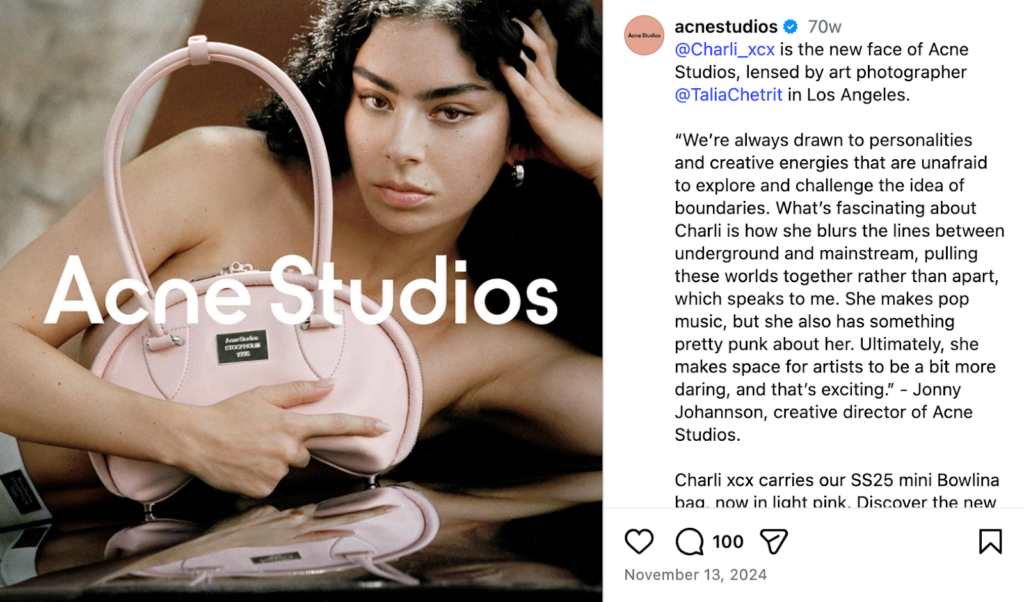
The brand’s ILLIT K-Pop collaboration (detailed in the campaigns section) is a direct response to this. So is the Charli XCX partnership in 2024. Both represent deliberate moves to stay relevant to 18–25-year-old consumers without abandoning the 25–40 core customer who built the brand’s reputation.
SWOT Analysis of Acne Studios
So far, we’ve explored what actually makes Acne Studios stand out:
A brand built on subtlety, creativity, and a slightly unconventional take on luxury.
It leans into art, culture, and carefully crafted fashion marketing campaigns that feel more like statements than traditional ads. But behind that distinct identity, there’s a strategic reality shaping how the brand grows: Here is a SWOT analysis of Acne Studios.
| STRENGTHS | Strong global brand image & credibility Affordable luxury pricing strategy (vs traditional luxury brands) Collaborations with Mulberry and Fjällräven Iconic products: denim, mohair scarf, Musubi bag Cultural authority via Acne Paper magazine |
| WEAKNESSES | Niche product offering limits mass-market reach Marketing strategies lack consistency Long time-to-market increases copycat risk Limited offline presence in China vs competitors |
| OPPORTUNITIES | Rapid growth of China’s luxury fashion market K-Pop and Gen Z cultural alignment potential Expansion into luxury activewear Accessories push: Musubi bag & SS25 Camero bag DTC channel growth reducing wholesale dependency Digital expansion: Xiaohongshu, TikTok, Douyin |
| THREATS | Intense competition from Toteme, A.P.C., Ami Paris, Sandro Global luxury slowdown impacting consumer spending Rapid trend cycles eroding brand differentiation Over-expansion risking dilution of “cool” brand equity Currency fluctuations affecting international pricing |
Acne Studios Advertising Strategy: From Non-Advertising to Global Spotlight
Here’s a direct quote from CEO Mattias Magnusson that captures the central tension in the Acne Studios advertising strategy perfectly:
“People who know us tend to generally like what we do. But most people barely know that we exist.”
For most of its history, the Acne Studios advertising strategy was essentially: don’t advertise. No TV spots. No paid social media saturation. No transactional celebrity endorsement announcement press releases, as many fashion marketing agencies do.
Instead, the brand built awareness through what we might call ambient cultural marketing: creating touchpoints that built brand identity from the inside out.
Acne Paper Magazine
This is the crown jewel of the non-advertising strategy: a biannual print publication that covers art, photography, architecture, academia, film, and contemporary culture.
Each issue is structured around a thematic concept, with contributions from genuinely heavyweight cultural figures: David Lynch, Tilda Swinton, Noam Chomsky, Carine Roitfeld, Paolo Roversi. The 18th issue was published in 2023.
That Acne Studios advertising effort works better than any social media for fashion brands because it tells the world, in the most sophisticated possible way, exactly what kind of brand Acne Studios is.
Every reader of Acne Paper understands, without being told, what values, references, and aesthetics this brand embodies.
The Pink Bag: The Zero-Cost Billboard
Every Acne Studios purchase leaves the store in a distinctive pale pink bag. This turns every customer into a walking billboard at essentially zero additional cost. In fashion-aware cities like London, New York, or Tokyo, that pink bag is an immediately recognizable cultural signal.

The brand has been described as having “started millennial pink” which means the packaging decision carries cultural resonance far beyond its functional purpose.
Guerrilla Gifting & Word of Mouth
The CEO’s candid admission that ‘most people barely know we exist’ reflects a strategic recognition that organic insider awareness, while powerful, cannot by itself fuel the brand’s next growth phase.
To go from $195 million to $400 million+, Acne Studios needs to become known to people who aren’t already in the creative class inner circle.
The new Acne Studios advertising strategy involves three concrete moves:
Global Outdoor Campaigns: A campaign shot by photographer Talia Chetrit to promote the Musubi bag was deployed across outdoor billboards and street-level posters — a marked departure from the brand’s historically subtle promotional approach and a direct investment in mainstream visibility. + Charli XCX collaboration.Premium Location as Brand Advertising: The new Paris flagship on Rue Saint-Honore is a brand statement. A 385-square-metre space on one of the world’s most prestigious shopping streets creates a level of brand visibility and prestige association that no digital advertisement can replicate. Cultural Events as Earned Media: The brand staged a “sunset ceremony” in Malibu in collaboration with artist Angelo Plessas, attracting actors including Nico Hiraga and musicians including Arlo Parks and Lykke Li. These events generate earned media, organic social content, and cultural currency.
<h2 id=”acne-campaigns”>Acne Studios Marketing Campaigns: Real-World Examples</h2>
Let’s get specific. Here are the Acne Studios advertising campaigns that best illustrate how the brand’s strategy translates into actual creative and media work and what each one tells us about the brand’s evolving approach.
#1: Acne Studios FW2016 — David Sims & Strategic Outdoor
Acne Studios’ Fall/Winter 2016 campaign, shot by acclaimed British photographer David Sims, was an early and notable move toward more traditional advertising media. The campaign was activated in three waves, timed to fashion calendar moments:
Paris Fashion Week Hong Kong Golden Week Milan – public transport into mobile billboards through the city Images distributed internationally online to extend the physical campaign’s reach
#2: SS2024 — ILLIT K-Pop Collaboration
This is the campaign that most clearly signals where the Acne Studios advertising strategy is heading.
For Spring-Summer 2024, Acne Studios partnered with ILLIT (as you may know, it’s a K-Pop group on the cusp of major global recognition) for a full campaign shoot in London, photographed by Charlotte Wales.
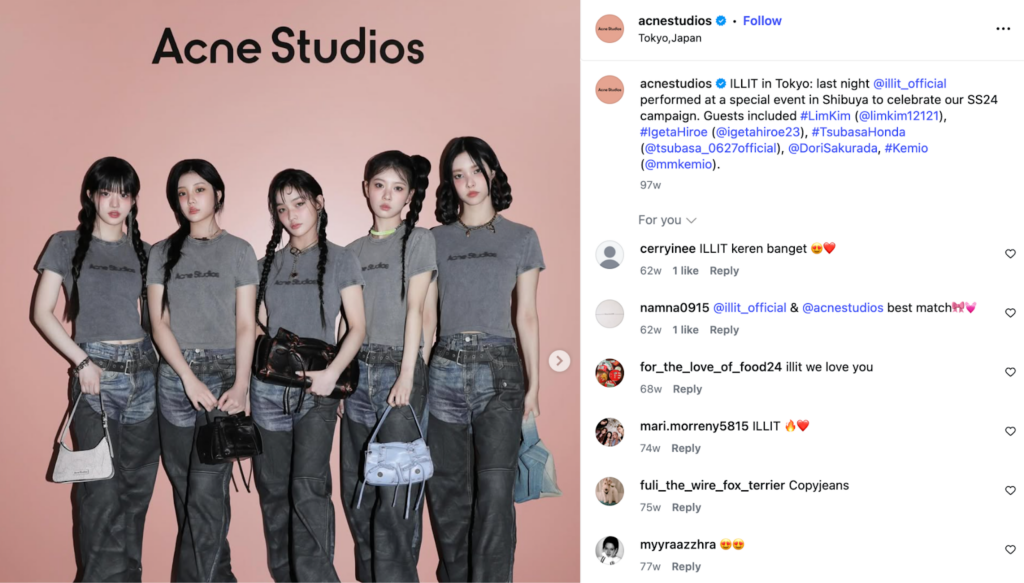
The strategic logic here?
Acne has always presented itself as a nurturer of new creative voices rather than a buyer of established fame. ILLIT was chosen at the moment of their rapid rise, aligning Acne with a cultural moment. K-Pop has one of the most potent fan mobilization ecosystems on earth; for a brand growing in Asian markets, that infrastructure is extraordinarily valuable. ILLIT’s fanbase provided organic social media amplification that the paid campaign placement alone couldn’t deliver. ILLIT’s audience is primarily Gen Z aged 15–25, exactly the demographic Acne needs to recruit as the next generation of brand loyalists.#3: Charli XCX — Riding the Cultural Wave
With her Brat album, Charli XCX reached peak global cultural penetration in July 2024, one of the defining cultural moments of the year.
Acne’s collaboration, aligned with this period, demonstrates a specific form of marketing intelligence: identifying the right cultural wave at exactly the right moment.

Not chasing an established celebrity at their peak cost, but aligning with someone whose credibility is surging in a way that organically matches Acne’s aesthetic values.
#4: Chinese New Year Limited Edition — Cultural Integration Done Right
For the Spring/Summer 2023 women’s collection, Acne Studios launched a Chinese New Year limited series of accessories featuring the Year of the Rabbit design motif.
Best & the most interesting part? High-quality video and photography content was distributed on Xiaohongshu and Weibo, the social platforms most favoured by China’s Gen Z consumers.
The measurable results were clear:
219,000 relevant tag views across Chinese platforms, 10,000+ likes on Instagram posts featuring the Chinese cultural content, Increased sales velocity through limited-purchase strategy creating scarcity and urgency.#5 SS25 Show: The Jonathan Lyndon Chase Collaboration
The Spring/Summer 2025 show & related marketing series, including BTS videos, deserve mention as brand communication in its own right.
The show featured a new installation by Philadelphia-based visual artist Jonathan Lyndon Chase, as well as soft sculpture, furniture, and painting that explore themes of Black subjectivity, queerness, and domestic tenderness.
Johansson’s decision to collaborate with an emerging artist whose practice explores vulnerability, identity, and queer experience positions Acne Studios as a brand that uses its platform to support and amplify culturally significant voices.
Acne Studios Digital Marketing Management
Behind the artfully curated aesthetic, Acne Studios is investing seriously in digital infrastructure.
Let’s look at how Acne Studios’ digital marketing performs:
acnestudios.com functions as a strong, brand-led eCommerce channel, generating an estimated $3.5M+ in monthly online revenue, supported by roughly 1.7 million monthly sessions While its conversion rate sits at 0.5%–1%, below typical ecommerce benchmarks, this is consistent with luxury behavior, where fewer but higher-value purchases dominate; the brand maintains a premium average order value of $300–$325.
The high direct and organic search proportions are positive signals, obviously. They indicate that Acne Studios has built real, active brand awareness. These visitors are seeking out the brand, not being pushed to it through paid channels. That’s earned marketing at work.
What about SEO?
The branded keyword “acne studios” drives substantial organic search volume — over 166,000 monthly searches per Semrush data. Non-branded terms related to hero products (“acne studios scarf,” “acne studios bag,” “acne studios denim”) drive additional discovery traffic.
One interesting historical SEO challenge: the word “acne” has strong medical associations, creating noise in non-branded search results and audience targeting. The brand has largely overcome this through sheer volume of branded search and direct traffic.
Can we say that controlled chaos and the art of being cool describe the Acne Studios social media approach? It’s a big yes.
Acne Studios’ Instagram (@acnestudios) has approximately 4.5 million followers. That’s a solid number, but notably smaller than comparable brands, Balenciaga has over 14 million for context. What the follower count doesn’t reveal is the quality of the audience: highly fashion-literate, professionally influential, and brand-loyal in a way that passive followers never are, like we see in the Maison Margiela marketing case. It says so much about Acne Studios target audience.
The Instagram feed operates like an art director’s personal mood board rather than a conventional fashion brand account. Editorial-quality photography. Behind-the-scenes campaign content. Runway footage. Cultural references.
No giveaways, no “tag two friends,” no engagement-bait captions. Average likes per post hover around 5,300.
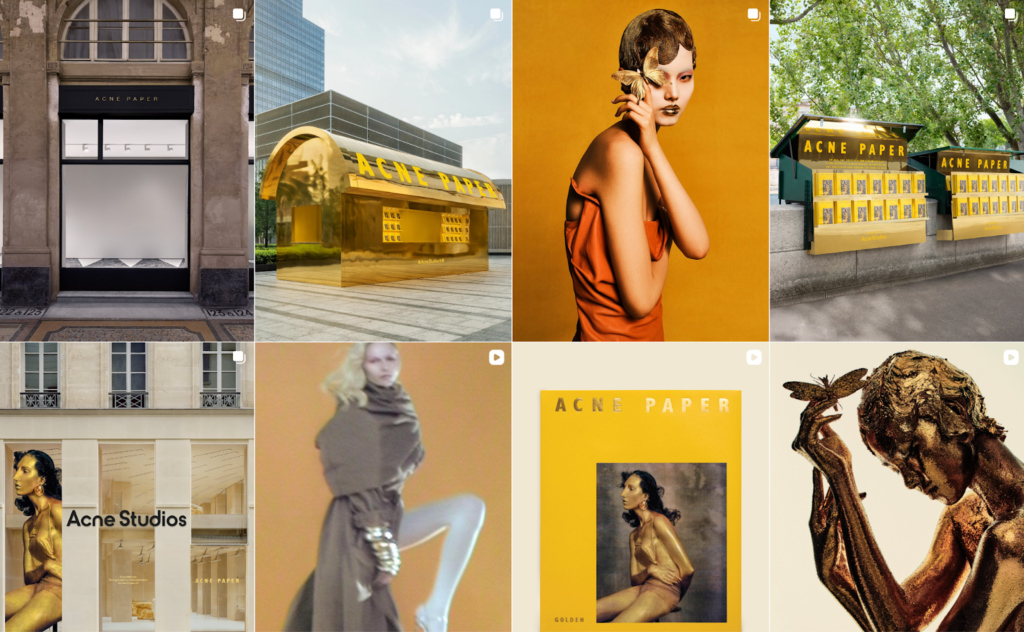
It’s also true for TikTok and Youtube. So, I can say that Acne Studios treats social media channels as a space to project a mood. Take the Fall/Winter 2026 show as an example. Names like Chappell Roan, Peggy Gou, Johnny from NCT, and Tiakola didn’t just show up to sit front row. They became extensions of Acne’s social media presence.
Each one brought their own audience, their own aesthetic, and their own way of telling the story. So instead of one polished campaign rolling out from a single brand account, Acne suddenly existed in dozens of different feeds.
At that point, I need to mention that the YouTube traffic leadership is particularly interesting. It suggests long-form video content, runway shows, campaign films, brand documentaries, is driving more purchase intent than short-form static content. For a brand with the visual richness of Acne Studios, investing in video content pays dividends.
FAQ about Acne Studios Advertising Strategy
What is the marketing strategy of Acne Studios?
Acne Studios basically built a $285 million brand by refusing to advertise like everyone else. While other brands were buying billboards and paying celebrities, Acne was doing something smarter; making products so good that the right people naturally wanted to wear them and talk about them. Acne Studios marketing strategy was always about cultural credibility over paid reach: a real art magazine, product gifting to influential creatives, and letting word of mouth do the work. Now they’re slowly adding more traditional advertising into the mix, like outdoor campaigns, bigger stores, more visible collabs, but carefully, making sure everything still feels unmistakably like Acne Studios.
How does Acne Studios position itself in the global fashion market?
Acne Studios positions itself as a brand: expensive enough to feel luxurious, but not so expensive that a creative professional can’t justify a purchase. A t-shirt is $140–$200, jeans are $200–$350, bags go up to $1,500+.But beyond price, what really defines their position is cultural reputation. This is a brand that lives in the art world, publishes a serious magazine, and collaborates with real artists. One analysis called them “the brand who started millennial pink,” and that kind of organic cultural credibility is worth more than any paid campaign.
What is included in the Acne Studios marketing mix?
On product, Acne makes clothes, bags, shoes, and accessories, with hero items like the mohair scarf, Musubi bag, and signature denim that have basically become cultural objects. On price, the average online order is $300–$325. And they don’t heavily discount, protecting the brand’s value. On place, they have 80+ stores globally, a Paris flagship on Rue Saint-Honoré. On promotion, the mix ranges from an art magazine and an iconic pink bag to K-Pop collaborations and Shanghai art fairs. It’s one of the most interesting promotional toolkits in fashion.
Who is the target market of Acne Studios?
The classic Acne customer is 25–40, lives in a city, and works in something creative: design, film, architecture, or fashion. They let a perfectly cut coat do the talking rather than a big logo. But the brand is also actively pulling in younger consumers through K-Pop collabs and music partnerships aimed at Gen Z. And then there’s China, a whole separate strategic priority, where the target customer loves limited editions, celebrity endorsements, and shops heavily on Xiaohongshu and Weibo. Acne has done a smart job adapting its approach for each group without losing what makes the brand feel like itself.
What makes Acne Studios advertising campaigns unique?
Acne Studios advertising campaigns feel like cultural moments. The ILLIT K-Pop collab for SS2024 was a well-timed alignment with a breakout cultural moment. Similarly, the Charli XCX partnership landed right at the peak of her Brat era, showing real awareness of how culture moves and when to jump in. Even the FW2016 David Sims outdoor campaign was precise rather than loud, posters in Paris during Fashion Week, activations in Hong Kong during Golden Week. And the Chinese New Year limited edition generated 219,000 tag views and 10,000+ Instagram likes simply by connecting authentically with its audience.
How does Acne Studios use advertising to strengthen its brand identity?
Acne Studios is a brand for thoughtful, creative people who have good taste and don’t need to shout about it. The Acne Paper magazine features David Lynch, Tilda Swinton, and Noam Chomsky; it doesn’t sell you anything directly, but after reading it you know exactly what world this brand inhabits. The SS25 collaboration with artist Jonathan Lyndon Chase, whose work explores queerness and domestic vulnerability, tells you something specific about the brand’s values. Even the pale pink shopping bag reinforces the identity, it’s so recognizable in fashion cities that carrying one says something about who you are. So, Acne Studies uses advertising in all these ways to strengthen its brand identity.
What channels does Acne Studios use in its advertising strategy?
Acne Studios uses a mix of channels that each feel intentional rather than just “let’s be everywhere.” Acne Paper magazine is their most distinctive owned channel. Their stores (especially the Paris flagship on Rue Saint-Honoré) function as permanent physical advertising. They’ve recently moved into outdoor billboards with the Musubi bag campaign. On social, Instagram has 4.5 million followers but YouTube actually drives more website traffic; their campaign films and runway content are doing serious work.