
How Big Is the Cancer Risk from Processed Meat?
I quantify the risks of colon and rectal cancers from eating bacon, ham, hot dogs, sausage, and lunch meat. In 2018, arguably the most prestigious […]
 FrankLin
I quantify the risks of colon and rectal cancers from eating bacon, ham, hot dogs, sausage, and lunch meat.
In 2018, arguably the most prestigious cancer research institution in the world, the International Agency for Research on Cancer (IARC), part of the World Health Organization, published its report on processed meat, concluding that foods like bacon, ham, hot dogs, lunch meat, and sausage are cancer-causing, classifying processed meat as a Group 1 carcinogen. “These findings,” concluded the director of the agency, “further support current public health recommendations to limit intake of meat.” Critics questioned putting processed meat in the same carcinogenic classification as asbestos and tobacco. Or, as a pesticide company roughly put it, how can eating processed meat be in the same category as mustard gas?
As I discuss in my video How Much Cancer Does Processed Meat Cause?, the classifications only relate to the strength of evidence that the agent causes cancer or not, not how much cancer. This doesn’t mean they all pose the same level of danger. It’s safer to eat a sandwich filled with pastrami than plutonium, even though they are both Group 1 carcinogens, which means both substances are known to cause cancer in people. So, just how dangerous is meat? The relative risk of colorectal cancer was 18% for every 50 grams eaten a day. But what exactly does that mean?
Well, 50 grams is about one hot dog, or two breakfast links, or two slices of Canadian bacon or ham. So, a daily sandwich with one or two slices of baloney would increase your colorectal cancer risk by 18%. But a half-pound of pastrami on rye would bump it up more like 80%. Okay, but what does the 18% increased risk really mean? One way to look at it is absolute risk versus relative risk. Assuming that the lifetime risk of colorectal cancer is about 5% (1 in 20), increasing your risk by about 20% would only bump up your absolute risk of getting colorectal cancer from 5% to 6%. Now, on a population scale, an 18% drop in risk could mean about 25,000 fewer cases of colorectal cancer every year in the United States, 25,000 fewer families a year dealing with that diagnosis, if we swapped out the daily baloney sandwich for hummus or if we chose veggie dogs instead. So, it all depends on how you look at it.
Colorectal cancer is the United States’ second leading cause of cancer death for men and women combined, after lung cancer. So, if you don’t smoke, colon and rectal cancer may be your greatest cancer nemesis. But we can drop the risk of getting it by about a fifth with a single dietary tweak: cutting a serving of processed meat out of our daily diet.
How does 18% increased cancer risk compare to other risky behaviors? In my testimony before the Dietary Guidelines Scientific Committee, I made what may sound like a hyperbolic metaphor. I asked, “We try not to smoke around our kids, why would we send them to school with a baloney sandwich?” That is not hyperbole. According to the Surgeon General, living with a smoker increases our risk of lung cancer by 15%. So, breathing second-hand smoke day in and day out increases our risk of lung cancer almost as much as eating a serving of processed meat day in and day out increases our risk of colorectal cancer.
The meat industry responded by saying that we must consider the risks together with the benefits before we tell people what to eat or breathe. Think about all the baloney benefits—lunch meat isn’t just about cancer, but convenience.
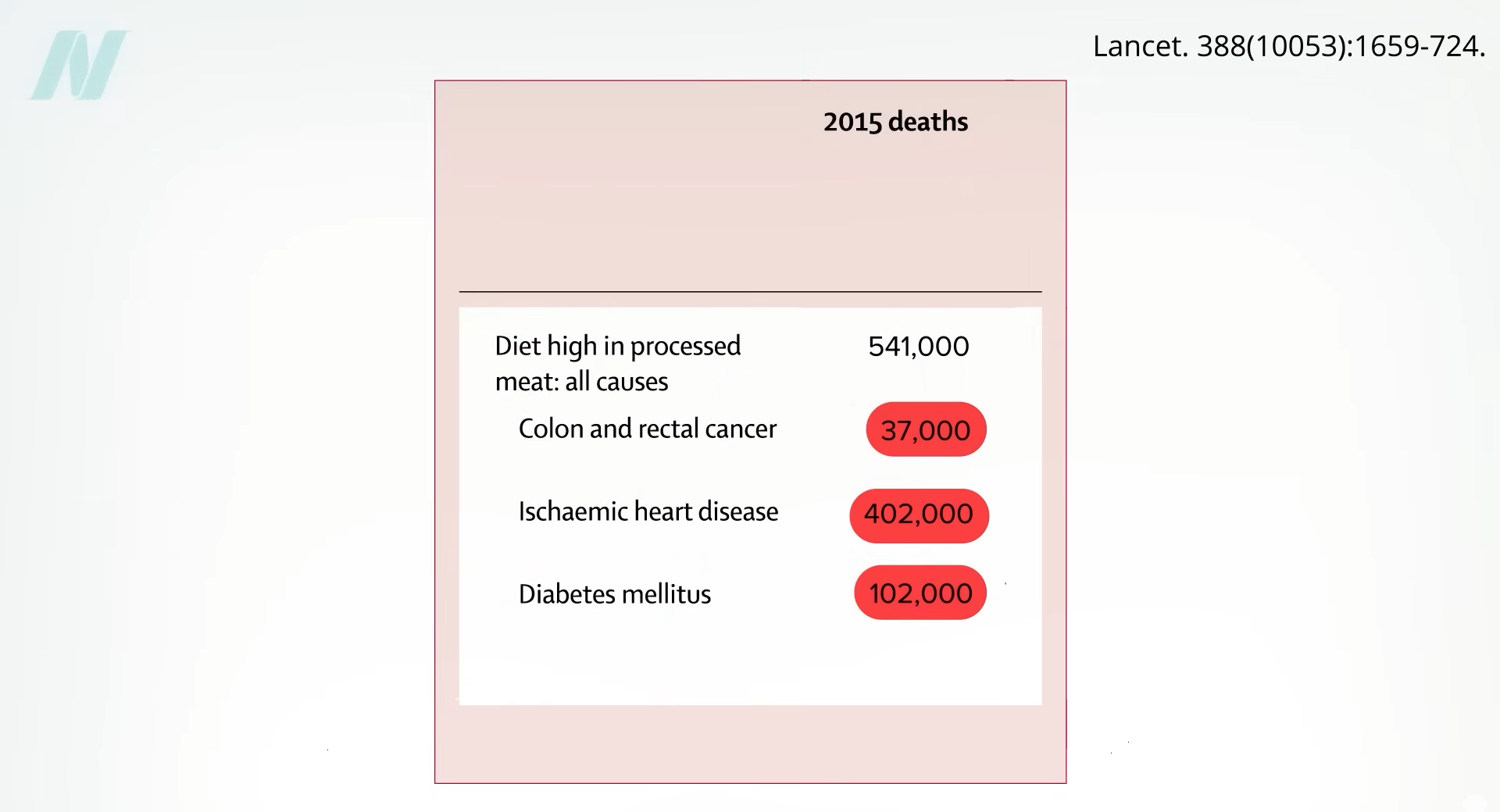
Indeed, processed meat isn’t just about cancer. An article railing against the World Health Organization’s “meat terrorism” cited the Global Burden of Disease studies comparing how many cancer deaths are caused by processed meat consumption compared to tobacco or alcohol use. But if you look at the study they’re referencing, the roughly 37,000 deaths attributable to higher processed meat intake are just the colorectal cancer deaths and don’t also include the 100,000 deaths from diabetes or the 400,000 deaths from heart disease. So, in actuality, we may be talking about half a million deaths attributable to processed meat, as you can see below and at 4:06 in my video.
And it’s not just colon and rectal cancer. If you look at the science since the IARC decision was published, processed meat may also increase the risk of prostate cancer, breast cancer, and pancreatic cancer.
Unfortunately, research shows that “despite growing public health concerns about processed meat consumption, there have been no changes in the amount of processed meat consumed by US adults over the last 18 years.” Of course, it would have helped if the last Dietary Guidelines for Americans had happened to mention that processed meat was a carcinogen. Publishing “an explicit and science-based statement on processed meat” in the next Dietary Guidelines would certainly help. But the scientific committee made no such recommendation.
Sadly, even those with colorectal cancer “hardly improve their overall lifestyle after diagnosis,” though that may be because “70% of cancer patients have never received nutrition advice from their [medical] providers during or after treatment.” That just blows me away.
An article published in a scientific cancer-research journal stated that “despite the continued obfuscation of the issue by the meat industry—they learned well from the tobacco merchants—meat should continue to be a focus of public health action.” New York City is leading the way, passing legislation to ban processed meats from school meals. Not giving our kids carcinogens? What a concept!
Meanwhile, the processed meat industry is trying to reformulate its products. It’s kind of like in the pharmaceutical area, where you try to mitigate the potential adverse effects of one drug by prescribing an additional drug. For example, fiber could be added to hot dogs to try to counterbalance the risk, potentially reducing the cancer load by changing how it’s processed instead of by banning processed meat altogether.
Doctor’s Note
If you missed the previous video, see IARC: Processed Meat Like Bacon Causes Cancer.
For my full testimony on the U.S. Dietary Guidelines, check out Highlights from the 2020 Dietary Guidelines Hearing.

















.jpg&h=630&w=1200&q=100&v=c0f97a310e&c=1)