LinkedIn’s new tool lets you test the outputs of various AI models
The testing tool is designed to help LinkdIn members select the best AI tool for their use case.
 BigThink
This audio is auto-generated. Please let us know if you have feedback.
LinkedIn is trying out a new tool that enables users to try out the latest artificial intelligence models from various providers, as a means to “taste test” their outputs, and find the best AI tool for their needs.
LinkedIn’s Crosscheck is designed to help users find the right AI tools for their needs, while also feeding relevant information back to AI developers.
Crosscheck, which is now live for LinkedIn Premium members in the U.S., enables members to try out the latest models from OpenAI, Anthropic, Google, Microsoft and others, all in one source.
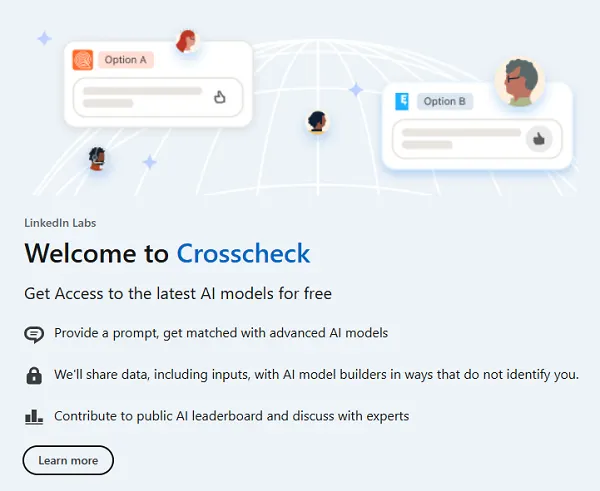
Within Crosscheck, Premium users can share any prompt, which will then be matched with the various AI tools that Crosscheck can access. The system will then provide two responses from different AI tools, without identifying which models were chosen, and users can then rate those responses for quality.
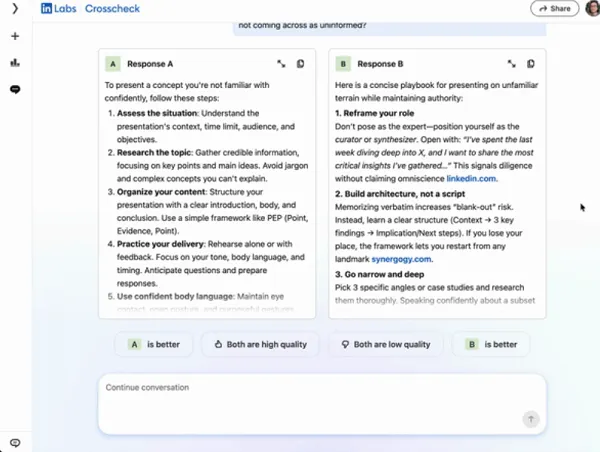
Those ratings are then used to improve AI models, with LinkedIn sharing user conversations and feedback with AI model developers to help improve their products.
There are even leaderboards of the top-performing AI tools for Crosscheck queries across verticals.
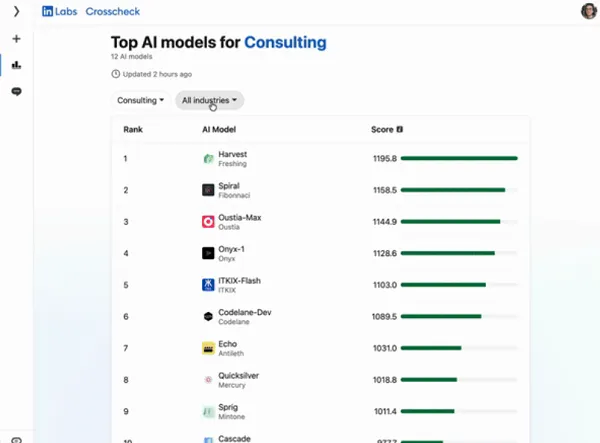
The idea is that this will provide more insight into the specific value of each AI tool for professional users, with specific insight from LinkedIn’s community. Which could be a valuable measure of their relative performance for different sectors and query types, while also potentially helping LinkedIn guide its users towards the right models for their needs.
Though LinkedIn would presumably have a leaning towards OpenAI, for now at least.
LinkedIn’s parent company Microsoft has invested billions into OpenAI, in order to secure use of OpenAI’s tools within its suite of programs. At the same time, Microsoft is also developing its own AI models and approach, in order to reduce its reliance on OpenAI’s systems, though primarily, at least at this stage, it’s still leaning on OpenAI models.
Which could potentially give OpenAI’s tools a little more weight in its assessments, but then again, the leaderboards are fairly diverse, and reflective of a broad range of AI models.
Either way, it’s another example of LinkedIn leaning into the AI shift, which has become a key focus for the app, as it looks to help its members navigate the next stage.
Indeed, every other post on LinkedIn is about how “AI isn’t going to take your job, but someone who uses AI will,” underlining the professional push towards AI usage and adoption, and the importance of developing AI skills.
Actual business insights into AI usage slightly differ, with a recent study published by the National Bureau of Economic Research showing that across 6,000 business executives in the U.S., U.K., Germany and Australia, 89% of them reported seeing virtually no change in labor productivity over the last three years, despite widespread adoption of AI. Modest gains are expected in future, but it is worth noting that the projected benefits and actual reality haven’t met up as yet.