Range Rover Marketing Strategy: How a Luxury Icon Dominates the Entire SUV Market
Let’s get this out of the way first: the Range Rover marketing strategy succeeds where most brands fail, by refusing to beg for attention. In an industry obsessed with visibility, Range Rover takes a stance that feels almost confrontational:...
 Astrong

Let’s get this out of the way first: the Range Rover marketing strategy succeeds where most brands fail, by refusing to beg for attention.
In an industry obsessed with visibility, Range Rover takes a stance that feels almost confrontational: it does not explain itself, it does not chase relevance, and it does not compete on noise. And that restraint is exactly what makes the brand so powerful.
If you’ve been reading this closely, you’ll notice a pattern. Range Rover doesn’t treat marketing as a collection of tactics. It treats it as a system of signals.
So much so that every automotive marketing campaign, every digital interaction, every social post sends the same message: this brand is calm because it’s in control.
That confidence is intentional. The advertising doesn’t rush you. The website doesn’t pressure you. Social media doesn’t perform for algorithms. Instead, each touchpoint quietly reinforces that Range Rover knows who it’s for, and it has no interest in convincing anyone else.
This is where the strategy becomes uncomfortable for many brands to copy.
In this guide, we’ll break down the Range Rover marketing strategy and move from fundamentals, the marketing mix, and target audience to execution across digital marketing, social media, and brand strategy.
Let’s start.
What’s Inside
Range Rover Marketing Mix (4Ps) SWOT Analysis of Range Rover Range Rover Target Market Range Rover Marketing Strategy: Automotive Marketing + Luxury Sustainability Within the Marketing Strategy Range Rover Digital Marketing Strategy Range Rover Social Media Strategy Competitive Comparison: Range Rover vs. Mercedes-Benz vs. Tesla FAQ about Range Rover Marketing StrategyRange Rover Marketing Mix (4Ps)
Before discovering campaigns or channels, it’s worth grounding ourselves in the basics. The Range Rover marketing mix is where the discipline really shows.
| Design-led luxury SUVs with real off-road capability |
| Premium pricing with minimal discount dependency |
| Selective retail, flagship showrooms, private experiences |
| Cinematic storytelling, controlled exposure, minimal urgency |
What’s interesting here is not what Range Rover does, but what it refuses to do.
There’s no feature overload, no aggressive promotions, and no mass-market retail footprint. This restraint is what protects the Range Rover luxury SUV’s market position and keeps the brand aspirational.
SWOT Analysis of Range Rover
For brands and marketers, a SWOT analysis offers a grounded way to assess how Range Rover marketing, brand equity, and operational strategy intersect with real-world performance.
Strengths ⚡️
Range Rover’s greatest strength remains its globally recognized luxury identity.
Born in changing times, it created a new kind of vehicle – one capable of going anywhere yet fitting in everywhere. From the red carpet to the countryside, each member of the Range Rover family continues to set new standards of luxury.
What’s more?
Positioned at the very top of the premium SUV category, the brand blends British heritage with luxury cues, reinforcing its position as a leader in the luxury SUV market. Jaguar Land Rover’s “House of Brands” model allows Range Rover to operate with standalone authority. It means a sharper focus on desirability over scale. (According to the brand’s own annual reports), Investment in connected services, infotainment, and telematics enhances customer experience and long-term loyalty. The connected vehicle ecosystem enhances customer intimacy through infotainment, telematics, and connected services. This directly supports Range Rover’s target market expectations around the digital luxury experience.Weaknesses 🚫
While exclusivity is a strength, it also introduces constraints. Pricing limits elasticity in price-sensitive regions, making Range Rover market share more vulnerable, especially during periods of economic uncertainty. The brand’s focus on desirability over volume is intentional, but it narrows the addressable market.From a marketing lens, all these mean Range Rover marketing strategy must work harder to justify value, particularly as competitors introduce feature-rich electric and hybrid luxury SUVs at aggressive price points.
Opportunities 🌟
Electrification represents one of the most significant growth opportunities for Range Rover.Jaguar Land Rover has committed to electrifying all brands by 2030, with Range Rover positioned as a flagship for luxury electric SUVs.
On the marketing side, connected car data unlocks advanced personalization. As demonstrated in the IDC Connected Cars case study, vehicle data can inform tailored services, proactive maintenance, and communication. If executed well, this creates an opportunity to defend and potentially grow Range Rover market share in the luxury SUV segment, even as competition intensifies.Threats ⚠️
The luxury SUV category is becoming increasingly crowded. Brands such as Bentley, Mercedes-Maybach, BMW, and emerging electric-first players are investing heavily in design, technology, and digital-first marketing. This places constant pressure on the brand’s market position and raises the cost of standing out. Modernization, if misaligned with core brand values, can trigger backlash among loyal customers. As luxury buyers increasingly prioritize sustainability, software, and experience, Range Rover’s marketing strategy must evolve without eroding long-standing brand equity.In summary, the SWOT for Range Rover looks like this:

Range Rover Target Market
As anyone can predict, at its core, Range Rover targets high-net-worth individuals who view vehicles as an extension of identity & status.
This audience is typically affluent professionals, entrepreneurs, executives, and legacy-wealth households who value discretion and craftsmanship.
As can be seen in the brand’s ads & social media presence:
From a demographic perspective, the Range Rover target market skews toward buyers aged 40–65, with strong representation among urban elites and suburban luxury homeowners.
And yes, these customers are often multi-car households, and at that point, Range Rover plays a dual role: a prestige vehicle for daily use and a capable SUV that aligns with travel, leisure, and outdoor lifestyles. This duality is a definition of the Range Rover marketing strategy.
Psychographically, the brand appeals to consumers who prioritize quiet confidence. Unlike flash-driven luxury brands, Range Rover marketing consistently avoids overt excess. The messaging and value proposition mainly focus on refinement and mastery (we’ll take a close look at it below).
Geographically, the Range Rover target market is strongest in mature luxury regions such as the UK, Europe, North America, and the Middle East; the brand continues to grow in Asia-Pacific areas.
What’s particularly important, as we mentioned earlier, subjects like sustainability, technology, and digital experience are now baseline expectations for luxury buyers. And the brand’s marketing tactics increasingly speak to environmentally conscious affluence.
By weaving technology and sustainability (and storytelling from time to time) into a brand experience, Range Rover reflects how digital marketing for luxury cars works best today.
Range Rover Marketing Strategy: Automotive Marketing + Luxury
How do you market a vehicle that already carries status?
Actually, the Range Rover’s strategy sits comfortably between classic automotive marketing (like Volkswagen does) and the subtle codes of true luxury branding.
The brand rarely tries to “sell” in the traditional sense. Instead, it assumes desire and focuses on reinforcing why that desire is justified. One of the clearest examples of this is the “Above & Beyond” campaign.
Not promoting horsepower or technology specs, the campaign frames Range Rover as a symbol of mastery. The storytelling leans on environment and human presence; it aligns with the expectations of the Range Rover target market.
Another example showing that the brand creates campaigns beyond “traditional performance ads” is “Dragon Challenge.”
As you may know, the campaign documents the Sport model climbing the Heaven’s Gate road in China. It’s actually a calm and cinematic ad, and it allows the challenge itself to carry the message. There is no aggressive tone, no overstatement, just controlled confidence, just like Range Rover itself.
At the other end of the spectrum sits “Speed Bump.”
This campaign uses a clever, almost playful idea to highlight engineering intelligence. By turning a speed bump into a brand moment, Range Rover makes technology feel approachable without diluting luxury. It’s a good example of how the brand adapts to a younger, more urban audience while still protecting the wider brand narrative.
Then there’s “The Definition of Luxury Travel,” which is fully about experience and lifestyle.
This campaign reframes the vehicle as part of the journey, not just the transport. Visuals focus on serenity and movement through beautiful environments. Here, Range Rover marketing moves beyond automotive storytelling into the territory of hospitality and design.
Another important layer is controlled exposure. Range Rover campaigns are often fewer, but more impactful. Limited launches, invitation-only experiences, and carefully timed reveals all contribute to sustained desirability.
Digitally, these campaigns are supported through carefully curated content and high-frequency advertising. Social content is cinematic, websites feel editorial, and product pages prioritise experience over comparison.
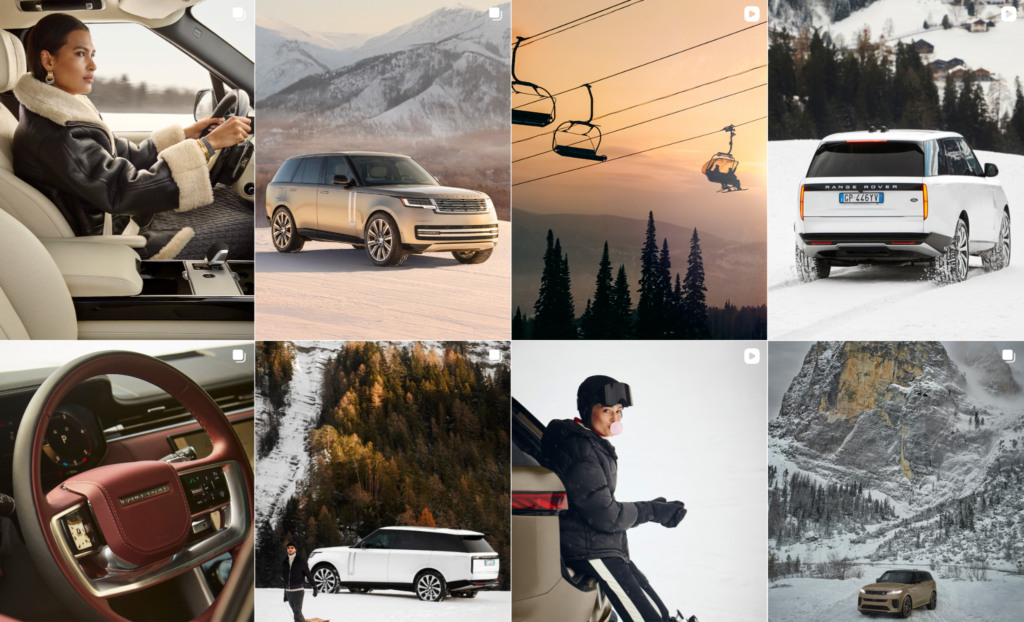
Source: https://www.instagram.com/rangerover/
Before closing that section, let’s mention one of the brand’s quiet strengths: Localization.
As we mentioned above, the brand consistently anchors itself in British design authority and modern luxury, then adjusts how that story is told locally.
This logic is well captured in the following perspective:
The adoption of the national strategy enables the firm to capitalise on the advantage of home country resources and capabilities, particularly given that the product is presented as a premium and luxury product. Countries of origin have a large impact on such products, and for a product to gain success demand globally, a firm has to show that there is something unique about the products that make it premium, which is what JLR is doing through this strategy.
Range Rover adapts emphasis: in some regions, comfort and rear-seat experience are foregrounded; in others, capability, landscape, or presence take priority. Yet the underlying brand cues remain constant.
And, local launches, destination-based activations, and region-specific storytelling place the vehicle into culturally meaningful settings without altering tone.
Digitally, localization is handled with equal discipline. Language, imagery, and use-case framing are adapted, but design systems, pacing, and narrative structure remain aligned. This protects trust and coherence across markets.
Sustainability Within the Marketing Strategy
What is the most guaranteed way to get credit? Of course, talking about sustainability.
For Range Rover, sustainability shows up as a constant running through product, design, and experience in its marketing.
In other words, the brand presents sustainability as something that naturally belongs to modern refinement.
Electrification is a clear example of this thinking.
Hybrid and electric models are introduced as advanced expressions of the well-known Range Rover experience. The message to the target market is that sustainability enhances comfort and performance instead of limiting them.
In the brand’s own words:
We are evolving our business to reflect the changing world. Our global operations are transforming to become cleaner and more energy efficient. We are reimagining material use in design and engineering, and collaborating with our supply chain to become intrinsically sustainable as we move towards an electric future.
The statement goes on to say that JLR will improve how its operations affect the climate, resource consumption, nature, and biodiversity.
We aim to achieve carbon net zero by 2039 through the decarbonisation of our manufacturing & operations, our supply chain and vehicles emissions.
On the sustainability point, materials and craftsmanship play an equally important role. Marketing narratives highlight responsible sourcing, durability, and design longevity. In that thinking, sustainability is about making things better and longer-lasting.
For the brand, sustainability appears within product films, launch narratives, and brand storytelling.
So, as we mentioned earlier, Range Rover’s marketing succeeds because it knows when to lead and when to step back. By using “sustainability” as a design principle and an experience standard, the brand builds trust quietly.
Range Rover Digital Marketing Strategy
At the centre of Range Rover’s digital marketing strategy is the owned digital ecosystem.
The brand’s website, configurators, and digital brand hubs are designed to feel closer to luxury publishing than automotive retail.
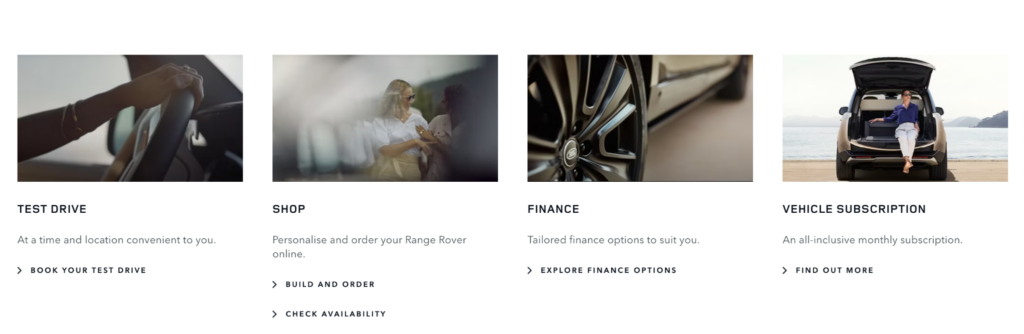
Source: https://www.rangerover.com/en-gb/index.html
This is a deliberate contrast to mainstream automotive brands that rely on constant visibility and performance-heavy messaging. In other words, for Range Rover, digital is about reinforcing perception.
On the other hand, product pages prioritize storytelling before specifications. This aligns closely with the expectations of the brand’s target market, where buyers are emotionally motivated.
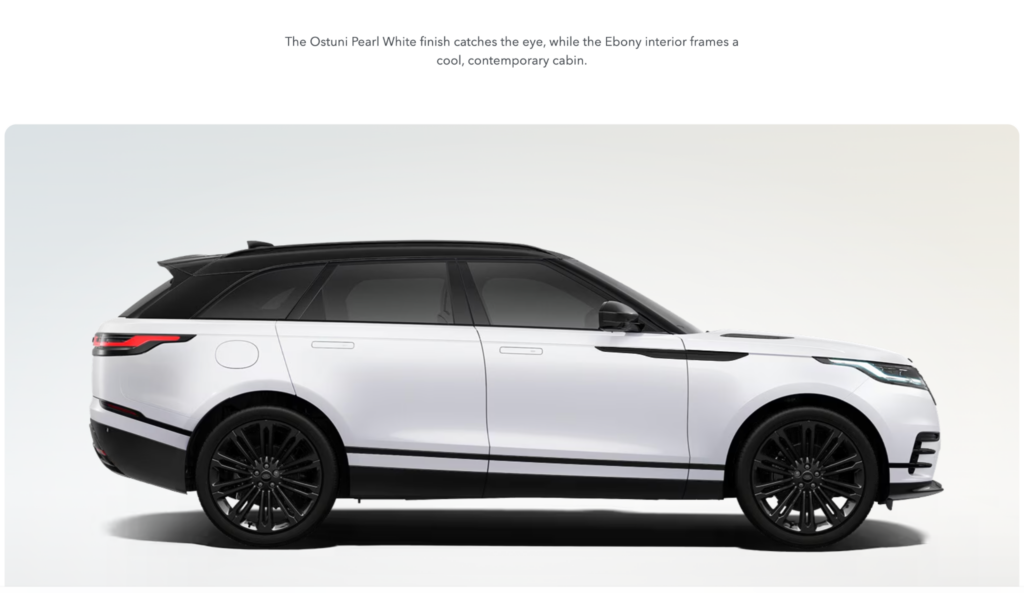
Source: https://www.rangerover.com/en-gb/range-rover-velar/index.html#inspiration
Raffine’s case study titled “Maintaining a Solid Online Presence Across 80 Markets” highlights that today’s customers demand “a virtual experience that matches the experience they would receive in a physical retail environment.”
The statement continues as follows:
They demand to be fully informed, and the brand website must give them all the relevant information they need to research their vehicle purchase before they even visit a showroom. From the comfort of their own home or from a mobile device they can easily browse for various options and configure their dream car online. In some markets they can even find and purchase their perfect new or used vehicle online.
With its digital channels, Range Rover appears to provide what customers need.
What’s more, for Range Rover, personalization plays a quiet but important role. Digital tools such as vehicle configurators and tailored follow-up experiences allow the car brand to support decision-making without overt sales pressure.
According to the JLR annual report:
Connected services, customer data, and digital CRM systems are used to improve continuity across touchpoints—from discovery to ownership.
Taken together, Range Rover’s digital marketing shows how advertising for luxury cars differs fundamentally from mass automotive practice. For brands and agencies, the lesson says: in luxury, digital works best when it behaves less like a channel and more like an extension of the brand itself.
Above, we examined the broader marketing strategy of the brand. Here’s where that thinking really comes to life, on social media.
Range Rover social media strategy isn’t trying to win the algorithm every week.
In other words, Range Rover’s digital presence doesn’t feel like a typical automotive feed. It feels closer to a luxury magazine or a design journal. Take a quick look at its TikTok feed:
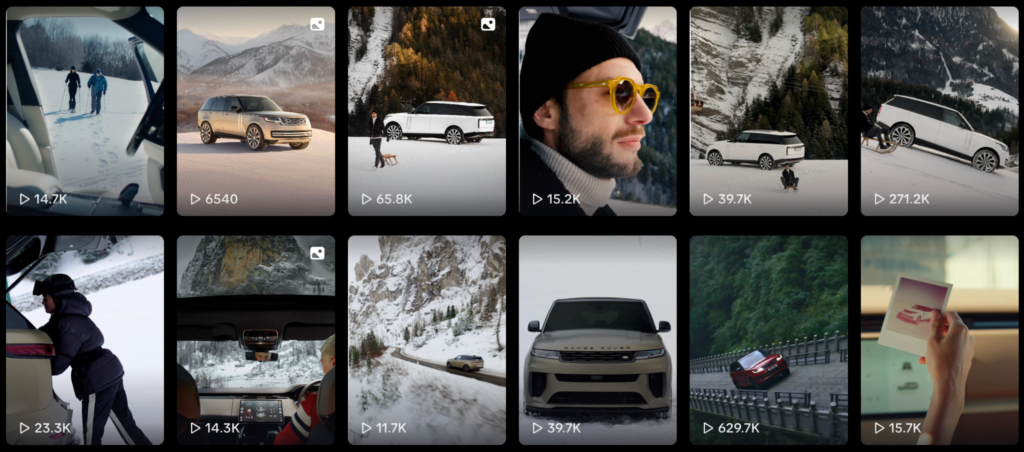
As you can see, the brand treats social media as a visual extension of its luxury world. Posts are spaced out, imagery is polished and cinematic, and copy is minimal. Silence between posts is just as intentional as the posts themselves.
Campaigns & collaborations also translated powerfully to social media. Remember Wimbledon partnership social campaigns. Range Rover’s 2025-dated campaign, tied to its official partnership with The Championships, Wimbledon, included two dedicated social content series, “Codes of Conduct” and “For the Love of Detail,” shared on Instagram and other digital platforms.
Social-first short films and storytelling within the campaign form a core digital activation on platforms.
Another good example is Range Rover’s collaboration with Luke Evans. It shows how the brand uses celebrity partnerships without slipping into influencer-style marketing.
Range Rover integrates Evans as a natural extension of the brand world. Known for his refined public persona and British heritage, Luke Evans mirrors the same qualities Range Rover consistently communicates.
On social media, this collaboration unfolds through cinematic short films and editorial-style content shared across platforms like Instagram and YouTube.
Speaking of Range Rover social media efforts, we need to mention the London Collection.
As you may know, within that campaign, Range Rover introduces a capsule lifestyle collection: fashion-led pieces inspired by British design, modern tailoring, and understated luxury. Instead of promoting a vehicle, it is a deliberate shirt for a car brand.
From a social strategy perspective, this works because it respects the Range Rover target market. Affluent audiences increasingly expect luxury brands to exist across culture, design, and lifestyle. The London Collection allows Range Rover to appear in new digital contexts.
Competitive Comparison: Range Rover vs. Mercedes-Benz vs. Tesla
If you’re looking at the luxury SUV market today, it’s easy to assume all premium brands are competing in the same way. They’re not.
Range Rover, Mercedes-Benz, and Tesla, from a marketing point of view, are playing very different games and speaking to you in very different ways.
When Range Rover markets itself, it rarely feels like it’s trying to convince you of anything. The assumption is that you already understand what the brand stands for.
As we stated before, Range Rover marketing isn’t chasing the newest feature or the loudest claim. It’s all about creating a sense of mastery and assurance.
True leaders shape history. They dream bigger, push harder. They turn possibilities into reality, creating legacies that define a generation. Range Rover is a leader.
That approach makes you feel you’re buying into something that feels settled and enduring.
On the other hand, Mercedes-Benz’s marketing speaks to you in a very different tone. It’s built on engineering leadership, as a German-created brand. Screens, technology, and constant evolution are front and centre.
If the subject is new systems, new models, or new capabilities, Mercedes-Benz makes a strong case. The trade-off, from a branding perspective, is that scale and visibility can sometimes soften exclusivity. Mercedes often needs to explain why it’s luxurious; Range Rover tends to let that go unsaid.
Then there’s Tesla, which doesn’t really follow traditional luxury rules at all.
Its appeal comes from its role as a disruptor. The Tesla marketing strategy isn’t about craftsmanship or heritage, as in Range Rover, but about innovation and changing how cars fit into your life.
If you see luxury as speed, simplicity, and being ahead of the curve, Tesla speaks directly to that mindset. But if you care about warmth, tactility, and emotional depth, Tesla can feel functional rather than refined.
FAQ about Range Rover Marketing Strategy
What is the Range Rover marketing strategy, and how does it reinforce its luxury SUV positioning?
Range Rover uses a lifestyle-led marketing strategy that prioritizes emotion, heritage, and design over technical detail. Its campaigns (we explained above) focus on craftsmanship, calm confidence, and real-world capability, showing the vehicle in refined, aspirational settings without overt selling. This supports its luxury SUV positioning by portraying Range Rover as timeless luxury that performs effortlessly and doesn’t need to prove itself.
Who is the target market for Range Rover, and how is this reflected in its marketing campaigns?
Range Rover targets affluent consumers such as business leaders, entrepreneurs, and high-net-worth individuals who value authenticity. This is reflected in marketing that avoids mass appeal; the brand uses minimalist visuals, architectural environments, and cultural cues associated with good judgment. The tone assumes confidence and familiarity with luxury, mirroring how its audience sees itself.
How does Range Rover differentiate itself within the luxury SUV market?
Range Rover sets itself apart by creating an area where genuine capability and true luxury coexist. The brand treats both as non-negotiable and presents them without theatrics, in contrast to competitors who place a strong emphasis on either performance or prestige. It’s heritage in off-road engineering, paired with refined design. It allows it to stand apart as a brand defined by quiet authority rather than excess.










_1.png)







.jpg&h=630&w=1200&q=100&v=c0f97a310e&c=1)