A Declaration of Religious Faith
On the buddha-nature of sequoias and sugi The post A Declaration of Religious Faith appeared first on Tricycle: The Buddhist Review.
 AbJimroe
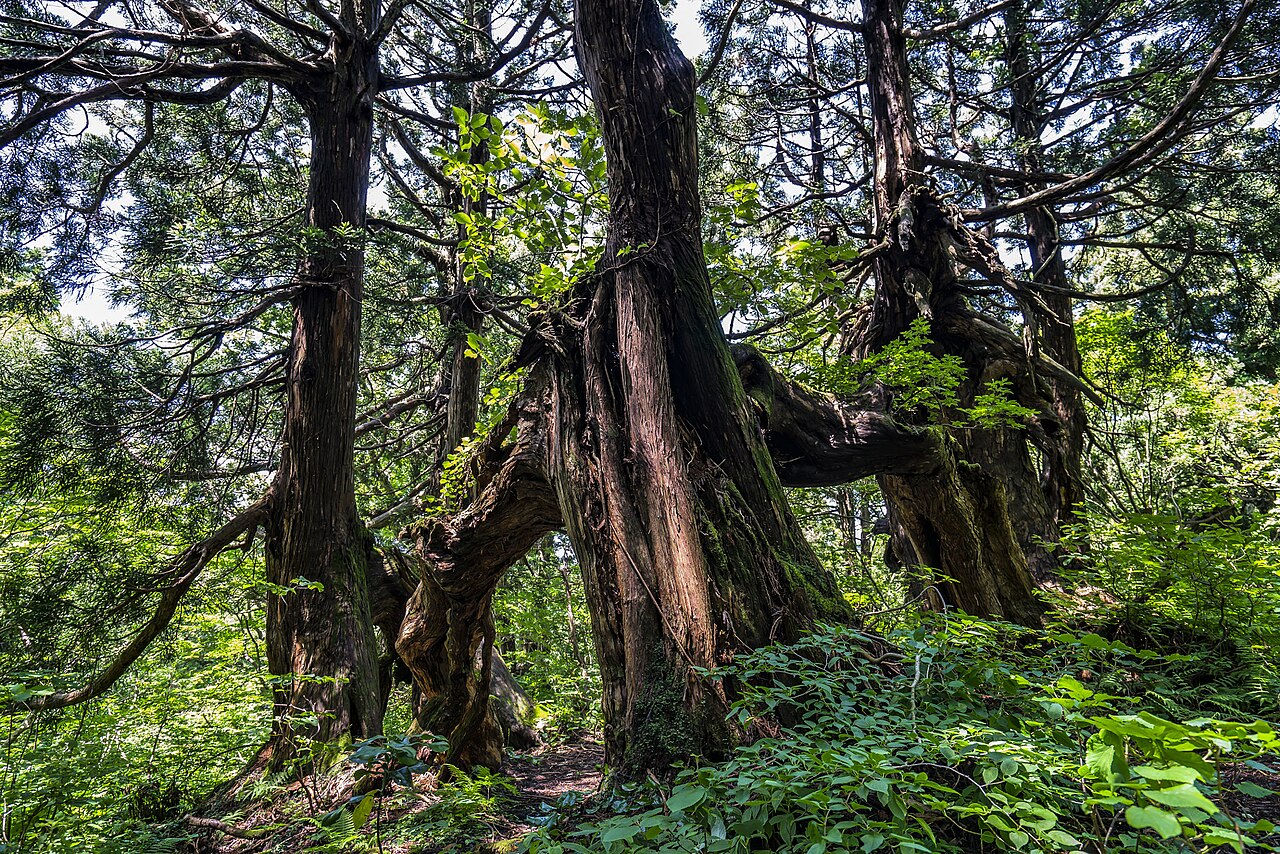
In the peak of summer I went to Takachiho in Miyazaki Prefecture, driving from Kumamoto and crossing the southern tip of Aso. I wanted to see sugi—the Japanese cedar or Cryptomeria japonica. Takachiho is full of sugi. No, actually, it’s more accurate to say that it’s full of sugi and full of shrines. No, actually, it’s even more accurate to say it’s full of sugi, shrines, and gorges. Iwato Shrine, on the outskirts of Takachiho, has all three: sugi, shrine, and gorge.
Iwato Shrine has an eastern shrine and a western shrine with a gorge running in between. If you make a request at the western shrine, the senior priest will open up the closed gate and escort you inside. Within a stand of trees deep inside there is a designated place for worshiping from a distance, and you can see the gorge from there. You can see the opposite shore. As I regarded how both this side and that side were covered in trees, giving off a luster deep enough to take away one’s breath, the priest spoke, saying that the shintai, or place in which the kami of the shrine resides, is the cave that served as the hiding place for the sun goddess Amaterasu, of a well-known tale from Japan’s earliest mythology. He said it was over on the other side of the gorge, but that no one had gone inside for several hundreds of years, and so it was in pretty bad shape.
He said there were seven old sugi growing over there, and that it was not a place that people could enter, but that you can see the tops of the trees from where we were. I looked to where he was pointing, and the tops of thick, fluffy trees were sticking out from the top of the forest.
Real sugi were, originally, either of the Taxodiaceae family or the Cupressaceae family. It is thanks to the study of molecular phylogenetics, which has blossomed since the 1990s, that this is already so ambiguous. I need to try to accept the fact that the Taxodiaceae family has been incorporated into the Cupressaceae family, in the same way that I accepted the gradual dissolution of the Liliaceae family. But long ago, when the Taxodiaceae family was just the Taxodiaceae family plain and simple—a state of affairs I found calming—it included several types of sugi, like the Japanese sugi, but also the sequoias.
North America is a continent of amazing rock formations. Rocks that have been living through time on a global scale—the Grand Canyon, Monument Valley, the canyon of Zion National Park, Bryce Canyon—they close in on you here with their amazing colors and scale. But the sequoias, which have lived up to several thousand years of age—their presence eclipses these rocks.
When I stood in front of the giant tree named “Sherman” in Sequoia National Park, as I faced this life-form that was so much larger than I was and had long surpassed me in age, I thought my feelings at the time must be similar to that of having a religious faith or belief. I am certain that I would not feel the same way facing a person, no matter who it was, nor facing an elephant, no matter how large it was, nor even when facing a tiger with an empty stomach at the moment I was to be eaten.
No matter how long I stare in wonder at the rocks and valleys of the Grand Canyon or Monument Valley, that saying never comes to mind. But every time I see a giant sequoia, I think: “There’s no way that doesn’t possess buddha-nature.”
At the time, I wasn’t quite 50 years old; I was tiny, helpless, just a speck. My companion was a giant tree, two thousand and several hundred years old, and yet still reproducing, continuing to add young trees to the surrounding area. I wondered if I’d be swallowed by this life force—but it wasn’t the same as with a tiger. It wasn’t as if I was going to be destroyed, eaten, or even hurt. More so than “being swallowed,” I had the sense it was more like a “being received,” just as one is.
There is a saying that “all living things possess buddha-nature.” It seems there have been many debates about whether this is true for inanimate things such as mountains, rivers, grasses, and trees. I don’t know what conclusion they have reached. However, no matter how long I stare in wonder at the rocks and valleys of the Grand Canyon or Monument Valley, that saying never comes to mind. But every time I see a giant sequoia, I think: “There’s no way that doesn’t possess buddha-nature.”
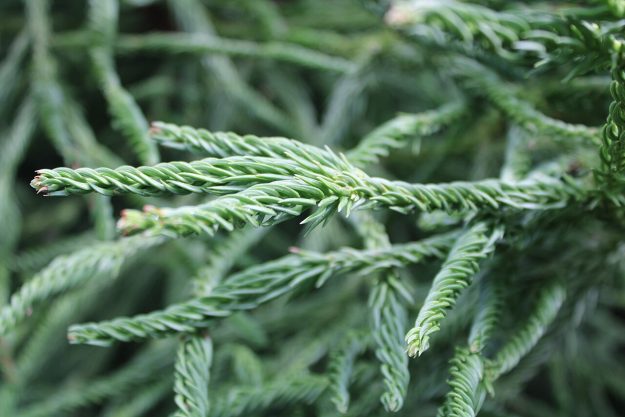 Japanese cedar at Soos Creek Botanical Garden. | Image via Chris Light / Wikimedia Commons
To go to Takachiho from Kumamoto, you have to pass the town of Takamori in Minami Aso, and then head east. There is an old sugi in Takamori. It is a tree called the Takamoridono no sugi. They say that in this spot, four hundred years ago, in the Tensho era, a powerful local clan named Takamori lost a battle and the feudal lord committed seppuku, slicing open his belly. I don’t know whether the sugi grew as a memorial to this act of seppuku, or if the tree was already there and he committed seppuku while leaning against it, but in any case, it is a spot soaked with blood.
When I went there for the first time, I was shocked. You see, on the side of the road in Takamori there stands, inconspicuously, a small sign that seems meant to be overlooked. Without overlooking it, I turned and zig-zagged along the narrow path. And then there was a small gate on the path, which was, quite rudely, shut. A lock was wrapped around it and so it appeared as if it couldn’t be opened or closed. For the faint of heart, this was the end of the line. But when I looked closer, there was a note hanging from the gate. It read: “Many people have come here to see the tree as of late because of a TV program. Hunters, please be careful.” Across the way was a pasture, and there were several cows looking this way suspiciously. Inside the gate was also a pasture, and so cows roamed around on the inside. It seemed the lock was meant to keep the cows from running away. While the cows remained suspicious, I undid the lock and went inside, then closed the gate and returned the lock back to the way it was. Inside, it was hard to tell if there was a path or not. There’s a sudden rise in elevation. I’m out of breath. Flowers are in bloom, either of the Liliaceae family, the Asteraceae family, or the Apiaceae family. There’s cow dung all over. Seems like I’ll end up stepping in some. The path-that-may-or-may-not-be-a-path continues forward toward a grove of sugi. It is luxuriant. There is a sign small enough for an ant that points into the grove of trees, and so I have no choice but to bend over and descend into the cavity-like center of the grove.
What overwhelmed me as I came into the middle of it was the feeling of vibrant motion that I sensed from the sugi (there were two of them). I did not get this sense of vibrant motion from any of the large sugi elsewhere. The branches of these sugi twisted and turned, and before my eyes they split in two. One went up and the other went left and right—it looked as if they were leaping up and down. Before my eyes they reached the heavens, and then came back down to earth, wrapping up the space in between and creating what looked like a giant dome with an arched ceiling. Branches and leaves grew thickly out from their trunks. Tree sap circulated from tip to tip. Words that I knew from the Lotus Sutra came pouring out of my mouth: “Big roots, big stems, big branches, and big leaves.” Surrounding the sugi trees were groves of glossy-leaved evergreens. With the sunlight filtering through them, each leaf shone brilliantly, one by one. I wanted to chant more from the Lotus Sutra: “Medium roots, medium stems, medium branches, and medium leaves.” And then small vines, small mosses, and small ferns covered over everything, they covered over the bark of the tree trunks, they covered over the skin of the earth. Once again, I desire to continue chanting: “Small roots, small stems, small branches, and small leaves.”
“Little ones to him belong / they are weak but he is strong”—this I also want to chant (although it is from an old, old translation of a certain hymn from the Meiji era). It continues: “Yes, Jesus loves me / Yes, Jesus loves me / For the Bible tells me so.”
The fact that one is able to confirm one’s smallness and weakness when something bigger and stronger stands in front of it, and that it’s OK to be small and weak, and that if you rely on this something big, that you can then go on living your life as yourself, just as you are—the many ways of expressing these ideas were packed tightly into the space around me, and they made me feel warm inside.
♦
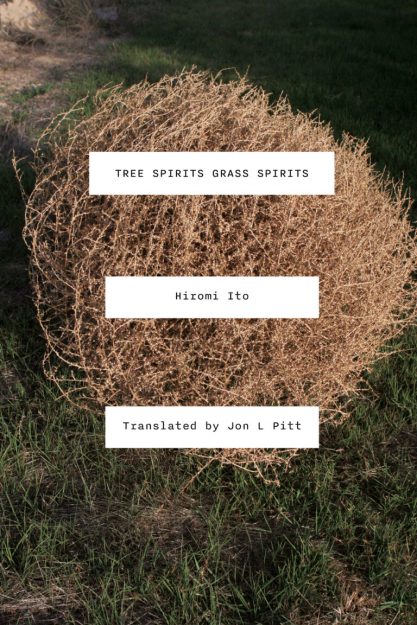
From Hiromi Ito’s Tree Spirits Grass Spirits, translated by Jon L. Pitt (Nightboat Books, 2023), courtesy of Nightboat Books.