AI visibility score: How to summarize your AI visibility
Your brand’s AI visibility score covers the part of the search landscape that traditional SEO rank tracking can’t see. Tracking it is becoming as essential as monitoring Google rankings — and a lot harder to pin down.
 Troov
Troov

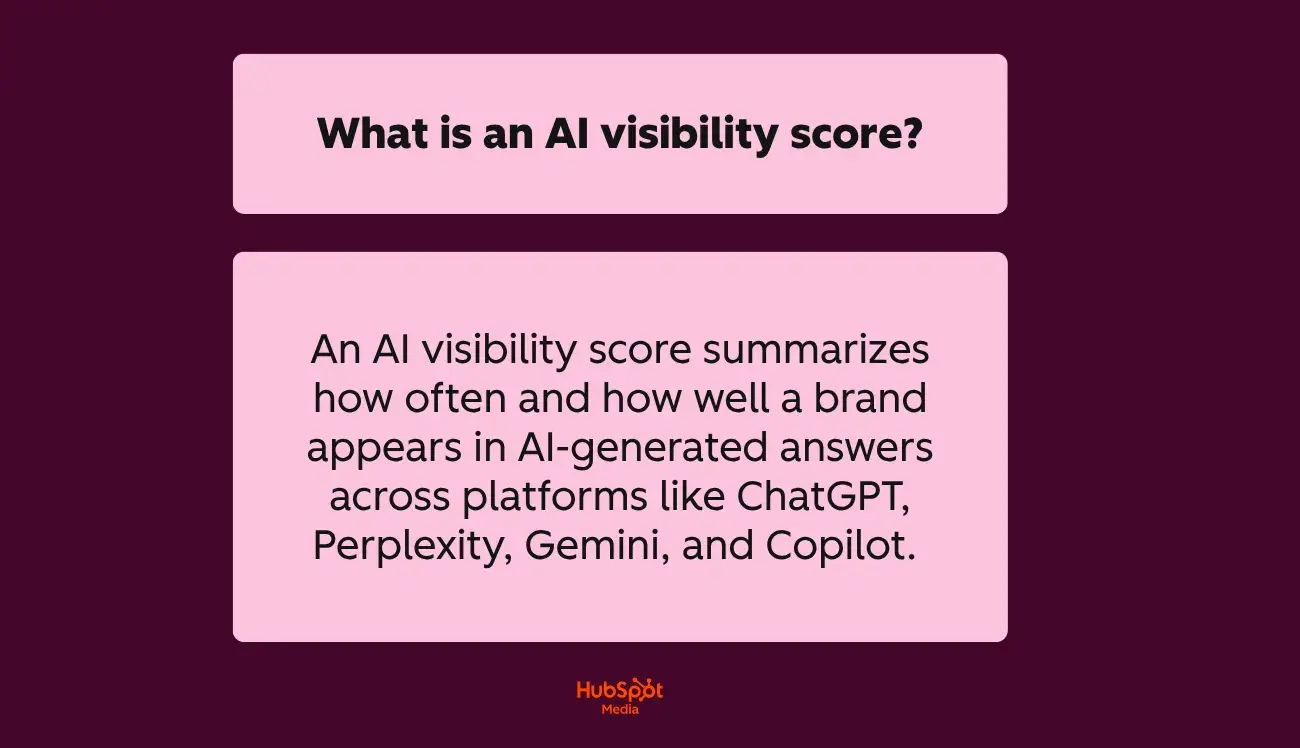
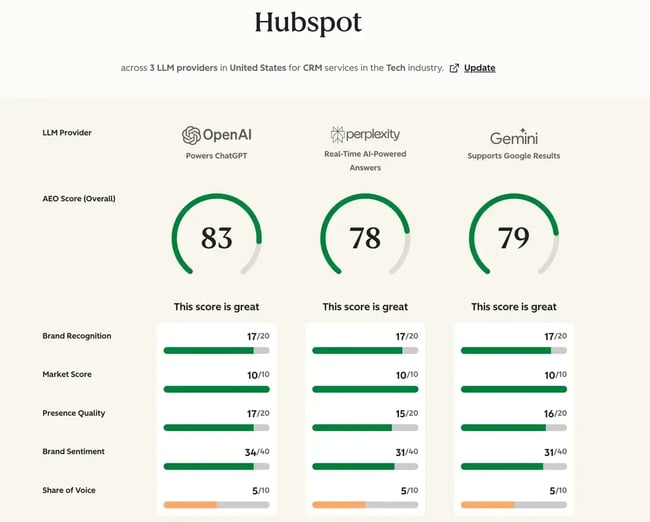
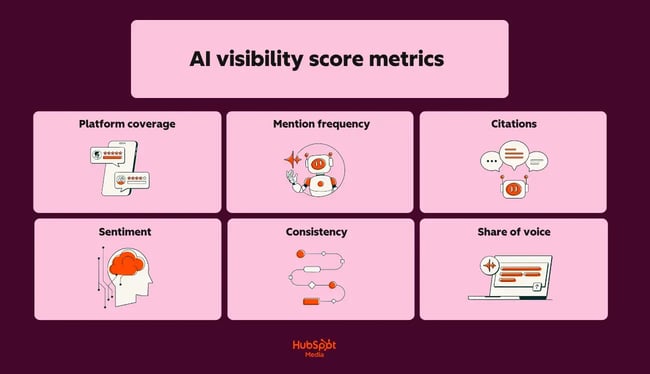
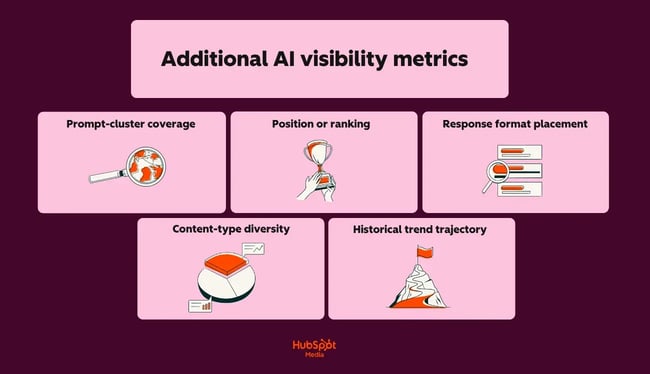
Your brand’s AI visibility score covers the part of the search landscape that traditional SEO rank tracking can’t see. Tracking it is becoming as essential as monitoring Google rankings — and a lot harder to pin down. An AI visibility score summarizes how often and how well a brand appears in AI-generated responses across platforms like ChatGPT, Perplexity, and Gemini, aggregating metrics such as: Most marketing teams are still piecing together scattered data from multiple answer engines, struggling with inconsistent measurement standards, and finding it nearly impossible to connect their AI presence score to actual pipeline impact, even as AEO experiments prove these platforms are reshaping how buyers discover brands. This guide breaks down exactly what an AI visibility score measures, which inputs matter, how to benchmark it against competitors, and how to improve it through content authority, digital PR, and answer engine optimization strategies. Table of Contents An AI visibility score summarizes how often and how well a brand appears in AI-generated answers across platforms like: Think of it as a single number that rolls up multiple AI visibility metrics (i.e., platform coverage, mention frequency, citation rate, sentiment, consistency, and share of voice) into one directional indicator of your brand’s presence in answer engines. HubSpot AEO produces a single AI visibility score that tracks how a brand appears across ChatGPT, Perplexity, and Gemini — showing exactly which prompts cite the brand, which cite competitors instead, and where the brand is completely absent, all from one dashboard. In AEO, measurement is still nuanced and fragmented. Data lives across dashboards, definitions vary platform to platform, and there’s no universal standard yet for what “good” looks like. A composite visibility score gives marketing leaders and SEO specialists a shared reference point: one metric they can track over time, benchmark against competitors, and use to align cross-functional conversations without getting lost in platform-by-platform noise. In practice, an AI visibility score is evaluated across answer engines by analyzing how a brand performs within specific prompt clusters (the groups of questions your audience actually asks). Benchmarking then compares the brand’s AI visibility score with competitors’ visibility across the same prompt clusters, so the score isn’t just an internal vanity metric; it’s a competitive positioning tool. Most AEO tools show marketing teams the gap. HubSpot AEO shows them their gap — translating complex visibility data into plain-language insights teams can act on without specialized AEO expertise. For Marketing Hub Professional and Enterprise customers, that score lives alongside CRM data, campaign metrics, and content tools rather than in a separate tab. A few nuances shape what counts as a “good” score: In the section below, let’s break down each of these metrics and what they actually measure. AI visibility metrics include: Each metric captures a different dimension of how a brand shows up in AI-generated answers and together they feed into the composite AI visibility score. Here’s what each core metric measures: Beyond the six core metrics, several additional inputs can sharpen a composite score: Pro tip: Run the free HubSpot AEO Grader before mapping a custom metric framework — a baseline score takes about five minutes and surfaces which of these inputs to prioritize first. A good AI visibility score depends on: No single number works as a universal benchmark. What counts as “good” for a SaaS company competing in a saturated CRM market looks completely opposite to what’s good for a niche B2B manufacturer with three direct competitors. This is also where the distinction between HubSpot’s two AEO offerings matters. The free HubSpot AEO Grader gives a one-time snapshot scored across sentiment, presence quality, brand recognition, share of voice, and market position — useful for setting a directional baseline. HubSpot AEO, available standalone or in Marketing Hub Professional and Enterprise, tracks the AI visibility score continuously across ChatGPT, Perplexity, and Gemini, which is what “good” requires once a brand starts measuring movement quarter over quarter. Answer engines weigh sources on their own terms, surface brands inconsistently, and update their models on their own respective timelines, so a visibility score that looks strong on Perplexity might not hold on Gemini. That’s why so many marketing leaders find AI visibility metrics frustrating. Traditional SEO metrics eventually converged around shared benchmarks, but AEO is still too early and too fragmented for that kind of standardization. Answer engines don’t index pages the way traditional search does. They synthesize answers from content that clearly and directly addresses the questions users are prompting. That means your content strategy needs to be organized around prompt clusters rather than individual keywords alone. Here’s how to build prompt-aligned clusters that improve your search visibility score: Marketing Hub Professional and Enterprise customers can skip the manual mapping step — HubSpot AEO uses CRM data to suggest the prompts a brand’s actual buyers are likely asking, and refines those suggestions as the CRM data grows. Pro tip: Run the free HubSpot AEO Grader before mapping a custom metric framework — a baseline score takes about five minutes and surfaces which of these inputs to prioritize first. Answer engines need to understand what your brand is, what it does, and how it relates to your category before they can confidently include you in generated answers. Entity clarity (i.e., how unambiguously AI models can identify and categorize your brand) directly impacts your AI visibility score. The practical steps here are unglamorous but high-impact: Citation rate is one of the highest-leverage AI visibility metrics because citations serve double duty: they validate your authority to AI models, and they drive referral traffic back to your content. Earning them requires getting your content and brand mentions into the sources that answer engines already trust. To earn more citations: Improvement without measurement is guesswork. Once you’ve taken action on content, entity clarity, and citations, you need a repeatable process to track which moves are boosting your AI visibility score (and where competitors are still outpacing you). Start by establishing a measurement cadence: HubSpot AEO automates this comparison by tracking competitor share of voice across the same prompt set every day, so the quarterly review becomes synthesis rather than data collection. Turning an AI visibility score into a repeatable metric that leadership trusts is where most teams struggle — not because the data doesn’t exist, but because it’s scattered. An AI visibility score is evaluated across several AI search engines, each with different answer formats, source behaviors, and update cycles. Without a consistent reporting structure, a different story surfaces every time someone asks, “How are we doing in AI search?” — and that erodes confidence in the metric before it gets traction internally. Here’s a reporting framework that makes AI visibility metrics operationally useful: Marketing Hub Professional and Enterprise customers can pull the weekly, monthly, and quarterly views directly from HubSpot AEO, where the AI visibility score, competitor comparison, and citation analysis live alongside campaign and pipeline metrics in the same workspace — not as a separate report stitched together at the end of every cycle. Inconsistent measurement is the fastest way to undermine reporting credibility. Lock in definitions early: This is the layer that turns AI visibility from a content team metric into a revenue conversation. The connection points aren’t always direct — but they’re trackable: Because HubSpot AEO sits inside the same platform as Marketing Hub’s campaign analytics and the Smart CRM, the connection between AI visibility shifts and pipeline impact is part of the reporting layer rather than something the team rebuilds across spreadsheets each quarter. The most effective AI visibility reports are those that are consistently produced. Keep the format simple: Most teams should measure their AI visibility score monthly, with a deeper competitive benchmarking review each quarter. Monthly tracking gives enough data to identify real trends in I visibility metrics (i.e., platform coverage shifts, citation rate changes, mention frequency movement) without overreacting to the normal variability that comes from AI model updates and retraining cycles. A few timing considerations worth noting: Pro tip: HubSpot AEO helps marketers assess and benchmark answer engine visibility across major AI platforms, providing a starting point for platform coverage, competitive positioning, and prompt-cluster gaps. AI hallucinations about a brand — inaccurate claims, outdated information, or fabricated details in AI-generated answers — are a problem of entity clarity. They happen when AI models encounter conflicting, incomplete, or outdated information about your brand across their training data and source material. Here’s how to address them systematically: Fixing hallucinations directly improves your sentiment and consistency metrics, which in turn lifts your overall search visibility score. An AI visibility score and a traditional SEO visibility score measure different things, but they increasingly influence each other. Your AI visibility score is evaluated across answer engines, such as: A traditional SEO visibility score reflects how well a brand ranks across traditional search engine results pages. They’re separate metrics, but the content and authority signals that drive both are deeply connected. Here’s where the overlap matters most: A strong AI visibility score doesn’t directly change Google rankings, but the same strategies that improve AI visibility metrics — content depth, entity clarity, citation earning, and topical authority — are exactly what a strong traditional SEO visibility score is built on. Investing in one channel compounds returns in the other. The teams getting ahead aren’t abandoning SEO — they’re adding the measurement layer that accounts for where their audience increasingly goes for answers. ChatGPT, Perplexity, and Gemini are already shaping how buyers discover, evaluate, and shortlist brands, and the teams that treat AI visibility as an optional experiment will fall behind those that operationalize it. An AI visibility score gives you the ability to do what marketers have always needed to do with any new channel. Measure it, benchmark it, improve it, and tie it back to business impact. This space is still early. Industry benchmarks are forming, not fixed. Measurement standards are converging, not settled. The tools and frameworks are maturing fast, but there’s no autopilot mode yet. Marketing teams using Marketing Hub Professional or Enterprise have HubSpot AEO built in, which means brand visibility tracking, citation analysis, and recommendations live alongside the content tools used to act on them. HubSpot AEO shows the gap. Marketing Hub closes it. Start with a baseline. Run HubSpot’s free AEO Grader to see how AI platforms currently characterize your brand, and download HubSpot’s free AEO Guide for the playbook on what to do next. HubSpot built that playbook on its own marketing team — the same approach that drove a 1850% lead increase from AI sources. The brands that win in an AEO-driven era won’t be the ones that waited for perfect data. They’ll be the ones who started measuring, iterating, and improving with the frameworks available today. Now you have one.
What is an AI visibility score?
Why does an AI visibility score have to be a singular metric?
AI Visibility Metrics and Components Explained
What is a good AI visibility score?
How to Improve Your AI Visibility Score
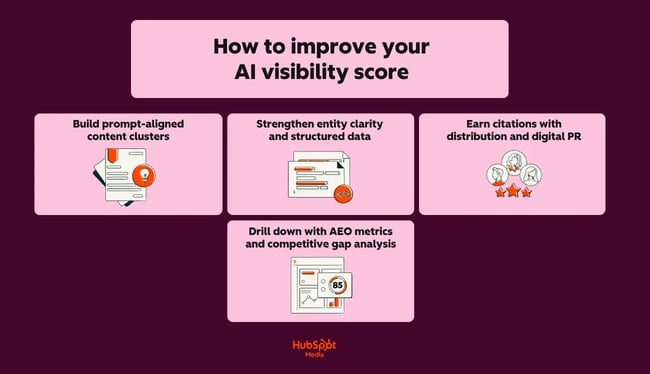
1. Build prompt-aligned content clusters.
2. Strengthen entity clarity and structured data.
3. Earn citations with distribution and digital PR.
4. Drill down with AEO metrics and competitive gap analysis.
How to Report Your AI Visibility Score and Impact
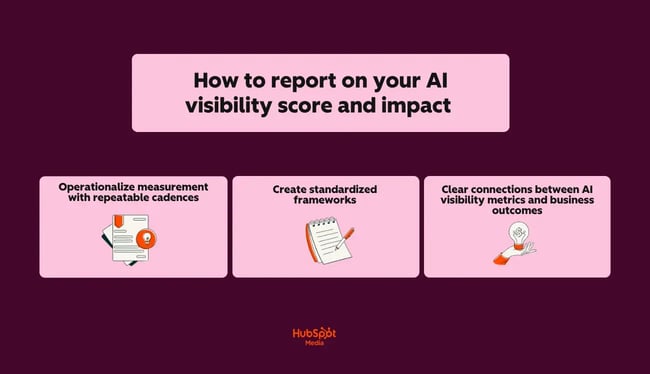
1. Establish your reporting cadence and layers.
Weekly (lightweight). Spot-check your priority prompt clusters for any major shifts in mention frequency or sentiment. This isn’t a formal report; it’s a five-minute scan that catches sudden changes from AI model updates or competitor moves before the monthly cycle.
Monthly (core report). Track your composite AI visibility score, platform-by-platform coverage, citation rate, share of voice, and consistency metrics across your defined prompt clusters. This is the report that goes to your content and SEO team leads. Compare each metric to the previous month and flag any meaningful movement.
Quarterly (executive and strategic). Roll up monthly data into a trend narrative for marketing leadership. This is where you benchmark against competitors, evaluate what a good search visibility score is for your category based on the quarter’s data, and connect AI visibility trends to pipeline indicators. Benchmarking compares a brand’s AI visibility score with competitor visibility across the same prompt clusters, so your quarterly report should always include a competitive positioning view.2. Standardize what you’re measuring.
3. Connect AI visibility to business impact.
4. Build a reporting template that your team can maintain.
Frequently Asked Questions About AI Visibility Scores
How often should you measure an AI visibility score?
How do you fix AI hallucinations about your brand?
Does AI visibility score affect organic search performance?
An AI visibility score is necessary in an AEO-driven era.











![TikTok Content Trends to Watch in 2025: What’s Next for Creators? [Expert Insights]](https://www.hubspot.com/hubfs/Untitled%20design%20%2873%29.jpg)











.jpg&h=630&w=1200&q=100&v=1a56ad72fe&c=1)