Australia’s teen social bans are having little effect
A new report showed that usage hasn’t changed significantly as teens continue to check in by getting around the restrictions.
 MikeTyes
This audio is auto-generated. Please let us know if you have feedback.
Australia’s eSafety Commissioner released a report examining the effectiveness of Australia’s under-16 social media ban. The study found that most underage teens are still accessing social apps, despite gradually improving enforcement efforts from major platforms.
The report is a follow-up to the Commission’s April update on the teen social media ban, which looked at the first three months of the initiative and examined the impacts it had on teens.
The new report looked at a broader range of responses based on a survey of a selected group of 4,121 children aged between 10 and 16 living in Australia, as well as one of their parents.
The data showed that while the bans have led to a reduction in underage users holding accounts on the major social apps, the restrictions haven’t actually reduced usage. Many users now check in on social apps through non-logged in means, or through subversion of the restrictions.
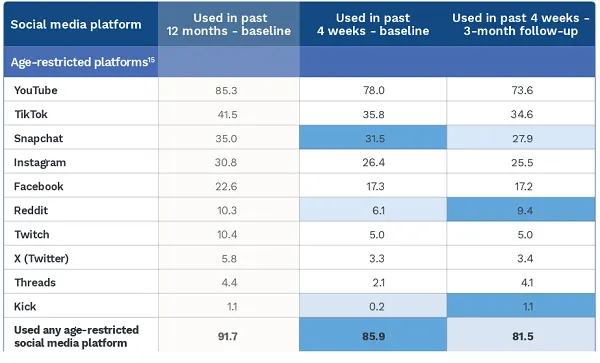
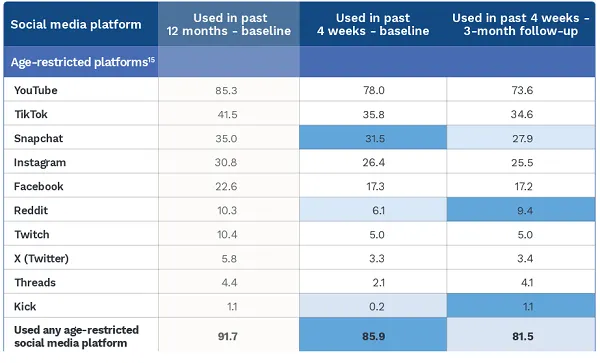
As per the table above, when the teen social ban was enacted, 85.9% of Australian teens reported using at least one age-restricted platform regularly. The latest figures showed that since the ban, this has decreased slightly, though 81.5% of underage users continue to access restricted apps.
As per the report: “We note that several social media platforms can be accessed without logging into an account. Children may also use social media through accounts belonging to others, such as parents, siblings or friends. Given this, and the discrepancy between the proportion of children who reported holding their own social media account and the proportion who reported using social media platforms, the data reported here likely reflects usage both with and without children being logged into their own account.”
That’s still some level of impact, as people can’t access the whole app experience without logging in. It could be argued that this has had a big impact on harmful teen exposure. But essentially, teens are still finding ways to access social media, even with the bans in place.
In terms of app-specific impacts, the data showed that Snapchat was the only app that saw a significant decrease in teen use, declining from 31.5% of teens at the launch of the ban to 27.9% at three months.
The data also showed that more underage teens are using Reddit and Kick, which could also be a result of them being forced off the bigger apps.
The data also indicated that the primary reason children have continued to hold age-restricted social media accounts appeared to be “ineffective implementation of age assurance measures by platforms.”
“Across age-restricted platforms, the main reason children gave for why they still held an age-restricted account was that the platform hadn’t yet asked them to confirm their age (50.2%),” the report said. “Others reported that the platform had incorrectly estimated their age (18.2%). While there was some evidence of children taking action to bypass the age restrictions — most notably by listing their age as 16 or above on their accounts (37.1%) — other attempts to bypass the restrictions, including parental assistance to do so or using a VPN, were less common.”
So the concern that kids would just use VPNs to access social apps hasn’t played out as some predicted. Though given that most teens still have some access to social apps anyway, they may not need to resort to such measures.
The report also found that young teens were spending more time in messaging apps and playing online video games as a result of the change.
“At three months, most children reported that there was little to no change in their engagement with offline activities, behaviours associated with problematic online use, and their wellbeing,” the report said.
In summary, most Australian teens are still accessing restricted social media apps in some form. They’re also spending more time using other digital connection tools as a result of the under-16 social media ban.
Which is what many had predicted. The idea that kids would spend more time outdoors as a result of teen social bans is flawed logic, because they’ve already developed new social behaviors that are linked to online connection, shifting the paradigm for how they develop social skills and relationships.
This seems unlikely to change, even after years of having these bans in place. The data also showed that teen social bans have had no impact on the harmful behaviors that they’ve been theoretically enacted to address.
These insights could help to inform expanded approaches to similar teen bans in other regions.








![I Took a Deep Dive Into PERT to Create More Accurate Time Estimates [+ Templates, Examples, and Formula]](https://knowledge.hubspot.com/hubfs/pert-1-20250213-8082845.webp)