Partner Yoga Poses for Couples: Guide to Trust & Intimacy
✨ QUICK ANSWER BOX Partner yoga poses for couples are synchronized stretches and postures practiced by two people together. Popular […]
 UsenB
UsenB
✨ QUICK ANSWER BOX
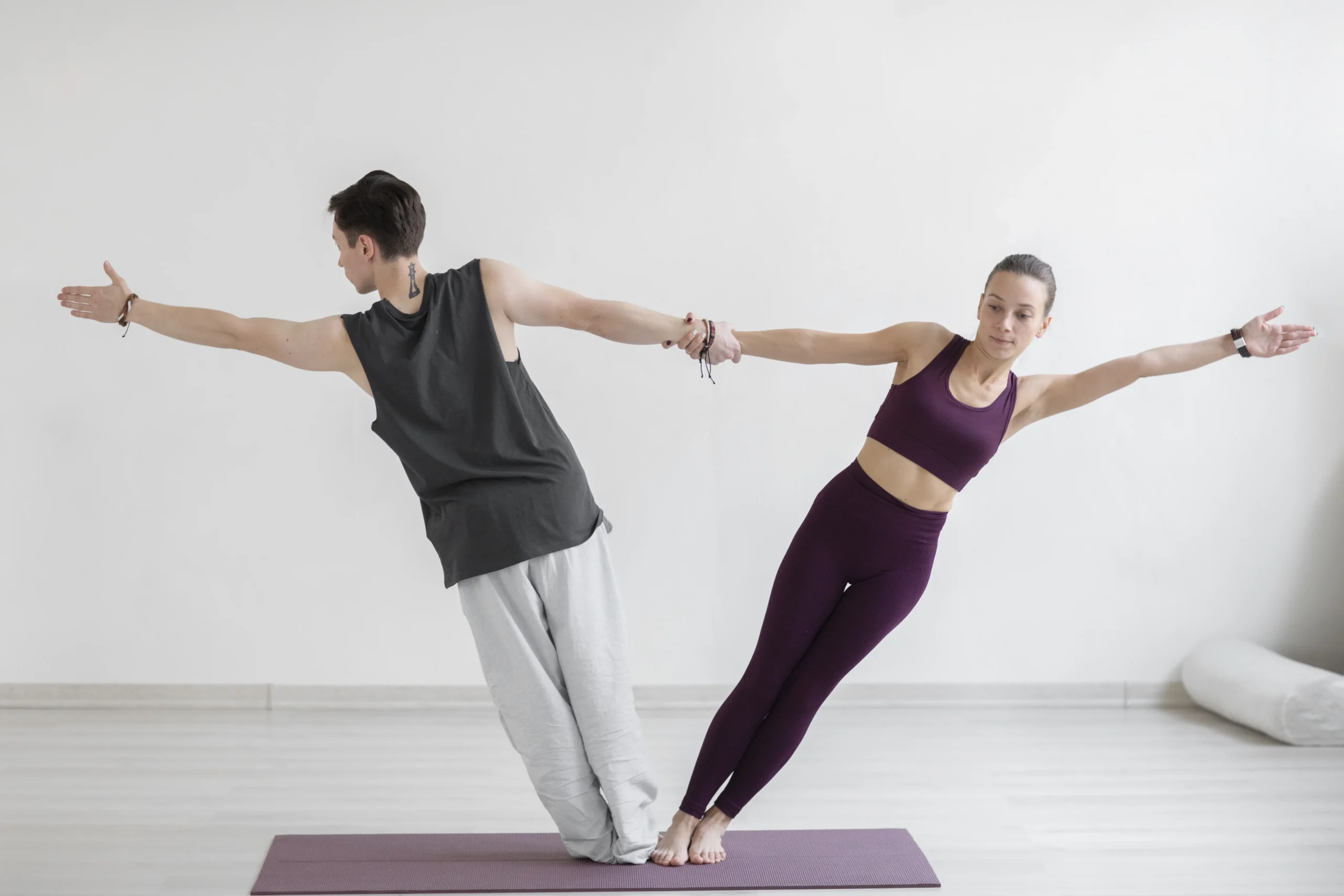
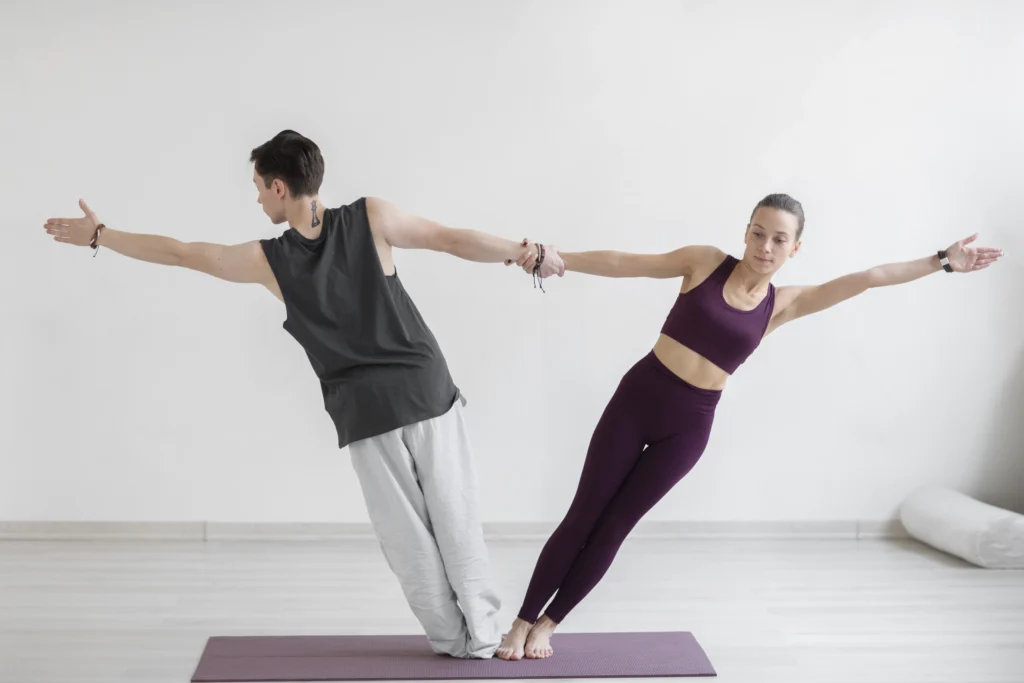
Partner yoga poses for couples are synchronized stretches and postures practiced by two people together. Popular poses include Double Tree Pose (back-to-back standing), Seated Forward Fold, and Partner Boat Pose. Partner yoga builds trust, improves communication, and deepens physical and emotional intimacy. Both partners should have basic yoga experience and communicate clearly before attempting partner poses. Beginners start with gentle, supported poses; advanced practitioners explore deeper backbends and inversions together.
Yoga is usually thought of as a solitary practice — just you, your mat, and your breath.
But what happens when you practice yoga with another person? When you synchronize your breathing with your partner’s? When you deliberately place your weight in their hands and ask them to hold you steady? When you look into their eyes during a pose that requires complete trust?
Something shifts.
Partner yoga (also called couples yoga or acro yoga for partners) transforms the practice from an individual journey into a shared one. It goes beyond the physical benefits of yoga — though those are real, measurable, and significant. Partner yoga becomes a powerful tool for building emotional intimacy, improving communication, increasing trust, and literally synchronizing your nervous systems with another person’s.
Most couples know that shared activities strengthen relationships. What few realize is that partner yoga offers something unique: a practice where your physical safety literally depends on the presence and attention of another person. You cannot practice partner yoga alone. The practice requires partnership, vulnerability, and trust.
This guide walks through everything you need to know to begin practicing partner yoga safely and meaningfully with your partner — including step-by-step instructions for 10 foundational partner poses, how to modify for different flexibility levels, common mistakes to avoid, and the psychological and physical benefits that emerge when couples practice together consistently.
Ready to deepen your connection? Let’s begin.
WHAT IS PARTNER YOGA? THE PRACTICE OF SYNCHRONIZED CONNECTION
Partner yoga is the practice of performing yoga poses and stretches with another person, where partners support, balance, or deepen each other’s practice. Unlike solo yoga where you are responsible only for your own safety and alignment, partner yoga creates interdependence — each partner relies on the other for safety, balance, and correct positioning.
Partner yoga is distinct from but related to acro yoga (acrobatic yoga), which combines yoga, dance, and acrobatics and typically involves one partner as the “base” supporting the other as the “flyer.” Partner yoga, by contrast, usually involves two practitioners of roughly equal ability working together with more balanced, reciprocal support.
The Three Dimensions of Partner Yoga
Partner yoga operates on three levels simultaneously:
Physical Dimension: Poses that deepen flexibility, build strength, and allow partners to reach deeper stretches together than they could alone. When one partner gently eases the other deeper into forward fold, for example, the stretch intensity increases beyond what solo practice achieves.
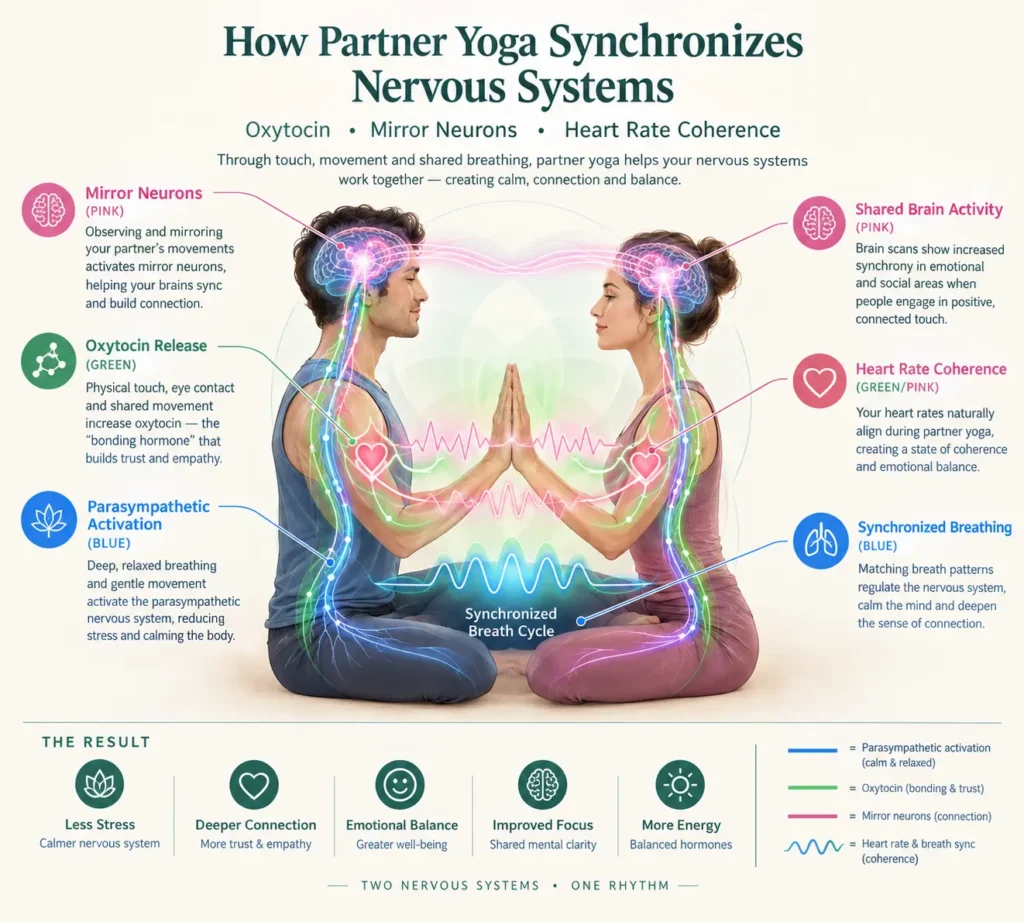
Energetic Dimension: The synchronization of breath, prana (life force), and nervous system state. When partners practice together with synchronized breathing, their heart rate variability aligns, their nervous systems downregulate together, and a measurable physiological coherence emerges.
Emotional/Relational Dimension: The building of trust, presence, attunement, and vulnerability. Partner yoga requires clear communication, attention to your partner’s experience, and the willingness to be dependent on another person’s strength and care.
Historical Context: Where Partner Yoga Comes From
While modern partner yoga is sometimes presented as a new practice, partnered yoga postures appear in historical yoga texts. The Gheranda Samhita (an 18th-century yoga text) references poses that require a partner, and partner practices have long existed in tantra yoga traditions where synchronized movement between partners was used to deepen spiritual practice and energetic connection.
The contemporary partner yoga and acro yoga movement as it is commonly practiced today gained momentum in the 1980s and 1990s as yoga teachers began experimenting with deepening the practice beyond solo asana. Today, partner yoga is offered in many yoga studios, recommended by relationship counselors as a couples therapy tool, and used in corporate wellness programs to build team cohesion.
SEVEN POWERFUL BENEFITS OF PARTNER YOGA FOR COUPLES
Benefit 1: Builds Trust & Safety (The Deepest Intimacy Foundation)
Trust is not abstract. Trust is asking someone to hold your weight while you fold forward. Trust is letting another person balance you in a pose where you cannot see the ground. Trust is saying “I feel safe in your hands” and actually feeling that safety.
Partner yoga creates real, embodied trust — not just intellectual agreement but nervous system recognition of safety. When couples practice partner yoga consistently, the parasympathetic nervous system (rest-and-digest response) of both partners gradually attunes to feel safe in the other’s presence. Cortisol decreases. The vagal tone — the measure of nervous system regulation — improves. Over weeks of practice, this builds a measurable shift in how safe each partner feels with the other.
Research in partner attunement (the nervous system science of feeling safe in another’s presence) shows that couples who practice synchronized movement together develop stronger unconscious trust than couples who do not. The body learns what the mind sometimes struggles to believe.(1)
Benefit 2: Improves Communication & Attunement
Partner yoga is practiced in almost complete silence. Yet it is one of the most communicative practices two people can share.
Every adjustment the partner makes sends a message: “You can trust me.” “I am paying attention.” “I notice when you’re at your limit.” “I honor your body, not just my goal.” Every breath creates a rhythm that says “I am here with you.”
Couples who practice partner yoga regularly report improvements in:
Non-verbal communication — understanding what their partner needs without speaking Listening skills — developing the sensitivity to notice subtle signs of discomfort or resistance Boundary-setting — practicing the respectful “no” when a pose goes too deep Presence — giving undivided attention to another person for extended periodsThese skills transfer directly to everyday communication. Couples who can practice gentle, attentive partner yoga develop the same quality of presence in conversation, conflict resolution, and emotional intimacy.
Benefit 3: Deepens Emotional & Physical Intimacy
Vulnerability creates intimacy. When you practice a partner pose that requires you to surrender your weight to another person’s support, you are practicing profound vulnerability. And when that vulnerability is met with presence, care, and strength, intimacy deepens.
Physical touch in partner yoga is intentional, purposeful, and non-sexual (though it can certainly enhance sexual intimacy when practiced by intimate partners). This quality of touch activates the release of oxytocin — the bonding hormone — in both partners’ brains. The nervous systems synchronize. Cortisol decreases. The sense of being “known” and “held” by another person increases.
Couples practicing partner yoga report increased feelings of closeness, increased sexual desire, and increased sense of emotional security with their partner. The practice quite literally changes the brain’s neural pathways related to bonding and trust.
Benefit 4: Increases Flexibility & Deepens Stretches Beyond Solo Capability
When your partner gently presses your back in a forward fold, you can reach a deeper stretch than you could ever achieve alone. The physics is simple: external gentle pressure can deepen a stretch that internal effort alone cannot.
This means that partners practicing together can improve flexibility more quickly than practicing solo. The gentle, partnered approach (avoiding the “no pain, no gain” mentality) creates increases in range of motion that are durable and injury-free.
Benefit 5: Regulates the Nervous System & Reduces Stress
Synchronized breathing with another person is one of the most direct ways to activate the parasympathetic nervous system. When couples practice partner yoga with coordinated breath:
Heart rate variability syncs between partners Cortisol (stress hormone) decreases in both Vagal tone (nervous system regulation) improves The amygdala (fear/threat center) downregulates The prefrontal cortex (rational thinking) upregulatesThis means partner yoga is as much a stress-management tool as meditation or massage. Practiced even once per week, it can significantly reduce the chronic stress load that most modern couples carry.
Benefit 6: Creates a Shared Practice & Shared Ritual
Couples who practice partner yoga together develop a sacred shared ritual — a time when both partners are fully present, fully attentive, and fully committed to each other’s wellbeing. This shared commitment is relationship-strengthening.
When yoga is solo, one partner practicing does not affect the other’s life directly. But when both partners commit to a weekly partner yoga practice, it becomes a relational practice that both of you choose together, show up for together, and benefit from together. This creates a sense of “we are building something together.”
Benefit 7: Enhances Breath & Nervous System Awareness
Partner yoga, practiced with synchronized breathing, creates heightened awareness of how breathing affects the entire body and nervous system. Couples practicing together learn to notice:
How the partner’s breath changes during different poses How matching the partner’s breath creates coherence How breath can be used to regulate arousal and calm How nervous system states are communicated through breath patternsThis breath awareness then transfers into daily life — couples who practice partner yoga become more attuned to the breath and nervous system signals in ordinary conversation, creating deeper attunement overall.
THE SCIENCE BEHIND PARTNER YOGA
Nervous System Synchronization
When two people practice synchronized movement with coordinated breathing, remarkable changes occur in both nervous systems:
Heart Rate Variability (HRV) — the variation in time between heartbeats — becomes increasingly similar between partners after weeks of practice Cortisol patterns align — both partners’ cortisol rhythms synchronize to similar daily patterns Vagal tone — the strength of the vagus nerve’s ability to regulate the nervous system — improves in both partners Ventral vagal engagement — the state of “social safety” in the nervous system — increases measurablyResearch from Tiffany Field at the University of Miami Touch Research Institute has shown that synchronized movement and touch create measurable decreases in cortisol and increases in serotonin and dopamine in both partners. The effect is not placebo — it is measurable in saliva cortisol levels, brain imaging, and heart rate variability.
Oxytocin & Bonding
Touch during partner yoga triggers the release of oxytocin — often called the “bonding hormone” — in both partners’ brains. Oxytocin increases:
Trust in the partner Sense of safety and security Desire for physical and emotional closeness Capacity for empathy and attunementRegular partner yoga practice (even once weekly) creates sustained elevation of baseline oxytocin levels — meaning partners begin to feel bonded and safe with each other even outside the yoga practice.
Mirror Neurons & Attunement
When two people practice synchronized movement, their mirror neurons fire in patterns that match each other. Mirror neurons are the neural systems that create empathy, attunement, and the sense of “understanding” another person. Practicing synchronized movement literally “mirrors” the other person’s neural patterns, creating measurable empathy.
10 PARTNER YOGA POSES FOR COUPLES: COMPLETE STEP-BY-STEP GUIDE
BEGINNER PARTNER POSES (Start Here)
Pose 1: Double Tree Pose (Vrksasana Partner Variation)
Physical Benefits: Balance, ankle and hip stability, focus and concentration
Emotional Benefits: Back-to-back support, mutual dependence, sense of being held
Difficulty Level: Beginner
Setup (Steps 1-3):
Step 1: Stand Back-to-Back Stand with your backs touching, heels 12-18 inches from your partner’s heels. Feel your partner’s full back body supporting yours. Establish synchronized breathing — match your partner’s inhale and exhale rhythm.
Step 2: Root Down Through Your Feet Press all four corners of both feet into the ground. Micro-engage your thigh muscles. Both partners should feel equally grounded and stable — if one person is doing more work than the other, adjust your hip and foot positioning to share the weight equally.
Step 3: Ground Your Standing Leg Press your right foot firmly into the ground. Feel the entire surface of your right foot contacting the mat. Notice your partner doing the same on their left side (you are mirroring each other).
Entry Into Pose (Steps 4-6):
Step 4: Lift Your Left Leg Bend your left knee and lift your left foot toward your left hip, keeping the knee open to the side. Your left foot sole should face inward (not twisted outward aggressively). Your partner lifts their right leg simultaneously, creating a symmetric shape.
Step 5: Press Foot Against Inner Thigh Press your left foot sole against your left inner thigh — as high as comfortable without forcing the hip open. The foot sole should face inward; the left knee should point directly to the left side, not forward or backward.
Step 6: Bring Hands to Prayer or Above Head Bring your palms together at your heart center (prayer position) or extend both arms overhead, fingertips reaching toward the ceiling. Your partner does the same. Stay pressed back-to-back throughout.
Hold & Breathe (Step 7):
Step 7: Hold for 5-8 Breaths on Each Side Maintain the pose for 5-8 full breaths (25-40 seconds). Keep pressing your back into your partner’s back — that continuous contact is the security that allows both of you to balance. If either partner starts to wobble, press the back more firmly. Lower the raised leg, shake out both legs gently, and repeat on the second side.
Modifications:
Limited hip flexibility: Place your raised foot lower on the inner thigh, or rest your raised foot on the ground with just toes for balance Difficulty balancing: Practice with both partners’ fingertips touching a wall or chair for light support Deeper variation: Both partners extend raised leg forward into Half Moon, pressing backs together for additional challengePose 2: Seated Partner Forward Fold (Paschimottanasana Partner Variation)
Physical Benefits: Hamstring, calf, and spinal flexibility; calming nervous system
Emotional Benefits: Gentle mutual support, taking turns caring for partner
Difficulty Level: Beginner
Setup (Steps 1-3):
Step 1: Sit Facing Each Other Sit on your mat facing your partner, legs extended straight in front of you. Position yourselves so that your feet touch or nearly touch — your partner’s feet press gently against yours, creating connection through the feet.
Step 2: Establish Synchronized Breathing Take three deep breaths together, matching your inhale and exhale rhythms. This synchronized breathing creates the parasympathetic activation that makes the pose deeply calming.
Step 3: Ground Your Sitting Bones Press both sitting bones firmly into the mat. Roll your inner thighs slightly down toward the mat. Feel your lower back lengthen and your spine begin to extend.
Folding Into Pose (Steps 4-6):
Step 4: Inhale and Lengthen the Spine On an inhale, extend your spine upward — imagine the crown of your head reaching toward the ceiling. Your partner does the same. This creates space in the spine before folding.
Step 5: Exhale and Fold Forward On an exhale, both partners fold forward together slowly from the hips, keeping the spine relatively long (not rounding from the neck). Let your hands slide down your partner’s legs — toward the ankles or shins, depending on your flexibility. Your partner’s hands slide down your legs simultaneously.
Step 6: Reach Toward Your Partner’s Hands If flexibility allows, reach your fingertips toward your partner’s fingertips or grasp hands gently. The hand connection is optional — do not force it. Many practitioners prefer to rest their hands on their own legs or their partner’s legs.
Hold & Breathe (Step 7):
Step 7: Hold for 8-12 Breaths Breathe deeply for 8-12 breaths (1-2 minutes). On each exhale, you and your partner can deepen the fold together — a mutual deepening that supports both participants. If either person reaches their limit, pause and hold steady. Come out of the pose on an inhale, rolling the spine back up one vertebra at a time.
Misinformation Correction: Commonly believed: “You should feel pain in a deep stretch.” Truth: Pain is a signal to back off. In partner forward fold, you should feel a gentle, gradually increasing sensation of length — never sharp pain or burning. Pain signals tissue damage; stretching sensation signals safe lengthening.
Modifications:
Tight hamstrings: Bend your knees slightly, allowing the fold to come more from the hip crease than the hamstrings Lower back sensitivity: Keep your knees bent more generously and fold from the hip, not the lower spine Deeper variation: Flex your feet (toes pointing toward your shins) to intensify the hamstring stretchPose 3: Partner Boat Pose (Navasana Partner)
Physical Benefits: Core strength, hip flexor engagement, balance
Emotional Benefits: Synchronized effort, mutual commitment, playfulness
Difficulty Level: Beginner-Intermediate
Setup (Steps 1-3):
Step 1: Sit Facing Each Other Sit on your mat facing your partner, knees bent, feet flat on the floor. Position yourselves close enough that your knees nearly touch or your feet can touch.
Step 2: Lean Back Slightly Both partners lean back about 45 degrees, supporting yourselves with your hands on the mat behind your hips.
Step 3: Ground Your Sitting Bones Press your sitting bones into the mat — this is the foundation of the pose. Lift your chest so your torso is not completely reclined but not completely upright either — approximately 45 degrees.
Lifting Into Pose (Steps 4-6):
Step 4: Lift Both Feet Simultaneously On an exhale, both partners lift both feet off the ground simultaneously. Your shins should be parallel to the floor (or as close as your strength allows). Your partner does the same. Synchronizing the lift creates a sense of shared effort and playfulness.
Step 5: Place Feet Sole-to-Sole Press your foot soles against your partner’s foot soles — a foot-to-foot connection that deepens the connection and creates a symmetric shape. Your partner presses back with equal pressure.
Step 6: Engage Your Core Draw your low belly in toward your spine. Feel the work primarily in your abdominal muscles, not in your hip flexors or lower back. Lift your chest to prevent spinal rounding.
Hold & Breathe (Step 7):
Step 7: Hold for 3-5 Breaths Initially Hold the pose for 3-5 breaths initially (15-25 seconds), then lower your feet. Rest for a breath and repeat 2-3 times. As your core strength builds, extend holds to 8-10 breaths.
Why This Pose Works for Couples: Partner Boat Pose requires synchronized timing and equal effort — one partner cannot do more work than the other without breaking the foot-to-foot connection. This mutual dependence makes it an excellent trust and teamwork builder.
Modifications:
Limited core strength: Keep one or both feet on the ground, lifting only as high as you can maintain Neck tension: Look straight ahead or slightly downward, not upward (which strains the neck) Deeper variation: Clasp hands behind the head and lower your torso back slightly to intensify core workINTERMEDIATE PARTNER POSES (After 2-3 Weeks of Beginner Practice)
Pose 4: Partner Supported Shoulder Stand (Sarvangasana Assisted)
Physical Benefits: Thyroid support, inversion benefits, spinal decompression
Emotional Benefits: Deep trust, allowing support, vulnerability
Difficulty Level: Intermediate
Setup (Steps 1-2):
Step 1: One Partner Lies Down One partner (we’ll call them the “base”) lies on their back on the mat with knees bent and feet flat. The other partner (the “supporter”) stands at the base’s head, ready to provide hand support.
Step 2: Base Partner Prepares The base partner lifts their hips and places their hands on their low back, elbows shoulder-width apart, supporting their back with their hands. This hand placement is essential for neck safety.
Entry Into Pose (Steps 3-5):
Step 3: Supporter Provides Hand Support The supporter stands facing the base’s head and places their hands on the base’s upper back — just below the shoulder blades. This hand placement provides security and prevents the pose from feeling unstable.
Step 4: Base Partner Lifts Legs The base partner extends both legs upward toward the ceiling, creating an inverted vertical line from shoulders to toes. The supporter’s hands maintain light contact with the base’s upper back to provide security and reassurance.
Step 5: Establish Synchronized Breathing Both partners breathe deeply and synchronized for 3-5 breaths before holding the pose. This nervous system attunement makes the pose feel safer and more supported.
Hold & Breathe (Step 6):
Step 6: Hold for 15-30 Seconds Initially Hold for 15-30 seconds initially, gradually building to 60 seconds as strength and confidence increase. The supporter maintains light hand contact throughout, providing both physical and emotional security. Exit by having the base partner lower one leg, then the other, rolling the spine down slowly.
Critical Safety Note: Shoulder Stand is an advanced inversion that can stress the neck. Do not practice this pose if either partner has neck, shoulder, or spine issues without professional guidance. Always prioritize neck safety over depth of inversion.
Modifications:
Limited upper body strength: Practice Wall Shoulder Stand instead, with the base partner’s feet up the wall and hips on the ground (less intense inversion) Neck sensitivity: Replace with Legs Up the Wall (Viparita Karani) partner variation — safer inversion with same nervous system benefitsPose 5: Partner Backbend (Wheel Pose / Urdhva Mukha Svanasana Assisted)
Physical Benefits: Spinal extension, chest opening, shoulder flexibility
Emotional Benefits: Vulnerability, heart opening, trust
Difficulty Level: Intermediate
Setup (Steps 1-2):
Step 1: Base Partner Prepares The base partner sits on the mat with knees bent, feet flat on the floor, hands on the mat behind the hips, and chest lifted (similar to Reverse Table Top Pose — a gentler backbend than full Wheel).
Step 2: Supporter Positions Behind The supporter stands or kneels behind the base partner, prepared to provide support at the base’s chest or upper back.
Opening Into Pose (Steps 3-5):
Step 3: Base Partner Leans Back Gently The base partner gently leans their upper back and head back, opening the chest and heart space. The movement should be gentle, never forced.
Step 4: Supporter Provides Light Hand Support The supporter places one or both hands on the base partner’s chest or upper back, providing light support and reassurance. The supporter does not push the base deeper into the backbend — the supporter only provides security and the base partner determines the depth.
Step 5: Deepen With Breath On each exhale, the base partner naturally sinks deeper into the backbend. The supporter maintains steady, supportive hand contact, allowing the base partner to deepen at their own pace.
Hold & Breathe (Step 6):
Step 6: Hold for 5-10 Breaths Hold for 5-10 breaths (30-50 seconds), then come back to center slowly. The supporter gently helps the base partner return to upright by supporting their upper back as they use their core to lift the torso upright.
Why This Pose Matters for Couples: Heart opening is deeply emotional. Backbends open the chest, which in traditional yoga philosophy is associated with the heart chakra and the capacity for giving and receiving love. When one partner gently supports the other’s heart opening, the gesture carries profound relational meaning.
Modifications:
Limited spinal flexibility: Practice a smaller backbend, keeping the chest lifted but the head upright (less intense opening) Neck sensitivity: Keep the head and neck in neutral alignment rather than dropping the head back Deeper variation: Base partner moves into full Wheel Pose with hands on the mat supporting the backbend (supporter can rest hands on the base’s chest for additional reassurance)Pose 6: Partner Twisted Lunge (Parivrtta Parsvakonasana Assisted)
Physical Benefits: Spinal rotation, hip opener, side body stretch
Emotional Benefits: Playful connection, lightness
Difficulty Level: Beginner-Intermediate
Setup (Steps 1-3):
Step 1: Base Partner in Lunge The base partner steps their right foot forward into a low lunge position. The back knee rests on the mat or a blanket for comfort. The base partner’s torso is upright.
Step 2: Supporter Stands Beside The supporter stands to the right side of the base partner (same side as the base’s forward foot), prepared to assist with the rotation.
Step 3: Establish Connection Both partners should be close enough to touch. The supporter’s right hand is ready to rest on the base partner’s back or upper arm to facilitate the twist and provide support.
Entering the Twist (Steps 4-6):
Step 4: Bring Hands to Heart Center The base partner brings both palms together at the heart center (prayer position).
Step 5: Rotate Toward Forward Leg The base partner inhales to lengthen the spine, then on the exhale, rotates the torso to the right (toward the forward foot), bringing the left elbow toward the outside of the right thigh. The supporter gently places a hand on the base’s back to provide support and reassurance during the rotation.
Step 6: Deepen With Breath Support The supporter maintains light contact, allowing the base partner to determine the depth of the twist. On each exhale, the base partner can deepen the rotation naturally.
Hold & Breathe (Step 7):
Step 7: Hold for 5-8 Breaths Hold for 5-8 breaths (25-40 seconds), then return to center on an inhale. Step back out of the lunge, shake out both legs, and repeat on the left side with the supporter assisting on the left.
Pose 7: Partner Double Pigeon (Eka Pada Rajakapotasana Assisted)
Physical Benefits: Deep hip opening, intense gluteal and hip flexor stretch
Emotional Benefits: Patience, gentleness, meeting resistance with care
Difficulty Level: Intermediate (requires significant hip flexibility)
Setup (Steps 1-2):
Step 1: Base Partner in Pigeon The base partner sits in Pigeon Pose — right knee bent in front, right hip open, left leg extended behind. The torso is upright. This is already a deep hip opener and should feel appropriate before adding partner support.
Step 2: Supporter Sits Behind The supporter sits on the mat behind the base partner, close enough to provide light hand contact on the base’s back or shoulders.
Deepening the Pose (Steps 3-5):
Step 3: Base Partner Folds Forward The base partner slowly folds forward, bringing their forearms or hands to the mat in front of them. The fold should come from the hip and low back, not the neck.
Step 4: Supporter Provides Gentle Pressure The supporter places their hands on the base’s back or shoulder blades, providing very gentle, steady pressure. The supporter does not push aggressively — the pressure is supporting, not forcing.
Step 5: Communicate Depth The base partner verbally communicates the intensity (“This is a good stretch” vs. “This is too intense”) and the supporter adjusts the pressure accordingly. Deep hip opening requires patience and clear communication.
Hold & Breathe (Step 6):
Step 6: Hold for 1-2 Minutes Hold for 1-2 minutes (8-16 breaths), breathing slowly. This is a deep, intense stretch and longer holds with steady, patient breathing are more effective than short holds. Come out of the pose slowly. Rest in Child’s Pose, then repeat on the left side.
ADVANCED PARTNER POSES (After 4+ Weeks of Consistent Practice)
Pose 8: Partner Supported Handstand
Physical Benefits: Shoulder and arm strength, balance, core engagement
Emotional Benefits: Deep trust, allowing yourself to be inverted and supported
Difficulty Level: Advanced
How It Works: One partner (base) stands with hands on the mat in plank position or low lunge. The other partner (flyer) places their feet on the base’s shoulders or low back (depending on flexibility) and presses into a handstand variation, supported by the base’s shoulders. This is an advanced acro yoga variation that requires significant trust and strength from both partners.
Safety Considerations: This pose should only be practiced after both partners have established substantial strength and trust. Spotters or trained teachers should supervise initially. Neck and shoulder integrity are essential — either partner with pre-existing shoulder, neck, or spine issues should avoid this pose.
Pose 9: Partner Supported Spinal Twist (Advanced Rotation)
Physical Benefits: Deep spinal rotation, thoracic spine flexibility
Emotional Benefits: Complete trust, allowing your spine to be manipulated by a partner
Difficulty Level: Advanced
How It Works: One partner lies on their back with one knee drawn toward their chest. The other partner stands beside them and gently draws the bent leg across the body into a spinal twist, using their forearm and body weight to deepen the rotation safely. The lying partner’s upper back twists away from the bent knee, creating a deep spinal rotation.
Safety Considerations: Spinal twists are powerful and can be injurious if forced. The supporter must go slowly, checking in frequently with the base partner, and must never use aggressive force. Stop immediately if the base partner reports sharp pain.
Pose 10: Partner Supported Backbend Sequence
Physical Benefits: Sequential spinal extension, deep chest opening, shoulder flexibility
Emotional Benefits: Sustained heart opening, prolonged vulnerability
Difficulty Level: Advanced
How It Works: Partners practice a sequence of backbends (Camel Pose, Bridge Pose, deeper variations) with one partner supporting the other’s spinal extension at each stage. The sequence deepens gradually over 3-5 minutes, with the supporter maintaining steady, supportive contact throughout. This advanced sequence should only be practiced by partners with excellent communication and significant flexibility/strength.
FIVE COMMON MISTAKES IN PARTNER YOGA (AND HOW TO AVOID THEM)
Mistake 1: Pushing Deeper Than Your Partner Is Ready For
The Problem: The supporter gets enthusiastic and applies deeper pressure or a more intense assist than the base partner is ready for. This creates a breach of trust and can cause injury.
The Fix: Always ask first: “Would you like me to deepen this, or is this enough?” “How does this feel — should I ease off, stay here, or gently go deeper?” Communication must happen before every deepening. The base partner’s comfort level always takes priority over a “perfect” pose expression.
Mistake 2: Practicing With Mismatched Flexibility Levels
The Problem: One partner is significantly more flexible than the other, leading to either frustration (the more flexible partner feeling limited) or discomfort (the less flexible partner feeling pushed).
The Fix: Choose poses that are accessible to the less flexible partner. The practice is not about achieving the “deepest” version of a pose — it is about the connection between partners. A gentle, accessible pose practiced with presence beats a deep, forced pose practiced with tension.
Mistake 3: Forgetting to Synchronize Breathing
The Problem: Partners practice the poses but forget to synchronize their breath. Without synchronized breathing, the deep nervous system regulation and parasympathetic activation that makes partner yoga so powerful is diminished.
The Fix: Before each pose, take 3-5 breaths together. Establish a rhythm. Maintain the synchronized breathing throughout the pose hold. This is not a luxury — synchronized breathing is the mechanism that creates the relational and physiological benefits of partner yoga.
Mistake 4: Practicing Without Clear Boundaries or Consent
The Problem: The supporter adjusts or modifies the base partner’s pose without asking first, or the base partner does not feel empowered to say “stop” or “that’s too deep.”
The Fix: Establish clear communication signals before practice. Create permission for the base partner to verbally and non-verbally communicate their boundaries. Check in frequently. Make it easy for either partner to say “stop” or “I need a break” at any time.
Mistake 5: Practicing Unsafely With Spinal or Shoulder Issues
The Problem: One or both partners have pre-existing spinal, neck, or shoulder issues but practice poses that stress these areas anyway.
The Fix: If either partner has any history of spine, neck, or shoulder problems, consult a yoga teacher or physical therapist before practicing advanced partner poses. Modifications exist for every pose — use them without hesitation. Your long-term health is more important than performing the “real” pose.
HOW TO STRUCTURE A PARTNER YOGA PRACTICE: SAMPLE 30-MINUTE ROUTINE
Beginning (2-3 minutes)
Sit facing your partner Synchronize breathing (3-5 minutes) Set an intention togetherWarm-Up (5 minutes)
Cat-Cow Pose (solo) Gentle shoulder circles (solo) Standing side stretch (solo)Standing Partner Poses (8-10 minutes)
Double Tree Pose (2 min each side) Partner Twist (1 min each side)Seated Partner Poses (10-12 minutes)
Seated Partner Forward Fold (2-3 minutes) Partner Boat Pose (3 rounds × 3-5 breaths each) Partner Pigeon or Hip Opener (2-3 minutes each side)Cool-Down & Closing (3-5 minutes)
Lie on your backs facing each other, eyes closed Synchronized breathing Exchange gratitudeKEY TAKEAWAYS
Partner yoga is not just physical — it is a relational, emotional, and neurological practice that synchronizes two nervous systems and builds trust at the deepest levels. Asana is only one dimension — partner yoga includes physical benefits (deeper stretches, strength), energetic benefits (prana synchronization), and emotional/relational benefits (trust, attunement, intimacy). Beginner poses are enough — you do not need to practice advanced acro yoga or inversions to gain the transformative benefits of partner yoga. Double Tree Pose, Seated Forward Fold, and Partner Boat Pose are profoundly effective. Synchronized breathing is the mechanism — the nervous system synchronization and oxytocin release that makes partner yoga powerful are directly driven by synchronized breathing. Do not skip this. Communication is more important than depth — the “deepest” pose done without clear consent and attunement is less valuable than a gentle, accessible pose done with full presence and mutual care. Both partners must feel safe — trust cannot be forced. If either partner feels unsafe, uncomfortable, or pressured, pause and rebuild the foundation before advancing. Consistent practice creates cumulative benefits — one session creates temporary nervous system synchronization. Weekly practice for 4+ weeks creates lasting changes in baseline trust, attunement, and nervous system regulation. Modifications are not “less than” — practicing poses adapted for your actual bodies and flexibility levels is not inferior to the “full” expression. Adaptation is wisdom, not limitation. Partner yoga reveals relationship dynamics — how you practice together often mirrors how you relate generally. Communication, consent-seeking, presence, and boundary-respect in partner yoga become habits in daily life. This practice is accessible to all couples — regardless of flexibility, strength, experience level, age, or relationship type. Every couple can benefit from the trust and connection partner yoga creates. Solo practice and partner practice are complementary — individuals practicing solo build personal power; couples practicing together build relational power. Both are necessary for holistic wellbeing. The nervous system benefits are measurable and real — this is not mystical or philosophical. Heart rate variability synchronizes. Cortisol decreases. Oxytocin increases. These are physiological facts documented by research.FAQ SECTION
Q1: Do both partners need the same flexibility level to practice partner yoga?
No. Partner yoga works best when both partners practice within their actual flexibility, not the deeper partner’s flexibility. Choose poses accessible to the less flexible partner. Adaptation and accessibility are strengths, not limitations. The connection matters more than depth.
Q2: Is partner yoga safe if one person is much stronger than the other?
Yes, with awareness. The stronger partner must resist the urge to carry too much weight or make adjustments without consent. The less strong partner should communicate early if they feel unsafe. Many poses can be adapted so both partners share effort equally.
Q3: Can partner yoga improve my relationship outside of practice?
Yes. The communication, attunement, and trust built in partner yoga directly transfer to daily life. Couples who practice partner yoga report improved conflict resolution, better listening skills, and increased physical and emotional intimacy. Effects accumulate over weeks of consistent practice.
Q4: How often should couples practice partner yoga?
Start with once weekly (30 minutes). As comfort and strength increase, progress to twice weekly. Even one 30-minute partner yoga session weekly creates measurable improvements in trust, communication, and nervous system synchronization. Consistency matters more than intensity.
Q5: Can partner yoga replace individual yoga practice?
No. Partner yoga complements but does not replace solo practice. Individual yoga builds personal strength, flexibility, and self-awareness. Partner yoga adds connection. Ideally, practice both — individual yoga 3-4 times weekly, partner yoga 1-2 times weekly.
CONCLUSION
Most yoga is solitary. You practice alone. You breathe alone. You move through your poses in your body on your mat, and the practice is beautiful and transformative.
But what happens when you invite another person into that sacred space? When you synchronize your breath with theirs? When you literally place your weight in their hands and ask them to hold you steady? When you support their deepening even as they support yours?
Something sacred emerges.
Partner yoga is not an add-on to yoga practice. It is yoga taken to its relational dimension — the practice of finding union not just within yourself but with another person. The ancient meaning of the word “yoga” is union. For thousands of years, yoga has been understood as union of the individual self with the universal consciousness. But yoga is also, quite literally, union with the person beside you.
When you practice Double Tree Pose with your partner — standing back-to-back, your weight distributed against theirs, your balance dependent on their steadiness — you are practicing trust in its most concrete form. When you practice Seated Forward Fold together, folding at the same pace, breathing at the same rhythm, reaching toward each other’s hands, you are practicing attunement. When you support your partner’s backbend, your hands on their chest as their heart opens, you are practicing the capacity to hold another person’s vulnerability with care.
These practices are not separate from your relationship. They are your relationship — made visible, made embodied, made measurable in the synchronization of your nervous systems and the alignment of your breath.
The scientific research is clear: couples who practice partner yoga build measurable trust, improve communication, increase intimacy, and develop lasting nervous system synchronization. But you do not need research to know this. You will feel it in the first session. You will feel it in the deepening of safety session after session. You will notice it in conversations outside the practice — the presence, the listening, the attunement that began on the mat.
Start this week. Practice one partner yoga pose. Synchronize your breath. Feel what happens when two people deliberately move together with presence and care.
The practice is waiting for you.
Visit TheShivYoga.com to explore partner yoga classes and practice with a teacher who understands this ancient art of union.


















.jpg&h=630&w=1200&q=100&v=c0f97a310e&c=1)