Do You Actually Need a GEO Agency — or Can Your SEO Team Handle Generative Search?
For many brands, a GEO agency no longer feels like an experiment. As generative search becomes embedded in how people discover, compare, and decide, GEO services are moving from “interesting” to operationally relevant. That shift raises a real question...
 Koichiko

For many brands, a GEO agency no longer feels like an experiment. As generative search becomes embedded in how people discover, compare, and decide, GEO services are moving from “interesting” to operationally relevant.
That shift raises a real question inside marketing teams: is working with a GEO agency now a necessity, or can an in-house SEO team evolve quickly enough to keep pace?
This isn’t a theoretical discussion anymore. Generative AI is already reshaping how people search, evaluate options, and make decisions. According to research “Generative Engine Optimization (GEO): The Mechanics, Strategy, and Economic Impact of the Post-Search Era,” the digital world is currently “undergoing its most significant structural transformation since the commercialization of the World Wide Web in the mid-1990s.”
The GEO Best Practices Guide by Orange 142 states, “The integration of generative AI into search was inevitable,” as users extend AI tools from productivity into research and purchasing behavior.
What this means for brands and agencies is simple but uncomfortable: traditional SEO alone no longer guarantees visibility. Generative search systems interpret, synthesize, and prioritize information differently. As a result, GEO services are becoming part of the strategic conversation for many SEO agencies and digital marketing teams.
In this blog, we discover what’s actually changing, where GEO fits into modern search strategy, and whether investing in a GEO agency is essential or if internal SEO teams can realistically adapt fast enough without outside support.
What’s Inside
Generative Search Changes the Rules (And SEO Alone Is No Longer Enough) What Is Generative Search, Really? How AI Search Engines Select Sources (Not Rankings) Why Traditional SEO Teams Struggle With Generative Search SEO Teams Are Trained for Pages, Not Answers The Gap Between “Optimized Content” and “Citable Knowledge” What a GEO Agency Actually Does (That SEO Teams Usually Don’t) Entity Authority and Source Credibility Engineering Structuring Knowledge So AI Can Trust and Reuse It Testing, Tracking, and Iterating AI Visibility Signals When an In-House SEO Team Can Handle Generative Search When You Actually Need a GEO Agency If AI Answers Ignore Your Brand Completely If You Can’t Explain Why AI Picks Certain SourcesGenerative Search Changes the Rules (And SEO Alone Is No Longer Enough)
Generative search doesn’t just tweak how results are ranked; actually, it fundamentally changes how visibility is granted.
AI-powered search engines synthesize information, compress multiple viewpoints into a single response, and surface only a small set of trusted sources. That shift has real consequences for brands that have historically relied on traditional SEO tactics to capture attention.
This change is not theoretical. McKinsey estimates that generative AI could drive $4.4 trillion in long-term annual productivity gains across corporate use cases, with knowledge work and information retrieval among the largest contributors.
Search sits directly inside that value creation layer. When AI systems summarize, evaluate, and cite content on a user’s behalf, visibility becomes less about ranking positions and more about being recognized as a reliable source worth referencing.
Traditional SEO teams are optimized for crawling, indexing, and ranking signals. But generative search introduces new variables:
How do large language models interpret authority? How is content summarized? Which brands are deemed trustworthy enough to be included in an answer at all?User behavior reinforces why these variables are becoming an issue so quickly. 39% of U.S. people have already used AI within just two years, compared with 20% internet adoption in its first two years, signaling how fast AI-driven interfaces are becoming mainstream.
Users are growing accustomed to asking AI for direct answers, recommendations, and comparisons. And it reduces the number of touchpoints where traditional SEO tactics once played a role.
So, SEO remains foundational, but on its own, it is no longer sufficient to guarantee visibility inside generative answers. That gap between what SEO teams were built to do and what generative search now requires is why many brands are reassessing their approach and asking where a geo agency fits into the equation.
What Is Generative Search, Really?
Generative search is best understood as a shift from retrieving information to delivering answers.
AI-powered search systems synthesize information from multiple sources and return a single, consolidated response. As the OtterlyAI Generative Engine Optimization Guide puts it plainly:
AI-search engines are answering machines rather than search engines.
According to the same guide, zero-click searches already account for roughly 60% of searches in both the U.S. and Europe, meaning users often get what they need without ever visiting a website.
As you already know, in traditional search, success was driven by rankings and clicks. In generative search, success depends on whether your brand, product, or expertise is included in the answer at all. Regarding that issue, Gartner predicts that organic search traffic will decline by 50% by 2028 as AI-generated answers increasingly replace traditional results.
Generative search (and AI search engines like Google AI Overviews, ChatGPT Search, and Perplexity) combines large language models with live web retrieval. A technique known as Retrieval-Augmented Generation (RAG) is used to generate up-to-date, cited answers.
That’s why citations and mentions matter more than ever.
In practical terms, generative search is about being recognized as a trusted source. That recognition is what determines whether AI systems reference you, summarize you, or ignore you entirely. And that shift is what sets the foundation for why brands are now rethinking SEO, visibility, and the role a geo agency may play going forward.
How AI Search Engines Select Sources (Not Rankings)
Actually, AI doesn’t “rank” content the way search engines used to.
It decides what to pull into the answer, and that decision happens before a user ever sees anything.
In traditional search, your job was to earn a spot on the page and hope someone clicked. In AI search, the system makes that call for the user. It looks at a pool of information, decides which sources it trusts enough to reference, and then blends them into a single response. If your content isn’t chosen at that stage, it simply doesn’t show up, no matter how strong your rankings might be elsewhere.
AI systems are filtering for things like:
Is this source credible and widely trusted? Do multiple sources agree on this point? Is the information clear, factual, and easy to summarize? Does this source fit naturally within the platform’s ecosystem?This shift also explains why visibility feels harder to predict. As we mentioned earlier, a large share of searches now end without a click at all, because the answer is delivered directly in the interface.
The paper The Mechanics, Strategy and Economic Impact of the Post-Search Era, looks at how different AI search platforms actually choose their sources. What it found is that there’s no single rulebook. Each system has its own preferences and biases:
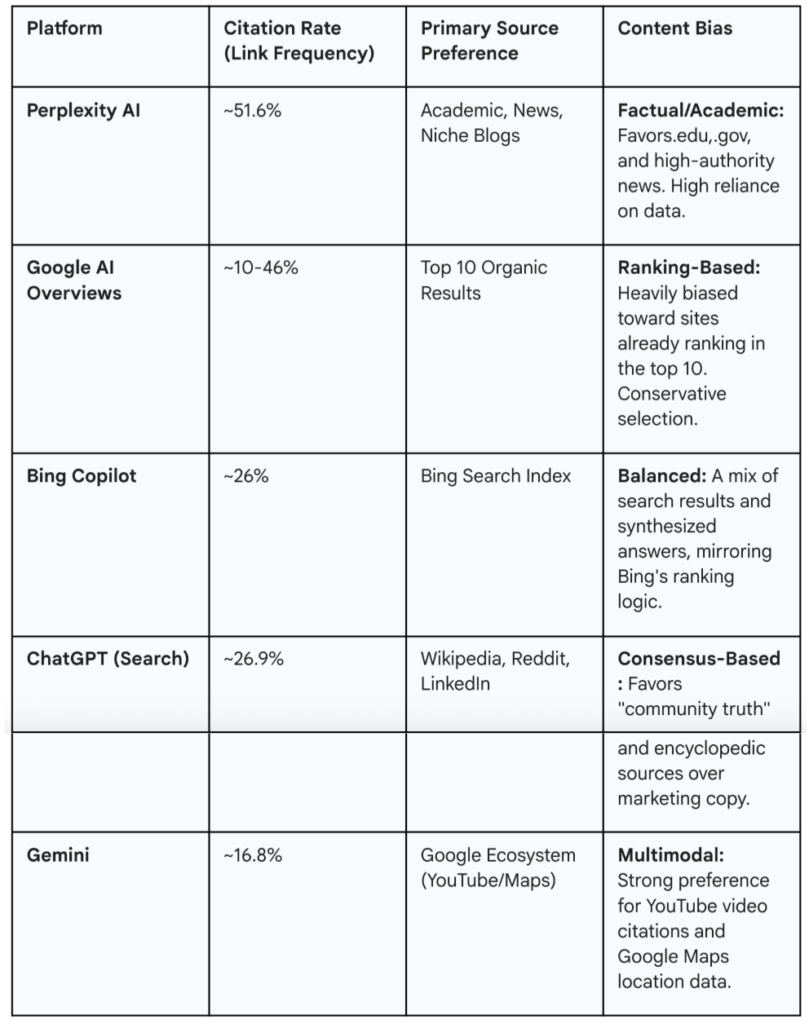
Source: Generative Engine Optimization (GEO): The Mechanics, Strategy, and Economic Impact of the Post-Search Era
Seen together, this paints a clear picture: there isn’t one generative search algorithm to optimize for anymore. There are multiple systems, each deciding trust in slightly different ways.
Why Traditional SEO Teams Struggle With Generative Search
Most SEO teams aren’t failing; they’re operating under assumptions that no longer hold.
Traditional SEO was built around a clear goal: improve rankings, drive clicks, and optimize pages for traffic.
Generative search breaks that model. AI systems don’t reward pages for ranking well; they reward sources for being useful to the answer. That subtle difference is where many SEO teams start to feel friction.
The first challenge is misaligned incentives.SEO teams are typically measured on metrics like impressions, clicks, and keyword positions. Generative search, however, often produces answers without clicks at all.
When success looks like being cited or referenced, classic KPIs stop telling the full story. To bridge the gap between output and influence, teams need a GEO KPI because you can’t optimize what you aren’t set up to measure.
The second issue is how content is created.SEO workflows tend to prioritize keyword coverage, page templates, and incremental optimization.
Generative search favors something else entirely: clear explanations, defensible facts, strong sourcing, and content that can be easily summarized by a model. Pages written to “rank” don’t always translate into content that an AI system wants to pull from.
There’s also a tooling gap.Most SEO platforms are still designed to monitor SERPs, backlinks, and on-page signals. They don’t show:
Whether a brand is appearing in AI answers, How often it’s being cited, Which competitors are becoming preferred sources in generative results?Without visibility into those systems, teams are effectively optimizing in the dark.
Another point is organizational structure.Generative search cuts across SEO, content, PR, brand, and even product teams. Traditional SEO functions often sit in silos, focused narrowly on search performance.
AI systems, on the other hand, draw from the entire information ecosystem, earned media, thought leadership, community platforms, structured data, and authoritative references. Coordinating across those inputs isn’t something most SEO teams were designed to do.
Finally, there’s a mental model gap.SEO has always been about competing for positions. Generative search is about earning trust. That requires thinking less like a tactician and more like a publisher, educator, or source of record. For teams trained on algorithm updates and ranking factors, that shift doesn’t happen overnight.
None of this means SEO teams are obsolete.
In fact, many of the fundamentals they manage, technical health, structured content, and authority, are still essential. The struggle comes from the transition. Generative search asks SEO teams to move upstream, away from rankings and toward source credibility. And without new processes, metrics, and mandates, that’s a difficult leap to make alone.
SEO Teams Are Trained for Pages, Not Answers
Most SEO agencies & teams are very good at optimizing pages. That’s what they were built to do, what they’re measured on, and what their tools are designed to support.
Generative search, however, changes the unit of value. AI systems don’t judge success by page performance: actually, they judge whether a source helps them construct a clear, trustworthy answer. That gap is where traditional SEO starts to feel strained.
Large language models interpret a prompt, decide which sources are credible enough to use, and then synthesize a response. What the user sees is an answer, not a page. And that distinction changes how visibility is earned.
This is where many teams run into friction. SEO professionals are trained to ask, “How do we rank this page?” AI systems are asking, “Which sources do we trust to explain this?” Those are different problems, requiring different inputs.
The table below shows why this transition is more than a small adjustment and why some brands begin exploring support from a GEO agency as generative search matures:

Source: Ottlerly.AI guide
So, updating a page or earning a backlink doesn’t always change whether an AI system chooses to reference that content. Visibility depends more on clarity, authority, consistency, and how easily information can be summarized and reused.
This is also why some organizations look beyond their existing SEO function. A generative engine optimization company approaches the problem from a broader angle: it focuses on how a brand appears across the information ecosystem that AI systems draw from.
The Gap Between “Optimized Content” and “Citable Knowledge”
For years, “optimized content” meant content that ranked well. If a page hit the right keywords, earned backlinks, and followed SEO best practices, it was considered successful.
Generative search introduces a different standard. AI systems don’t just look for optimized pages; they look for citable knowledge.
When citable knowledge appears in Google results as an AI summary, users click an organic result only 8% of the time. In that environment, being “optimized” is no longer enough.
AI engines prioritize information they can confidently reuse. The report titled How to Optimize Content for GEO and AEO in an AI-Native World defines generative engine optimization as the practice of designing content so LLMs are more likely to cite it directly.
So, optimized content is often written to satisfy algorithms. Citable knowledge is written to satisfy models.
From an operational standpoint, this is where a GEO agency often becomes relevant. Building citable knowledge requires original data, third-party validation, consistent brand presence across trusted platforms, and content structured for AI parsing. And all these require a bold strategy and cross-functional coordination.
What a GEO Agency Actually Does (That SEO Teams Usually Don’t)
At a glance, a GEO agency can look like an extension of SEO. In practice, the work is fundamentally different.
As we mentioned before, where SEO teams focus on making pages rank, a GEO agency focuses on making knowledge travel from your brand into AI-generated answers.
Again, generative search doesn’t reward effort at the page level alone. It rewards brands that consistently show up as credible inputs across the wider information ecosystem.
Let’s be more specific, a GEO agency:
Designs content for citation, not traffic. Coordinates visibility across those environments. So a brand appears consistently wherever AI systems look for consensus. Builds content so it sounds less like promotion and more like something an AI would trust and reuse. Focuses on how a brand shows up across the broader information ecosystem that AI systems rely on. That might include turning internal expertise into data-backed explainers, placing insights in credible third-party publications, or structuring content so it’s easier for AI models to extract and reuse.For example, many GEO agencies in the USA work with brands to transform product knowledge into reference-style content (definitions, benchmarks, or research summaries) that look less like marketing and more like something an AI would confidently cite.
Entity Authority and Source Credibility Engineering
So far, we’ve explored what a GEO agency really does. Now, it’s time to mention entity authority and source credibility.
Entity authority (or E.E.A.T.) refers to how strongly an AI system recognizes and understands a brand. In generative search, entities are not pages. They are conceptual objects with attributes: what they are known for, which topics they consistently appear in, and how often they are validated by other trusted sources.
The research paper we previously cited, Generative Engine Optimization (GEO): The Mechanics, Strategy, and Economic Impact of the Post-Search Era, explains entities as follows:
The fundamental unit of understanding in GEO is the entity, not the keyword. LLMs understand the world through a vast Knowledge Graph of entities (people, places, concepts) and the relationships between them.
And a brand that is regularly linked to certain entities in the training data forms a strong association in the vector space.
For example, if Salesforce frequently co-occurs with CRM and Enterprise across thousands of documents, the model learns this relationship as a fundamental truth. GEO involves strengthening these associations through consistent messaging and schema markup.
In simple terms: if an AI doesn’t clearly “know who you are,” it won’t reference you.
In its YouTube video, SMA marketing says that when it comes to generative optimization, the biggest thing we’re trying to do is make our brand surface in AI responses.
We want to make sure that our brand is part of the AI conversation, so that means our content should be approached a little bit differently from an SEO standpoint. Within these large language models, we’re educating those models with our content so that we’ll include our entity in relevant results. We want to make sure that we are known for certain topics, niches, problems, and answers to questions. That’s a slightly different view of content and the metrics we use are going to be different traditionally.
Source credibility, on the other hand, is about risk.
AI systems are designed to avoid hallucinations and misinformation. To do that, they favor sources that demonstrate reliability through evidence, attribution, and third-party validation. Generative engines prioritize sources that show:
Clear authorship and provenance, Verifiable facts and data, Independent corroboration across trusted platforms.When combined, entity authority answers “Who is this?” and source credibility answers “Can we trust them?” Generative search engines need both before including a brand in an answer. One without the other isn’t enough.
That’s why this work is increasingly described as source credibility engineering. It’s not accidental. Brands have to clarify their identity. In a post-search world, being visible isn’t about ranking higher; it’s about being recognized and trusted as an entity worth citing.
Structuring Knowledge So AI Can Trust and Reuse It
Once an AI system recognizes an entity and believes it’s credible, the next question becomes practical: Can this information actually be reused?
In generative search, trust alone isn’t enough. Knowledge has to be structured in a way that AI systems can clearly interpret and extract.
In human terms, AI systems don’t “read” content the way people do. They break it down into pieces and then reassemble those pieces into new answers. Content that is vague, overly promotional, or poorly organized creates friction.
Then, what kind of information are AI systems more likely to reuse?
Key concepts are clearly defined, Claims are separated from opinions, with evidence attached, Relationships between ideas are explicit.This is also where many brands struggle. Traditional content is often written to persuade or rank. It blends messaging, context, and conclusions in a way that works for humans skimming a page but creates ambiguity for AI systems trying to extract a clean answer.
So, structuring knowledge for AI means being deliberate. What’s more?
Explanations need to stand on their own. Facts need clear attribution. Data needs context that travels with it.When AI systems encounter this kind of content repeatedly from the same source, trust compounds.
Before closing that section, let’s remember that some content types, like questions and detailed search queries, are more likely to be processed by AI, as Pew Research Center stated:

Source: Pew Research Center
Testing, Tracking, and Iterating AI Visibility Signals
GEO work treats visibility as an ongoing feedback loop, not a one-time optimization.
The GEO Best Practices Guide states:
As AI search engines become more prevalent, success can’t just be measured by website traffic anymore. What matters now is how accurately and favorably AI systems present your brand when answering user queries. GEO is about ensuring AI systems understand and represent your brand correctly when synthesizing information for users, not just about appearing high in search results.
Once brands accept that generative search visibility can’t be measured by rankings alone, the next challenge is knowing what to track instead.
Actually, AI visibility requires new, model-native metrics and signals that reflect how brands actually appear within AI-generated answers. Generative Engine Optimization (GEO): The Mechanics, Strategy, and Economic Impact of the Post-Search Era highlights several indicators that GEO agencies use to test and track AI systems:
Share of Model (SoM)This looks at how frequently a brand appears across a defined set of prompts within a category. For instance, when AI is asked a broad range of questions about enterprise CRM software, SoM compares how often one brand is surfaced relative to others.
Citation RateIt distinguishes between a brand being casually referenced and being explicitly linked or named as a source. The research shows that sources receiving formal citations are more likely to be reused in future responses.
Sentiment ScoreThis signal looks at how a brand is described, whether the tone suggests endorsement, neutrality, or concern. The paper emphasizes that sentiment matters because AI summaries can shape perception quickly and at scale.
Conversational Engagement Rate (CER)This measures what happens next. When an AI response includes a brand, does it prompt the user to ask follow-up questions about it? A higher engagement rate suggests that the brand is relevant enough to sustain the conversation.
So, GEO agencies test how brands show up across prompts, improve structure and clarity, and reinforce authority signals.
Over time, they track how those changes influence SoM, citation behavior, sentiment, and engagement, measuring GEO success by whether the brand earns consistent visibility. In a generative search landscape, success comes from becoming part of the conversation.
When an In-House SEO Team Can Handle Generative Search
So far, we’ve explored that GEO is a different story from SEO. Visibility works differently. Content is evaluated differently. Even success is measured differently.
Generative search introduces new surfaces, new expectations, and new forms of influence that don’t map neatly to rankings, traffic, or keyword performance. And that affects how brands think about geo pricing and the value of appearing in these environments.
That sometimes means brands need outside help.
In the early stages, an in-house SEO team can handle parts of generative search. Teams that already produce high-quality content, maintain strong technical foundations, and understand authority signals are starting from a good place. With time and effort, they can experiment with generative formats.
However, traditional SEO dashboards weren’t built for measuring GEO KPIs. Rankings don’t explain whether a brand is being cited. Traffic doesn’t reveal how often it appears in AI answers. Even impressions fall short when AI systems summarize information without sending users anywhere. Once teams try to move beyond surface-level observation and into real GEO performance measurement, the gaps become obvious.
One of the GEO agencies we listed in our blog titled “What is a GEO Agency? Top 7 GEO Agencies Leading AI Search Optimization,” Propeller, showcases its solutions as follows:
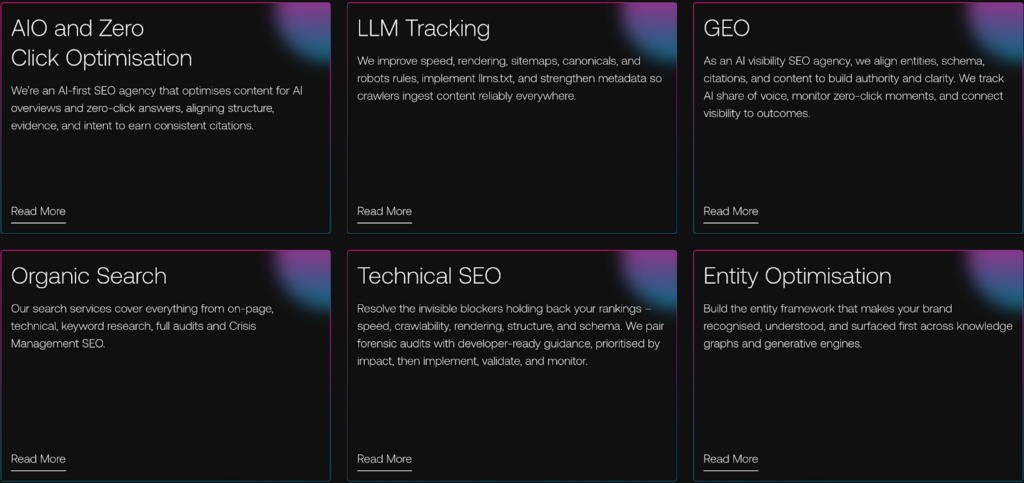
From zero-click optimization to LLM tracking and entity optimization, there are various services GEO agencies cover. It seems that in-house SEO teams need to address these areas, one by one.
When You Actually Need a GEO Agency
One of the clearest signals that GEO is moving from “nice to have” to “strategic requirement” is how user behavior is shifting.
Search engines still dominate overall volume, but the direction of travel matters more than the absolute numbers.

Source: AI Search Optimization / GEO Geo Tracker: Your Brand’s AI Visibility
According to the data shown above, traditional search engines still drive roughly 1.6 trillion visits, yet that traffic is declining year over year. At the same time, chatbot-driven traffic sits closer to 50 billion visits, but it’s growing at an accelerated pace of more than 80% year over year.
As long as most discovery happens through classic search, SEO performance can mask weaknesses in generative visibility. Brands still get traffic, still rank, still convert. But underneath that stability, attention is slowly migrating to AI-native interfaces. These interfaces that don’t reward rankings, don’t guarantee clicks, and don’t surface ten options at once.
This is typically when you need a GEO agency becomes necessary.
You need a GEO agency when growth is happening somewhere your dashboards don’t fully cover. In-house teams may notice traffic holding steady while brand mentions inside AI answers lag behind competitors. Or leadership may start asking why certain competitors keep appearing in AI-generated recommendations despite similar SEO performance.
The traffic split above also highlights another inflection point: AI traffic compounds differently. Chatbot sessions are conversational. Once a brand appears inside an answer, it can influence multiple follow-up questions in the same session. That dynamic doesn’t exist in traditional search, and it’s rarely captured by SEO tooling.
GEO agencies are built to monitor those early signals, track generative search performance before it shows up in revenue reports, and strengthen visibility where momentum is clearly building.
In short, you don’t hire a GEO agency because search is dead. You hire one because the next layer of discovery is growing faster than SEO alone can explain or control.
If AI Answers Ignore Your Brand Completely
One of the clearest warning signs in the generative era is simple: Your brand doesn’t appear at all. When AI answers ignore your brand, it’s usually not a content quality issue.
In traditional search, absence was easy to diagnose. You checked rankings. You reviewed impressions. You adjusted pages. In generative search, the story is different. As we mentioned before, AI systems can deliver complete answers without ever touching your site, which means SEO metrics alone no longer reveal whether you’re visible or invisible.
Brands often assume they have visibility because traffic is stable. But when teams start measuring AI search visibility, they often discover that competitors are being cited, recommended, or discussed. At that point, the issue is the AI answer inclusion rate.
As you can predict, the inclusion rate measures how often a brand appears across a defined set of prompts within its category. If that number is “consistently” near zero, it indicates that AI systems don’t yet see the brand as a reliable or necessary source (regardless of how well its pages perform in search results).
In those circumstances, a GEO agency asks:
Are we included at all?How often do AI systems choose competitors instead? Are we invisible across informational, comparison, and recommendation prompts?
This is also where the difference between GEO vs SEO metrics becomes clear.
If You Can’t Explain Why AI Picks Certain Sources
The inability to provide a clear explanation for why AI uses particular sources is a common red flag in generative search work. When selection feels arbitrary, it usually means the brand is still evaluating AI behavior through an SEO lens that no longer fits.
This is where the thinking behind a generative engine optimization company differs from traditional SEO services. GEO work begins with reverse-engineering source selection: understanding what makes information reusable for large language models.
As previously explained, AI systems favor content that is structured, evidence-based, and explicit. And, in practice, this explains why AI often cites research reports, neutral explainers, or third-party articles over branded content. So, the issue is interpretability.
This is the point many brands begin exploring leading GEO agencies or a specialized AI GEO agency. Not because internal teams lack skill, but because explaining AI behavior requires a different operating model. GEO specialists spend less time optimizing individual pages and more time understanding why certain sources become default references across prompts.
Let’s remember a fact at that point: The Identifying and Scaling AI Use Cases report highlights that only 1% of organizations consider their AI efforts fully mature, largely because teams struggle to interpret and operationalize AI decision-making.
That gap shows up clearly in search; brands may see AI answers change, competitors appear, or messaging shift, but without the frameworks to explain those outcomes, optimization becomes guesswork.
This is why top GEO SEO agencies focus on explainability as much as execution. They help brands understand:
Why are certain sources selected repeatedly? Why are others ignored despite strong SEO? Which signals actually influence AI reuse?Until a team can confidently explain why AI picks one source over another, visibility will continue to feel unpredictable. GEO doesn’t eliminate uncertainty, but it replaces intuition with patterns and guesswork with mechanisms.