Google Doesn’t Punish AI Content; It Punishes Bad Content (331k Pages Studied)
On the one hand, Google says they don’t care whether AI is used for content creation, as long as the content isn’t designed “with the primary purpose of manipulating ranking in search results.” On the other hand, people like...
 Troov
Troov
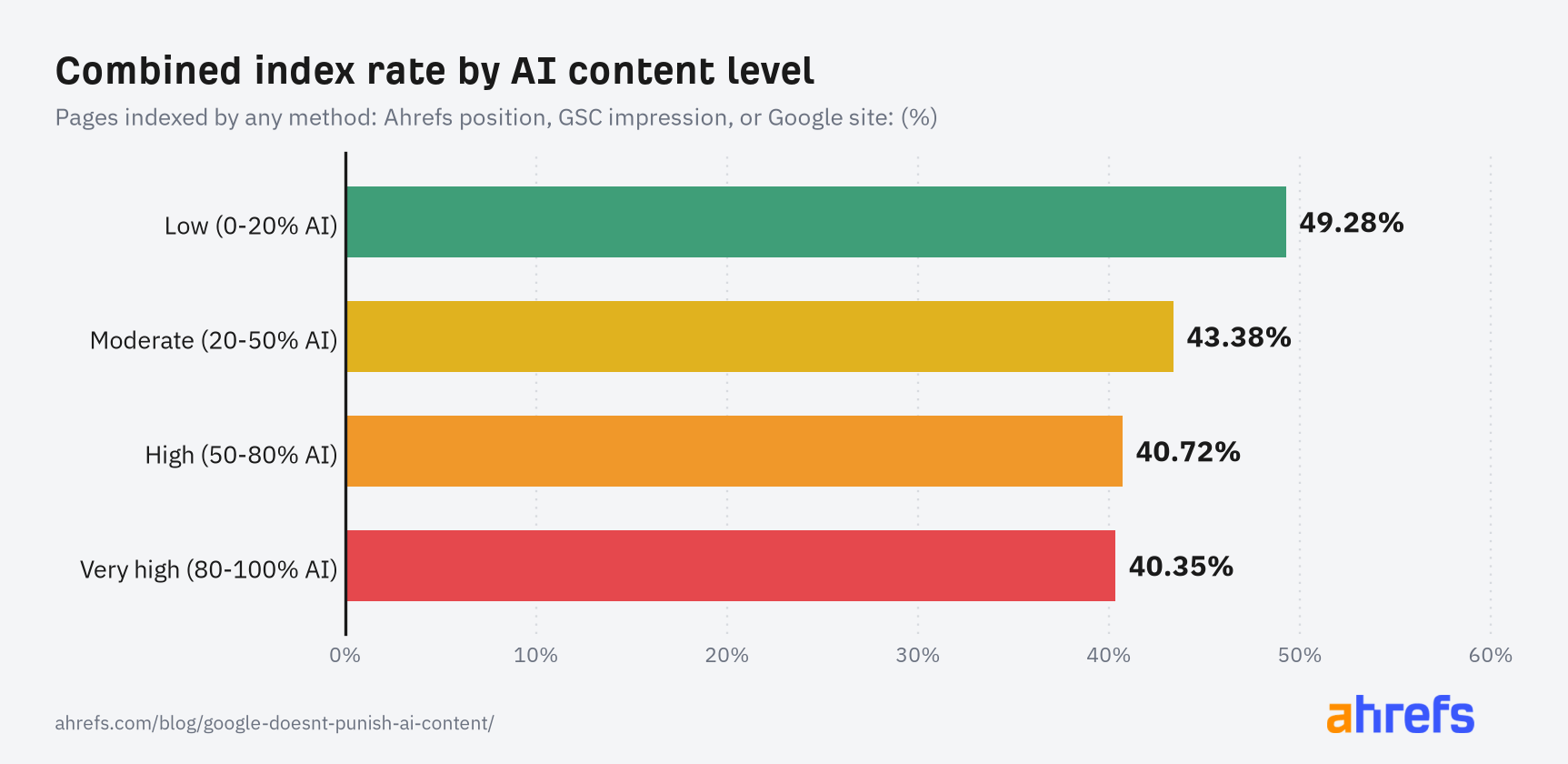
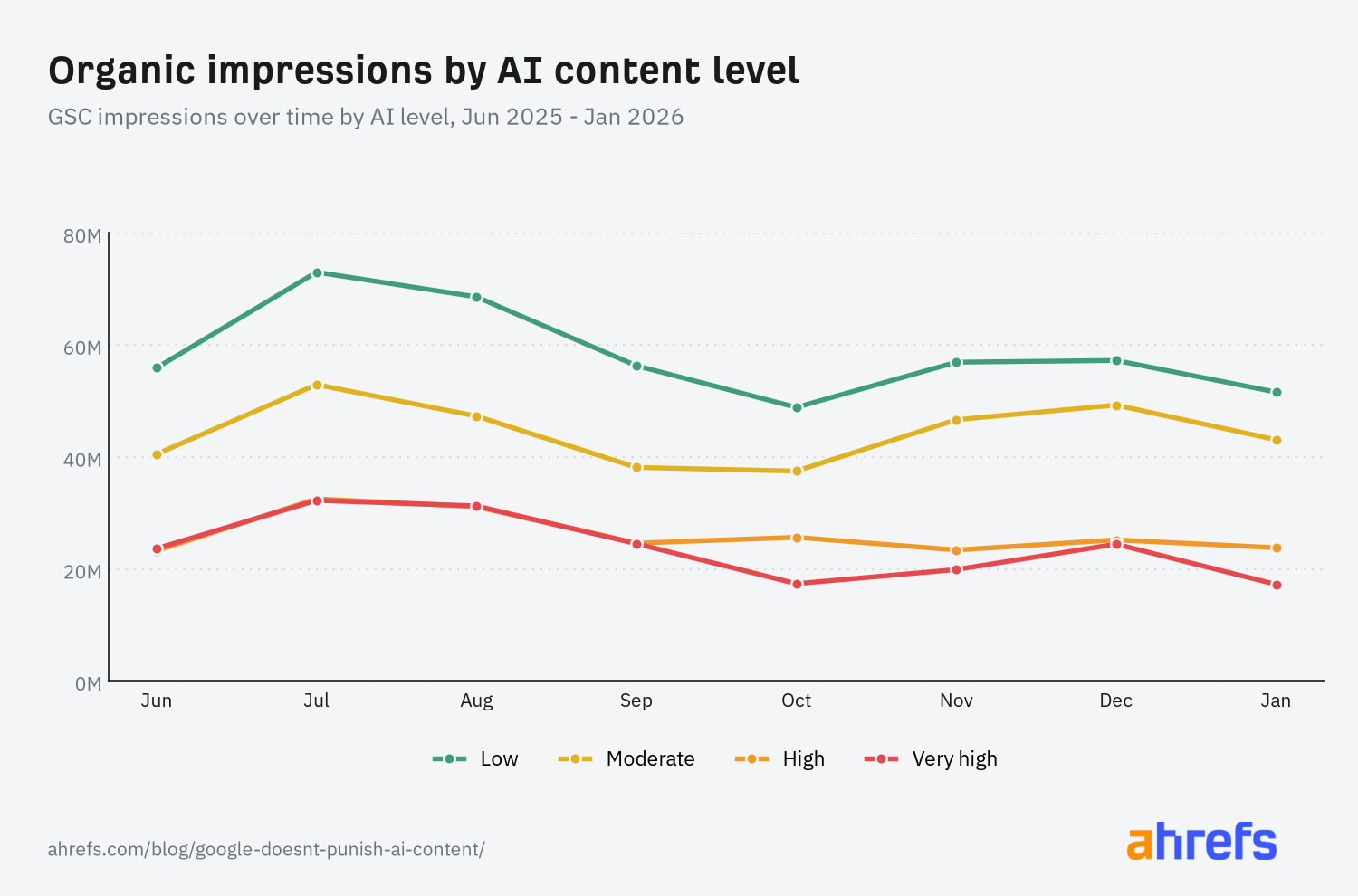
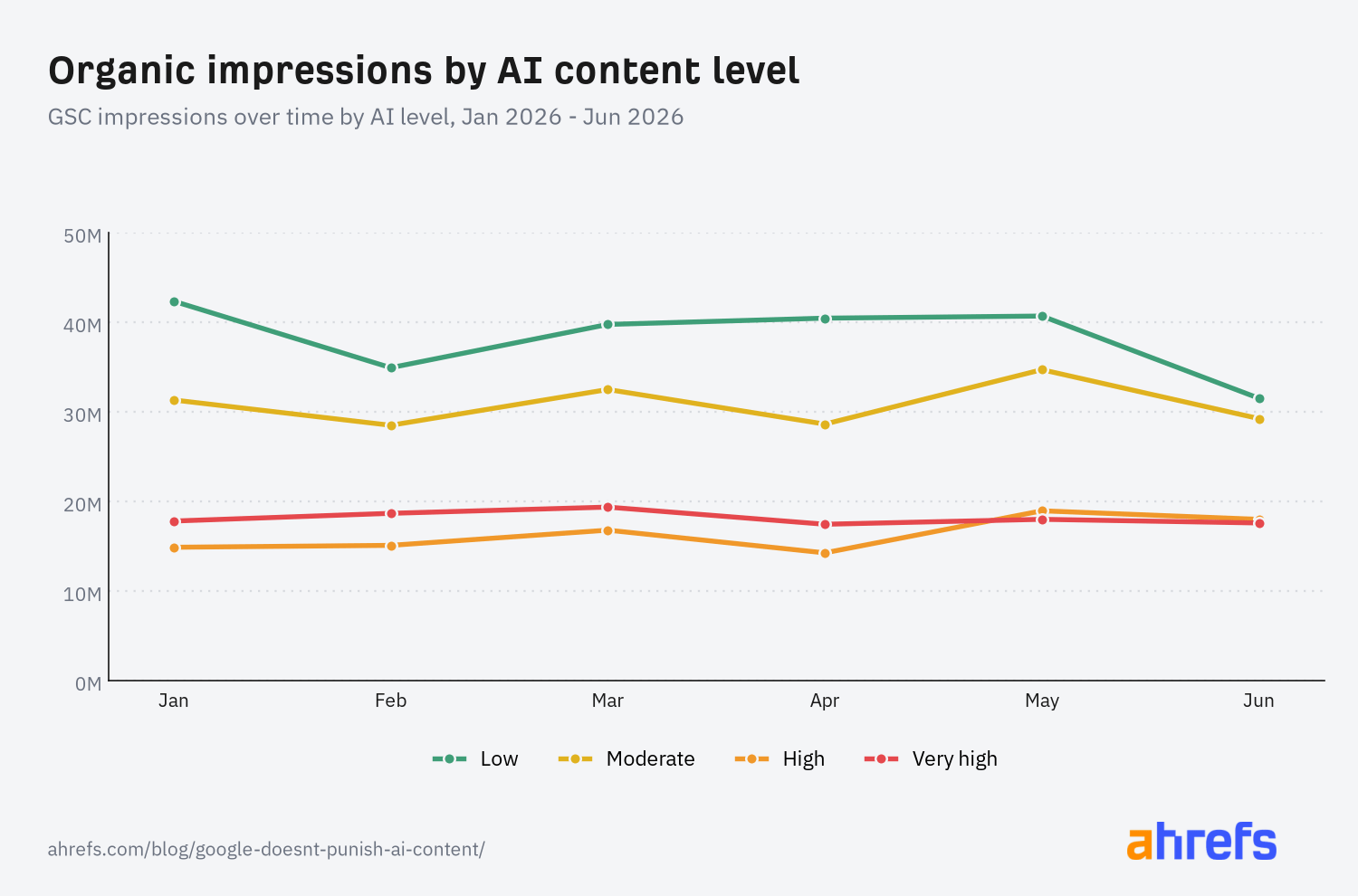
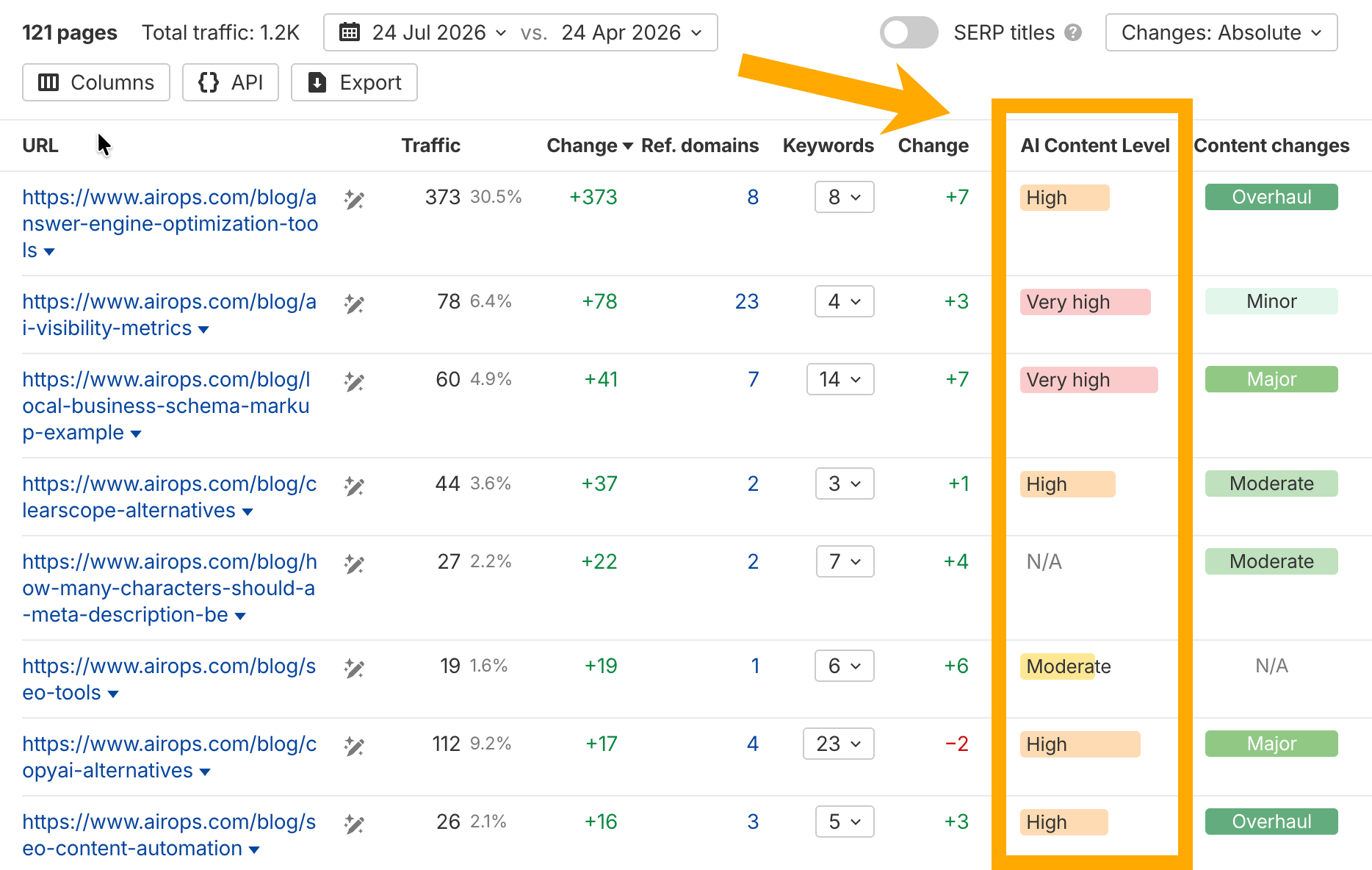
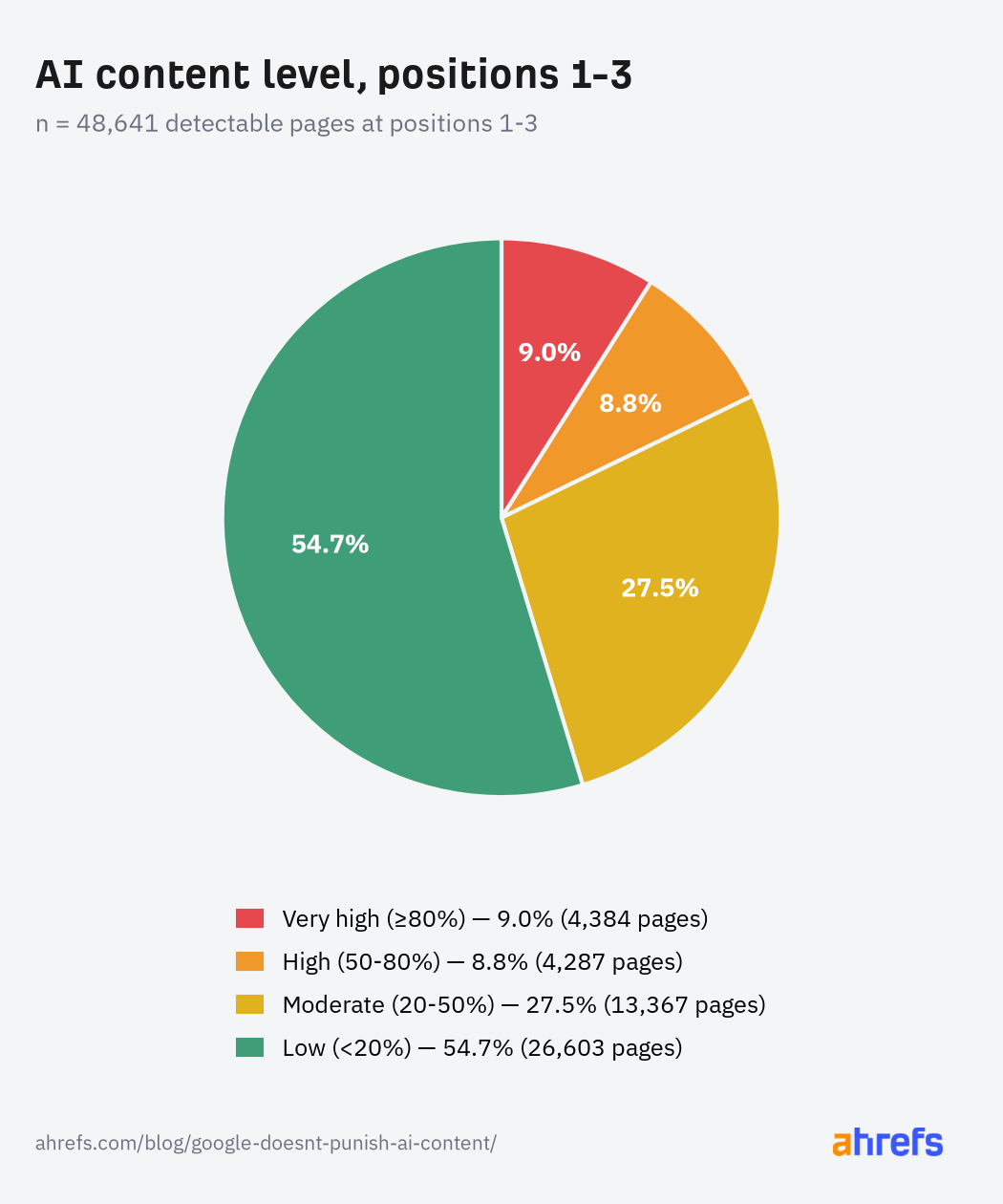
I still have plenty of questions about how Google treats AI-generated content. On the one hand, Google says they don’t care whether AI is used for content creation, as long as the content isn’t designed “with the primary purpose of manipulating ranking in search results.” Automation has long been used in publishing to create useful content. AI can assist with and generate useful content in exciting new ways. On the other hand, people like Lily Ray and Glenn Gabe have shared many examples of so-called “mount AI” traffic graphs: websites that scaled content creation with AI, saw a heroic spike in rankings and traffic… and then watched their organic performance tank a few months after publication. An example of a “Mount AI” traffic graph from Lily’s article. Many marketers are now unwilling to use generative AI in any capacity for fear Google will punish them. But is Google punishing these websites for using AI content? Or is their AI use incidental to the fact that they’re making spammy, scaled content? We set out to answer four questions that might shed some light on the issue: Based on this research, I believe that Google is not against AI content; it is against bad content, but confusion arises because AI content and bad content overlap a significant amount of the time. This research uses Ahrefs AI content detector, which Ahrefs customers can use via Site Audit and the Top pages and Page inspect reports in Site Explorer. AI content levels indicate the estimated percentage of AI-generated text on the page, ranging from low (<20%) to very high (≥80%). For greater accuracy, AI detection only triggers on pages at least 350 words in length. Importantly, AI content detection is not perfect, and the way we detect AI content will be different from how Google does (if it does). In the same way that an LLM uses probability to generate text, AI detectors use probability to classify it. This type of research is, in my opinion, the best way to use AI content detection: looking at large-scale datasets and directional trends, and not fixating on individual articles and their AI content. We analyzed 1,000,000 pages pulled from the top 10 positions in 100,000 SERPs in June 2026. Around 300,000 of these pages were available in our crawler database, of which 150,000 contained enough page content for AI detection. We found that the majority of top-ranking pages are predominantly human-written. 54.7%—over half—have less than 20% AI content. Together, pages with under 50% AI content account for 82.2% of top-3 rankings. But although our data suggests that higher AI use is correlated with lower ranking positions, it also suggests that it is possible for fully AI-generated content to rank in positions 1-3. Fully or near-fully AI-generated pages are a small minority, but they certainly exist in this sample: 9% of top-ranking pages are ≥80% AI content, and 5.3% are 100% AI-generated. Here’s how the data breaks out: But what about the rest of the SERP? Looking at the distribution of AI-generated content across the top 10 positions, highly AI-generated content gets rarer as you move higher in the SERP. Position 1 has the highest share of low-AI-content pages and the lowest share of very-high-AI-content pages: But there is a gentle gradient: the prevalence of AI-generated content gets gradually rarer moving from position 10 to 1, in relatively small increments. Every ranking position, including position 1, still contains a meaningful share of heavily AI-generated pages: between 8-12% containing ≥80% AI content. We also calculated the average and median AI content level across a sample of 15,000 pages for each position. It’s a similar story: AI content becomes more common further down the SERP, but still appears in higher positions: Analysing ranking pages introduces a type of selection bias: we are only evaluating successful URLs that Google has already deemed fit for indexing. But does AI use reduce the chance of a URL being indexed in the first place? We looked at the indexation rates for buckets of pages with different AI content levels. We sampled 1,000,000 pages from our crawler database, 1 page per domain. Around 100,000 pages contained enough content for AI detection. We counted a page as indexed if it had any of the following traits: If we bucket pages by their estimated AI content level, we can see that higher AI content levels correlate with lower indexation rates: Here’s how the data breaks out by bucket: While the indexation rate is lower for content with high or very high AI content levels, a full 40% of these pages were still indexed—not a million miles away from the 49% indexation rate of low AI content. Finally, we wanted to see how the organic performance of AI-generated pages trended over time relative to non-AI-generated pages. To do this, we used GSC data from live URLs, matched those URLs with our crawler database, filtered out pages with too little text for AI detection, and then bucketed the URLs by their estimated AI content level. This left us with the following samples: For each bucket, we used GSC data to plot the change in impressions over time, starting with one panel of websites from June 2025 to January 2026… …and a second panel of websites from January 2026 to June 2026: Organic performance is obviously influenced by many, many factors, and there are few concrete conclusions we can draw from this limited time window, but I thought the data was interesting for a few reasons: There are many reasons why AI-generated content might earn fewer impressions, so it would be wrong to assume that there is any kind of automatic suppression happening. Sites that lean heavily on AI content may tend to be newer or lower-authority in the first place; inversely, sites with good organic performance may be disincentivized to publish AI content. Most likely, in my opinion, is that increasing use of AI correlates with decreasing content quality. I think this is the key to understanding how Google treats AI content. Throughout this research, AI use seems to be correlated with lower performance in search: lower impressions, lower ranking position, and lower indexation rate. But this doesn’t tell the entire picture. AI-generated content is found in significant amounts in every ranking position, including the top 1 to 3. A significant amount of AI-generated content is successfully indexed. Impressions to AI-generated content remained relatively stable over time. There are no obvious hard cutoffs suggesting a binary AI classifier is preventing AI-generated pages from ranking highly or making it into the index. Instead, we see a gradual gradient: performance generally worsens with increasing AI use… probably because content quality generally worsens with increasing AI use. As I’ve said before, when companies engage in an AI content strategy, they are often engaging in a strategy that is very different from traditional content creation and SEO—different and worse in many ways. Basic AI content often: These are all problems that could markedly worsen the organic performance of any piece of content, but they are especially common in most AI-generated content. As Dan Taylor explained in his great SEJ article recently, publishing this content at scale is the perfect recipe for your very own “Mount AI” situation, as Google “burst-crawls” new low-quality, AI-generated pages but dumps them from the index soon after: Google might initially burst-crawl the new setup out of curiosity. But, if the domain lacks the baseline authority to sustain that scale, Google will throttle its resource allocation. Just because Google gives you the resources to index your pages initially, it does not mean it will grant them to you indefinitely. I don’t think Google is trying to punish AI-generated content; I think it is relying on the same old hallmarks of content quality that it always has. It’s just that AI-generated content is usually lower quality than human-generated content. Crucially, these quality problems commonly co-occur with AI use, but they are not guaranteed by AI use—as shown by the not-insignificant number of indexed and top-ranking AI-generated pages. I know from firsthand experience that it is very possible to create detailed, interesting, well-researched content using AI generation—the caveat being that most people do not. Yet. I don’t believe marketers and SEOs should be scared of AI content creation—but they should be scared of spam and scaled content.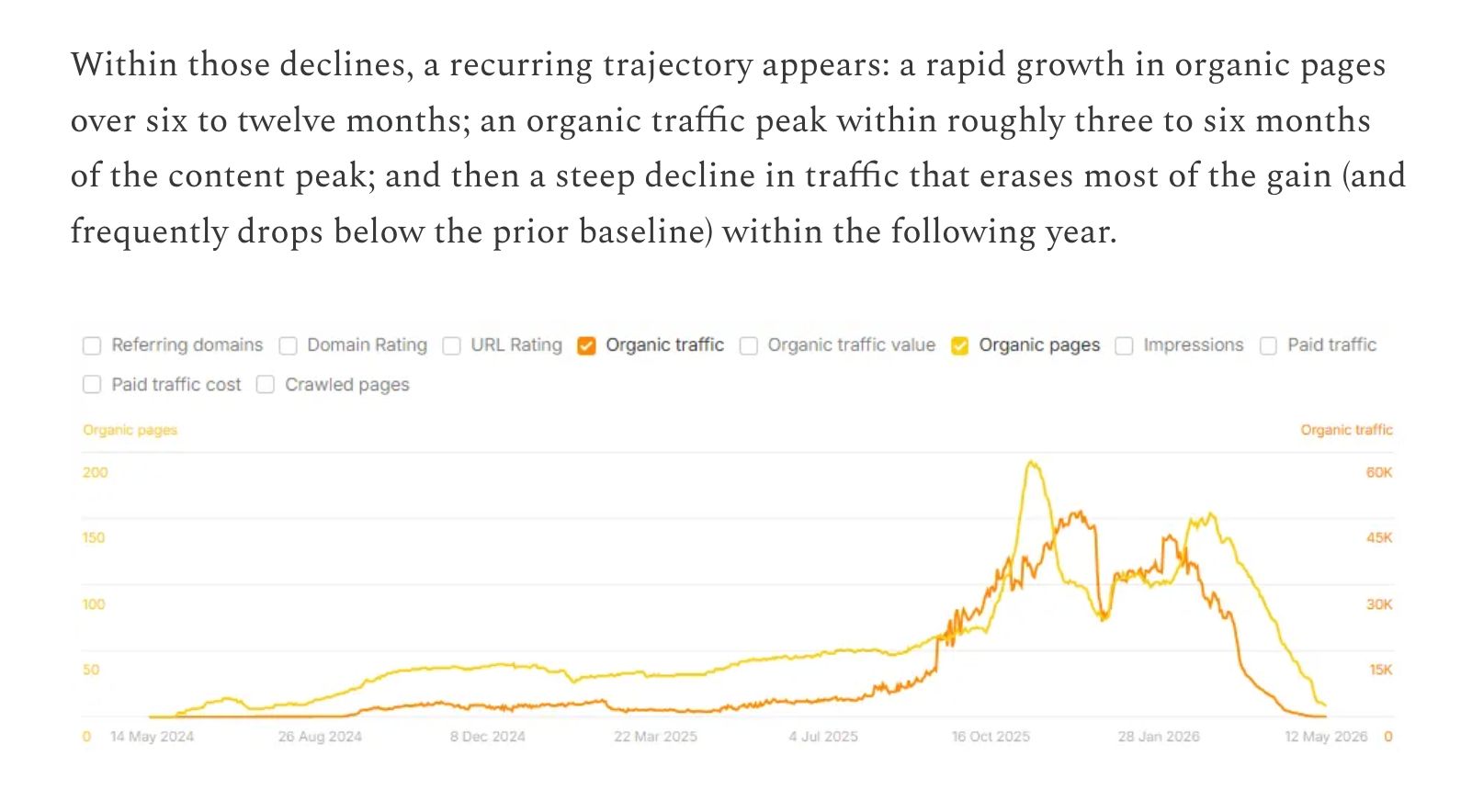
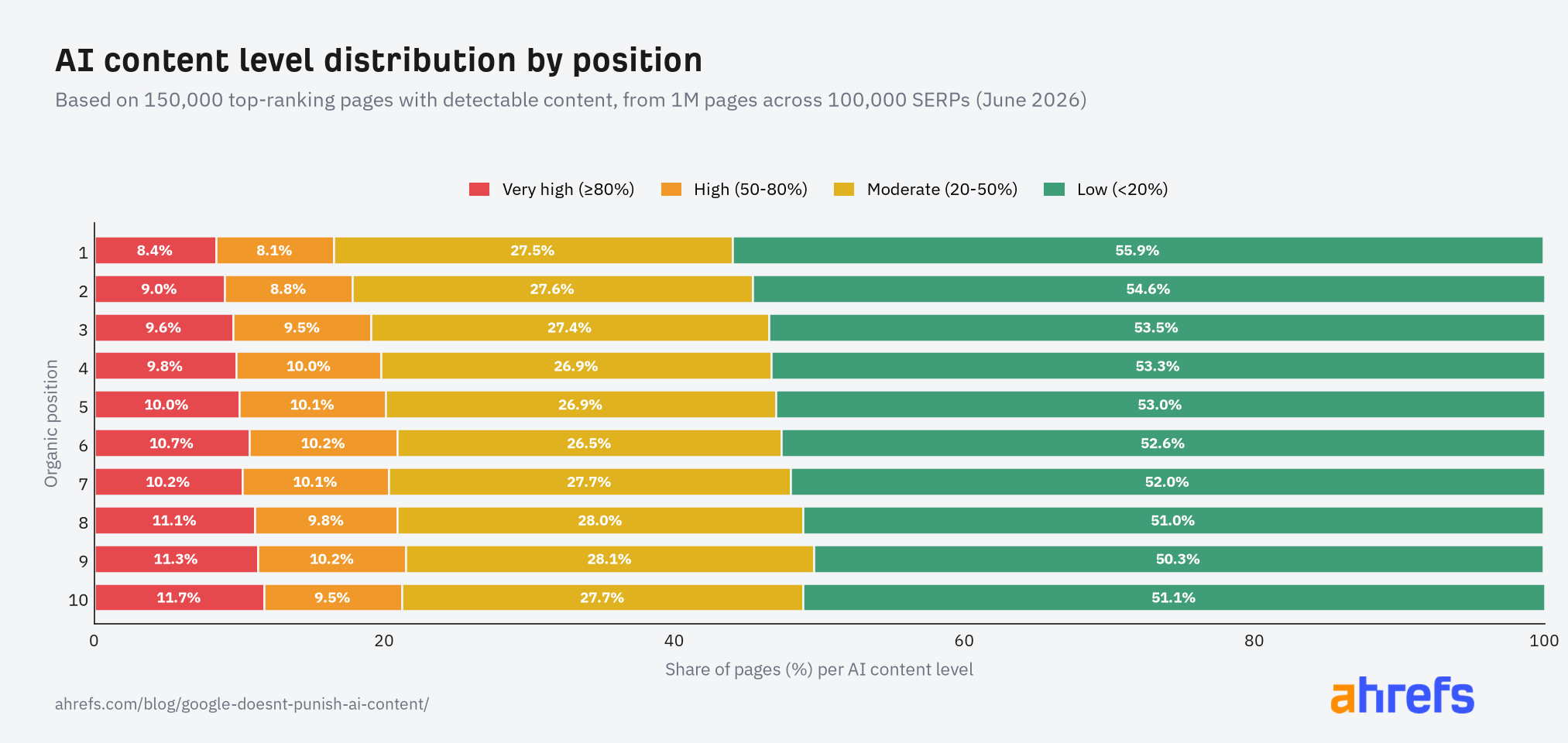
PositionVery High (≥80%)High (50-80%)Moderate (20-50%)Low (20%) 1 8.4% 8.1% 27.5% 55.9% 2 9.0% 8.8% 27.6% 54.6% 3 9.6% 9.5% 27.4% 53.5% 4 9.8% 10.0% 26.9% 53.3% 5 10.0% 10.1% 26.9% 53.0% 6 10.7% 10.2% 26.5% 52.6% 7 10.2% 10.1% 27.7% 52.0% 8 11.1% 9.8% 28.0% 51.0% 9 11.3% 10.2% 28.1% 50.3% 10 11.7% 9.5% 27.7% 51.1% 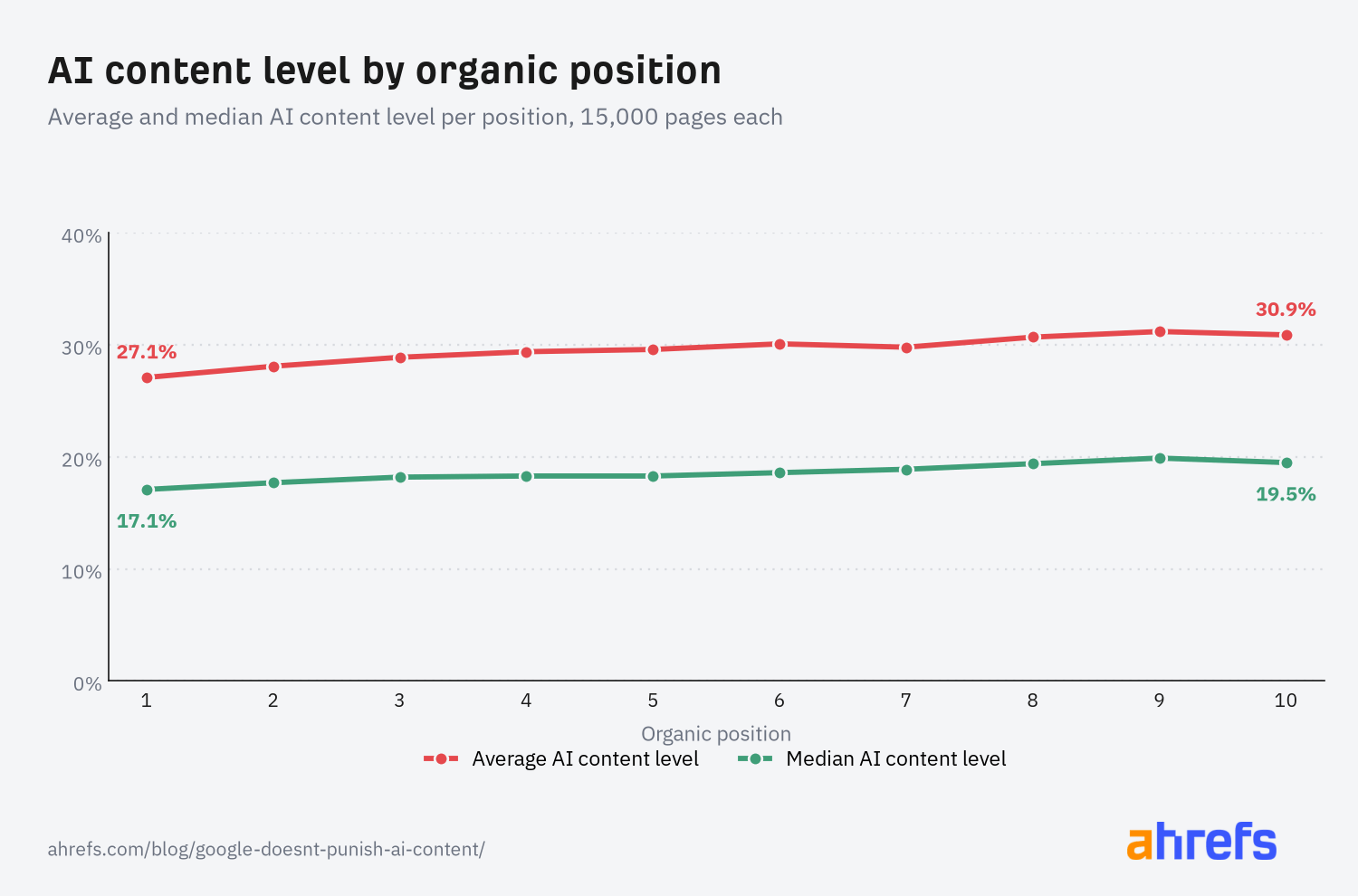
SERP PositionAverage AI Content LevelMedian AI Content Level 1 27.1% 17.1% 2 28.1% 17.7% 3 28.9% 18.2% 4 29.4% 18.3% 5 29.6% 18.3% 6 30.1% 18.6% 7 29.8% 18.9% 8 30.7% 19.4% 9 31.2% 19.9% 10 30.9% 19.5%