Hermès Advertising Strategy: Marketing the Prestige of “Hard to Get”
Hermès advertising strategy is the real reason you can’t buy a Birkin, actually (not money all the time). Let us tell you another wild thing about luxury marketing: that “most coveted handbag in the world” advertises itself. While other...
 ShanonG
Hermès advertising strategy is the real reason you can’t buy a Birkin, actually (not money all the time).
Let us tell you another wild thing about luxury marketing: that “most coveted handbag in the world” advertises itself. While other brands are spending millions on celebrity endorsements and flashy campaigns, Hermès is doing something completely counterintuitive. And it’s working brilliantly.
If you’ve ever wondered how a brand can charge $12,000 (and up to $380,000 for rare models and some second-hand ones) for a handbag and still have people waiting years to buy one, you’re in the right place. I am exploring the Hermès advertising strategy, or rather, the genius of their marketing approach that feels like no marketing at all.
Decoding the Hermès Strategy of “Being Out of Reach”
The Birkin Effect: The Logic Behind Hermès Advertising Hermès Advertising Campaigns: Building Desire Without Chasing Hype The Waiting List as Marketing Tool Sex and the City Effect What Makes Hermès Advertising Work Online Without Feeling “Online” Hermès Digital Marketing (The Luxury Funnel Rewritten) Hermès Social Media Strategy (Feels Like a Museum, Not a Marketplace) The Resale Market as Unofficial Hermès Advertising FAQ about Hermès AdvertisingThe Birkin Effect: The Logic Behind Hermès Advertising
According to a Lund University paper on the Birkin Effect, the story begins as follows:
It’s 1983, and actress Jane Birkin is on a flight from Paris to London. She’s struggling to fit her belongings into the overhead compartment when everything spills out. Sitting next to her is Jean-Louis Dumas, the CEO of Hermès. She mentions how hard it is to find a practical yet elegant leather weekend bag. By the end of that flight, they’ve sketched what would become the most iconic handbag in history: the Birkin bag.
That spontaneous conversation created more marketing value than a billion-dollar ad campaign ever could. And that’s the essence of Hermès advertising: authentic stories that money simply cannot buy.
Why did I name that section like that? Actually, there’s a phenomenon people call “The Birkin Effect.” It is a term that describes how external narratives and consumer storytelling can shape a brand’s reputation more powerfully than any corporate advertising campaign ever could.
The same research on Hermès’ brand identity explains it:
The Birkin Effect represents a hybrid, a dialogue between internal brand strategy and external cultural reputation where identity and reputation no longer exist in sequence but in continuous interaction.
Think about it: when was the last time you saw a Hermès commercial during the Super Bowl? Or a Birkin bag plastered across a billboard in Times Square? You haven’t, because that’s not how Hermès advertising works. Instead, the brand has mastered what I call “strategic silence.”
The numbers back this up beautifully. From 2007 to 2020, Hermès saw consistent revenue growth, reaching total revenue of €6.8 billion, with its revenue and cash flow showing steady upward trends year after year. Even more impressive? In fiscal year 2023, Hermès achieved an annual revenue of €13.4 billion. All of this is happening with minimal traditional advertising spend.
So what’s the logic here? Hermès advertising strategy is built on a fascinating paradox: the harder something is to get, the more people want it. And the brand has turned that into an art form.
What kind of hardness am I talking about? The paper titled “How Hermès Penetrated the Elite Clientele?” explains the brand’s production principles as follows:
An artisan makes up to 3-4 bags per week, and each bag is made by the artisan after a long period of careful sewing. The entire Hermès production is limited to no more than 15 bags per month, and this long production determines its rarity and also greatly affects its price.
This isn’t just manufactured scarcity. It’s genuine craftsmanship that happens to create natural exclusivity.
Hermès marketing positions this limitation as a feature. As one analysis notes, a Birkin costs $800 to manufacture, and the most expensive sold for in excess of $300,000.
Through this data, we can see that although the cost of Hermès handbags is high compared to other brands, the difference is huge compared to their selling price.
At this point, I couldn’t help but mention the promotional efforts of pop culture icons and celebrities. Actually, these people do not try to advertise the brand, but they want to show how good & rich they are by buying these bags. I bet you’ve seen Cardi B’s Birkin collection since she always talks about it on social media.
The rapper is not the only one. Footballers, singers, influencers, or fashionistas… all love showing off their Birkins. And that’s beyond the fashion marketing campaigns we are used to seeing.
And that’s the real Birkin Effect: when your customers turn your product into a status symbol, a milestone, an investment, and an heirloom all at once, without you having to say a word. Consumer narratives reveal incredibly personal connections.
Hermès Advertising Campaigns: Building Desire Without Chasing Hype
Now let’s talk about how Hermès actually promotes its products.
According to former CEO Jean-Louis Dumas, the brand philosophy is simple:
We don’t have an image strategy, we have a product policy.
Instead of traditional advertising, Hermès marketing focuses on heritage and storytelling in the quietest way possible. When Hermès does create campaigns, they’re masterpieces of storytelling that prioritize emotion and artistry over product placement.
Let’s look at some of their most memorable Hermès campaigns that exemplify their unique approach to Hermès advertising.
Tracing Wonder
The “Tracing Wonder” campaign is an excellent place to start because it exemplifies Hermès’ ability to create advertising that does not feel like advertising.
Firstly, his campaign invites viewers into a world of curiosity. It emphasizes the journey of discovery and the wonder inherent in craftsmanship, themes that resonate with Hermès’ heritage without explicitly selling anything.
The campaign highlights that Hermès creates emotionally charged and aesthetically rich narratives.
Terre d’Hermès
The “Terre d’Hermès” campaign for their men’s fragrance is another brilliant example of understated luxury marketing.
As you are aware, brands typically invest in celebrity endorsements and show a cologne bottle in a video clip. Hermès did not create in this manner.
The Hermès campaign focuses on connection to the earth and masculine elegance. The visuals are poetic and contemplative, more art film than commercial.
The Hermès Bag: A Mother-Daughter Tradition
Perhaps one of the most emotionally resonant campaigns.
This Hermès ad directly addresses the narrative of legacy that consumers have organically built around Hermès products.
In the diary she’s been keeping since age 4, Eriko takes the pulse of the world, notes down the fragrances and hues of life, and pays a vibrant tribute to her mother, who bequeathed her a Kelly bag.
This peerless piece has a life of its own, which the young woman prolongs and honors at all times. Both a talisman and a keepsake, this sensitive leather haiku stands the test of time.
It takes the stories their customers are already telling and reflects them in a way that feels like the brand truly understands them.
Footsteps Across The World
That Hermès advertisement series tells stories of craftsmanship, travel, and cultural connection without boasting about having stores in 45 countries with 331 locations worldwide.

Source: Hermes YouTube Playlist
In other words, the Hermès campaign demonstrates that being global doesn’t mean being common. Each “footstep” represents a carefully curated presence, not mass-market expansion.
The Endless Line
It is perhaps the most abstract and artistic of Hermès’ major campaigns. It focuses on the tradition of artisanal excellence and the timelessness of Hermès design.
Without pushing product features or limited-time offers, Hermès expresses that it exists outside the normal fashion cycle. And the “endless line” metaphor refers to their unbroken heritage since 1837.
What all these campaigns share is a refusal to be obvious. They’re not shouting “Buy this bag!” In luxury marketing, “whispering” is better than shouting, and this is the approach that new-age fashion marketing agencies embrace.
The Orange Box Campaign
Beyond specific narrative ad campaigns, one of Hermès’ most recognizable marketing assets is packaging.
We’ve all seen the orange box with the duc-carriage-with-horse logo; since its debut in the 1950s, it’s remained a powerful symbol in the fashion industry. That distinctive orange box has become so iconic that it needs no explanation. When someone posts an Instagram photo of that orange box, everyone knows exactly what it means.
So, the box itself has become free advertising, appearing in countless social media posts, unboxing videos, and lifestyle content, none of which Hermès pays for.
The Waiting List as Marketing Tool
And then there’s the infamous waiting list, which might be Hermès’ most genius marketing move.
You may think that each brand’s main objective is to maximize sales, but not Hermès’. As you may know, the brand produces less than the market demands within its business model. It means you need to be part of a (long) waiting list to acquire a Hermès. However, getting on that list is difficult because the brand ranks customers based on previous purchases.
I am actually talking about a waiting list that could last up to 6 years. That is why there are hundreds of waiting list-related questions on forums:

However, that entire process isn’t frustrating customers. It’s creating desire. And it’s based on a simple sales rule: If you make the supply appear limited, the demand for the product increases.
Sex and the City Effect
The most valuable advertising Hermès never paid for came from popular culture.
What about saying that one of the most popular TV shows of all time, Sex and the City, had a significant impact on Hermès advertising at the time?
The line, “It’s not a bag, it’s Birkin,” caused a huge stir, and the name of the bag and brand was introduced to people who had never been involved in the luxury world before.
That single line, which Hermès didn’t write or pay for, became one of the most powerful pieces of brand marketing in history.
The bag was also featured on the television show Gilmore Girls, and numerous other media appearances have increased its visibility and cultural reach.
The Birkin effect, as I mentioned before, is in every corner of social media as well as in the series. Remember the short video & meme showing Georgina Rodriguez is interested in her Birkin bag instead of Cristiano Ronaldo during an international event?
So yes, Birkin and Hermès, of course, have been a part of pop culture and what we watch and are inspired by.
What Makes Hermès Advertising Work Online Without Feeling “Online”
Now, I know what you’re thinking: “But we’re in the digital age! How does a brand survive without aggressive digital marketing?”
Great question. Actually, Hermès digital marketing approach has quietly built a sophisticated digital presence. In other words, they’ve just done it in a way that feels undigital.
Hermès Digital Marketing (The Luxury Funnel Rewritten)
As marketers already know, traditional digital marketing follows a “solid” playbook: attract attention, generate leads, convert sales, repeat. But Hermès digital marketing flips this entire model on its head.
First, let’s acknowledge that Hermès does have an online presence. Even though there are waiting lists for signature things like Birkin, Kelly, or H logo flats, the brand sells its products via its ecommerce platforms.
But here’s the brilliant thing: even during the pandemic, when physical stores closed, Hermès’ online strategy didn’t become desperate or discount-driven.
According to Wang, “while revenues dropped by 25 percent from €3.3 billion ($3.9 billion) to €2.5 billion… the growth of its online channels, where sales continued to rise even as its stores reopened.”
It is not achieved in a short period of time, it takes years and years of building and practice. Hermès was able to develop its online sales channel as a stand-alone channel because it realized the importance of the online platform early on and actively developed it.
This is crucial: Hermès didn’t compromise their exclusivity for convenience. You still can’t just click “add to cart” on a Birkin bag. The Hermès marketing strategy online maintains the same selectivity as their physical stores.

Their e-commerce platform showcases products, tells brand stories, and maintains the aura of luxury. But it doesn’t make luxury feel cheap or accessible to everyone. That tension is intentional.
Social media is where most luxury brands struggle.
How do you be present on Instagram without looking thirsty?
How do you use TikTok without diluting your brand?
Hermès has figured it out by treating social media less like a sales channel and more like a digital gallery. Take a quick look at Hermès’ Instagram account for a second: It seems like an art show or a feed of an independent artist:

So, Hermès social media presence, meanwhile, remains refined.
As a part of their fashion social media strategies, they share craftsmanship videos, behind-the-scenes glimpses of artisans at work, and artistic imagery. In other words, Hermès social media strategy is to create content so beautiful and meaningful that customers want to participate in spreading it.
They also team up with independent illustrators for both social media posts and their official website. Take the brand’s 2026 theme (Venture Beyond) introduction as an example; the brand collaborated with Linda Merad:

Source: https://www.instagram.com/hermes/
Similarly, for the campaign Fly High for Hermes Jewellery, another illustrator, Julia Dufosse, created the following visuals:
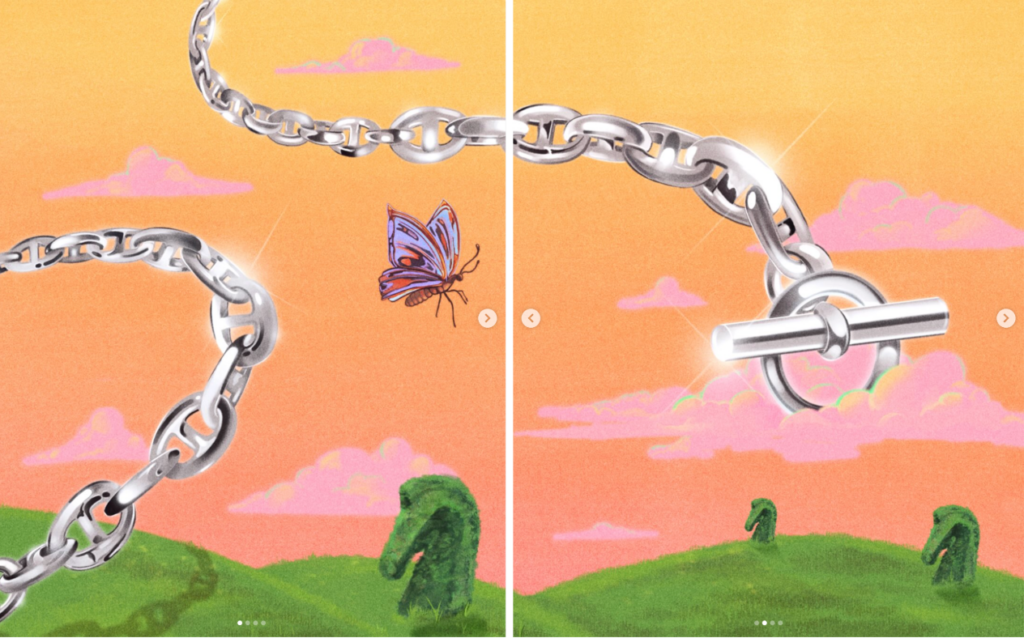
Source: https://www.instagram.com/p/DR4LXCCjII4/?img_index=1
User-generated content is another bold aspect of Hermès’ social media strategy.
According to the said Lund research titled The Birkin Effect: An Outside-In Perspective in the Brand Identity Matrix in Hermès’ Heritage Branding, digital storytelling mediates the perception of luxury within social media environments, and:
Digitalization blurs the boundary between production and consumption, enabling users to become co-creators of meaning through interaction with the brand.
In simpler terms, Hermès lets its customers create the social media content for them.
Check out Instagram, and you’ll find thousands of posts tagged #Birkin or #HermèsKelly. But most aren’t from Hermès official accounts. They’re from collectors, fashion enthusiasts, and everyday owners sharing their personal stories.
Hermès doesn’t need to pay influencers because the influence happens naturally.
The Resale Market as Unofficial Hermès Advertising
Brands would despise it if there were a resale market in which their products sold for more than retail price. But what about Hermes? It’s pure “marketing gold.”
The resale market has become one of the most powerful (and completely unpaid) forms of Hermès advertising imaginable. When a handbag you paid $12,000 for is now worth $30,000, what does that tell the world? It’s an investment.
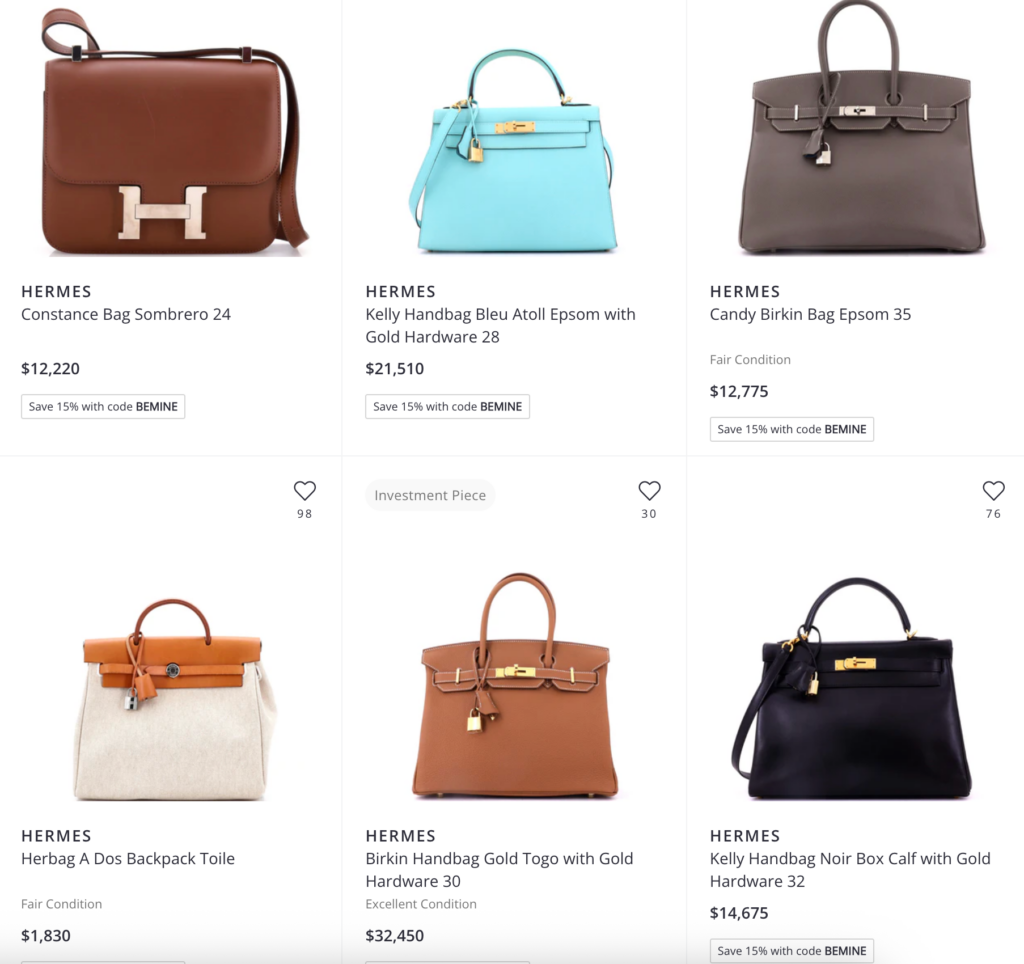
Source: shop.rebag.com/collections/hermes
This investment narrative has become central to the Hermès marketing story, even though the brand itself never positions its products this way.
The angle is so compelling that consumers who take their bag investments seriously, they never wear them out. Yet even those who could profit from selling often don’t.
The resale market also solves a huge marketing challenge: it provides social proof at the highest level. When Jane Birkin’s original Birkin prototype sold at auction in July 2025 for $10.1 million, it became the highest price ever fetched by a handbag.
That single auction generated international headlines and reinforced the bag’s legendary status. That’s free advertising money that literally cannot buy. Major news outlets covered the story, fashion magazines dissected its significance, and social media exploded with commentary. All unpaid marketing for Hermès.
Platforms like The RealReal, Vestiaire Collective, and specialized luxury resellers have essentially become Hermès’ unpaid marketing department, constantly reinforcing messages about value retention, investment potential, and cultural cachet. Every listing that shows a Birkin selling for more than retail is an advertisement for Hermès.
Hermès actually is not actively encouraging resale, but they’re not fighting it either.
The resale market also creates a fascinating feedback loop in Hermès advertising strategy:
High resale values → increased desirability → longer waiting lists → more exclusivity → even higher resale values.
It’s a virtuous cycle that requires zero ad spend from Hermès.
FAQ about Hermès Advertising
What makes Hermès advertising different from traditional luxury advertising?
The biggest difference is that Hermès advertising doesn’t really feel like advertising at all. It’s more like art appreciation. While most luxury brands are fighting for attention with celebrity endorsements, splashy billboards, and aggressive campaigns, Hermès takes the complete opposite approach by creating narratives that invite you into their world rather than pushing products at you. As I mentioned earlier in the article, Hermès doesn’t spend heavily on traditional advertising and has zero brand ambassadors promoting their products for money.
How does Hermès marketing strategy avoid mass visibility while maintaining global demand?
Hermès has mastered the art of being everywhere and nowhere at the same time through what I call “strategic silence,” maintaining global reach without mass-market visibility. The brand has over 300 retail locations across the world, spanning key economic regions and upscale consumer sectors, plus e-commerce platforms in 28 countries, but you won’t see them plastering their logo everywhere or running aggressive advertising campaigns. They rely on selective presence in prestigious locations and refined digital platforms that serve more as storytelling spaces. The genius move is that the brand never says how many of its distinctive bags it produces each year, creating mystery and desire through scarcity.
Why does Hermès rely more on brand scarcity than performance-driven marketing?
Hermès relies on scarcity over performance marketing. Because in the luxury world, scarcity creates meaning in a way that product specifications never could. Sure, the technical details are impressive; as I stated earlier, an expert artisan takes 40 hours to make a Birkin bag. But let’s be honest, you’re not paying $12,000 to $380,000 for a bag because of scratch resistance. The real power comes from the fact that the entire Hermès production is limited to no more than 15 bags per month, combined with a waiting list that can extend up to 6 years. This scarcity isn’t manufactured for marketing purposes, but Hermès brilliantly leveraged it by understanding that the exceptionally high price serves as a core differentiator.
How does Hermès advertising reinforce exclusivity without aggressive promotion?
Hermès reinforces exclusivity through cultural partnerships and customer empowerment, not loud advertising. Their campaigns, like “The Hermès Bag: A Mother-Daughter Tradition,” validate emotional narratives without explicitly selling, while partnerships with major art institutions to host brand-themed art exhibitions, like the “Amazing Land Walk,” position the brand as a cultural institution. Most cleverly, Hermès lets customers reinforce its exclusivity. Their selective retail presence in 331 stores across 45 countries speaks volumes without saying anything; you won’t find Hermès in every shopping mall, but you’ll find them in the world’s most prestigious locations where the address itself communicates exclusivity. By creating systems where customers feel chosen rather than marketed to, the brand’s actions and selective availability speak louder than any advertising campaign ever could.
What role does storytelling play in Hermès marketing compared to other luxury brands?
Storytelling is absolutely central to Hermès marketing. While most luxury brands are busy protecting their image, Hermès lets their customers’ own lives become part of the brand’s story. You can really feel this in their ads; they aren’t shouting for attention but rather inviting you to step into a dream. Even the Birkin bag started totally naturally, born from a random chat on a plane about needing a practical bag for the weekend. Jane Birkin herself was the ultimate example of this; she didn’t baby her bags; she beat them up, covered them in stickers, and used them every single day. It goes to show that the best stories aren’t the ones written by a marketing team, but the ones we actually live out.
How has Hermès marketing evolved in the digital age without diluting the brand?
Instead of panicking and trying to be everywhere at once, they treated the internet as a tool to support their business rather than something that should change who they are. They managed to open online shops in nearly 30 countries, yet they kept that “VIP” feel by making sure you still can’t just click “add to cart” on a Birkin. Their social media feels like a digital art gallery where they show off how things are made. The coolest part is that they don’t even have to pay influencers; people love the brand so much they show off their bags for free, which keeps Hermès relevant to younger crowds without them even trying.








![How to Write a Content Brief [Template + Examples]](https://www.hubspot.com/hubfs/content-brief-1-20250120-7521165.webp)