Inspiring Back-to-School Marketing Campaigns in 2026 [Ideas & Slogan Generator Included!]
At this time of the year, you can come up with inspiring back to school campaign ideas and boost your sales. Many companies are profitably engaged in the fall semester of schools and colleges with their innovative marketing ideas...
 Troov
Troov
![Inspiring Back-to-School Marketing Campaigns in 2026 [Ideas & Slogan Generator Included!]](https://digitalagencynetwork.com/wp-content/uploads/2022/08/inspiring-marketing-ideas-for-back-to-school-1.png)
At this time of the year, you can come up with inspiring back to school campaign ideas and boost your sales.
Many companies are profitably engaged in the fall semester of schools and colleges with their innovative marketing ideas for schools, higher education institutions and obviously, for students and their parents. Numerous kids and parents have already begun purchasing school supplies, clothing, and technological devices.
Click & Learn about Back-to-School Marketing Campaigns
What are Back to School Marketing Campaigns and Why Do They Matter? 6 Back to School Market Trends Shaping Consumer Behavior Key Demographics: Gen Z, Parents, and Gen Alpha Trends Shifts in Shopping Timing and Budgeting Habits Best Back to School Marketing Strategies for Maximum Reach 9 Essential Back-to-School Campaign Ideas Interactive and Gamified Campaigns User-Generated Content (UGC) and Social Media Contests Effective Back-to-School Marketing Campaigns from Renowned Brands Christian Dior – Back to School with Diorling by Baby Dior Doritos – The New Kid GAP – Gap to School Target – Back to School: Made Simple Staples – That Back to School Feeling Old Navy – ONward! Back to School Amazon – Spend Less on Your Kids Urban Outfitters – Shift Happens Back to School Marketing Ideas for Retail Stores vs. E-commerce Back to School Marketing Ideas for Retail Stores (In-Store Experiences & Visual Merchandising) Back-to-School E-commerce Marketing Strategies (Personalization, Cart Abandonment & UX) High-Converting Back to School Email Marketing Tactics Segmented Email Campaigns for Parents vs. Students Automated Lifecycle & Abandoned Cart Emails for BTS Catchy Back to School Marketing Slogans and Taglines Slogans for Parents & Caregivers Slogans for Students (K-12 & Higher Ed) Slogans for Tech, Apparel, and Supplies Frequently Asked Questions About Back to School MarketingWhat are Back to School Marketing Campaigns and Why Do They Matter?
Back-to-school marketing campaigns are seasonal campaigns designed to reach families, students, educators, and college shoppers as they prepare for the new academic year, as you already know.
And these seasonal marketing campaigns can promote individual products, curated collections, discounts, bundles, loyalty rewards, in-store events, social contests, or complete shopping solutions. The strongest campaigns connect those offers to a clear customer need, such as managing costs, completing a school list quickly, finding a first-day outfit, or preparing a college dorm.
The 2026 commercial opportunity is significant. According to the National Retail Federation’s data, families with Children, those in elementary through high school, plan to spend an average of $863.86 on back-to-school purchases. Total K-12 back-to-school spending is expected to reach a record $43.3 billion, up from $39.4 billion in 2025 and above the earlier record of $41.5 billion in 2023.
Planned K-12 spending by category includes:
$293.11 on electronics, representing $14.7 billion in total spending $250.29 on clothing and accessories, representing $12.5 billion $174.01 on shoes, representing $8.7 billion $146.45 on school supplies, representing $7.3 billionThe same sources says back-to-college spending is expected to reach a record $103.5 billion in 2026, crossing the $100 billion mark for the first time. College students and their families plan to spend an average of $1,437.79, up from $1,325.85 in 2025 and above the previous record of $1,366.95 in 2023.
Together, planned K-12 and college spending reaches $146.8 billion, showing why the season remains a major commercial period for retailers, e-commerce companies, consumer brands, and agencies. This combined figure is calculated from NRF’s projected totals of $43.3 billion and $103.5 billion.
So, it is clear that a successful back to school campaign must do more than announce a seasonal promotion. It should help shoppers compare products, control their budgets, save preparation time, and feel ready for the year ahead.
6 Back to School Market Trends Shaping Consumer Behavior
Back-to-school customers do not behave as one audience. Parents may focus on price and convenience, younger students may influence style choices, and college shoppers may prioritize electronics, furnishings, and independent living.
The following six trends can help us understand how those needs shape campaign strategy.
Key Demographics: Gen Z, Parents, and Gen Alpha Trends
Trend 1: Parents Manage the Budget, but Their Priorities Are Changing
Parents remain central to K-12 purchasing, especially when decisions involve price, durability, delivery, returns, and completing several school lists.
JLL found that 64% of parents expect inflation to affect their back-to-school shopping. Among parents concerned about inflation, one in three plans to use at least three cost-saving methods during the season.
Deloitte reports that 31% of parents use four or more cost-saving tactics. These highly active value seekers plan to spend approximately $610 per child, 14% more than other shoppers in Deloitte’s research.
The finding matters for marketers. Customers searching for value are not always trying to minimize every purchase. They may spend more when the product, bundle, reward, or service makes the decision feel justified.
Campaigns aimed at parents should make value visible through:
Grade-based lists, Product durability information, Transparent bundle savings, Flexible delivery and pickup, Simple returns, Loyalty rewards, Price-based product filters, Clear stock information.Apart from parents, what about students?
Trend 2: Students Have a Direct Role in Product Selection
PwC found that 61% of parents allow children from pre-K through high school to participate directly in online shopping by adding products to a digital cart. Children’s preferences influence 58% of back-to-school purchase decisions in PwC’s study.
Zeta Global also found that more than half of back-to-school purchases involve significant or complete child input, regardless of the household’s planned spending level.
This creates a dual-audience challenge. Campaign visuals, creator content, trends, and product styling can speak to students, while price information, durability, reviews, delivery terms, and bundle value support the parent’s decision.
For brands, one campaign may need two connected messages:
“This reflects your style” for the student. “This is a smart purchase” for the parent.Actually, as marketers, we do not know the total standalone Gen Alpha spending. Still, the findings cover children from pre-K through high school and show that younger shoppers are becoming active participants in digital purchasing.
So we can recommend that brand owners & marketers avoid presenting Gen Alpha as an independent buyer group without supporting evidence. A stronger approach is to describe its role in family product discovery, wish-list creation, trend selection, and shared-cart activity.
Privacy, age-appropriate experiences, and parental controls should remain part of any marketing strategies for schools aimed at younger audiences.
Shifts in Shopping Timing and Budgeting Habits
Trend 4: Value Is Broader Than the Lowest Price
A study found that only 16% of surveyed shoppers select a retailer based on price alone. Other priorities include the best quality for the price at 20%, confidence in selecting the correct products at 18%, convenience and time savings at 17%, and trusted brands at 16%.
Twenty-nine percent are willing to pay more for quality or durability, while approximately 24% shop according to a preset budget.
These results suggest that a discount does not communicate the full value proposition. Customers may also need proof of durability, usefulness, product fit, availability, and convenience.
Deloitte’s findings support this view. Most shoppers in its survey use at least one saving tactic, but customers using four or more tactics also report higher average spending.
Brands can support these shoppers through:
Essentials collections with clear price limits, Bundles showing the total saving, Product comparison tools, Durability claims supported by evidence, Customer ratings and reviews, Loyalty rewards, Free-delivery thresholds, Promotions linked to complete shopping lists.Trend 5: There Is No Single Back-to-School Shopping Calendar
That means, brands should not build their campaign calendar from one national survey alone. School start dates, customer age, location, product type, delivery time, and first-party sales data can all change the peak period.
According to the NRF data we mentioned above, among shoppers who had not completed at least half of their purchases, 46% were waiting for better deals, while 23% were spreading expenses over a longer period. Forty-seven percent planned to buy only the products required for the beginning of school and replenish supplies later.
On the other hand, JLL identifies July as the peak back-to-school shopping period in its 2026 parent survey.
So, a practical campaign calendar looks like that:
Back-to-School Campaign Schedule Q3 Overview
|
28 |
29 |
1 Early Planning & Inspiration |
2 |
3 Interactive Checklists |
4 |
5 |
|
6 |
7 Summer Sale Promos Launch |
8 |
9 |
10 Core Shopping: Supplies Push |
11 |
12 |
|
13 |
14 Delivery Cutoff & In-Store Pickup |
15 |
16 Post-Start: Forgotten Essentials |
17 |
18 |
19 |
For marketers, the customer journey is no longer a straight line. A student may discover a backpack through social content, a parent may compare its price through search or an AI assistant, and the purchase may be completed through a marketplace, retailer website, store, or pickup service.
Every touchpoint should communicate aligned pricing, availability, campaign messaging, delivery information, and product details.
Best Back to School Marketing Strategies for Maximum Reach
A strong seasonal campaign combines reach, relevance, convenience, and a clear reason to purchase. The following strategies translate those principles into campaign planning.
👉🏻 Omnichannel Marketing Strategies
Back-to-school campaigns should connect paid media, organic social content, email, websites, apps, physical stores, influencer activity, and customer-service communications.
Start with one clear campaign idea. That idea should remain recognizable across every channel, even when the format changes.
A parent might see a short-form video about an essentials bundle, receive an email with a grade-specific checklist, visit a product landing page, and collect the order from a nearby store. Each step should feel like part of the same experience.
Useful omnichannel tactics like:
Connecting social ads to dedicated seasonal landing pages Making online promotions available in stores Offering buy-online-pick-up-in-store options Using QR codes in physical displays Retargeting visitors with products they viewed Promoting creator content through email and product pages Keeping pricing and bundle details aligned across channels👉🏻 Strategic Timing and Seasonality
Back-to-school demand develops in stages. Launching every campaign asset at the same time can reduce your ability to address changing customer needs.
Early messaging can focus on inspiration, preparation, checklists, trend discovery, and loyalty-member previews. Mid-season communication can highlight core products, bundles, and category offers. Final-stage messages can focus on urgency, delivery deadlines, store pickup, and forgotten essentials.
Brands should also account for regional school calendars. Start dates can vary by country, state, city, school district, and university.
Search behavior, website activity, previous-year transactions, inventory levels, email engagement, and local calendar data can help determine when each campaign stage should begin.
As we mentioned before, the season does not end on the first day of school. Students may still need replacement products, course-specific materials, sports gear, dorm items, or technology accessories after classes begin.
👉🏻 Discounting, Bundling, and Loyalty Offer Strategies
Discounts can attract attention, but the structure of the offer matters.
A broad percentage reduction may generate traffic, yet bundles can create clearer value for customers with long shopping lists. A primary-school stationery kit, college technology bundle, sports-practice pack, or dorm-room starter collection can reduce decision time.
The source article recommends bundling school supplies, snacks, technology products, and sporting equipment to make preparation easier. It also notes that bundles can save customers time and reduce the pressure created by lengthy school lists.
Brands can test offers such as:
Spend-and-save thresholds, Multi-buy pricing, Free delivery above a minimum value, Category bundles, Sibling discounts, Student verification offers, Teacher discounts, Loyalty-member early access, Bonus points on selected products, Gift cards with qualifying purchases.The offer should support the brand’s commercial objective. A bundle may help increase average order value, while free delivery could improve conversion among price-conscious customers.
9 Essential Back-to-School Campaign Ideas
Let’s start with 9 essential back-to-school marketing ideas:
As online back to school shopping is one of the most preferred places to shop in the US, eCommerce stores must enhance their offerings with the aid of eCommerce marketing agencies.
Customers can purchase your goods with a single click; however, you must develop innovative back to school campaign ideas to convince clients to choose you! Top ideas:
Meet customers’ needs, Consider offering back-to-school promotions, Provide back-to-school packages, Think about influencer marketing, Organize social media contests (how to? Check out our blog on social media for schools), Sort your customers into distinct groups, Check your mobile purchasing experience, Engage your audience with email marketing, Get noticed with giveaways.Meet Consumers’ Needs
Every student enters the new school year with a unique perspective. Although the majority of students have returned to full-time, in-person education, some still face a hybrid remote/in-person education system.
Keep this in mind when designing and selling your items. Demonstrate how your items may benefit students and fulfil their needs. Personalize a variety of things, including backpacks (for school) and mouse pads (for at-home learning).
Consider Offering Back-to-School Promotions
Every company must provide a convincing reason for clients to choose them over their competition. This is referred to as a Unique Selling Proposition (USP). Your unique selling proposition can be found by completing the statement, “Customers will purchase from me because my company is the only…”
Crafting unique USPs as part of your back to school ad campaigns for K-12 or higher education can attract more customers, especially when combined with digital marketing ideas for schools that showcase your brand’s strengths.
Your USP might alter as your firm or industry evolves, and you can create unique USPs for various consumer types.
For instance:
A stationery store might offer a free same-day delivery service to local businesses such as schools and colleges – a compelling USP for firms that require quick delivery. The same stationery store may give a discount as a back-to-school promotion to clients who spend over a specific amount; this would be a USP for price-conscious consumers.Provide Back-to-School Packages
Back-to-school shopping might be daunting due to its lengthy checklists. You can bundle deals for clients’ convenience. These packages may contain essential school supplies, snacks, high-tech devices, and sporting equipment.
Back-to-school packs appeal to the busiest consumers. This is because they save buyers money and reduce the amount of time required to find what they require before the start of the school season. Also, product bundles alleviate the stress associated with completing a lengthy back-to-school shopping list. This is one of the simplest and most effective back-to-school promotion ideas.
Think about Influencer Marketing
As more consumers go to their favorite social media stars for product suggestions, influencer marketing plays a more significant part in back-to-school campaigns.
A recommendation on an influencer’s feed adds a personal touch to your back-to-school marketing effort. Influencer marketing can also enhance the legitimacy of your products and increase brand recognition among your target audiences.
This is due to the fact that social media influencers, such as family blogs, have frequently established a robust and genuine connection with their followers. They can assist you in reaching a younger, social media-savvy audience through back-to-school posts and back-to-school advertising.
Contests are one of the quickest ways to engage your audience and increase brand recognition. A win-win situation. It generates significantly more interest than a typical social media post.
Here are some Facebook contest suggestions to help you get started:
Friend-tagging contest A present giveaway Photo contest Caption writing contestSort Your Customers into Distinct Groups
Back-to-school buyers come in a variety of sizes and forms, including:
Parents Students in elementary and secondary school College students Teachers ProfessorsAlways customize your back to school marketing campaign initiatives to your target audience. You may even tag them in your CRM so that you can send them tailored offers. The channels, strategies, and promotions may vary based on the preferences and demands of your target audience.
Whether you are attempting to reach back-to-school buyers in elementary school, high school, or college, tailor your marketing to the prevalent fashions of your target audience. You can also connect with the parents by empathizing with their problems or feelings.
If a product resonates with consumers, they are far more inclined to purchase from your company than the competitor.
Check Your Mobile Purchasing Experience
Note that back-to-school sales will not be limited to in-store and online purchases. This season also sees an increase in mobile commerce. You must ensure that your customers have an exceptional mobile buying experience.
Optimize your website, remain vigilant for flaws and attempt to offer a unified experience across channels. Another reason to take mobile-responsive design seriously is that Google will ignore your website if it is not mobile-friendly, which will at the very least have a negative effect on your SEO.
Engage Your Audience with Email Marketing
Email marketing strategy is one of the most cost-effective ways to reach your audience, despite the fact that there are several alternatives.
There are specific advertising types that work particularly effectively for e-commerce stores. Included are:
Re-engagement: These initiatives target subscribers who have not engaged with the brand within a given time frame. Upselling/Cross-selling: Occasionally, upselling and cross-selling are more effective than customer acquisition. With upsell marketing, you aim to persuade the user to acquire additional products in addition to their initial plans or premium versions. Cross-selling methods encourage consumers to purchase complementary products that are relevant to their purchase (e.g, accessories). Exclusively for loyal customers: Offer exclusive promotions to your email addresses list to boost sales. Display to your audience products they may be interested in based on their website activity or previous purchases.Get Noticed with Giveaways
Back-to-school giveaways and gift cards could be an excellent way to create excitement and interest. Consider holding a giveaway that you can promote on social media or in-store if you have the time and resources. Perhaps you could put together a pack of your favorite back-to-school products and distribute it to brand-engaged individuals.
And to promote your contest further, consider forming partnerships with social media influencers and brands. Find ways to connect with their audience to generate enthusiasm, exposure, traffic, and purchases.
The back-to-school season is an excellent opportunity to boost your sales. You can do a great job with the right strategies and campaigns.
Effective Back-to-School Marketing Campaigns from Renowned Brands
Let’s take a look at some real examples of successful back to school campaign ideas that have made an impact on both parents and students. An informative writing topics can help break down these examples into actionable insights, showing how these brands successfully connected with their target audiences.
Christian Dior – Back to School with Diorling by Baby Dior
This ultra-luxurious, cinematic campaign elevates childhood fashion by showcasing the Baby Dior “Diorling” autumn collection against a backdrop of classic European architecture and high-end atelier design.
Dior’s ad captures children moving through elegant hallways and tailored garden spaces, wearing impeccably structured coats, fine knitwear, and leather shoes.
The creative direction treats children’s fashion with the exact same prestige, quiet lighting, and artistic gravity typically reserved for Dior’s haute couture adult runways, framing the return to school as an entry into sophistication and heritage.
Why It Worked
The marketing campaign ignored traditional utility-driven children’s advertising entirely to appeal directly to ultra-high-net-worth parents. By identifying back-to-school apparel as an investment in elegance rather than playground-wear, the campaign tapped into the aspirational desire of luxury consumers to project status through their children. It established a distinct high-fashion benchmark in a category usually dominated by durability and low price points.
Doritos – The New Kid
It centers on the universal anxiety of being the “new kid” on the first day of school. The boy navigates an intimidating school hallway filled with distinct social cliques and overwhelming sensory noise. Everything changes when he pulls out a bag of Doritos; the bold, unmistakable crunch instantly shifts the room’s energy.
Why It Worked
It resonated by positioning a CPG product as a tool for social confidence during a high-stress transition. The FMCG marketing campaign leveraged the sensory experience of the product (its iconic crunch here) as a narrative catalyst. It successfully aligned the brand with teen culture, turning a simple snack into a symbolic badge of cool that makes fitting in feel effortless.
GAP – Gap to School
Featuring an energetic soundtrack and a diverse cast of real kids and teens, the GAP campaign centers on dynamic choreography, spontaneous dancing, and candid reactions. The cast wears signature GAP denim, bold primary-color tees, and easy-layer fleece, with the camera staying close to the action to capture the flexibility and comfort of the clothes in real-world motion.
Why It Worked
It achieved broad appeal by celebrating authentic diversity and uninhibited movement over stiff, posed catalog shots. By showing the clothes handling real, energetic play while maintaining a clean, timeless aesthetic, the campaign reassured parents of the apparel’s quality while giving kids a canvas for self-expression. It perfectly reinforced GAP’s core brand identity as an “everyday American classic.”
Target – Back to School: Made Simple
Target’s back to school campaign focused on simplifying the back to school shopping experience both for parents and students. The retail giant used a combination of TV ads, social media, and in-store promotions to highlight how parents could easily find everything they needed at Target. As convenience and affordability are the main concern for those who shop during the back to school season, the campaign solely focused on these aspects. And for the first time, Target offers 20 must-have school supplies that cost less than $20 to cover all classroom essentials for students.
Why It Worked
It spoke directly to the stress and fatigue parents feel when navigating back-to-school checklists. By showing up as the ultimate friction-free solution, the campaign transformed a chaotic chore into a satisfying, organized victory. The clear focus on omnichannel convenience and affordability provided a compelling performance-driven reason for busy households to choose Target over single-category competitors.
Staples – That Back to School Feeling
Staples used humor and nostalgia to create its latest back to school campaign that resonated with both parents and students. They used influencer marketing by collaborating with David Pierre, a Canadian content creator, for their funny and nostalgic ad. The ad depicted the mixed emotions that come with the back to school season, balancing the excitement of new supply with the dread of homework. On TikTok, the ad was a huge success with almost 500K views.
@staplescanada I don’t mean to throw a wrench into your summer here, but I want to remind everyone that we are weeks away from back-to-school. [ad] . . respost @David Pierre So, parents, whether you’re ready or not, you can rejoice because Staples Canada makes back-to-school shopping easy, affordable, and fun. I got all the essentials for Eva and Ben in one visit! This means I can return to enjoying the few weeks of glorious summer we get here in Canada! Visit Staples today, and don’t make back-to-school shopping harder than it has to be! #StaplesCanada #BackToSchool ♬ original sound – Staples CanadaWhy It Worked
By using sharp humor and relatable & common family dynamics, Staples broke through the overly sentimental noise of traditional back-to-school advertising. The narrative successfully drove foot traffic by turning a routine shopping trip for school supplies into an uplifting, celebrated ritual for the primary financial decision-maker: the parent.
Old Navy – ONward! Back to School
How cute are the little influencers?
Old Navy partnered with younger influencers for their first day at school outfits and to showcase the brand’s affordable and stylish clothing. The target audience of these collaborations are middle graders and teenagers, as well as their parents. The influencer-driven campaign received a lot of engagement and led to a significant increase.
Why It Worked
It created a powerful connection by pairing affordable, stylish family fashion with tangible community impact. Modern consumers increasingly favor brands that demonstrate social responsibility. By giving shoppers a way to feel good about their purchases (knowing their spent dollars actively supported equal educational access for children in need) Old Navy boosted brand equity while driving seasonal sales.
Amazon – Spend Less on Your Kids
Starring actress Michelle Buteau, this humorous ad promotes affordable prices on everything students might need from sports equipment to clothes. With the motto “love my kids but hate being broke” ad encourages you to do your back to school shopping on Amazon.
Why It Worked
It achieved viral success by breaking one of retail’s biggest taboos: telling parents it’s completely okay to spend less on their children. By using humor to relieve parental guilt around budgeting, Amazon showed up as a pragmatic, supportive ally. The campaign’s upfront honesty built immense brand affinity while directly highlighting the platform’s core competitive advantages: unbeatable prices, endless selection, and instant home delivery.
Urban Outfitters – Shift Happens
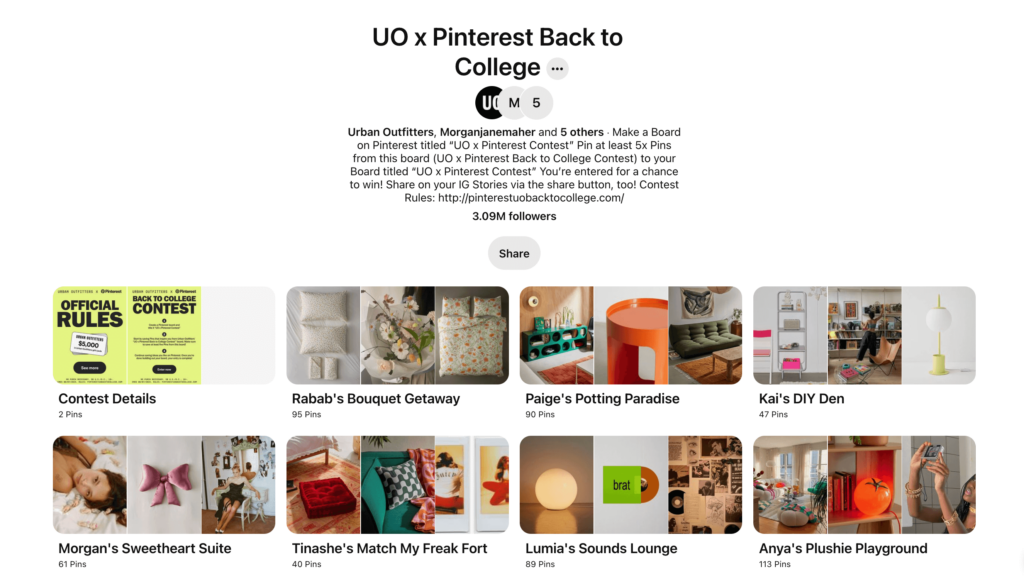
Urban Outfitters’ back-to-school campaign, “Shift Happens,” cleverly blends physical and digital experiences to connect with Gen Z. Partnering with Pinterest, the campaign features influencers creating brand-forward Pinterest boards, which are brought to life at a two-day activation event in New York. The campaign also includes pop-ups at college campuses and limited-edition drops from popular brands like Birkenstock and UGG. Through this multi-channel approach, Urban Outfitters aims to make the transition to adulthood an empowering experience for young consumers while boosting brand engagement.
Why It Worked
It resonated deeply with older students by abandoning polished corporate aesthetics in favor of raw, youth-led authenticity. Instead of treating back-to-school as a sterile shopping routine, the campaign framed it as a pivotal lifestyle shift and an identity reset. By speaking to young adults navigating independence, Urban Outfitters cemented its place as a cultural destination for fashion, decor, and personal identity.
Back to School Marketing Ideas for Retail Stores vs. E-commerce
Retail and e-commerce campaigns share the same basic goal: helping customers prepare for school. The execution changes because each environment presents different opportunities and sources of friction.
Back to School Marketing Ideas for Retail Stores (In-Store Experiences & Visual Merchandising)
As you already know, physical stores allow customers to see, touch, test, compare, and purchase products immediately.
Retailers can organize products around customer missions instead of standard departments:
A “First Day Ready” area might include backpacks, lunch products, stationery, clothing, and accessories. A “College Move-In” zone could combine bedding, storage, technology, kitchen items, and personal care.Effective in-store ideas can be:
Grade-based supply sections, Ready-made shopping lists at the entrance, Clearly priced essentials walls, Complete backpack or dorm-room displays, Product testing stations for electronics, Styling areas for first-day outfits, In-store scavenger hunts, QR codes linked to reviews or product details, Personalization stations for bags and stationery, Same-day delivery for unavailable products, Teacher and student discount days, Collection points for preordered school kits.Visual merchandising should communicate convenience quickly. Parents should be able to understand where to go, what is included, and how much a collection costs within a few seconds.
Retailers can also use local school lists to improve relevance. A store near several schools could organize products by district, grade, or classroom requirement. If you want to learn more tactics and see well-built practices, you can visit our blog of top retail marketing campaigns.
Back-to-School E-commerce Marketing Strategies (Personalization, Cart Abandonment & UX)
E-commerce customers expect speed, clear navigation, accurate product information, and a smooth mobile experience, no doubt.
The supplied source stresses the importance of mobile purchasing and a unified experience across channels. It recommends optimizing the website, monitoring technical issues, and making the shopping journey mobile-friendly.
Good e-commerce marketing features include:
Grade, age, course, and category filters, School-list upload tools, Prebuilt essentials bundles, “Complete the set” recommendations, Product comparison tools, Clear delivery estimates, Real-time stock information, Guest checkout, Multiple payment methods, Saved shopping lists, Store-pickup options, Simple return information, Mobile-first product pages, Recently viewed products.We think Amazon has all these features:
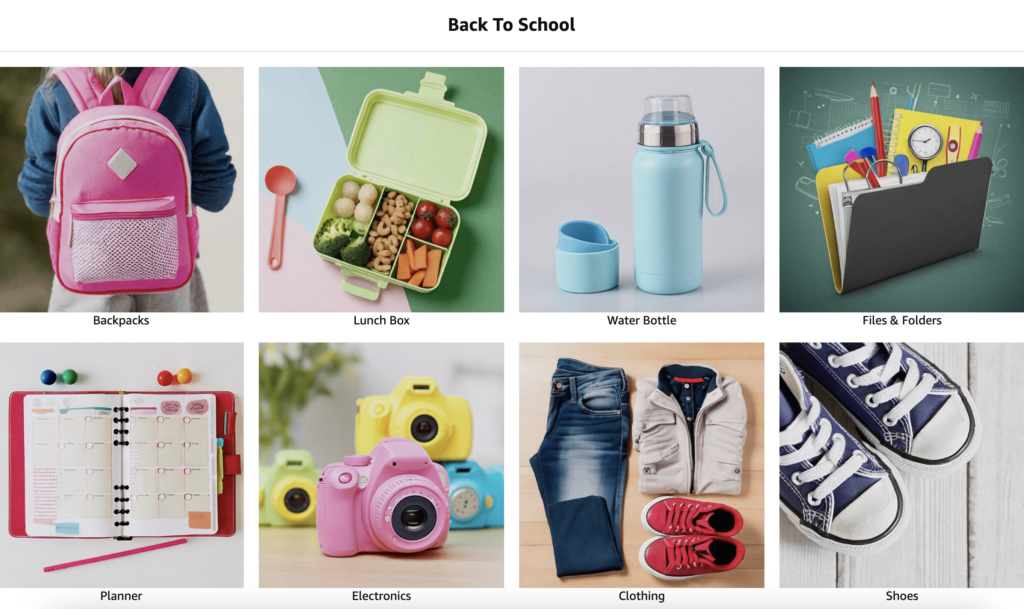
Personalization should be based on meaningful customer signals. Browsing behavior, previous purchases, selected grade level, saved lists, location, and loyalty status can help determine which products and messages are shown.
Cart-abandonment communication should also reflect the seasonal context. A useful reminder can mention stock availability, delivery deadlines, saved bundles, or pickup options. Excessive urgency can damage trust, especially when the stated deadline is not genuine.
High-Converting Back to School Email Marketing Tactics
Back-to-school season represents the second-largest retail surge of the year, making it a critical window for brands looking to boost revenue ahead of the holidays.
Converting this high-intent traffic, however, requires moving beyond generic mass blasts. High-converting campaigns are about hyper-segmentation (tailoring messaging separately for busy parents, budget-conscious college students, or late-shoppers) paired with psychological triggers like dynamic countdown timers and curated gift/supply guides.
So, time-sensitive urgency with personalized value 👉🏻 marketers can cut through overcrowded late-summer inboxes and drive meaningful action.
In that section, we’ll focus on high-converting back-to-school email tactics.
Segmented Email Campaigns for Parents vs. Students
Parents and students should not automatically receive the same campaign. Parent-focused emails can emphasize:
Complete supply lists, Price and durability, Multi-child shopping, Delivery and pickup options, Uniforms and practical clothing, Lunch preparation, Bundles and spending limits, Teacher-approved essentials.Student-focused emails can emphasize:
Personal style, Technology, Campus life, First-day outfits, Trending accessories, Dorm decoration, Study setups, Creator selections.Segmentation can also include:
K-12 parents, High-school students, College students, Teachers, Returning customers, Loyalty members, Customers who purchased last year, Customers browsing specific categories.A CRM can help brands assign customers to relevant groups and send offers based on their interests and past behavior. The supplied source directly recommends segmenting parents, elementary and secondary students, college students, teachers, and professors.
Automated Lifecycle & Abandoned Cart Emails for BTS
A back-to-school email sequence can follow the customer from early planning to the final purchase.
A practical sequence may include:
Introduce checklists, guides, and key dates to help customer plan early.
Highlight supplies, clothing, electronics, or dorm products based on customer browsing behavior.
Present a complete all-in-one solution at a clear, attractive bundle price.
Feature customer photos, creator content, top reviews, or trending popular products.
Show saved items left behind along with relevant shipping/delivery estimates.
Recommend essential accessories or products that complete the unsubmitted order.
Explain the last date/time for receiving products before the school term officially begins.
Suggest forgotten essentials, warranty info, or provide helpful care and setup guidance.
Re-engagement emails can be used for subscribers who have stopped opening or clicking. Loyalty customers can receive early access, exclusive bundles, or additional points.
As we stated above, the value of email is not limited to promotion. It can reduce uncertainty and help customers complete a complicated seasonal task.
Catchy Back to School Marketing Slogans and Taglines
The following slogans are original editorial suggestions. They are not taken from the campaign examples or data source.
Slogans for Parents & Caregivers
Big School Lists. One Simple Shop. Ready for Class, Easy on Your Budget. Everything They Need for Day One. Less Shopping Stress. More First-Day Smiles. Smart Supplies for a Fresh Start. Pack the Bag. Check the List. Start the Year. School Essentials Without the Search. A Better Start Begins Here. Make Every School Day Count. One Trip. One List. All Set.Slogans for Students (K-12 & Higher Ed)
New Year. New Gear. Your Style. Start Strong. Stand Out. Bring Your Best to Day One. Ready to Learn. Ready to Lead. Make This School Year Yours. Fresh Supplies. Fresh Ideas. Your Campus Era Starts Here. Study Ready. Style Ready. Pack Your Goals. New Classes, New Possibilities.Slogans for Tech, Apparel, and Supplies
Technology
Power Up for the School Year. Smarter Tech for Every Class. Charge Into a Better Semester. Built for Notes, Projects, and Big Ideas. Your Study Setup Starts Here.Apparel
First-Day Style Starts Here. Looks Made for the New School Year. From Classroom to Campus. Start the Year in Your Style. New Term. Fresh Fit.School supplies
Stock Up for Every Subject. Small Supplies. Big Ideas. Fill the Backpack. Fuel the Year. Tools for Every Bright Idea. Check Every Box on the School List.⚡️Back-to-School Slogan Generator⚡️
Audience
Tone
Category
Keyword (Optional)
Top Slogan Pick
Click generate to create taglines!
Frequently Asked Questions About Back-to-School Marketing
What are the best back-to-school marketing campaigns?
The standout back-to-school campaigns succeed by connecting with genuine human moments, whether through high fashion, everyday anxiety, or pure energy. Value-driven giants like Target, Staples, and Amazon win by offering affordability, nostalgic excitement, and budget-friendly ease. For apparel, GAP’s “Gap to School” brings high-energy choreography and real kids to highlight the everyday comfort and flexibility of signature denim. Doritos takes a funny, relatable approach in “The New Kid,” using the loud crunch of a chip bag to break the ice and conquer first-day social jitters in a crowded hallway. Taking the complete opposite angle, Christian Dior’s “Diorling by Baby Dior” elevates children’s autumn wear with European architecture and cinematic haute couture sophistication.
When should brands start their back-to-school marketing?
Timing is everything, and the sweet spot for launching your back-to-school marketing is right in the mid-to-late summer stretch from July through August. Shoppers are generally split into two camps: the hyper-organized early birds who like to spread their spending across several weeks, and the panic-shoppers grabbing supplies right before the first bell rings. By getting your engine running in July, you build momentum early enough to catch those proactive planners while staying top-of-mind right through the frantic late-August rush.
What are the top back-to-school marketing strategies for retail stores?
For physical retail stores, the main goal should be to eliminate decision fatigue and give customers a compelling reason to walk through the doors. The top strategy is offering curated, all-in-one product bundles, like pre-packed supply kits or dorm setup packages, that take the headache out of tedious shopping lists. Beyond smart bundling, brick-and-mortar stores thrive by hosting interactive in-store giveaways, highlighting local perks like same-day delivery, and strategically showcasing products that cater to both traditional classrooms and home study setups.
How can e-commerce brands optimize back-to-school marketing?
E-commerce brands need to focus on hyper-frictionless mobile experiences and smart audience targeting to turn casual scrollers into buyers. With nearly half of back-to-school shoppers making purchases straight from retail apps, optimizing for a fast, intuitive mobile checkout is non-negotiable. From there, segment your audience carefully—because a parent buying primary school art supplies needs entirely different messaging than a college student hunting for dorm tech—and boost your average order value by embedding smart cross-sell suggestions like laptop sleeves or pencil cases at checkout.
What are effective back-to-school email marketing tactics?
Email marketing works best when it feels like a lifesaver. Highly effective tactics center on offering subscriber-exclusive discounts that give loyal readers first dibs on sales, paired with personalized recommendations tailored to past purchases or specific grade levels. Most importantly, successful emails lead with genuine empathy (acknowledging the financial stress and time crunch parents are dealing with) and position your products as simple, budget-friendly solutions to their seasonal chaos.
What are catchy back-to-school marketing slogans?
The catchiest back-to-school slogans skip generic corporate speak in favor of short, punchy statements that evoke immediate action or emotional resonance. Standout examples from top brands include Target’s reassuring “Back to School: Made Simple,” Staples’ nostalgic “That Back to School Feeling,” and Old Navy’s vibrant “ONward!” For brands looking for a witty or brutally honest edge, lines like Amazon’s direct “Spend Less on Your Kids” or Urban Outfitters’ clever nod to growth “Shift Happens” land perfectly because they talk to customers like real people.