Mediums and Mountain Ascetics
Following her mother’s death, a writer turns to Japan’s spiritual traditions to find healing and connection. The post Mediums and Mountain Ascetics appeared first on Tricycle: The Buddhist Review.
 FrankLin
Over the course of the past decade, Hiroko Yoda has danced as a Shinto shrine maiden; ascended sacred mountains with yamabushi, or Shugendo practitioners; become certified as a kimono fitter; and visited Japan’s last living itako, or spirit medium.
Yoda is a writer, translator, and certified Shinto cultural historian, and she has dedicated much of her professional life to contextualizing Japanese folklore and spirituality for English readers. Her new book, Eight Million Ways to Happiness: Wisdom for Inspiration and Healing from the Heart of Japan, blends memoir, history, and cultural analysis in offering a lively and accessible introduction to Japan’s contemporary religious landscape, including the phenomenon of hanshin-hangi, or “belief without belief”; the connection between prayer and play; and the shifting roles of fortune tellers, angry ghosts, and more.
Tricycle sat down with Yoda to talk about the hybrid nature of Japanese spirituality, what she learned from her encounters with Japan’s mountain ascetics, and why she views spirit mediums as forms of grief care.
You open the book with a moving account of your experience of grief following your mother’s death, and I was wondering if you could talk about that experience and how that prompted you to reengage with Japan’s rich spiritual traditions. My mother’s passing was so difficult. It was just a massive blow, and I didn’t know what to do. I felt like my whole identity fell apart—I hadn’t realized how much I identified my self with my mother. It was almost like a reflection of the mirror. And then I lost her, and so I felt a sense of void and nothingness. I didn’t know what to do. Other family members and friends tried to comfort me, but nothing helped.
So I started walking. The first few times, I would go out and come back immediately and just cry. Then I would try to do something that I couldn’t do the day before: raise my head, look ahead rather than down at my feet, look at the sky. Then I started paying attention to my surroundings: the sky, and the birds flying above. I realized that I had felt like I was totally alone, but I wasn’t actually alone. Nature really taught me a lot: how kindness was always there, and how things change.
When my mother died, I felt like my identity was absolutely shattered. Through engaging with Japanese spiritual traditions, I began reconstructing my identity, and I began to heal. But the lessons that I received were not just for me alone—I wanted to share them with others.
The book takes its title from the term for eight million kami. Can you talk about that term? There’s a Japanese concept called yaoyorozu‑no‑kami. Kami means spiritual being, so yaoyorozu‑no‑kami means eight million spiritual beings. But eight million here is not an exact number—it simply means infinitely many. In times of old, the Japanese people thought that everything surrounding them had a spirit: the sun, the moon, trees, wind, soil, rocks, even the words they spoke. That idea is still active today, though it doesn’t necessarily mean that Japanese people believe that every single thing has a spirit that we worship. But we feel the sense of it, and it’s our worldview: the yaoyorozu‑no‑kami, or the eight million spiritual beings.
The term kami comes from the Shinto tradition, but it’s actually much bigger than that, and I would say it’s the foundation of Japanese culture. Kami is generally translated as “god,” but the problem there is that it becomes skewed toward a Judeo-Christian worldview where there’s a hierarchy with a single god on top. But there are kami everywhere. There is a kami of plagues and a kami of toothaches. We don’t worship those kami, but it’s a quiet reminder that no matter how much we wish those bad things to disappear, they’re still part of our life, and we have to deal with them somehow.
You talk a lot about the fluid relationship between kami and buddhas or bodhisattvas, where there can be a sort of blending or remix that takes place. Could you say more about that flexibility between traditions? There are three major belief systems in Japan: Shinto, Buddhism, and Shugendo. In Japanese culture the boundaries between these belief systems are very blurred. Temples and shrines are everywhere—in fact, the number of shrines and temples is three times more than the number of convenience stores. They’re everywhere, and most of them are open to the public. Anybody can go in as long as they behave in a respectful manner. And you can find Shinto shrines inside of the Buddhist temples. It’s all very blended together, and it’s often hiding in plain sight. If you know where to look, you realize that these traditions are everywhere in Japan. They’re the fabric of our lives.
If you know where to look, you realize that these traditions are everywhere in Japan. They’re the fabric of our lives.
One example of this is the image of the Seven Gods of Happiness, or the Seven Lucky Gods. I think the Seven Gods of Happiness are the perfect example of Japanese spirituality in a nutshell. There are seven deities, and each deity is from a different background: Buddhist, Hindu, Daoist, indigenous Japanese traditions, and more. Each deity is venerated in different temples and shrines, but when New Year’s comes around, you see them riding together in a treasure ship, and they’re said to give you good luck and fortune. And it’s just sheer celebration.
I think that in America, religion is often tied to identity, where changing from one faith to another is a big deal, but in Japan we don’t always see it that way. We don’t necessarily identify ourselves with religion in the same way. I think Japan is more rigid in society but more flexible in spirituality, whereas in America I think it’s more rigid in religion but more flexible in society.
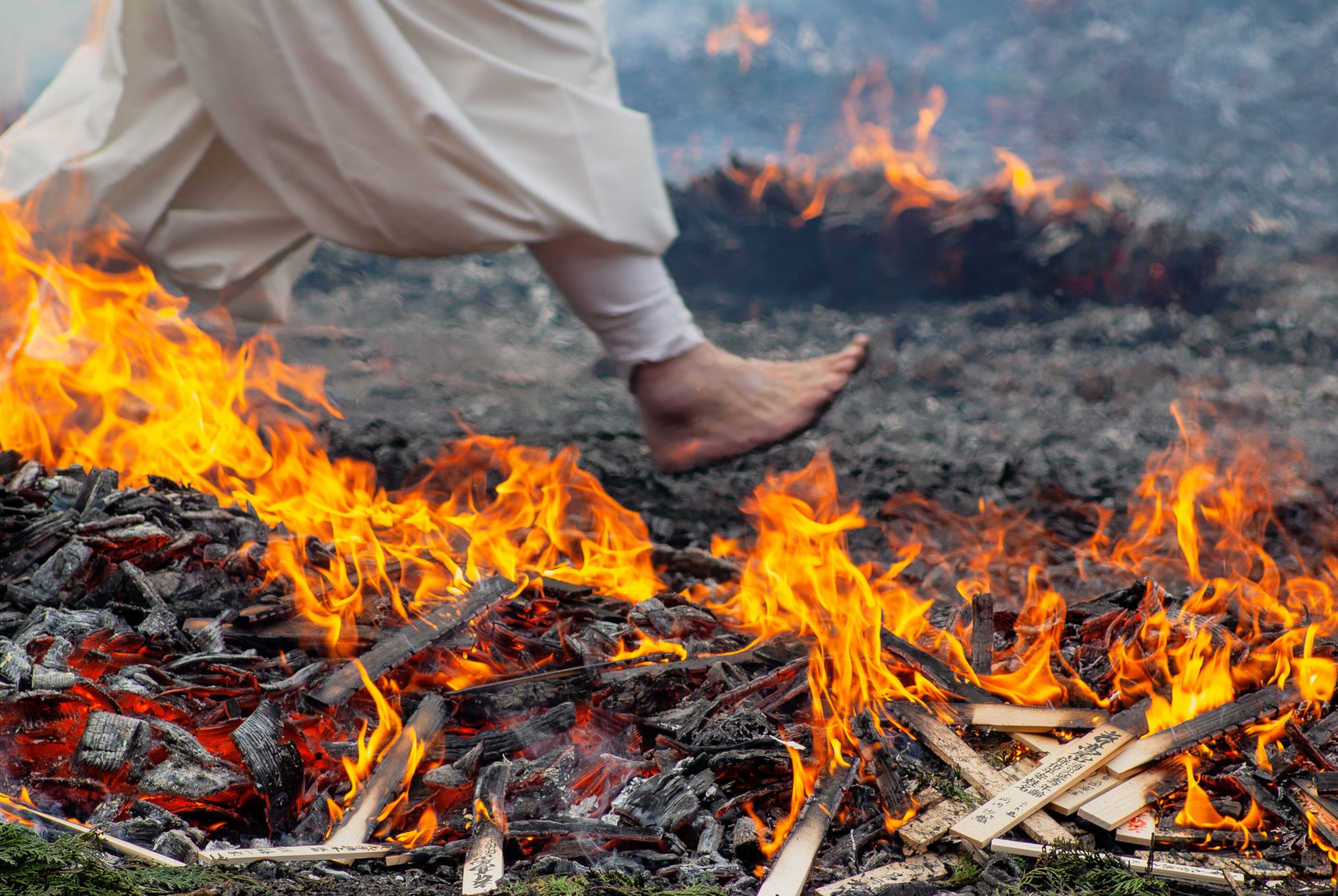
You mentioned Japan’s third major spiritual tradition, Shugendo, which many people may be less familiar with. So what is Shugendo, and what did you learn from your experience walking through mountains with Shugendo practitioners? Shugendo is a hybrid of many different beliefs including Shinto and Buddhism, and it centers on the mountains as a spiritual realm. It can be hard to talk about, kind of like the parable of the blind men trying to describe an elephant: It’s different in different regions; it’s different in different time periods; it’s different from person to person. Do means “the way,” like in Shinto. So Shugendo is a religion, but it’s bigger than that. It’s a way of life. Today there’s no such thing as a full-time yamabushi, or Shugendo practitioner. They have their regular jobs, and then they also go to the mountains to train.
Just like a lot of people in Japan, I had been to Shugendo temples but had no idea what they were. My experience of joining the walk with the yamabushi was almost accidental. I had picked up a book about Shugendo because I wanted to learn more about the tradition, and there was a page that mentioned where to go to train with the yamabushi. So I went.
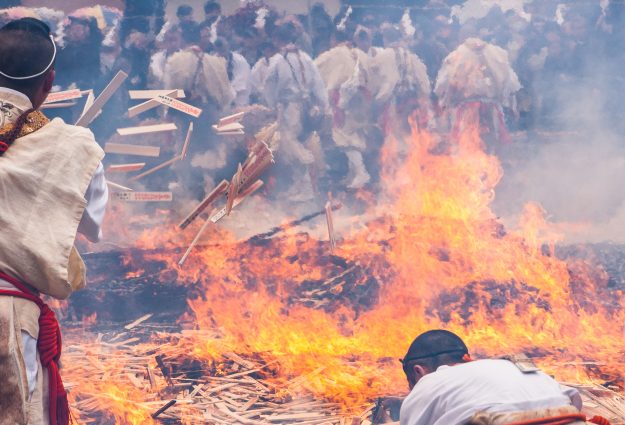 Shugendo fire-walking festival at Mount Takao. Photo by Hiroko Yoda.
My learning journey with Shugendo is still ongoing, but my takeaway from my time with the yamabushi is that nature can teach us and heal us, and Shugendo is one of the tools to do that. Seventy percent of Japan’s landscape is mountains, and so Shugendo has a long history of treating the mountains as a spiritual realm. That gives us the idea that the spiritual world might not be that far away—maybe it’s actually closer than we think.
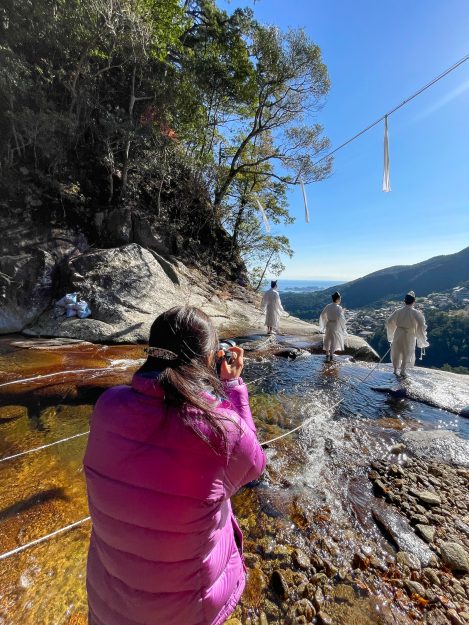 The author at the top of Nachi Falls at Hiro Jinja shrine in Wakayama. Photo courtesy Hiroko Yoda.
It was fascinating reading about some of the extreme forms of training that yamabushi will go through, like waterfall practices and running through the mountains, but then they’ll return to their villages or towns and work as healers. Can you talk about that training and how it feeds into healing or caregiving work? There’s a quote from Ryojun Shionuma, a yamabushi who did the Thousand Days of Training, a trial where he traveled thirty-one miles through the mountains each day for a thousand days. He said that even though he accomplished that trial, the difficulties of the ups and downs of daily life were basically equal to the difficulties that he faced in the mountains.
What I took away from his story is how to work with hardships in daily life. The name yamabushi means “those who surrender to the mountains.” All the hardships of training teach you not only that nature can heal but also the importance of humility and surrender and recognizing that we’re part of something much larger. Surrender actually nourishes our sense of belonging.
All the hardships of training teach you not only that nature can heal but also the importance of humility and surrender and recognizing that we’re part of something much larger. Surrender actually nourishes our sense of belonging.
I grew up in Tokyo, and sometimes when you live in a city, it’s easy to see yourself as the center of the universe or to become self-centered in small ways. But that’s actually a very lonely way to live. So I’m a hiker, and I really like hiking in the mountains, and just being in the mountains is healing in that way. It reminds me that I’m not alone. Of course I belong to society as a social being, but it’s easy to forget that sense of belonging with nature if you live in an urban city. And so the yamabushi reminded me of that. When I put my shoes on and walk outside and feel the fresh breeze, like I did after my mother died, it offers a chance to reflect and take some time to get outside myself. It’s a way of having a moment of healing and belonging.
In the course of writing the book, you also visited the last living itako, or spirit medium. So what is an itako, and what did you learn from your encounter with one? An itako is a spiritual medium. In ancient times, it was more common for children to be born blind or to lose their sight from disease, and in the northern part of Japan, when children lost their sight, boys became masseuses or acupuncturists, and girls became itako.
Today, it is much rarer for children to lose their sight since we have good hospitals and medications, and there are also more schools and resources for people who are blind so that they can find jobs. But back in time, especially in the countryside, becoming an itako was the traditional way to make a living. It’s like being a neighborhood counselor. Talking to the dead was only a part of their job—they also had to mediate neighborhood fights.
As I was writing the book, I got to meet the last traditional itako. Her name is Také Nakamura, and when I met her, she was 90 years old. She learned all her skills from a previous itako, entirely through listening and memorization, and when she dies, that knowledge will die with her. I learned about Také through a historian, and he helped set up a meeting with her. When we met, I asked her to contact my mother.
What I learned was that what she does is essentially grief care. When you lose someone very close to you, it’s easy to have all kinds of regrets: I should have done this, I should have done that, Maybe I could have done things better. In my case, with my mother, I still had a lot of anger and regrets. And what I learned from Také is that even though I lost her, my mother is there with me in my heart. In a nutshell, it’s just another way for me to remember that she lives with me. Through Takeé, my mother told me to live my life to its fullest. And as she said it, I realized that my whole existence is like a baton passed from my mother. I took it, and now I would live to the fullest.
Meeting Také and asking her to contact my mother made me realize that her job can easily be dismissed as nonsense—people might immediately say, “I don’t believe that, it’s not true.” But it’s not like that at all. In some ways it doesn’t matter if it’s true or not. There are a lot of questions that can’t be answered just as black or white. The truth was that I missed my mother, and when I interacted with Také it was a form of grief care.
Another thing is that her skills were totally a hodgepodge, a blended mixture of Shinto, Buddhism, and Shugendo but also local beliefs about ghosts, spirits, and the souls of the dead. I mean, it’s just a complete hybrid. It was fascinating to be with her and to see her altar, which was a mixture of all these traditions too.
 The author with the last living itako, Také Nakamura. Photo courtesy Hiroko Yoda.
That sounds like such a powerful experience. Yes, I learned a lot from her. And it was amazing because it’s so rare for me to interact with someone who is blind, so it was easy to forget that she couldn’t see me. She really surprised me in a lot of ways. I remember I asked her what the dead world looks like, and she immediately laughed it off. [laughs] And after it was over, we just sat there and chatted over green tea. It was like hanging out with a grandma. Spending time with her helped me realize that it’s not a question of belief; it’s a question of healing.
You spent more than a decade working on this book, traveling across Japan and visiting so many sacred sites and undertaking so many forms of training. Now that it’s out in the world, what are you hoping readers will take away from it? I hope the book is useful in providing a better understanding of Japanese spirituality, but I also hope it’s bigger than that. Japanese spirituality is radically inclusive, and it’s very flexible. So if readers can find a spiritual tool and then borrow it or apply it to their own life to help them find happiness and healing in some way, small or large, I’ll be very happy.
There are so many aspects to the eight million kami, and “eight million” means there’s always room for more. I found the spiritual path to heal myself, and because there are so many paths, there has to be a way for everyone. Who knows, if you don’t find one now, maybe you will some day.
I love the concept of eight million, and that’s why I wrote the book: to share that. Even though the book is published, I don’t feel like it’s the end. I feel like I’m on the starting point—there’s always room for more.
This interview has been edited for length and clarity.