Microsoft wants you to ditch SMS passwords as AI makes phishing harder to stop
Microsoft is warning IT admins to ditch SMS and voice authentication because AI phishing is making them easier to exploit. Here's the full timeline for the switch to passkeys.
 Koichiko

AI made phishing too easy, so Microsoft is closing the door on SMS logins.
 Rachit Agarwal / Digital Trends
Microsoft just sent a warning to IT admins, and it’s a big one. The company wants everyone to stop using SMS and voice-based authentication, and it’s citing AI-powered phishing as the main reason.
Why is Microsoft killing SMS authentication?
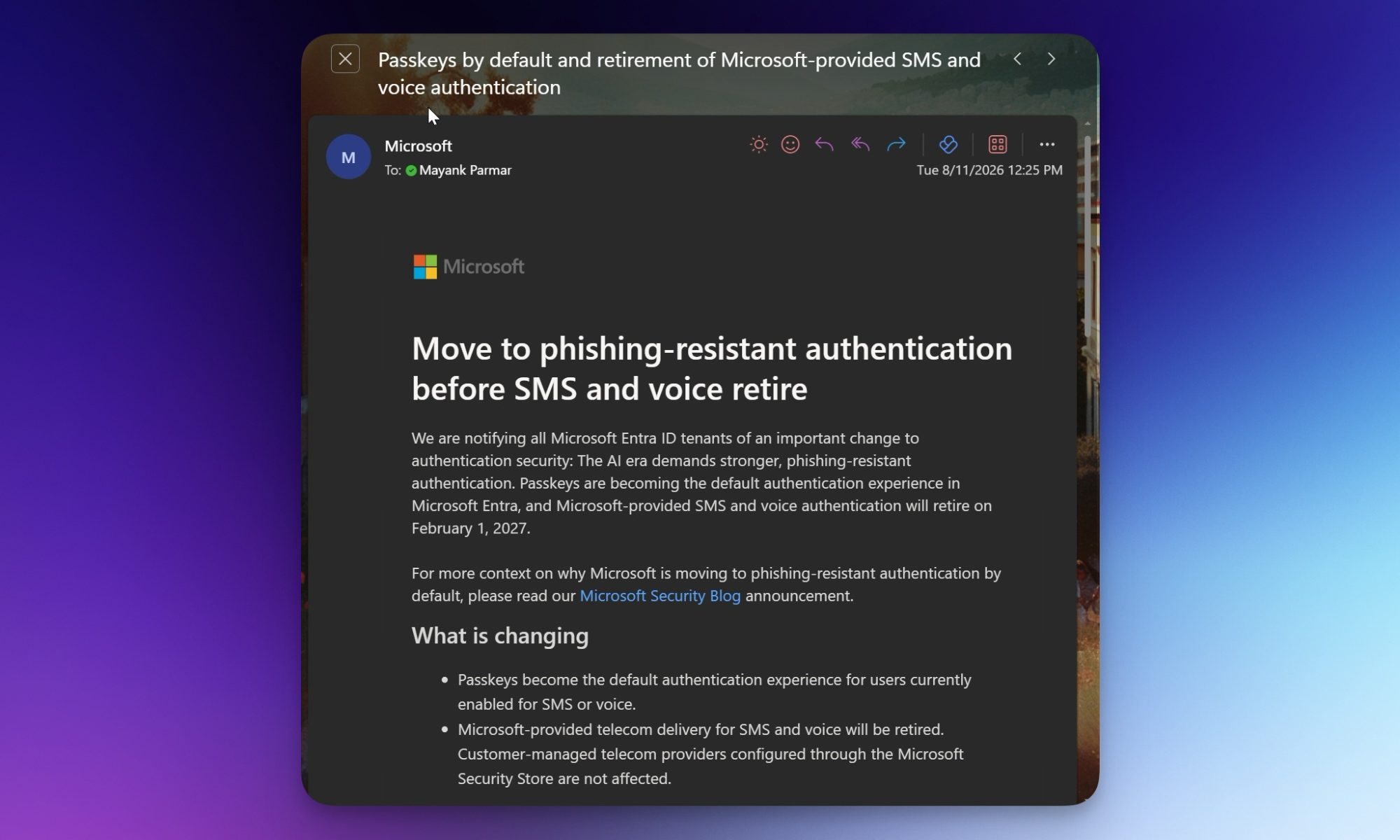
In an email spotted by Windows Latest, Microsoft explained that the AI era calls for stronger, phishing-resistant authentication. Basically, AI has made it far easier for attackers, even the less skilled ones, to manipulate SMS and voice channels. SIM swapping has also become easier with AI, allowing bad actors to move your number to a SIM card they control without much effort.
 Windows Latest
Microsoft says it’s seeing a sharp rise in AI-driven attacks to steal passwords and MFA codes, and these attacks have a noticeably higher success rate than older, pre-AI phishing attempts. So no, AI isn’t hacking your SIM card directly, but it is making it a lot easier to trick people into handing over their credentials willingly.
When is this happening?
Microsoft has laid out a two-step timeline. Starting September 1, Entra users using SMS or voice authentication will be asked to set up a passkey during sign-in. If you’re not ready for that switch, you’ll need to move away from SMS or voice authentication before the rollout begins.
 Rachit Agarwal / Digital Trends
Then, on February 1, 2027, Microsoft will fully retire SMS and voice authentication for Entra ID, and passkeys will become mandatory. There’s no opt-out either, so every single tenant will be affected, no exceptions.
What about personal accounts?
If you use a personal Microsoft account for Outlook, Xbox, or Windows 11, you’re not off the hook either. Microsoft has already started phasing out SMS for authentication and account recovery on personal accounts too, though there’s no confirmed deadline yet for regular users.
We should suggest not waiting around for Microsoft to flip the switch on you. Set up a passkey now, or switch to Microsoft Authenticator if that’s more your style. Passwords alone just aren’t cutting it anymore, especially with AI making phishing scarier by the day.

Rachit is a seasoned tech journalist with over ten years of experience covering the consumer technology landscape.
Twitch is using your streams to train Amazon’s AI, and you’re opted in by default
Turns out your favorite stream might secretly be teaching Amazon's AI a thing or two.

Twitch has quietly started feeding your streams, VODs, and clips into Amazon's AI training pipeline, and the opt-out button is tucked so deep in your settings that most people will never stumble on it.
As Kotaku reports, streaming reporter Zach Bussey spotted a new toggle inside Twitch's account settings on August 12 that lets you block your content from training Amazon's generative AI tools. The screenshot spread quickly, and so did the direct link to the exact settings page, mostly because Twitch never bothered to announce the change in the first place.
Qualcomm reveals Snapdragon C specs for budget laptops, and Intel could have a serious headache
More speed, better battery, and a price built for everyone.

Qualcomm wants to fix the biggest problem with budget laptops: performance and battery life. In May of this year, the company showed off its entry-tier new Snapdragon C Platform, made for budget laptops starting at $300, promising speed, battery life, and AI smarts that budget shoppers usually have to skip.
Now, the chip giant has just revealed the specs for its latest chip and if what it shows comes true, Intel is going to have a big headache on its hands. But competition is good for consumers, so they will be the real winners here.
This GitHub project wants to strip AI watermarks from your content, and things are getting interesting
This open-source tool is trying to remove the fingerprints AI leaves behind
AI companies are increasingly looking for ways to mark content generated by their models. Now, someone has built an open-source tool designed to remove some of those marks.
A GitHub project called watermarks-remover is designed to strip different types of AI provenance signals from text and files. According to its documentation, it can work with invisible Unicode characters, statistical text watermarks and metadata embedded in formats including PNG, JPEG, SVG, PDF, DOCX, ODT, HTML and Markdown.










/cdn.vox-cdn.com/uploads/chorus_asset/file/25829976/STK051_TIKTOKBAN_B_CVirginia_B.jpg)















.jpg&h=630&w=1200&q=100&v=1a56ad72fe&c=1)