mimosa on Agentic Workflows: Turning Mechanical Tasks into Scalable Systems
How Berlin-based agency mimosa is using agentic workflows to eliminate repetitive work, reduce operational errors, and build scalable internal systems while keeping strategy, design, and copy firmly human-led. “Admin is fun now.” Danilo Sierra, Managing Director at mimosa Agency...
 Kass
Kass
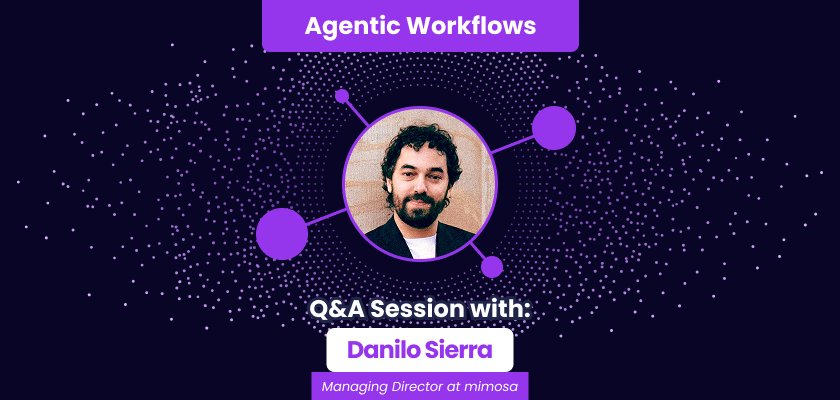
How Berlin-based agency mimosa is using agentic workflows to eliminate repetitive work, reduce operational errors, and build scalable internal systems while keeping strategy, design, and copy firmly human-led.
“Admin is fun now.”
Agency work is full of tasks that are necessary but rarely where people add the most value. Tagging, naming, archiving, research, quality checks, and moving information between tools can all consume time that could otherwise go toward strategy, creative thinking, and client relationships.
For Berlin-based agency mimosa, agentic workflows are becoming a way to rethink that balance.
The agency has integrated agentic workflows into multiple areas of its operations, with the greatest measurable impact currently coming from SEO and organic growth, data analysis and reporting, and internal operations.
Its approach is deliberately human-in-the-loop. Agents take on subtasks, mechanical processes, deterministic checks, and research, while people retain ownership of strategy, design, copy, and decisions that require judgment and context.
The goal is not to automate everything. It is to remove the friction around the work and give people more time for the work that matters.
Agency Snapshot
🧠 Agentic Maturity
Semi-autonomous, standardized workflows with human involvement at key stages.
⚙️ Primary Use Cases
SEO & organic growth, data analysis & reporting, and internal operations.
🌍 Industries
E-commerce & Retail, SaaS & Tech, and B2B Services.
🧩 Core Tech Stack
Anthropic Claude, custom-built internal systems, and open-weight models running locally on their own hardware via Ollama.
Where Agentic Workflows Deliver the Most Impact
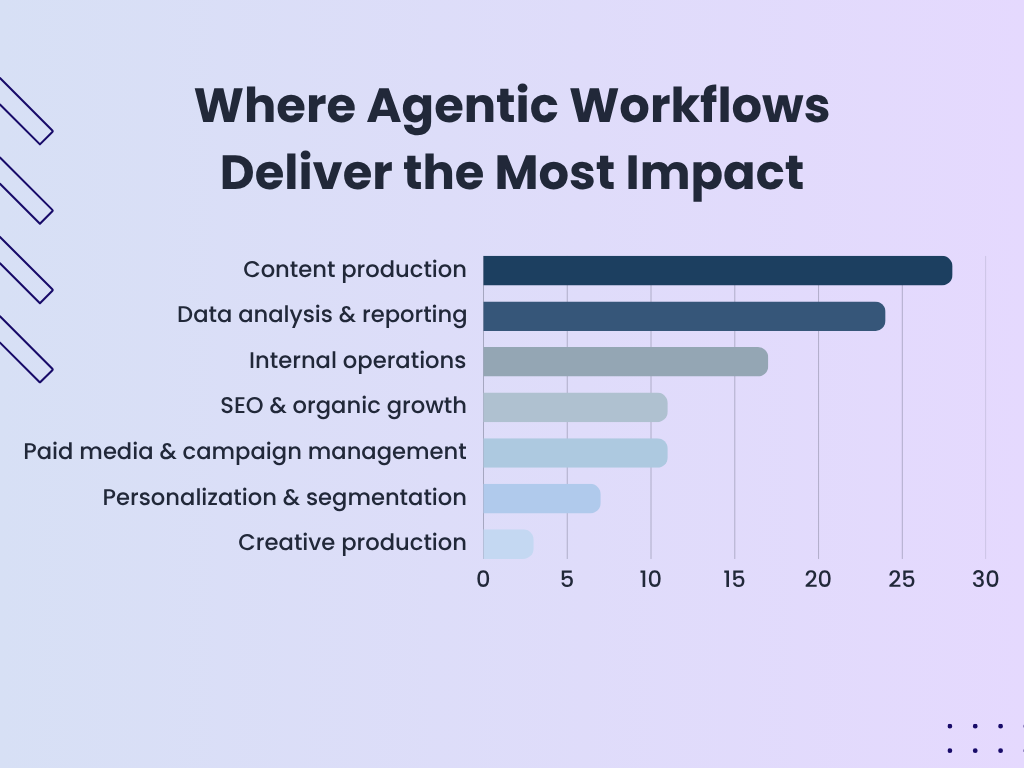
For mimosa, agentic workflows currently create the most measurable impact across three areas: SEO & organic growth, data analysis & reporting, and internal operations.
These are areas where repetitive processing, information gathering, checking, and organization can consume significant amounts of human time.
By shifting those mechanical elements into automated workflows, mimosa can reduce the amount of time people spend on repetitive operational work and create more space for higher-value tasks.
One of the clearest benefits the agency sees is the elimination of “dead time”, the moments spent waiting for information, moving work between tools, checking repetitive details, or completing small administrative tasks before the next meaningful step can begin.
Rather than simply asking AI to produce more, mimosa is using workflows to make the path from one stage of work to the next more efficient.
How Agentic Workflows Are Structured at mimosa
mimosa takes a deliberately structured approach to agentic workflows.
Rather than handing an entire process over to an autonomous system, the agency breaks work into subtasks and determines which parts are best handled by machines and which should remain with people.
Agents are particularly useful for mechanical activities such as tagging, naming, archiving, and research. They can also perform deterministic checks where a machine can answer a simple yes-or-no question before a person reads or reviews anything.
Another use case is scaling one idea across multiple languages and markets.
At the centre of these workflows is a coordinating agent working from written briefs. It can run sequences involving subagents, with those agents writing to a shared repository that provides context across the workflow.
Standing orders preserve important decisions, while a playbook captures lessons learned over time.
The boundaries are equally deliberate.
Strategy, design, and copy stay with the human team.
Inside the Workflow: From Input to Output
mimosa’s workflow architecture combines coordinating agents, specialized subtasks, shared context, and human checkpoints.
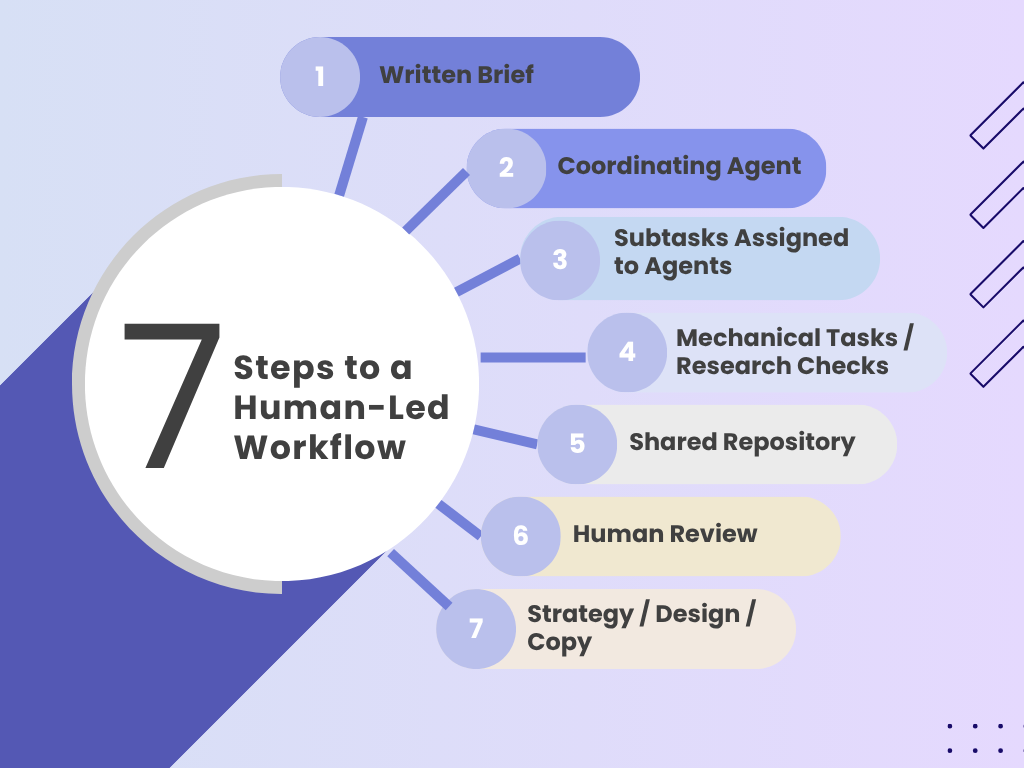
A process can begin with a written brief, which gives the coordinating agent the instructions and context needed to determine the sequence of work. Subagents then handle specific tasks, particularly those that are mechanical, research-based, or deterministic.
Their outputs can be written back to a shared repository, allowing information and context to move between stages rather than requiring people to manually transfer it from one tool to another.
The agency also uses standing orders to preserve decisions and a playbook to retain lessons from previous work.
This creates a system where workflows can become more reusable over time without removing people from the process.
The underlying principle is simple: machines handle the repeatable parts; people remain responsible for the parts that require judgment.
The Role of Human Oversight
For mimosa, human oversight is not an obstacle to automation. It is part of the architecture.
The agency’s current workflows are semi-autonomous and human-in-the-loop, with clearly defined tasks and checkpoints.
Machines are responsible for the work they are well suited to perform, while people retain responsibility for interpretation, judgment, creative direction, and final decisions.
This distinction becomes particularly important as workflows become more capable.
The objective is not maximum autonomy. It is to make sure automation supports the work without taking ownership of decisions that require human expertise.
As Danilo puts it:
“Strategy, design and copy stay with us.”
That principle also shapes how the agency thinks about its future role. Taste, strategy, quality assurance, and expertise remain areas where human contribution is central.
A Real-World Use Case
One of mimosa’s clearest examples of workflow automation is its quality-assurance checker for proposals.
Before anyone reads a proposal, the system checks a series of predefined requirements:
The content matches the headings. The rate card is identical across all three sections. Brand fonts are embedded. The colour palette comes from the brand file. The signature area is clear. Fill-in lines are empty.Previously, completing these checks required multiple tools and multiple manual steps.
Now, the process can be prompted and checked with virtually zero errors.
Interestingly, no model is involved in this particular workflow.
Instead, the system relies on deterministic checks that can provide clear yes-or-no answers before the proposal reaches a person.
This reflects an important part of mimosa’s broader approach to agentic workflows: not every automated process needs an LLM.
Sometimes, the most effective solution is simply a system that knows exactly what to check and can do so consistently.
Key Advantages of Agentic Workflows
For mimosa, one of the biggest advantages of agentic workflows is the elimination of dead time.
Traditional agency processes can contain numerous small points of friction: waiting for information, transferring data between tools, checking details, repeating administrative tasks, or preparing work for the next person in the process.
Individually, these tasks may seem minor. Across multiple projects and workflows, however, they can consume significant amounts of time.
Agentic workflows allow mimosa to connect these smaller steps and reduce the amount of time people spend moving work from one stage to another.
The benefit is therefore not simply that machines can perform more tasks.
It is that people can spend less time waiting, checking, transferring, and repeating.
Challenges and Limitations
Danilo identifies context window and memory loss as its most significant challenge when comparing agentic workflows with traditional processes.
Even when workflows are supported by shared repositories, written briefs, standing orders, and playbooks, maintaining the right context across increasingly complex processes can still be difficult.
The agency also identifies output quality inconsistency as a current risk.
A system can execute the same process repeatedly, but consistent execution does not necessarily guarantee consistent judgment.
There is also a risk of over-automation.
Not every task should be automated simply because it can be. The challenge is identifying where automation genuinely improves the workflow and where human involvement remains essential.
For mimosa, these limitations reinforce the importance of designing workflows around clear boundaries rather than pursuing autonomy for its own sake.
The Biggest Wins and the Biggest Trade-Offs of Agentic Workflows

mimosa’s experience highlights a clear trade-off between greater operational efficiency and the need to maintain context, quality, and human control.
On one side, agentic workflows can eliminate dead time, reduce repetitive work, and make processes more scalable.
On the other, increasingly complex workflows introduce new challenges around context retention, output consistency, and knowing where automation should stop.
The agency’s current model addresses this by combining automation with human oversight.
Agents can take on subtasks and repeatable processes, but people remain responsible for strategic and creative decisions.
For mimosa, the value of agentic workflows therefore comes from finding the right division of labour—not from making the workflow as autonomous as possible.
How Agentic AI Is Reshaping Agency Models
mimosa sees agentic workflows creating new possibilities for how agencies package and deliver their expertise.
Two areas it identifies are SaaS-like scalability and strategic infrastructure consultation.
Instead of building one-off processes that exist only within an agency’s day-to-day operations, agencies can increasingly create internal systems that reflect their own methodologies, standards, and ways of working.
mimosa also points to another emerging possibility:
“Branded software for internal use is now possible.”
This creates a bridge between agency expertise and software infrastructure. An agency can not only deliver a service, but also build the systems through which that service is delivered.
At the same time, mimosa believes the value of human expertise remains important as brands gain access to their own AI agents.
Danilo Sierra points to taste, strategy, quality assurance, and expertise as skills that are difficult to transfer completely into software.
AI can help surface previously invisible aspects of client relationships, but the relationships themselves are still built by people.
For mimosa, clients work with the agency not simply because it can produce an output, but because they value the experience of working with its people.
Conclusion
mimosa’s approach to agentic workflows is not centred on replacing people with autonomous systems.
Instead, the agency is building structured workflows where machines handle mechanical tasks, research, deterministic checks, and repetitive operational work, while people retain ownership of strategy, design, copy, judgment, and client relationships.
The result is a model that combines automation with accountability.
For mimosa, the opportunity is not simply to make agency work faster. It is to eliminate unnecessary friction, reduce dead time, turn internal knowledge into reusable systems, and give people more time for the parts of agency work that require human expertise.
As agentic workflows continue to evolve, mimosa’s experience points to a practical principle: the value is not in automating everything, but in knowing what should—and should not—be automated.








![45 Video Marketing Statistics for 2025 [New Data]](https://www.hubspot.com/hubfs/video-marketing-statistics-1-20250227-6425117.webp)

_1.png)
![How Meta Makes Its Money [Infographic]](https://imgproxy.divecdn.com/Kn_lAdtd3hjL-g3cebdKw3vQ_uTSMewIOId-plpm62o/g:ce/rs:fit:770:435/Z3M6Ly9kaXZlc2l0ZS1zdG9yYWdlL2RpdmVpbWFnZS9tZXRhX2Fkc18yLnBuZw==.webp)