Once a year, silent film fans from around the world descend on this tiny Scottish town
Henry Roberts discovers a programme of classic films at Hippfest, a movie celebration in the most unlikely of locations
 Kass
Kass

Silent cinema transcends borders. There are title cards, sure, but mainly the stories are conveyed through movement and expression, without the need for words. It’s no surprise then that there’s still a global fan base for films that reached their peak 100 years ago. As Alison Strauss, who runs HippFest, told me over coffee in Bo’ness library, “the silent film community is loyal and willing to travel.”
There are several silent film festivals each year around the world - Toronto in April, San Francisco in May, Pordenone in October. But for the last 16 years, silent film fans have flocked to a small town in Scotland every March, to enjoy five days of slapstick and spectacle. I’d wanted to go for years. Finally, I was at HippFest.
So called because it is housed in the Hippodrome, the oldest purpose-built cinema in Scotland, HippFest screens familiar favourites, new restorations and unseen gems. Cinephiles often note that silent films were never really silent. That’s certainly true for HippFest: each film was accompanied by a live score. Some films had traditional piano arrangements, as they would have had back in the 1920s, whereas others, like Fante-Anne (1920), which was paired with traditional Norwegian folk music mixed with modern electronica, had a 21st-century soundscape.
The first film on the programme, The Outlaw and His Wife (1918), started at midday on a Wednesday. You have to set off early, but it is possible to wake up in London and arrive in Bo’ness in time for the first film. I took a direct train from London’s King’s Cross to Edinburgh, a short train journey from there to Linlithgow and then a shuttle bus to Bo’ness before finally arriving at the Bo’ness picture palace.
.jpg)
Read more: First look at V&A Dundee’s Catwalk: The Art of the Fashion Show exhibition
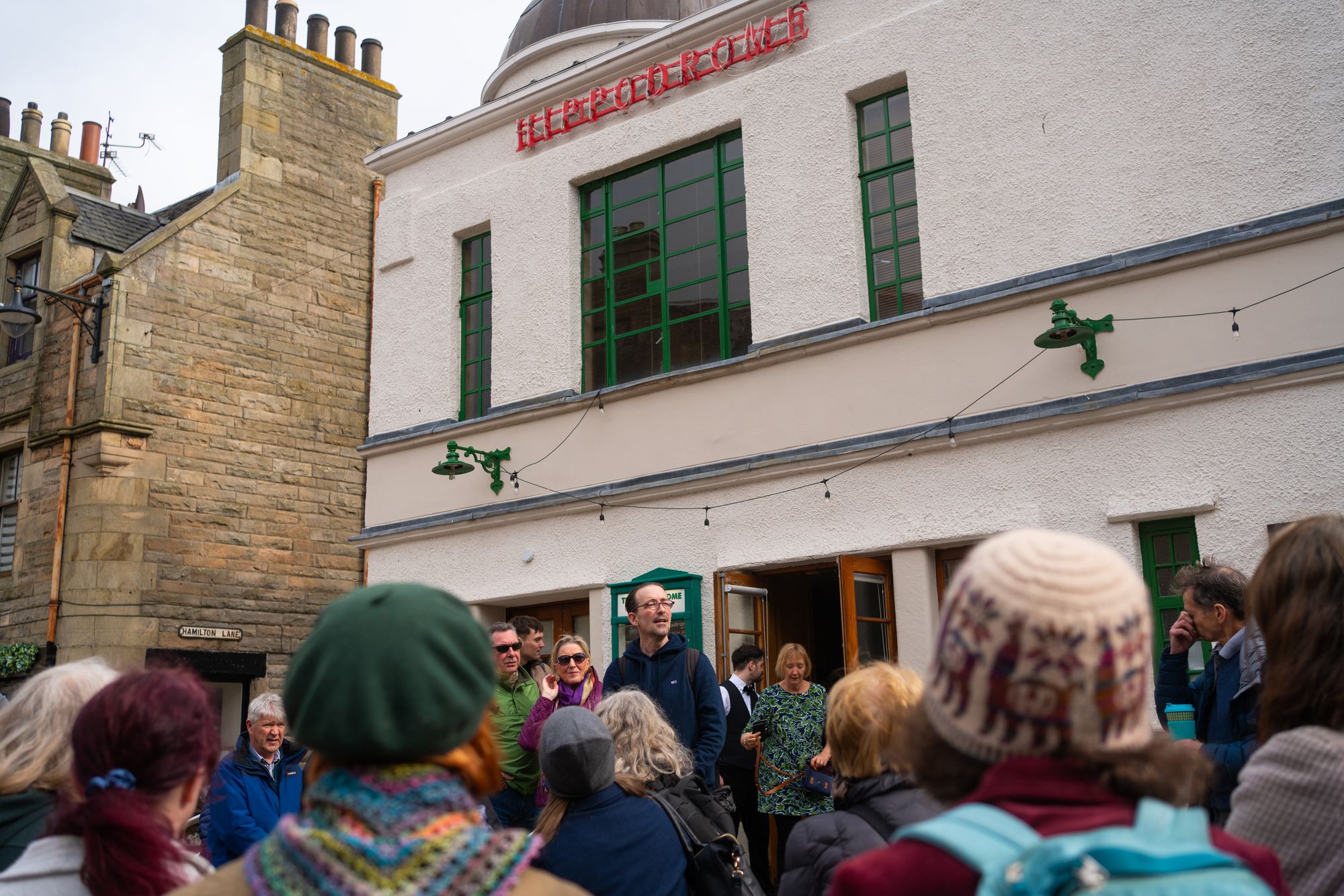
Walking through the cinema’s front doors feels like walking back in time; the circular auditorium, designed by local architect Matthew Steele in 1912, is a particularly whimsical feature. Visitors may recognise the cinema’s interior from an episode of Good Omens or the recent Bafta-winning film I Swear.
The cinema was first run by Louis Dickson, who lived between 1878 and 1962. Apparently, he named his house in Bo’ness “Hollywood”. Some members of the HippFest audience actually remember Dickson. Before the first film started, I had the good fortune to meet Lilian – “like the film star Lilian Gish!” she said – a 95-year-old local resident who has been coming to the cinema since Dickson’s day. She told me how he used to wander the aisles and kick out anyone who was talking or misbehaving. It’s a beautiful cinema, so no wonder he wanted to uphold standards.
I met other fascinating people during my time in Bo’ness: film restorers, musicians, and cinephiles like me. We would congregate outside the cinema after each screening and very often conversations would drift into the Wee Wine Bar around the corner.
The focus of HippFest is on the films, but the festival puts on plenty of other activities between screenings. On Saturday, I joined a tour of the nearby Rosebank distillery with its famous brick chimney. Try watching the vertiginous Mountain of Destiny (1924) after a generous whisky tasting. On Sunday morning, there was a walking tour of Bo’ness’s Art Deco buildings, most built by Matthew Steele in the twenties.
I got to see Steele’s designs up close during a separate tour of the cinema, led by the knowledgeable Kieran. The cinema has had a turbulent history. After years of being a pillar of the community, the Hippodrome closed down in 1975 due to a lack of revenue. (Had they waited just a few months, they could have capitalised on the release of Jaws, which would become the most successful box office smash at the time.) The beguiling space was used as a bingo hall in the 1980s, a far cry from its original glamour. Thankfully, the Hippodrome was renovated and reopened as a cinema in 2009.
There’s lots for visitors to explore in the surrounding areas all year-round. The Kelpies – the world’s largest equine sculptures – is a 20-minute drive from Bo’ness. Antonine Wall, the northernmost point of the Roman Empire, also starts nearby. The brooding Blackness Castle and the historic Callendar House are both within a short driving distance. But if, like me, you come to Bo’ness for the films, you will end up spending most of your time out of the sunshine and in the glorious darkness of the cinema.
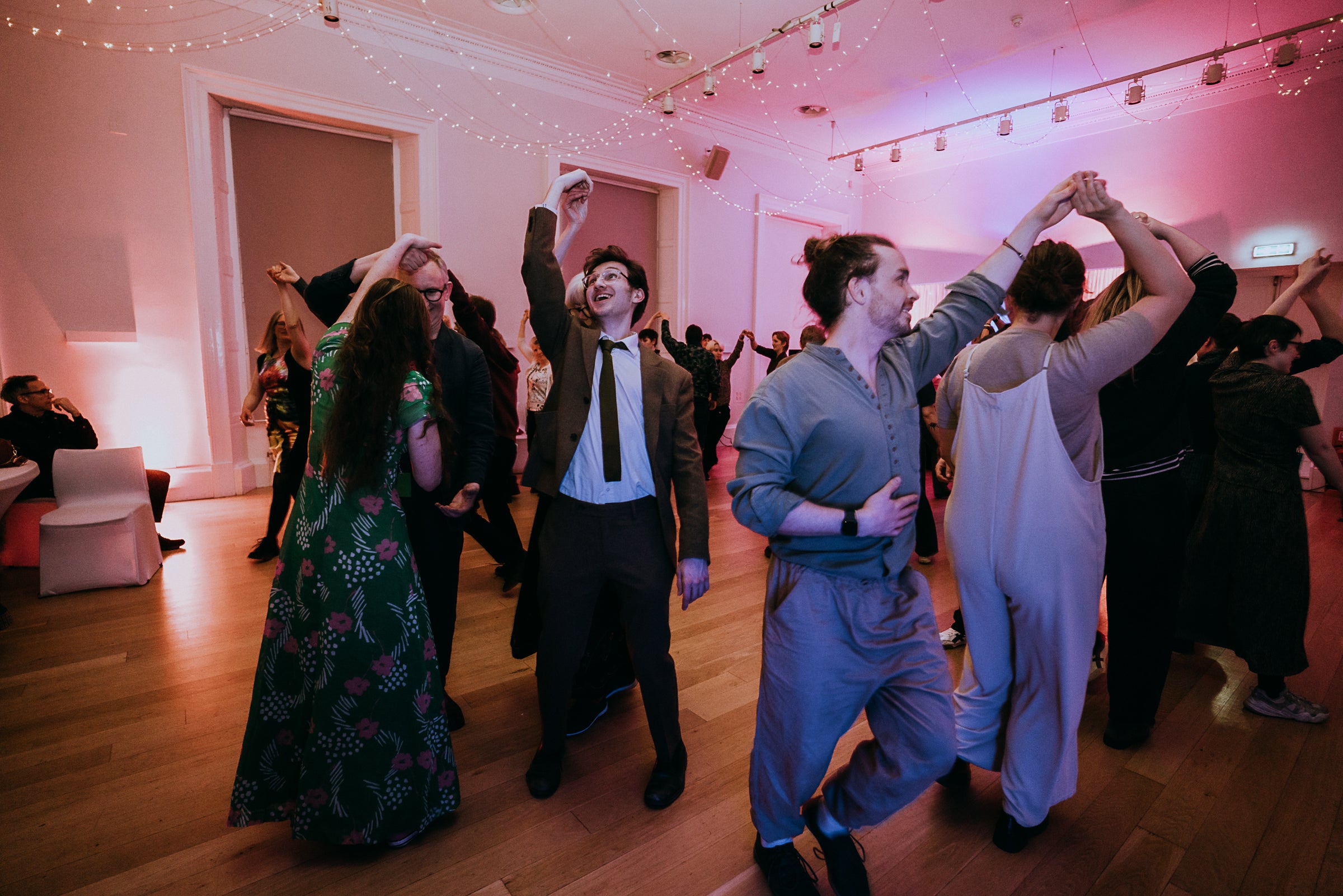
Bo’ness is a quiet town, but during HippFest there’s a buzz of activity. The opening night reception included a tutorial of a Norwegian folk dance, which we had just watched in Fante-Anne (Norway’s first indigenous feature film). I danced, but not very well. On Friday night, there was a 1920s-themed gala. Dressing up was encouraged and the cocktails flowed like a scene from the flapper comedy Why Be Good? (1929) which had just been screened. I danced. Just not very well. On Sunday, a group of us learnt some basic Charleston steps in a beginner’s workshop. I danced. Not very well.
Read more: I took a bikepacking trip to discover Scotland’s stunning National Cycle Network
But of course, the most memorable moments of the week were the films themselves. The programming was an excellent mix of international features: well-known canonical classics to films that are very rarely screened. I watched a beautiful restoration of Song (1928), starring Anna May Wong, the first Chinese-American film star. I laughed watching The Bat (1926), the zany precursor to Batman, and cried uncontrollably during the melodrama The Crowd (1928).
There was a packed house on Saturday morning for The Cameraman (1928) by Buster Keaton. It was encouraging to see so many families in the audience, ensuring the next generation will continue to look after these films. I don’t think there’s a sweeter sound than children laughing at Buster Keaton falling on his bottom to a live musical score.
It was five days to make you fall in love with cinema – for the first time or, for me, all over again.
How to do it
Visitors from London can get a direct train to Edinburgh from King’s Cross. It is then a short train journey to Linlithgow.
The festival provides a shuttle bus to Bo’ness or there is a local bus, but these run infrequently so guests will need to plan ahead.
Next year’s HippFest will take place 17-21 March 2027. Tickets start at £142.50 for a five-day pass, £99 for a weekend pass and £66 for an under-30s weekend pass.
Where to stay
Visitors can stay at the Richmond Park Hotel, where rooms start at £45 a night. Guests attending HippFest 2027 are eligible for a 15 per cent discount.
Henry was a guest at Richmond Park Hotel