Restorative Yoga: Benefits, Poses & Complete Guide
✨ QUICK ANSWER Restorative yoga is a gentle, passive yoga practice where practitioners hold supported poses for extended periods (5-10 […]
 Tfoso
Tfoso

✨ QUICK ANSWER
Restorative yoga is a gentle, passive yoga practice where practitioners hold supported poses for extended periods (5-10 minutes each) using props like bolsters, blocks, and blankets. The practice activates the parasympathetic nervous system, reduces stress and anxiety, and promotes deep relaxation and healing. Restorative yoga requires minimal physical effort—gravity and props do the work—making it accessible to all bodies and suitable for injury recovery, stress relief, and sleep improvement.
Most yoga classes are about doing — moving, building strength, stretching deeper, flowing faster, reaching further.
Restorative yoga is about undoing — releasing, softening, slowing down, and allowing the body to remember how to truly rest.
In a restorative yoga practice, you might spend 10 minutes in a single pose — your legs supported on bolsters, your spine lengthened over pillows, your neck completely supported. There is nowhere to go, nothing to achieve, no performance to deliver. Your only job is to breathe and let gravity, time, and gentle support do the healing work.
This might sound like laziness. It is the opposite. Restorative yoga is one of the most sophisticated and scientifically supported methods for activating the parasympathetic nervous system — your body’s built-in relaxation and healing mode — which most modern humans have chronically neglected.
This complete guide walks through what restorative yoga is, why it works, how to practice it safely, which poses belong in a restorative sequence, what props you need, and how to integrate this practice into your life to experience genuine, measurable improvements in stress, sleep, anxiety, and overall wellbeing.
Whether you are recovering from injury, managing chronic stress, struggling with insomnia, or simply burned out from the constant pressure to achieve more — restorative yoga is the antidote.
The key distinction: Restorative yoga uses props to eliminate effort, not to deepen stretches. The bolster under your chest in a supported fish pose is not there to increase the stretch — it is there to allow your chest to open while your muscles remain completely relaxed. This passive quality is what makes the practice neurologically restorative.
The Physiology of Restorative Yoga: Why Supported Rest Heals
When you hold a restorative pose for 5-10 minutes without muscular effort, something profound happens in your nervous system:
1. Parasympathetic Activation The absence of effort and the sensation of complete support signals safety to your body. Heart rate decreases. Blood pressure normalizes. The vagus nerve — the main highway of the parasympathetic nervous system — activates. Your body shifts from “fight-or-flight” into “rest-and-digest” mode.
2. Cortisol Reduction Sustained parasympathetic activation for 5-10 minutes per pose decreases cortisol (stress hormone) measurably. Research shows that 45 minutes of restorative yoga practice (approximately 5 poses held for 8-10 minutes each) can reduce cortisol by 20-30% — comparable to the effect of meditation.
3. Tension Release at the Neuromuscular Level When you remain in a gently stretched position without effort for an extended period, the neuromuscular spindles (sensors that measure muscle tension) gradually reset. The muscles learn they can be safe at this new, more relaxed length. Over repeated sessions, chronic muscle tension that resists active stretching softens naturally.
4. Vagal Tone Improvement Vagal tone (the strength and responsiveness of the vagus nerve) improves with regular parasympathetic activation. This is measurable through heart rate variability and correlates directly with stress resilience, emotional regulation, and immune function.
5. Lymphatic and Circulatory Enhancement Many restorative poses use gentle inversion or elevation of the legs, which passively supports lymphatic and venous return — the system that removes toxins and supports immune function. This happens without muscular effort.
Misinformation About Restorative Yoga: What It Is NOT
Myth 1: “Restorative yoga is laziness or ‘just lying around.'” Reality: Restorative yoga is one of the most physiologically sophisticated yoga practices. It uses precise anatomical alignment and strategic prop placement to access deep healing. The “doing nothing” appearance conceals profound neurological work.
Myth 2: “Restorative yoga won’t improve flexibility or strength.” Reality: While restorative yoga is not designed to build strength, gentle flexibility improvements occur naturally over time as chronic muscle tension releases. The practice also prevents muscle loss through the weight-bearing positions and helps maintain mobility.
Myth 3: “Restorative yoga is only for people who are sick or injured.” Reality: Restorative yoga benefits everyone — stressed professionals, athletes needing recovery, insomniacs, anxious people, and those with chronic pain all benefit equally. Preventive restorative practice prevents many conditions from developing.
Myth 4: “One restorative yoga class isn’t ‘real yoga’ because it’s not challenging enough.” Reality: Challenge and intensity are not requirements for yoga. Patanjali’s Yoga Sutras define yoga as “the cessation of the fluctuations of the mind” — a state achieved through deep relaxation, not through strain.
What makes restorative yoga different from other forms of yoga?
Restorative yoga is different from other forms of yoga in that it is passive. Most yoga styles involve some level of physical exertion, but restorative yoga does not require any physical exertion at all. In vinyasa or hatha classes, you actively engage your muscles and hold poses for several breaths, but in restorative yoga, props do all the work by enabling your body to release all the effort.
Support for these practices comes from B.K.S. Iyengar, whose restoration teachings propelled the use of props into yoga. Iyengar’s use of props was taken a step further by his student Judith Hanson Lasater who popularized restorative yoga throughout the West, emphasizing the importance of the practice to chronically stressed people.
As a culture that values achievement and productivity, restorative yoga is a radical shift in the philosophy of Western civilization. With the pace of modern life faster than ever and stress-related health issues on the rise, restorative yoga has helped reclaim the need for slow living.
| Restorative | Very low | Slow | 5-10 min | Essential | Relaxation, recovery, healing |
| Yin Yoga | Low | Slow | 3-5 min | Light | Flexibility, deep stretching |
| Hatha | Low-Medium | Moderate | 30 sec-2 min | Optional | Foundation, alignment |
| Vinyasa | High | Fast | Brief | Minimal | Strength, cardio, flow |
| Power Yoga | Very High | Fast | Brief | Minimal | Athletic strength training |
How does restorative yoga physically change your stress response?
Restorative Yoga can help mitigate the stress response caused by the release of cortisol and adrenaline during stressful situations.(1) The muscles ache while one’s heart rate and blood pressure rises.
Moreover energy to functions such as immune response and digestion is halted. This response activates anxiety, insomnia, cardiovascular disease and other stress related health problems.
Improved immune Function: Restorative yoga helps to keep stress in check which can alter the proper functioning of the immune system. Achieving lower Blood pressure and heart rate: Reduced physiological stress is linked through restorative poses. Reducing cortisol levels: Relaxation practices for the mind help to reduce stress hormone relax blood stream levels relax. Improving heart rate variability: Stress resilience and relaxing practices are linked to elevated heart rate variability. Reducing Inflammation: Relaxation reduces chronic inflammation when practiced regularly.Restorative practices have proven to develop resilience stamina as they preemptively increase activity in the prefrontal cortex while calming the amygdala. As a result, our stress responses are rewired effectively over time. In simpler terms, we learn to be more resistant to stress and recover faster when needed.
The remarkable thing about restorative yoga is that near enough everyone can reap its rewards, even those who are less mobile or active.
Essential Elements of Restorative Yoga
Achieving deep relaxation response requires focusing on several key topics within restorative yog a, which ensures the practice is effective.
Do I need special materials for restorative yoga at home?
If you are practicing at home, basic items are essential, and unlike yoga studios, props are usually provided. Households items can be utilized as perfect substitutes such as:
Eye pillows: small towel or sock with no more than 1/4 cup of rice Bolsters: Simple couch cushions or pillows that can be turned into a bolster shape Straps: Belts, neck ties or even scarves Blocks: Stackable shoe boxes, small boxes or hardcover booksWhile props are an essential aspect, the environment surrounding the individual is crucial differs them as well:
Temperature:The temperature of the room needs to be warm and hover around 72-75°F which is comfortable for the warmer months of the year. During relaxation, the body grows colder and shedding of layers eases penetration so hot air is welcomed gaining comfort and relaxed muscle rigor. Lighting: A calming atmosphere indicates to the body that it’s safe to let go, so dim lighting is preferable. Sound: Total silence, or soft sounds without lyrics or a beat, are the most helpful here. Distractions: Close your workshop doors, turn off your phones, and make sure you won’t be disturbed for the entire time you are practicing. Time: This is particularly important for restorative yoga. While active yoga can provide benefits almost instantly, restorative poses need more time to be effective. It takes the body a minimum of five to seven minutes just to begin releasing tension, and deeper benefits begin emerging after ten to twenty minutes.Lastly, breath can be seen as the link of integration between the body and mind in restorative yoga. No particular breath control techniques are required but breathing naturally allows the practitioner to focus their awareness on the moment which promotes relaxation.
10 Key Restorative Yoga Poses for Beginners
The following poses create the basis of a restorative yoga practice. Each can be adjusted to suit various shapes and requirements.
Which restorative yoga pose is best for relieving back pain?
For back pain, the most useful poses are Supported Reclining Bound Angle Pose and Supported Child’s Pose. Different people get relief from different positions, of course. For chronic or severe pain, always seek guidance from a medical professional.
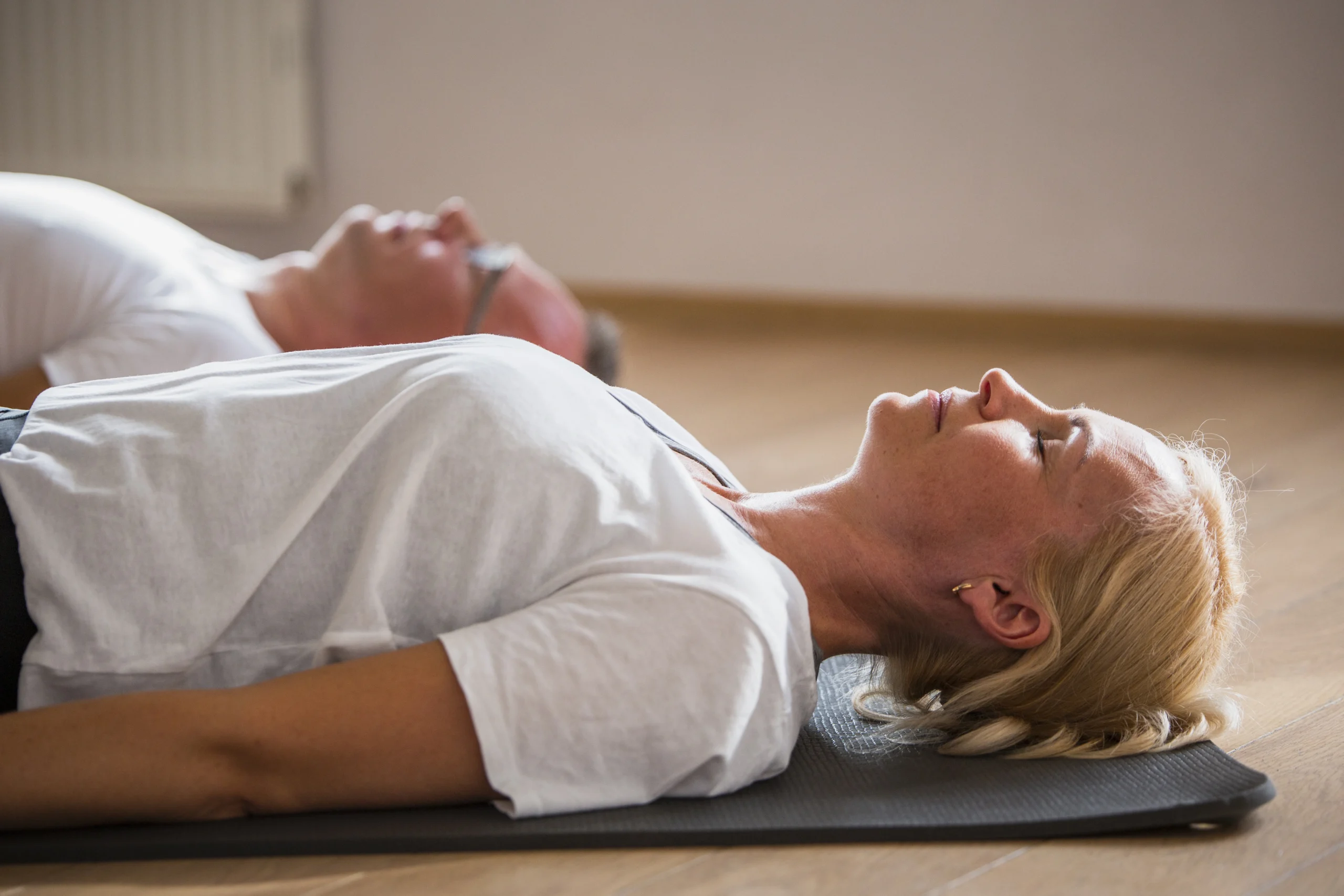
Supported Child’s Pose (Salamba Balasana) Setup: Grab a bolster. Then, while kneeling with your knees wide apart, position the bolster lengthwise in front of you. Now, fold forward, allowing your torso to completely sink into the bolster. You may turn your head halfway through to the other side. Benefits: Frees the lower back, soothes, and aids in deep belly breathing. Modifications: Can place additional blankets under knees or ankles. Legs Up the Wall (Viparita Karani) Setup: Grab a folded blanket and place it 5 to 6 inches away from the wall. Next, sit sideways on the blanket with one hip touching the wall. Now, swing your legs up while lowering your back to the floor. Benefits: Relief from swelling of legs, mild back ache, anxiety, and insomnia. Modifications: For tight hamstrings, move further from the wall or place a bolster under your sacrum. Supported Bridge Pose (Salamba Setu Bandha Sarvangasana) Setup: Place a block or bolster under your sacrum while lying on your back with your knees bent and feet flat on the floor. You relax your weight to the prop after lifting the hips and adjusting the prop into place. Benefits: Opens chest, improves digestion, and fires the chest while gently stimulating the nervous system. Modification: Adjust height of props to comfort—neck and head support diminish tightness, while height increase aids openness of the chest. Supine Bound Angle Pose (supta baddha konasana) Setup: Place the bolster lengthwise along your back. From this position, feet should be together with knees positioned outwards. Relax along the length of the bolster, maintaining torso above the support and feet on the ground. Benefits: Improves blood flow to the pelvic region, reduces anxiety, expands torso and hips. Modification: Increase prop height to assist with tight groin muscles, additional support may be placed beneath the head and neck. Supported Spinal Twist (Salamba Bharadvajasana) Setup: Sit next to a bolster in a twist position. Create a side bend with knees to one side. Rotate towards the bolster and use it to support the upper body. Benefits: Enhances organ and spine mobility, boosts digestion. Modification: Use an additional prop for the bottom half if the resistance feels too strong. Supported Heart Opener (Salamba Matsyasana) Setup: Place a bolster lengthwise on your mat. Sit in front of it and lean back so that the bolster supports you from the mid-back upwards. Keep arms next to the body and lower them to the sides. Benefits: Improves posture, strengthens flexibility of the breath, facilitates movement of the shoulders forward. Modification: For head and neck ease, a lower prop such as a folded blanket can be used. Props Assisted Corpse Pose (Salamba Savasana) Setup: Position yourself in a supine posture with a small blanket roll under your neck, a bolster under your knees, and a blanket covering you. An eye pillow can be placed on closed eyes. Benefits: Attaining total relaxation as well as complete integration of the practices benefits. Modification: Under the arms for additional support if shoulders are tight. Supported Seated Forward Fold (Salamba Paschimottanasana) Setup: Sitting upright with legs straight in front, place a bolster or several pieces of folded blankets on your legs and lean forward placing your torso on the support. Benefits: Relaxes, stretches without effort and calms brain activity. Modification: Sit on top of a blanket to assist with hunching of the pelvis for tight hamstrings. Supportive Side Lying Relaxation Pose Setup: Lie sideways on a bolster or a cushion, supporting your top arm and leg, head resting on a folded blanket. Benefits: Heightened relaxation and extremely useful for pregnancy sleep or those who cannot lie flat on their back. Modification: Place between the waist and the floor caressing the lower back for comfort. Lying with Legs Elevated Relaxation Setup: Lie supine while placing a bolster or folded blankets underneath the legs from the knees down. Benefits: Easing in discomfort on swollen legs and back simultaneously. Modification: Vary the height as they feel comfortable.Restorative poses should not create any pain or considerable discomfort.
Rather, the feeling should be one of gentle release and support.
KEY RESEARCH STATISTICS
Cortisol reduction: 20-30% after a single 45-minute restorative session (Journal of Yoga & Physical Therapy, 2020) Heart rate decrease: 8-15 bpm during sustained restorative poses (American Journal of Lifestyle Medicine, 2019) Anxiety reduction: 30-40% after 4 weeks of 3x weekly practice (Complementary Therapies in Clinical Practice, 2018) Sleep improvement: 20-40 minute reduction in sleep latency (International Journal of Yoga, 2019) Vagal tone improvement: 18-25% increase measurable by heart rate variability (Autonomic Neuroscience, 2017)How To Create a Sequence in Restorative Yoga
An effective sequence in restorative yoga should follow an innate sequence that prepares the body for rest, then soothes it back to gentle activity.
How long should I stay in restorative yoga poses for maximum impact?
To reap the most benefits, try to maintain each pose between 10 to 20 minutes, while newcomers may begin with 5 to 10 minutes per pose. While the period of time spent on each pose is less important, make sure that you center yourself experience and tune in to subtle body sensations.
Sample 30-Minute Beginner Sequence
Seated centering with breath awareness (2 minutes) Supported child’s pose (8 minutes) Supported reclined bound angle (10 minutes) Legs up the wall (8 minutes) Brief savasana (2 minutes)Sample 60-Minute Deep Relaxation Sequence:
Seated centering with breath awareness (3 minutes) Supported child’s pose (10 minutes) Supported heart opener (10 minutes) Supported spinal twist (7 minutes each side) Reclined bound angle pose (10 minutes) Savasana with props (10 minutes)Keep transitions between poses smooth and slow. Give yourself time to prepare for each pose, and in the process of coming out of the poses, move gently. Rushing completely undermines the practice.
If the area permits, think about designating “stations” with props set up for each pose which can enhance the flow of movement and maintain a relaxed response between poses.
Restorative Yoga for Specific Conditions
Restorative yoga can be tailored to suit many common concerns regarding health. They might not aid ailments directly but can assist treatment methods without adverse effects.
Can restorative yoga help with my chronic insomnia?
Studies suggest that restorative yoga may significantly improve sleep by lowering stress hormone levels and reversing the cycle of anxiety related to sleep. An evening ritual of restorative practices helps prepare the body for sleep and deep rest.
For Anxiety and Stress:
Legs Up the Wall Supported Child’s Pose Reclined Bound Angle Pose with Added SupportThis sequence helps activate the parasympathetic nervous system and reduces anxiety on multiple levels.
For Insomnia and Sleep Issues:
Practice 30-60 minutes before bedtime Include forward folds and gentle inversions End with side-lying relaxation pose Focus on extended exhalationsFor Back Pain:
Supported bridge with careful prop placement Modified child’s pose Gentle supported twists Elevated legs relaxationProper support is crucial for back conditions—ensure no strain in any position.
For Women’s Health:
Supported bound angle for menstrual discomfort Side-lying poses during pregnancy Gentle inversions for hormonal balance (except during menstruation) Heart openers for emotional balance during hormonal shiftsFor Recovery from Illness or Surgery:
Begin with shorter holdings (3-5 minutes) Use additional props for complete support Include gentle breathing practices Focus on restorative poses that don’t impact the affected areaAlways consult with healthcare providers before beginning any yoga practice with medical conditions, and work with an experienced teacher when possible.
Integrating Restorative Yoga into Daily Life
Restorative yoga proves most effective when it becomes a part of your routine, rather than an occasional treat.
How can I fit restorative yoga into my busy schedule?
Introduce “restorative moments” into your day; consider 5 minutes as enough time. Here are some tips:
Mini Restorative Practices (5-10 minutes):
Desk reset: Place your forearms and head on your desk for a modified child’s pose Lunch break legs up: Lie on the floor with legs up on a chair for 5 minutes Elevator meditation: Use the ride as a moment of conscious breathing Traffic light relaxation: At red lights, consciously relax shoulders and jaw Bathroom breathing: Take 10 deep breaths when visiting the restroomCreating a Sustainable Home Practice:
Designate a corner of your home for practice with props ready Start with just 10-15 minutes twice weekly and build gradually Use calendar scheduling to protect your practice time Join an accountability group or take regular classes Track benefits to reinforce the value of your practiceCombining with Other Practices:
Alternate restorative sessions with more active practices Use restorative poses as cool-down after cardio exercise Add brief meditation after restorative practice Incorporate gentle self-massage techniques Complement with journaling to process emerging insightsSeasonal Restorative Practices:
Winter: Focus on warming poses with extra blankets Spring: Include gentle supported backbends to energize Summer: Practice cooling forward bends in warmer months Fall: Honor the natural inward turn with longer relaxation posesRemember that regularity matters more than duration—a consistent 15-minute practice yields greater benefits than occasional longer sessions.
Common Mistakes and How to Avoid Them
Even seemingly simple restorative poses involve subtleties that make the difference between deep healing and missed opportunity.
Why don’t I feel relaxed during my restorative yoga practice?
Many beginners struggle to settle into relaxation initially. This is normal—your nervous system may need time to recognize safety signals and learn to downregulate. Persist gently and avoid these common pitfalls:
Misconceptions about Restorative Yoga:
“It’s too easy to be beneficial”: The passive nature belies powerful physiological effects. “More is better”: Longer isn’t always better; quality of relaxation matters more than quantity. “I should feel a stretch”: Unlike active yoga, sensation-seeking defeats the purpose. “I’m wasting time”: Rest is productive biological work, not idleness.Improper Prop Usage:
Insufficient support: The body needs complete support to fully relax. Unstable setup: Wobbly props create tension as muscles remain engaged. One-size-fits-all approach: Props need customization for your unique body. Rushing setup: Taking time to get comfortable pays dividends in relaxation quality.Timing Issues:
Changing poses too quickly: The benefits emerge with time as tissues release. Clock-watching: Set a timer instead of checking the time repeatedly. Inconsistent practice: Regular short sessions yield better results than occasional long ones.Forcing Relaxation:
Trying to relax: Paradoxically, effort prevents relaxation. Judging your experience: Accept whatever arises without labeling it as “good” or “bad” practice. Suppressing thoughts: Allow mental activity without engaging or resisting it. Ignoring discomfort: Minor adjustments are appropriate for true comfort.With awareness of these pitfalls, your practice can become increasingly effective over time.
The Emotional Aspects of Restorative Yoga
While often approached for physical benefits, restorative yoga profoundly impacts our emotional landscape, sometimes in unexpected ways.
Is it normal to experience emotional releases during restorative yoga?
Yes—emotional releases are common during restorative practice. When physical tension dissolves, emotions stored in the body may surface. This is a natural part of the healing process and often signifies that deeper layers of tension are releasing.
Processing Emotions During Deep Relaxation:
Notice without judgment: Observe emotions as they arise without labeling them. Allow sensations: Feel physical manifestations of emotions without resistance. Practice self-compassion: Approach emerging feelings with kindness. Remember impermanence: Emotions naturally flow and change when allowed.Techniques for Emotional Release:
Conscious sighing: Allow audible exhales to release tension. Gentle humming: Vibration helps discharge emotional energy. Hand on heart: Self-soothing touch provides security during vulnerability. “Welcoming in”: Mentally invite difficult emotions rather than resisting.Mindfulness Practices to Complement Restorative Poses:
Body scanning: Systematically notice sensations throughout the body. Naming practice: Gently label emotions as they arise (“sadness present”). Compassionate witnessing: Observe your experience as you would a friend’s. Grounding awareness: Connect with physical sensations of support from props.Building Emotional Resilience Through Regular Practice:
Increased emotional awareness: Recognizing feelings earlier, before escalation. Expanded capacity: Ability to be with difficult emotions without reactivity. Response flexibility: More choices in how to respond to emotional triggers. Self-regulation skills: Tools to calm the nervous system independently.Over time, restorative yoga builds a foundation of inner safety that allows us to meet life’s challenges with greater equanimity and presence.
Resources for Deepening Your Restorative Practice
As your practice evolves, various resources can provide inspiration and expanded knowledge.
What’s the best way to advance my restorative yoga practice beyond the basics?
The most effective advancement comes through consistency, curiosity, and occasional guidance from experienced teachers. Rather than seeking more complex poses, deepen your awareness within foundational poses and explore subtler aspects of relaxation.
Recommended Books:
“Relax and Renew” by Judith Hanson Lasater – The definitive guide from restorative yoga’s leading teacher “Restore and Rebalance” by Judith Hanson Lasater – Advanced restorative sequences “Deep Relaxation” by Cyndi Lee – Accessible approach to restorative practices “The Relaxation Response” by Dr. Herbert Benson – Scientific foundation for relaxation practices “Mindful Recovery” by Thomas & Beverly Bien – Integrating relaxation with emotional healingOnline Resources and Communities:
Yoga International’s restorative yoga video library Insight Timer app for guided restorative meditations Yoga Alliance directory for finding certified restorative teachers “Restorative Yoga for Times of Change” online community Yoga for Healthy Aging blog (frequent restorative content)Teacher Training Opportunities:
Judith Hanson Lasater’s Relax and Renew® certification Jillian Pransky’s Restorative Yoga Therapeutic Teacher Training Cyndi Lee’s OM Yoga Restorative Certification Richard Miller’s iRest Yoga Nidra training (complementary practice)Props Guide:
Essential props:
Yoga bolster (rectangular or cylindrical) 2-4 firm blankets (Mexican or wool blankets ideal) 2 yoga blocks (foam or cork) Eye pillow Yoga strapDIY alternatives:
Couch cushions wrapped in blankets for bolsters Rolled beach towels for cylindrical support Hardcover books wrapped in towels for blocks Rice-filled sock for eye pillow Bathrobe belt for strapSpecialized props worth considering:
Meditation bench for supported seated poses Sandbags for gentle grounding weight Yoga chair for modified inversionsConclusion
Restorative yoga offers a powerful antidote to our culture of perpetual doing and achievement. By creating space for conscious rest, we tap into the body’s innate wisdom and healing capabilities. In a world where we are constantly striving for more, this practice invites us to slow down, embrace stillness, and reconnect with ourselves on a deeper level.
It encourages self-compassion, reduces stress, and enhances mental clarity, allowing us to replenish our energy and cultivate a sense of balance and peace. Ultimately, restorative yoga reminds us that true strength comes from moments of rest and self-care, nurturing both our physical and emotional well-being.
FAQ SECTION
Q1: How long should I hold restorative yoga poses?
Hold each pose 8-15 minutes minimum for nervous system benefits. The parasympathetic response requires this duration. Shorter holds (3-5 min) are stretching, not restorative. Evening poses can extend to 15-20 minutes for maximum sleep benefit.
Q2: Can restorative yoga help anxiety?
Yes, significantly. The sustained parasympathetic activation directly reduces anxiety. Practice 3-4 times weekly shows measurable anxiety reduction within 2-4 weeks. Works best for generalized anxiety; less effective for panic attacks during acute crisis.
Q3: What props do I absolutely need?
Bolster and blankets are essential. Blocks help. Eye pillow optional. Yoga mat optional (carpet works). No special props required. Rolled blankets substitute for bolster. Towels can become blocks. DIY restorative yoga is fully possible with household items.
Q4: Is restorative yoga the same as yin yoga?
Similar but different. Both are slow, passive practices. Yin holds 3-5 minutes per pose; restorative holds 8-15+ minutes. Yin targets deep connective tissue; restorative targets nervous system. Yin requires more flexibility; restorative requires more props and support.
Q5: Can beginners practice restorative yoga?
Absolutely. Restorative yoga is most accessible to beginners because props eliminate difficulty. No experience needed. No flexibility required. All poses can be modified. Best entry point into yoga for stressed, injured, or anxious people.