Silent Underground
A twelve-hour meditation protest on the London Underground The post Silent Underground appeared first on Tricycle: The Buddhist Review.
 KickT
KickT
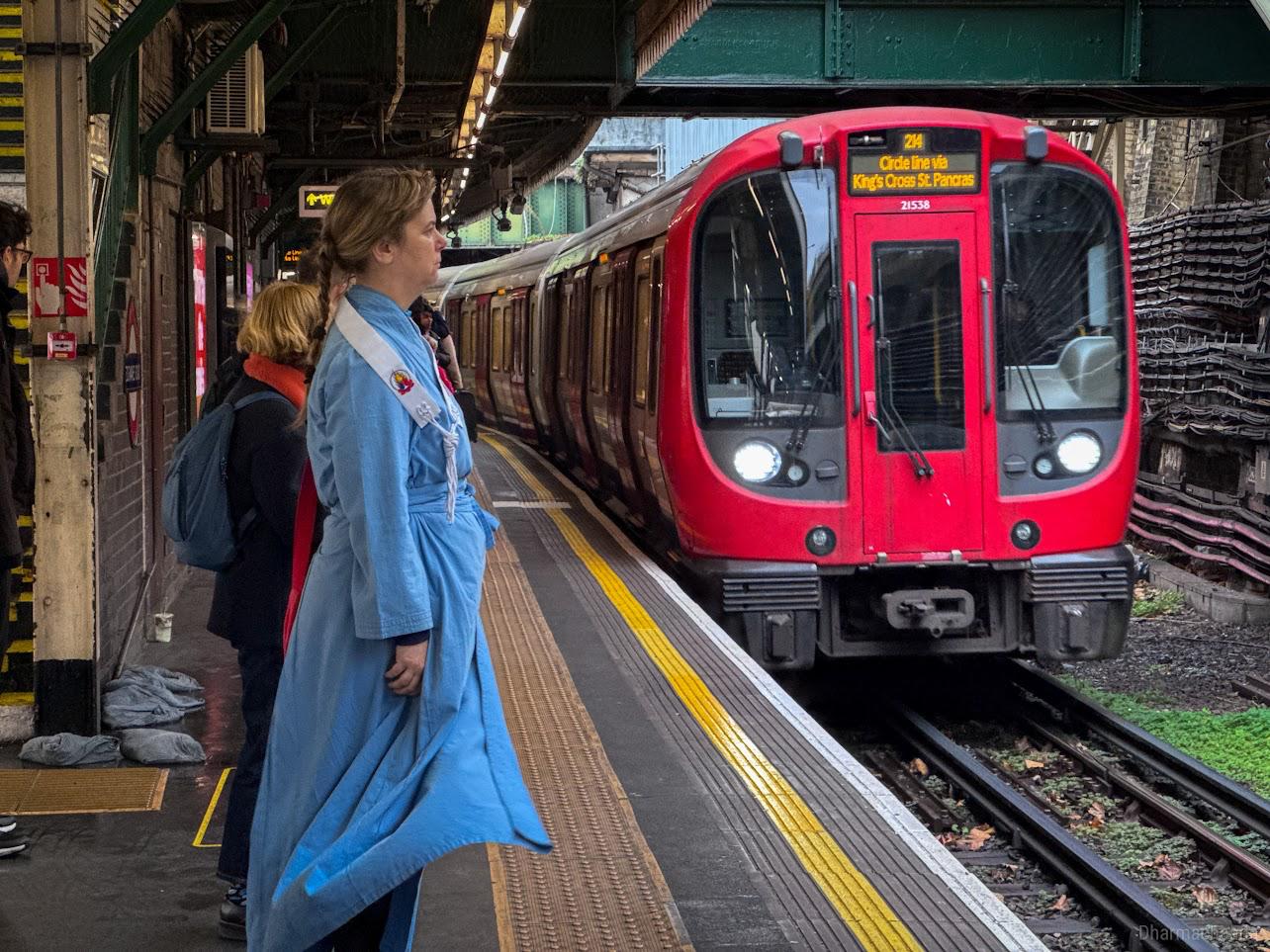
It’s 6:30 a.m. and still dark outside. Rain falls silver under a street lamp. The moon’s reflection floats on Bow Lock. I am getting dressed and will soon make my way to Bromley by Bow Underground station. A usual early morning in East London. But today, Monday, December 1, 2025, marks a difference. Instead of my fourteen-minute tube ride to Bethnal Green, I’ll be making my way to the Circle line. Rather than starting work, I will be meditating underground for twelve hours.
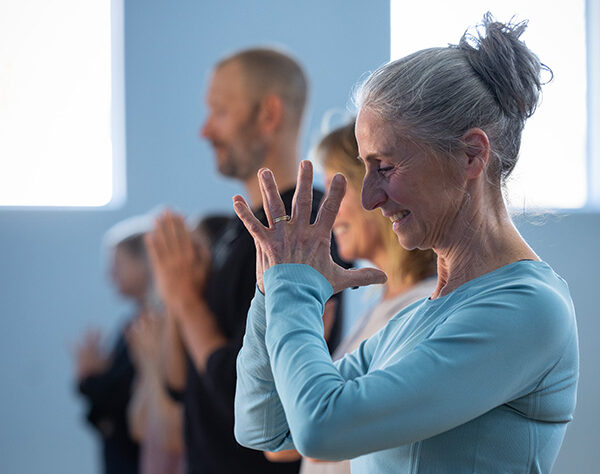
I put on my blue cotton robe, the color of summer sky, given at my Ordination Retreat in Spain. I wear my kesa. I pack a small bottle of water, acetaminophen, ear plugs, keys, glasses, mobile phone. All go into a bum bag, which I’ll use as a makeshift zafu for my hands. At Bromley by Bow station, I am joined by four friends from London Buddhist Centre. We nod, a mixture of anticipation, and for me, at least, trepidation, and set off for the Circle line intersection at Liverpool Street. There, we get on the wrong tube. We wait for the right one, traveling clockwise. I chose this several months earlier so that people can find me and meditate alongside me on the day for however long they wish.
My twelve-hour sit on the London Underground was devised to raise funds for a new Triratna Buddhist Centre, in Ware, in the UK. I wanted to make an intervention into the numbing monotony of public transport travel. It is a journey many of us do twice a day, five days a week, crammed into cars, noses to phones. I wanted to explore what changes when we do the unfamiliar, when we wake up from autopilot. If, as the Buddha taught, states of mind are contagious, what would happen to others in proximity to me meditating? The project was not only a fundraiser but a protest. It touched a cultural nerve. It went viral on BBC news with more than 1 million views.
We live in loud conditions. Noise in cities is increasing. Green spaces are diminishing. The Underground network itself has gotten louder. No wonder we blank out this noise with headphones and a preferred soundtrack or raise our voices to be heard. Health experts agree that any sound above 85 decibels (dB) can damage hearing. Parts of the Victoria line in London reach over 90 dB; at times, peaking at 112dB. New York is not far behind, with sound levels between 80–95 dB. Chronic noise pollution has also impacted our bodies in a concerning way. We are becoming physiologically less tolerant of quiet. Silent space is increasingly associated with what is unfamiliar and deeply uncomfortable. Sedatephobia (fear of silence or quiet surroundings) is a growing phenomenon. Forms of activist resistance that employ stillness and silence as strategies can therefore have a strong effect.
In the UK, many activist organizations have been using mass stillness and silence to bring attention to pressing issues. This includes Women In Black, an international activist network of those who identify as women. It began in 1988 to mourn harmful action such as war. Now, the network has grown and holds silent vigils in cities across the world. Similarly, Extinction Rebellion, founded in 2018 in the UK, is a global environmental movement using civil disobedience to draw attention to climate change.
Meditating as an act of protest is not new. In Triratna, the Order into which I am ordained, many engaged Buddhists have sat on the front lines of marches and sit-ins. It refutes a criticism leveled at Buddhism—that Buddhism is about an “inner” journey; the practice of meditation not “doing” anything. In fact, what unfolds on the cushion directly impacts what happens off the cushion. One might even argue that meditation is a direct action. We set an intention to work with our minds; and everything is mind-making. In the Metta Bhavana practice, we cultivate nonharm and loving-kindness for all sentient beings; we are training our minds to no longer generate hostility. In the Sedaka Sutta, the Buddha taught that “By protecting oneself, one protects others. By protecting others, one protects oneself.”
Thich Nhat Hanh’s book Being Peace contains one of his most well-known teachings. He wrote of the necessity to embody peace now rather than acknowledge peace as some future condition brought about by action. In other words, we are now, we are not in the future. This was recently exemplified by the Buddhist monks who began their silent “Walk of Peace” on October 26, 2025. They walked from Texas to Washington, D.C. “My hope is, when this walk ends,” said the Venerable Bhikkhu Pannakara, “the people we meet will continue practicing mindfulness and find peace.” This raises another point about practice; that through transforming the self, it transforms others. The focus of the monks’ attention was clearly on others: those whom they encountered on the way. The example the monks set through walking in silence was powerful because the direct action did not aim to preach but rather embody. The action was uncomplicated and accessible. It reminds us of the Buddhist emphasis of the importance of direct experience, or ehipassiko, that the dharma could not be taught but only “caught.” In a world where views are polarized and the bridge between is often too difficult to traverse, the monks’ action became an international sign of hope.
On the London Underground, people told me their concerns for my safety. I needed to be vigilant. There were muggings, assaults, general harassment. I felt initially vulnerable. I wanted the sangha to meditate alongside me, not safeguard me. Nor did I want to plug up my ears and block out my surroundings. I chose the Circle line partly because of its connotations of traveling without a destination and because the newer trains were used on the line. The sound was quieter and the car more spacious. But during those first two hours, with my eyes closed and my attention on my breath, I began to hear a hysterical voice coming toward me:
“We must ALL be saved. Only the Lord can save us.”
The voice grew louder, the speech nonsensical. My belly lurched. I wanted to open my eyes. But I realized if I did that, I would always be opening my eyes. I had another realization: In life, I was often fearful. I was constantly checking my surroundings for signs of threat. I had a choice. I kept my eyes closed and breathed into the fear. The voice got close. Then silence. I felt the person standing right over me. I felt their breath on my face. We were locked into something; connected; breathing. I am not sure how long we were like this. Then I felt the weight lighten and I was breathing alone again. Then the voice emerged but farther away:
“Save yourselves. The Lord can help us.”
I became aware that my fear had long passed.
Urgyen Sangharakshita, the founder of Triratna, wrote on The Greater Mandala of Uselessness, a Tibetan-influenced teaching associated with Chögyam Trungpa. The “uselessness” teaching is against capitalist interests and our Western compulsion with productivity. The more effort we put into trying to be useful, the more we become driven, willed, and attached to outcomes. Sangharakshita advocates, instead, for letting go of utility and spending more time just being. Letting go for me on the Underground that day meant letting go of habitual vigilance, and resting, instead, in self-surrender and just being. Dwelling from that place felt in sharp contrast to the busyness and hectic activity on the tube. I realized that my being there was an impromptu installation.
Performance art was anti-institutional, anticlass, and anticapitalist, and grew in the ’50s and ’60s in the US. Artists rejected the gallery system, wanting to engage with social issues, the nature of time, or their own bodies in ways that were outside of the academy. These artistic works could easily fall within a mandala of uselessness. Yoko Ono and John Lennon’s Bed-in for Peace in Suite 702 of the Amsterdam Hilton Hotel in 1969 was a well-documented antiwar protest where they talked with journalists at the side of their double bed.
Similarly, Taiwanese painter and performance artist Tehching Hsieh underwent yearlong performances between 1978 and 1986 where he explored the nature of time. His actions (punching in and out each hour on a time clock twenty-four hours a day for a year; in another tied to artist Linda Montano by an eight-foot rope) aimed to disintegrate boundaries between art and life, at a time when he was an undocumented immigrant in New York City. His durational and repetitive actions wrote him into a life to which he officially had no access. Each artwork demanded mindfulness. As Marina Abramović, one of the greats of performance art, says: “The hardest thing is to do nothing.” But in apparently doing nothing, Abramović is aware that a quality of presence can unfold. It is that charismatic presence that offers a richness in artistic practice and has potency in direct action.
In performance art, the boundaries between performer and viewer are often made ambiguous. We are less separate than we assume. In Abramović’s The Artist is Present, at the Museum of Modern Art in 2010, strangers could exchange a gaze with her for as long as they wished. To many, she was a mirror—a blank canvas for projection. Many spoke of a profound and cathartic shift in their being afterwards. It reminds me of the well-known late 1950s text by sociologist Erving Goffman on the presentation of the self in everyday life. He wrote that we present sides of ourselves in accordance with social norms, and in relation to the other. When something or someone disrupts the situation, it can spark others to liberate less recognized parts of themselves. We are highly relational beings. I wonder the extent to which others on the Underground confronted their “going to work” self that day; the self that travels every day on that particular line at that particular time. Members of the sangha who joined me said that there was a marked atmosphere, one that felt quiet and introspective. When I opened my eyes each time to leave the train at Edgware Road and change platforms (the Circle line is not, in fact, a Circle), I saw many passengers who were not on their mobile phones. I witnessed quite a few in meditation.
We are highly relational beings. I wonder the extent to which others on the Underground confronted their “going to work” self that day; the self that travels every day on that particular line at that particular time.
Agnes Martin’s paintings and drawings may not speak directly of activism, but they exude the quiet ethics of a life lived away from worldly pursuits. There is a rejection of ego and spectacle in her hand-drawn grids and elusive, painstaking lines. Her artistic practice was a kind of disciplined humility—slow-making, precise yet imperfect lines that grew out of contemplation and meditation rather than expressionistic drive.
She likened her work to the everyday quality of waking up happy but not knowing why. She wanted her works to be wordless, allowing viewers to slow down and feel rather than interpret. She did not want her works to be framed by narrative, she saw silence and simplicity as the path to a deeper perceptual experience.
This is similar to what durational practice felt like: Experience became flowing awareness. Loud speaker announcements and snippets of passenger conversations wove in and out. A family excitedly getting ready for the holiday season; a couple where the chat seemed awkward, one in tears. I felt utterly connected to these people. At one point, I opened my eyes as one of my sangha friends tapped me on the leg and waved happily as he got off the tube. He later told me that he hadn’t been on the Underground in years due to anxiety but that meditating together helped ease him into a different state of mind.
“I will do it again,” he said.
When the meditation stops, twelve hours later, I get off at Liverpool Street and back onto the District line to return to Bromley by Bow.
I scuff a man’s foot getting on the tube, sit down, and apologize. He asks how I am. Really happy, I say. He talks a bit about his day. To my surprise, the man next to him leans forward and checks in. One by one, complete strangers share how they are. The atmosphere is jovial and calm. Extraordinary people, saying ordinary things. For those brief moments, we are in it together.