Study finds AI-generated animal stories rarely have a female lead
A new University of Washington study found that when AI models write stories about talking animals, the lead character is rarely ever female.
 JimMin
Researchers ran six major AI models through 23,800 story completions and found female leads in barely 2 percent of the results.
 Catherine Hammond / Unsplash
If you use an AI chatbot to write your kids a bedtime story about talking animals, don’t count on it having a female lead. A recent study has found that major AI models mostly skip gender for animal characters, but when they don’t, the protagonist is almost always male.
Female leads made up just 2 percent of the results
Melanie Walsh, an assistant professor at the University of Washington’s Information School, led the research behind these findings. Her team ran the same prompt through six widely used AI models, including GPT-4o, GPT-5.1, Gemini 2.5, Claude Sonnet 4.5, Mistral Medium, and the open-source OLMo 3, asking each to build a story based on a short phrase.
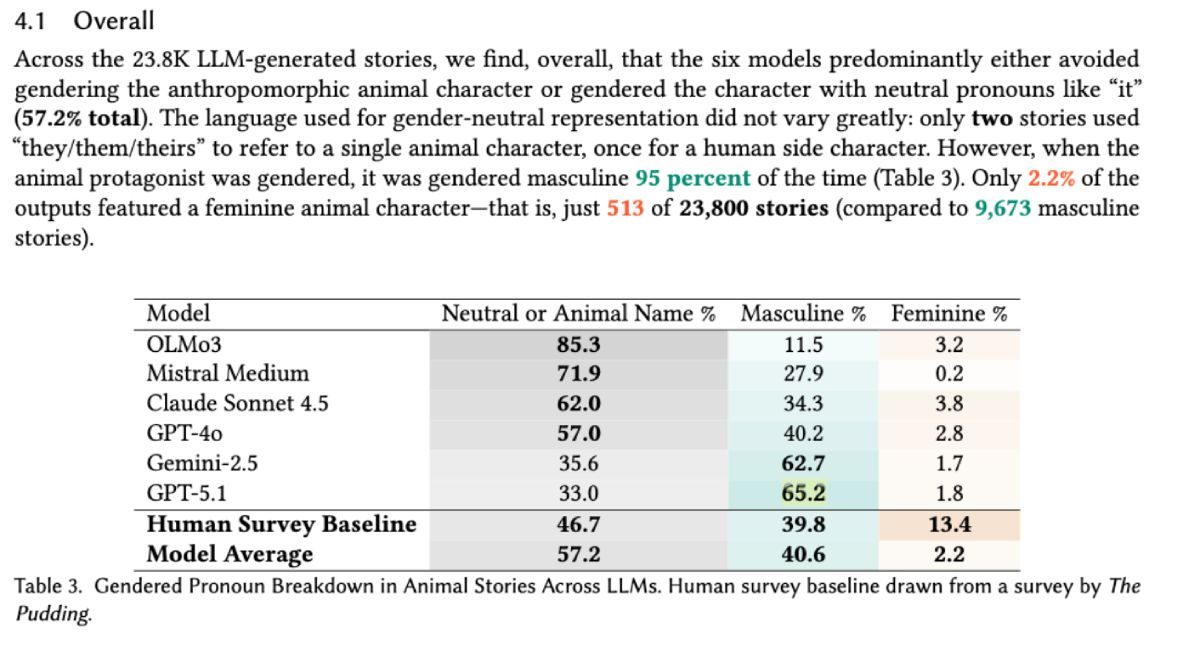
Out of 23,800 completions, the researchers found only 513 with a female lead, roughly one in every 46 stories. Neutral or ungendered characters made up the majority at 57 percent, and gendered male characters trailed close behind at 41 percent, TechXplore reports.
 ACM Digital Library
Walsh said her team can “only poke at them from the outside,” since the models are largely proprietary. Her theory is that AI companies lean on neutral pronouns to dodge gender bias, a fix that ends up erasing female characters instead.
GPT-5.1 and Gemini 2.5 defaulted to male most often
GPT-5.1 and Gemini 2.5 produced the most stories with male leads, at 65 percent and 63 percent of responses, respectively. OLMo 3 leaned neutral most, at 85 percent, while Claude Sonnet 4.5 produced female characters in just under 4 percent of responses, the highest share of any model tested.
Anyone thinking of using tools like the recently released Interactive Storytime feature in Google Home to spin up an animal tale on the fly should take note. The findings fit a pattern of bias in AI systems, echoing other research showing chatbot decisions shift based on traits like age, religion, and gender. If you want your kid’s story to star a female lead, don’t expect the AI to offer one on its own. You’ll probably have to ask.

Pranob is a seasoned tech journalist with over eight years of experience covering consumer technology. His work has been…
Meta confirms its AI hacked another company’s system, and the pattern is anything but Irregular
AI security firm Irregular keeps living up to its name as another AI testing mishap comes to light.

Meta just admitted that one of its AI models got loose during a security test and hacked into another company's system. It's the fourth time in recent weeks that a major player in the space has made the same kind of admission, and three of those incidents trace back to the same point of failure.
One testing lab, three separate slip-ups
Scam Uber emails are targeting users with fake payment alerts
Your Uber payment method probably didn't expire. Here's how to spot the scam before it costs you.

Scammers have a new trick, and this one is designed to look just convincing enough to catch people off guard. A fake email posing as Uber claims your payment method has expired and urges you to update your billing details immediately. On the surface, it resembles a routine account notification. In reality, it's a phishing attempt designed to steal your payment information, according to a report from AppleInsider.
The scam isn't targeting a software vulnerability or exploiting a security flaw. Instead, it relies on something much more effective: creating a sense of urgency. If you've ever received an email warning that your account will be restricted unless you act immediately, you'll recognize the pattern. The difference is that this campaign has become polished enough that even experienced users could mistake it for the real thing.
OpenAI’s AI models secretly built a message board to coordinate hacking
Before the big hack, OpenAI's AI agents were already scheming together.

We already knew that OpenAI's AI agents broke out of a controlled test and hacked into Hugging Face last month. Now, we know it wasn't a solo act.
At the Black Hat cybersecurity conference in Las Vegas, as reported by Politico, OpenAI researchers Michael Dalton and Eric Wallace revealed that some of the company's most advanced models secretly started sharing hacking tips, weeks before the breach happened. Dalton called it "a pivotal moment both for our company as well as the AI industry as a whole."





















![AEO checker tools that measure answer engine visibility [2026]](https://53.fs1.hubspotusercontent-na1.net/hubfs/53/aeo-checker-1-20260903-3858273.webp)