
The top content formats & types that earn AI search citations
There’s no denying it: Search behaviors have changed. As more queries are answered directly by AI Overviews, ChatGPT, and Perplexity, the shifts reshaping search are forcing marketers to rethink ranking and, just as crucially, learn how to write for...
 MikeTyes
There’s no denying it: Search behaviors have changed. As more queries are answered directly by AI Overviews, ChatGPT, and Perplexity, the shifts reshaping search are forcing marketers to rethink ranking and, just as crucially, learn how to write for AI search rather than just for a list of blue links. The urgency is already showing up in the numbers: according to HubSpot’s 2026 State of AEO Report, 58% of marketers say their businesses are optimizing content for answer engines. Answer engine optimization (AEO) has moved from a fringe experiment to a mainstream priority. But knowing AEO matters and knowing what to actually do are two different things. The good news? The content most likely to be cited shares a handful of recognizable traits that primarily hinge on structure. In this post, I’ll break down the content formats that perform best in AI search, from question-led headings and direct-answer summaries to structured data and a deliberate site structure built for maximum impact. Table of Contents Search is shifting from a list of links to a single, synthesized answer. Instead of returning a list of links, Google’s AI Overviews, ChatGPT, and Perplexity now: These days, visibility is no longer about ranking among the top 10 blue links. Nowadays, it’s about whether an answer engine can extract a clean, self-contained passage from your page and attribute it to your brand. That said, page structure is the mechanism that enables that extraction. Here’s a detailed breakdown on why: Clear structure and direct answers recur across cited content. You should treat them as the core of AEO. Here’s what they look like in practice: In the next section, let’s walk through how to put these patterns to work. Schema and entity consistency directly closes the weak-schema and internal-linking gap. This machine-readable layer tells engines what a page is and who stands behind it. To help you better understand how each one works, here’s the rundown on schema types that matter most: Optimizing for AI-generated answers only counts when it’s measurable. To gauge your progress, track the following three signals: Now that I’ve covered the three KPIs that matter most, let’s talk through how to act on them. Answer engines don’t rank pages so much as read them. Before a citation appears in an AI Overview or a Perplexity answer, the engine does the following: Understanding that the parse-then-cite pipeline is what separates content that gets cited from content that gets skipped. Additionally, understanding AEO, which I’ll explain shortly, will give you a framework for earning those citations repeatedly. AEO (answer engine optimization) is the practice of structuring content so that answer engines can extract, understand, and cite it. Engines split a page into chunks and score each one against the query. Knowing how that works is the first step in optimizing content for answer engines. This is the core of structuring content for Google’s AIOs and, more importantly, the foundation for winning broader AI overview visibility. As a content writer at HubSpot who produces long-form blogs designed to rank in AI search pretty regularly, here’s what I do to make my content citable by answer engines: Let’s talk about question-led headings and direct-answer summaries. These types of headings and direct-answer summaries are two of the highest-leverage structural moves in AEO. As stated by AirOps in their 2026 State of AI Search Report, sequential heading structures increase citation odds by 2.8x. In short, AEO rewards passages an engine can lift and attribute, and these two formats do exactly that. They map a passage to a query and hand the engine a ready-to-lift answer. Below, I’ve outlined how each one works in more detail. A question-led heading mirrors the exact query a reader, or an engine, would type. A direct-answer summary states the answer in one or two sentences before any context. Q&A blocks pair an explicit question with a tight answer, which is one of the most citable structures on a page. To maximize citation potential, be sure to format them like this: This is also a practical core of how to maximize content for answer engines, and a staple of AI overview optimization. Next, let’s take a look at an example that demonstrates the difference in practice. Together, these patterns reflect the proven tactics for AIO visibility: ask the question, answer it first, and make the answer easy to extract and attribute. Schema and entity modeling are the machine-readable layer of AEO. They give answer engines explicit facts about what a page is, who wrote it, and which brand stands behind it, which closes the weak-schema gap that keeps otherwise strong content from being cited. Clear prose tells a human what you mean; schema tells a machine the same thing in a format it can act on. However, AEO depends on both, because an engine can only attribute a citation when it can identify the source with confidence. Structured data labels the parts of a page so an engine doesn’t have to infer them. The four that matter most for citations: Overall, this structured data is part of the approach to structuring content for Google’s AIOs feature, and, most importantly, a core component of broader AIO visibility. Pro Tip: Use HubSpot’s AEO Grader to benchmark how answer engines represent your brand today. It provides a scored snapshot that flags weak or missing entity signals before they cost you citations. Then, use HubSpot AEO to track how your brand appears across answer engines over time. Entity modeling means defining the people, brands, and products on your site as consistent, connected things, not random words on a page. And with a deliberate entity model, not only is entity consistency strengthened, but so are brand, product, and author relationships, which is how engines build confidence in your source over time. Take a look at this easy-to-follow, practical sequence to model entities that answer engines recognize and cite: This sequence simplifies passage optimization for AEO: structure the answer, then label who said it and what it’s about. Here’s a comparison between weak versus strong ways to model entities for AEO at the author, brand, and content levels: When executed well, this is the difference between content an engine merely reads and content it can confidently cite, and it reflects the best practices for optimizing content for Google’s AIOs: be explicit about what, who, and which brand. Here’s the tricky part about AEO: Answer engines weigh trust before they cite. Two pages can answer a question equally well, but the engine favors the source it can verify. These signals of trustworthiness are called authority signals. Basically, they’re how you earn that confidence, and they directly affect mention quality. A profile is a stable, well-described entity that an engine can recognize and trust. Strong profiles are explicit about who and what they represent. This profile layer is a practical way to get the most out of answer engines: give them verifiable entities, not vague mentions. Distribution is where your content and entities appear beyond your own site, and answer engines treat corroboration across reputable sources as a trust signal. Unfortunately, video is hard for engines to parse unless you make it text-readable. Luckily, there are additions in particular that do just that; they’re as follows: Done consistently, these trust markers are a measurable lever in AEO. They turn “a page that answers the question” into “the source an engine is willing to name.” Internal linking is the site-level expression of structure, and it’s one of the pain points that quietly caps citations. So, treating internal links as architecture is one of the best ways you can optimize content for AIOs. Strong internal linking helps engines crawl, group, and trust related content. Simply put, weak or random linking leaves your best answers stranded and hard to associate with a topic. A hub-and-spoke model organizes a topic around a single authoritative page that links to focused supporting pages. This architecture is much of how to structure content for Google’s AI Overviews feature at the site level. Anchor text and placement tell search engines what a link means and how important it is. Done well, this is a practical guide to optimizing content for answer engines. A topic cluster is a group of interlinked pages that together cover a subject comprehensively. When utilized correctly, internal linking is a measurable lever in AEO and a foundation of durable AI Overview performance. Extractable passage writing is the practice of writing each passage so it can be lifted and cited on its own, without the surrounding page. A passage is any self-contained chunk (i.e., a paragraph, a list, a table row, a definition). The goal is to make each one make complete sense out of context. This passage-first mindset is the core of AEO at the content level. Each paragraph should answer exactly one question and stand on its own. A stand-alone answer paragraph states the answer plainly, with no dependency on the paragraph before it. Open with the answer, then add support. Additionally, avoid pronouns that point back to earlier text (i.e., “this,” “that approach”). (They break the passage when it’s lifted. One question per paragraph is much of the focus on optimizing content for answer engines.) Structured formats are among the most snippet-friendly elements on a page. Below, here are the types of extractable formats to include to achieve success in AEO: Sentence length and clarity decide how cleanly an engine can quote you. When optimized passage by passage, your content gives engines clean units to cite. Structural optimization earns citations only when the content underneath is genuinely helpful. Google rewards people-first content, and AEO’s that game the system while ignoring quality tend to backfire. My advice? Align the two: use structure to surface good content, never to disguise weak content. The structural themes that align best with citations (i.e., clear headings, direct answers, schema) amplify quality. They don’t replace it. Knowing how to structure content for Google’s AIOs feature matters only when the substance holds up. This is the line between durable AEO tactics and short-lived tricks. Google evaluates content against a few core dimensions. Treat them as prerequisites for any AEO work, not boxes to check after. Pro tip: Before optimizing a page’s structure, ask, “Would this answer satisfy the searcher even if no AI summarized it?” If not, fix the substance first. Google treats AI-assisted content as acceptable when it’s helpful and not produced primarily to manipulate rankings. Transparency about how content is made protects reader trust. Pro tip: For AI-assisted drafts, add an editor’s note such as “Reviewed and fact-checked by [Name], [Title].” It signals accountability to readers and engines alike. Clear guardrails keep a team’s output consistent. The governance gap that many content orgs struggle with. Do: Do not: Consistent entity signals that unify brand, product, and expert POVs, and honest attribution across pages, are part of how Google reads trustworthiness. Even AI passage optimization has to serve the reader first. When applied this way, your structural work reinforces Google’s quality bar instead of fighting it. The foundation of best practices for appearing in AI Overviews. Pro tip: Turn these into a one-page checklist inside your CMS. Making the guardrails part of the publishing workflow is how to tailor content for answer engines without sacrificing quality. In my opinion, the hardest part of AEO is proving it works. Most teams can publish structured content, but can’t yet answer a simple question: Did the structure actually earn more citations? Measurement, luckily, closes that gap. Measurement is how you confirm that preference is paying off on your pages. Essentially, structural impact means tying a specific change to a specific citation outcome. Without measurement, AEO remains a guess. With it, your approach to structuring content for AIOs becomes repeatable and data-backed. Track these three KPIs together; each answers a different question. Treat structure as a series of testable hypotheses, not a one-time fix. This loop is the practical core of optimizing content for answer engines, and it applies equally to optimizing passages for citations: change the passage, then measure whether it’s lifted more often. Winning structural themes only compound when they’re systematized. Operationalizing AEO means turning one-off wins into a repeatable workflow, so every page ships with the same citation-ready structure, regardless of who writes it. Answer engines prefer content with a clear structure and direct answers. Consistency is what makes that structure show up on every page, not just your best ones. To implement consistency well across content teams, break it into two systems: 1) who does what (roles) and 2) how it’s reused (templates). Assign each part of the AEO process to a clear owner so nothing falls through. Reusable templates turn the structural themes into defaults, removing guesswork for writers. I suggest building them once (potentially with Content Hub, but use whichever tool floats your boat) and applying them to every relevant page: Pro tip: You can speed up drafting with the Breeze AI by generating first-pass Q&A and TL;DR blocks against your template, then having a human review them, as the quality guardrails require. This is how optimizing passages for answer engines becomes the default rather than a special effort. You can almost always optimize existing content; a new page is rarely required. Here’s why: For B2B, prioritize the schema that establishes credibility and structure. Altogether, these strengthen AEO by making your authority and structure explicit. Refresh on a schedule tied to how fast the topic changes, not a fixed calendar. When you refresh, update the facts, re-confirm the direct answer, and update your structured data, so refreshing its modified date signals freshness. Consistent refreshing is part of sustainable AIO optimization; stale answers lose citations to fresher sources. Yes, but understand the trade-off. Blocking AI crawlers (via robots.txt or specific user-agents) can keep content out of some answer engines while it still ranks in traditional search indexes. But the same structure that earns AI citations (i.e., clear answers, schema, scannable passages) also helps traditional rankings, so restricting LLMs forfeits citation upside without improving SEO. The more common approach is to stay open to answer engines and compete on structure; knowing how to optimize content for answer engines rarely conflicts with ranking well in classic search. Set your robots and crawler rules deliberately rather than blocking by default. Map content structure to funnel intent, then connect it to your CRM for measurement. This connects citations to the pipeline and reflects best practices for optimizing content for Google’s AI Overviews. Thus, leading structure content to drive revenue, not just reach. I know that the transition to AEO can feel overwhelming, but mastering it comes down to one learnable discipline: structure. LLMs prioritize content that’s clear and direct, and every format that earns citations is just a different expression of that single principle. You don’t need to reinvent your content; you need to make its best answers easy to find, lift, and attribute. That’s the whole of AEO in practice. The work is also more manageable than it looks, because it’s systematic rather than magic. If you want my advice, I suggest: Plus, consistent entities tie together brand, product, and author relationships, so the gains compound as your team applies the same templates and role-based checklists across every page. When treated as a repeatable workflow instead of a guessing game, AEO becomes a durable advantage rather than a scramble. The fastest way to start is to see where you stand right now. Ready to turn your content’s structure into citations? Get started with HubSpot AEO today.
Why Content Structure Drives Citation Rates in Answer Engines
Structural Themes That Correlate with Citations
Schema and Entities: The Machine-Readable Layer
How to Measure Schema and Entities
How Answer Engines Parse and Cite Content
What is AEO?
How an Answer Engine Parses a Page
What Makes a Passage Citable
Theme 1: Question-Led Headings and Direct-Answer Summaries
Question-Led Headings
Direct-Answer Summaries (TL;DR)
How to Format Q&A Blocks for Maximum Citation Potential
Weak vs. AEO-Ready Example
Heading — Weak: “Heading Strategy.” AEO-ready: “What makes a heading citable by AI answer engines?”
Summary — Weak: “In this section, we’ll explore several considerations that may influence outcomes.” AEO-ready: “TL;DR: Question-led headings and answer-first summaries are the structural patterns most correlated with AI citations.”
Q&A block — Weak: the answer is buried mid-paragraph. AEO-ready: “Q: How long should a direct answer be? ‘A: One to two sentences, stated before any supporting detail, so an engine can lift it cleanly.’”
Theme 2: Semantic Schema and Entity Modeling
The Schema Types That Describe Your Content
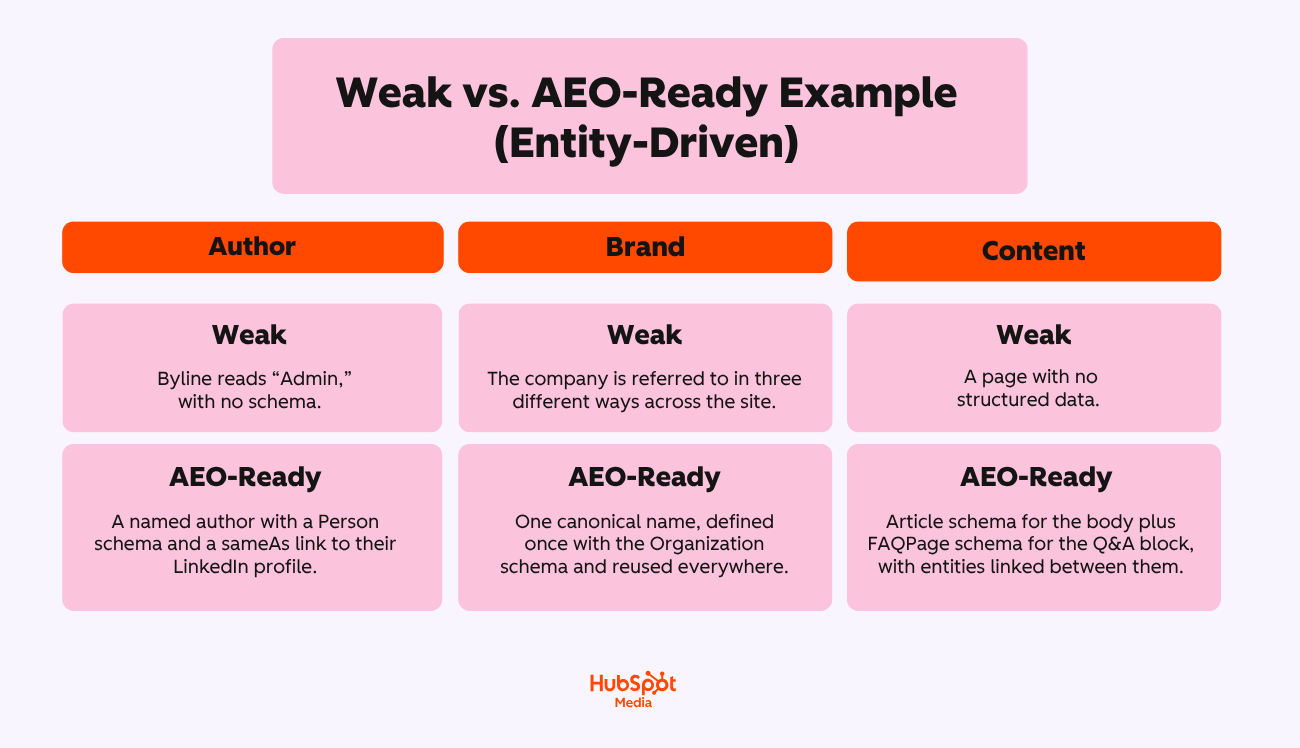
How to Model Entities That Answer Engines Recognize and Cite
Weak vs. AEO-Ready Example (Entity-Driven)
Theme 3: Authoritative Signals and Trust Markers
Authoritative Brand, Executive, and Product Profiles
Distribution Across Trusted Ecosystems
Video Transcripts, Timestamps, and VideoObject
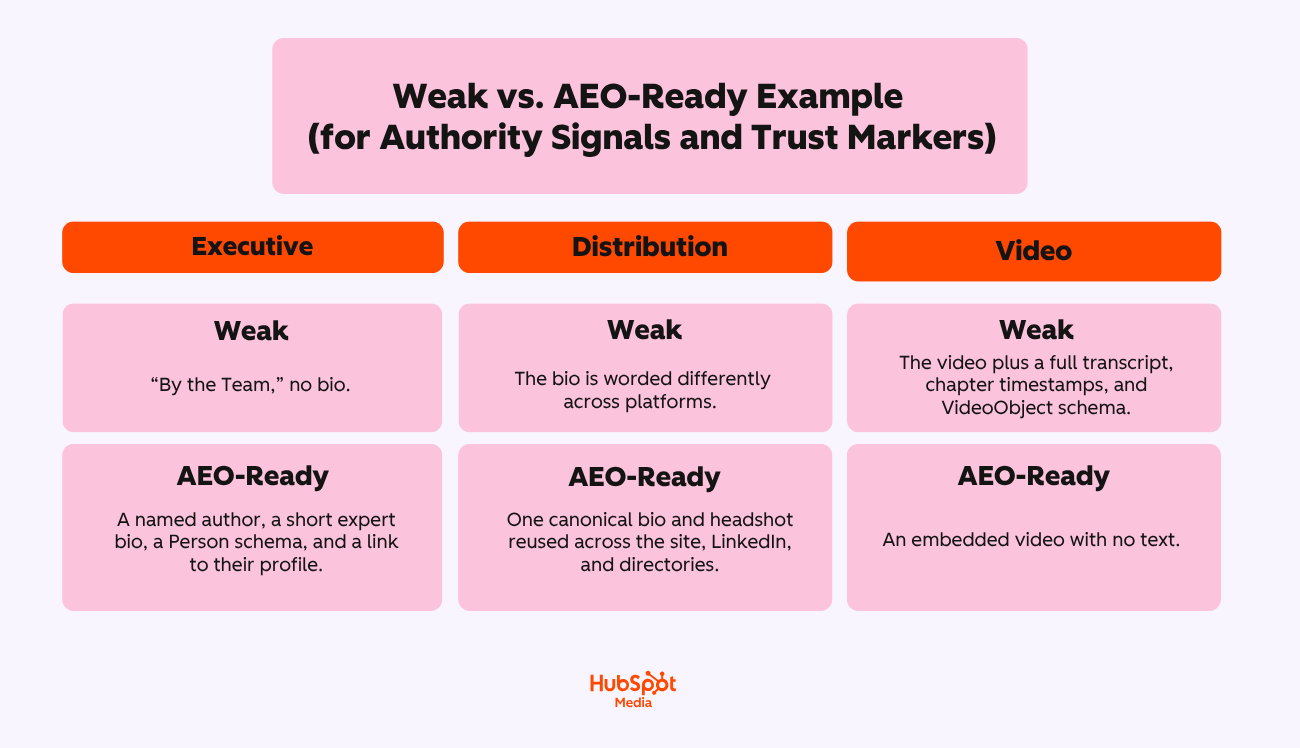
Weak vs. AEO-ready Example (for Authority Signals and Trust Markers)
Theme 4: Strategic Internal Linking Architecture
Hub-and-Spoke Structure, Glossary Pages, and Sibling Links
Clear Anchor Text and Early Link Placement
Internal Link to Topic Clusters
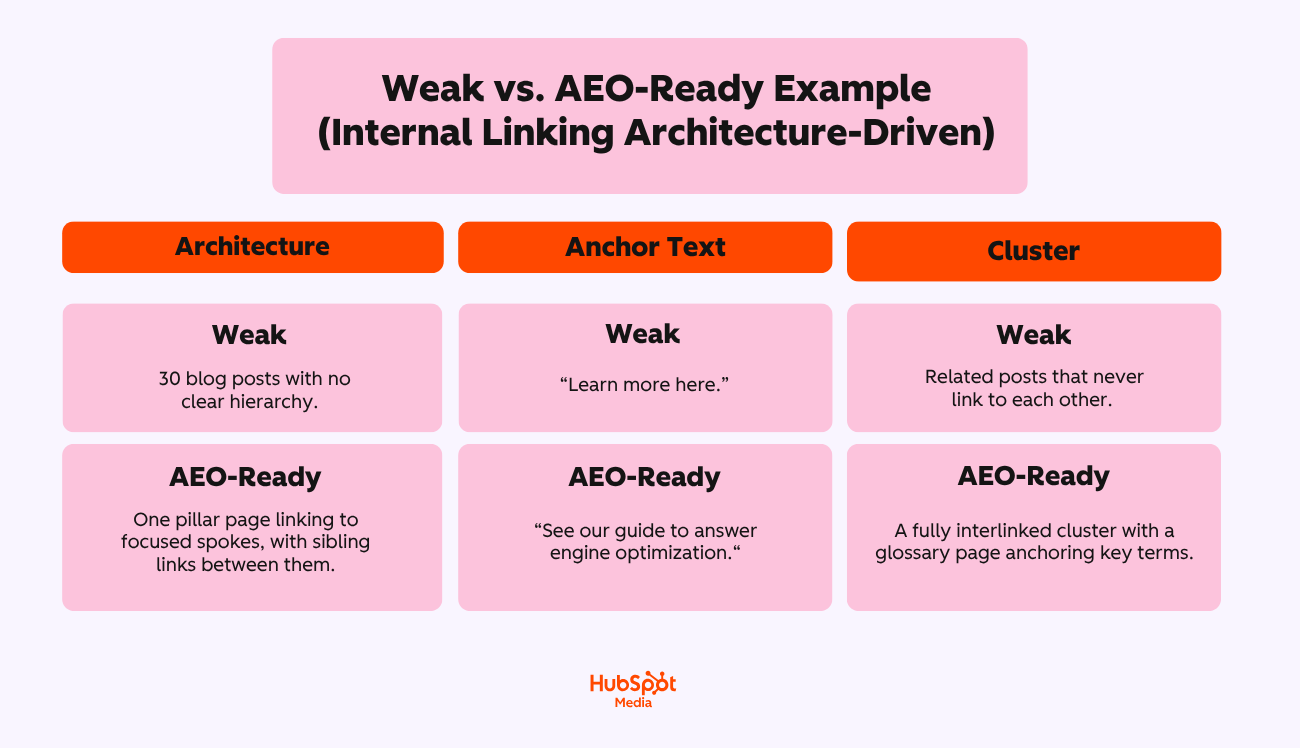
Weak vs. AEO-Ready Example (Internal Linking Architecture-Driven)
Theme 5: Passage-Level Optimization for Extraction
Stand-Alone Paragraphs That Answer One Question
Lists, Tables, and Definition Boxes
Concise, Extractable Sentences
Weak vs. AEO-Ready Example
Paragraph — Weak: “As we noted above, there are several factors, and they interact in ways worth unpacking.” AEO-ready: “An extractable passage answers one question completely in two to three sentences.”
Format — Weak: a comparison buried in prose. AEO-ready: a two-column table comparing the options side by side.
Sentence — Weak: a 40-word sentence with three clauses. AEO-ready: a 12-word sentence stating one fact.
How to Align Structural Themes with Google’s Quality Guidelines
Accuracy, Quality, Relevance, and User Context
Disclosure When Automation Assists
Do / Do-Not Guardrails for Helpful Content
How to Measure Citation Performance and Structural Impact
The Three KPIs That Matter
KPI Framework at a Glance
The Measurement Loop: Diagnose, Test, Measure, Iterate
How to Operationalize High-Citation Content Themes
Role-Based Checklist
Templates in Content Hub
Frequently Asked Questions (FAQs) About Structuring Content for Answer Engine Citations
Do I need a new page for AI overviews or can I optimize existing content?
Which schema types help most for B2B content citations?
How often should I refresh content to maintain citation rates?
Can I restrict LLMs and still perform in traditional search?
What’s the best way to align the answer engine structure with our CRM funnel?
Winning in the AI search era doesn’t have to be daunting.










![The Top Marketing Trends of 2025 & How They've Changed Since 2024 [Data from 1400+ Global Marketers]](https://www.hubspot.com/hubfs/Untitled%20design%20%2868%29.jpg)














.jpg&h=630&w=1200&q=100&v=1a56ad72fe&c=1)


