Yoga Poses for Endometriosis: Relief & Healing
Quick Answer Yoga can be a valuable complementary practice for endometriosis. Specific gentle yoga poses help reduce chronic pelvic pain […]
 Kass
Kass
Quick Answer
Yoga can be a valuable complementary practice for endometriosis. Specific gentle yoga poses help reduce chronic pelvic pain by activating the parasympathetic nervous system, releasing tension in the pelvic floor and hip muscles, reducing stress-driven cortisol (which worsens endo symptoms), and improving circulation to the pelvic region. The best yoga poses for endometriosis are restorative, yin-style, and breath-focused — not vigorous or heating. Always practice in consultation with your healthcare provider.
Living with endometriosis means living with pain that most people around you cannot see — and that medicine has not yet found a complete answer for.
The cramping. The pelvic heaviness. The fatigue that arrives without warning. The days that disappear into heat pads and cancelled plans. If you have endometriosis, you know this experience in your body in a way that no description fully captures.
Yoga poses for endometriosis cannot cure the condition. Nothing in this guide will claim otherwise. What yoga can do — and what a growing body of research and thousands of practitioners confirm — is offer genuine, meaningful relief from the daily physical and emotional weight of living with endo.
Through specific restorative poses, targeted breathwork, and the science of nervous system regulation, yoga addresses several of the mechanisms that drive endometriosis pain — chronic inflammation, pelvic floor tension, stress hormone elevation, and restricted circulation in the pelvic region.
This guide gives you exactly what you need: a clear explanation of why yoga helps, which specific poses are most effective, which poses to avoid, and a complete gentle sequence you can practice during both flare periods and maintenance phases of your condition.
What Is Endometriosis? A Brief Overview
Endometriosis is a chronic inflammatory condition in which tissue similar to the endometrium (the lining of the uterus) grows outside the uterus — on the ovaries, fallopian tubes, bladder, bowel, or pelvic lining.
Each month, this tissue responds to hormonal changes the same way the uterine lining does — thickening, breaking down, and attempting to bleed. But unlike uterine tissue, this blood has nowhere to go. The result is inflammation, scar tissue (adhesions), and pain that can range from moderate to completely debilitating.
Key Facts About Endometriosis
| Prevalence | Affects approximately 1 in 10 women of reproductive age globally |
| Diagnosis delay | Average 7–10 years from symptom onset to diagnosis |
| Primary symptoms | Chronic pelvic pain, painful periods (dysmenorrhoea), pain during sex, fatigue, infertility |
| Secondary effects | Anxiety, depression, sleep disruption, social withdrawal |
| Conventional treatment | Hormonal therapy, pain management, laparoscopic surgery |
| Complementary support | Yoga, acupuncture, dietary changes, stress management |
The Stress-Endometriosis Connection
This is the most important physiological link for understanding why yoga helps endometriosis.
Chronic stress elevates cortisol — the primary stress hormone. Elevated cortisol directly worsens endometriosis in three measurable ways:
1. Increased inflammation: Cortisol dysregulation promotes systemic inflammation — worsening the inflammatory environment in which endometrial lesions grow and cause pain.
2. Hormonal disruption: Chronic cortisol elevation disrupts estrogen regulation. Since endometriosis is an estrogen-dependent condition, anything that disrupts estrogen balance directly affects symptom severity.
3. Pelvic floor hypertonicity: Chronic stress causes the pelvic floor muscles to contract and hold tension continuously — a condition called pelvic floor hypertonicity. This muscular tension amplifies pelvic pain significantly beyond the pain generated by the endometrial lesions themselves.
Yoga addresses all three of these mechanisms directly — making it one of the most physiologically well-targeted complementary practices available for endometriosis management.
How Yoga Helps Endometriosis: The 4 Key Mechanisms
1. Parasympathetic Nervous System Activation
Slow, restorative yoga poses and extended exhale breathing shift the autonomic nervous system from sympathetic dominance (“fight or flight”) into parasympathetic dominance (“rest and digest”). This directly reduces cortisol, lowers systemic inflammation, and releases pelvic floor tension — all of which reduce endometriosis pain.
Research published on the National Center for Biotechnology Information confirms that yoga and pranayama practices directly activate the parasympathetic nervous system, reducing cortisol and inflammatory markers. (Read the research)
2. Pelvic Floor Release
The pelvic floor is a hammock of muscles running from the pubic bone to the tailbone, supporting the uterus, bladder, and bowel. In women with endometriosis, these muscles are almost universally held in a state of chronic tension as a protective response to ongoing pain.
Specific yoga poses — particularly hip openers, gentle forward folds, and supported inversions — directly release pelvic floor tension without triggering further pain. This release often provides immediate symptomatic relief that outlasts the practice session.
3. Improved Pelvic Circulation
Adhesions and chronic inflammation reduce blood flow and lymphatic drainage in the pelvic region. Gentle inversions, hip-opening poses, and twists stimulate circulation to the pelvic organs — supporting tissue oxygenation, reducing stagnation, and potentially slowing the progression of adhesion formation.
4. Emotional and Psychological Support
Endometriosis carries a significant psychological burden — anxiety, grief, isolation, and the emotional weight of chronic pain. The meditative, body-awareness aspects of yoga provide a container for processing these emotional dimensions of the condition, reducing anxiety-driven pain amplification and improving overall quality of life.
Yoga Poses for Endometriosis: What to Do and What to Avoid
Before presenting the specific poses, two critical filters must be applied.
✅ Yoga Styles That Help Endometriosis
Restorative Yoga — Passive poses held for 5–10 minutes with full prop support. Directly activates the parasympathetic nervous system. Best for flare days and recovery phases.
Yin Yoga — Long-held floor poses targeting connective tissue and fascia. Directly addresses the fascial restrictions caused by adhesions. Excellent for maintenance phase practice.
Gentle Hatha Yoga — Slow, mindful standing and seated poses with extended holds. Good for moderate symptom days when some movement is beneficial.
Yoga Nidra — Guided lying-still meditation. Reduces cortisol, supports sleep, and addresses the psychological dimensions of chronic illness. Can be practiced on even the worst flare days.
❌ Yoga Styles to Avoid or Modify
Hot Yoga / Bikram — The elevated temperature increases systemic inflammation. Avoid entirely during flare periods. Approach with caution during maintenance phases.
Power Yoga / Vinyasa (fast-paced) — Vigorous, heating practice elevates cortisol during the session. Not recommended during flare periods. Gentle vinyasa may be appropriate during low-symptom phases at practitioner discretion.
Intense inversions (Headstand, Shoulderstand) — During menstruation specifically, these poses are traditionally contraindicated due to the reversal of menstrual flow. This is particularly relevant for endometriosis.
Deep core strengthening — Boat Pose, intense Plank sequences, or any practice that creates strong intra-abdominal pressure should be avoided during flare periods. It can aggravate pelvic inflammation.
Jumping transitions — Any dynamic jumping or impact movement aggravates pelvic inflammation during flare periods.
12 Best Yoga Poses for Endometriosis: Step-by-Step
These poses are specifically selected for their ability to release pelvic floor tension, reduce systemic inflammation, and activate the parasympathetic nervous system. They are arranged in a complete gentle sequence.
Important: Listen to your body throughout. Pain is not part of this practice. Any pose that increases pelvic pain should be exited immediately and replaced with Child’s Pose or Savasana.
1. Diaphragmatic Breathing (Pranayama Foundation)
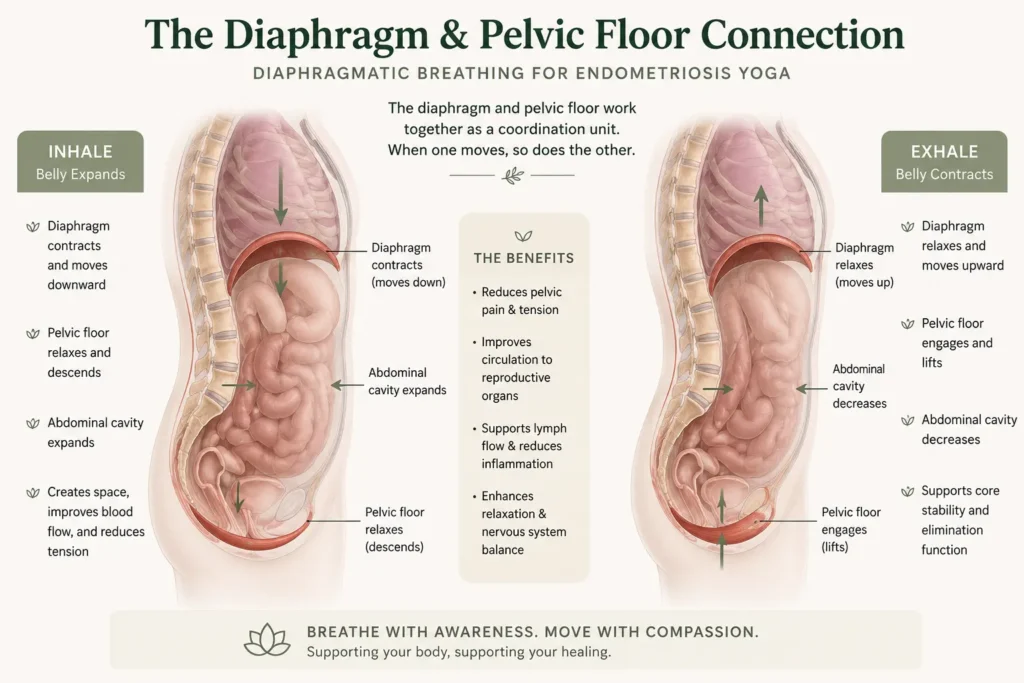
Diaphragmatic breathing is the starting point of every endometriosis yoga session — not because it is complicated, but because it is the fastest available route to parasympathetic nervous system activation and pelvic floor release.
Why it specifically helps endometriosis: The diaphragm and pelvic floor move in direct coordination. When you breathe diaphragmatically — allowing the belly to rise fully on each inhale — the pelvic floor descends and releases. This is a direct, anatomically-grounded mechanism for reducing pelvic floor hypertonicity, which is one of the primary drivers of endo-related pelvic pain.
How to do it:
Lie on your back with knees bent, feet flat on the mat or bed Place one hand on your chest and one on your belly Inhale slowly through your nose — your belly hand rises, your chest hand stays relatively still Exhale slowly through your nose — your belly falls naturally Extend your exhale to be longer than your inhale: inhale for 4 counts, exhale for 6–8 counts With each exhale, consciously release any tension in your lower belly, hips, and pelvic floor Practice for 10–15 breath cycles before beginning any physical posesHold: 10–15 breath cycles (3–4 minutes)
Endometriosis-specific note: During active flare days, this breathing exercise alone — practiced lying down for 10–15 minutes — can provide meaningful pain reduction without any physical movement. The extended exhale activates vagal tone, which directly reduces the pain-amplifying effect of the sympathetic nervous system.
2. Constructive Rest Position (Semi-Supine)
Constructive Rest is the most underrated pose in endometriosis yoga — and one of the most immediately effective for pelvic floor release.
Why it specifically helps endometriosis: In this position, gravity assists the release of the psoas muscle — the deep hip flexor that connects the lumbar spine to the femur and runs directly through the pelvic cavity. In women with endometriosis, the psoas is almost always chronically contracted in response to ongoing pelvic pain. Releasing the psoas releases intra-pelvic pressure and directly reduces pain.
How to do it:
Lie on your back with knees bent, feet flat on the floor hip-width apart Let your knees rest against each other gently — they do not need to be held apart or together Place your hands on your lower belly — just below the navel Close your eyes Breathe diaphragmatically (from pose 1 above) Do absolutely nothing else — simply allow gravity and breath to release the psoas over time Notice the lower back gradually softening and flattening toward the floor with each exhaleHold: 5–10 minutes
Endometriosis-specific note: Many women with endometriosis report that 10 minutes in Constructive Rest provides more pelvic release than any other single intervention. The key is patience — the psoas releases slowly and cannot be forced.
3. Child’s Pose (Balasana) — Wide-Knee Version
Child’s Pose in its wide-knee variation creates a passive, gravity-assisted stretch through the inner thighs, groin, and pelvic floor that directly targets the tension patterns associated with endometriosis.
Why it specifically helps endometriosis: The wide-knee Child’s Pose creates gentle traction through the pelvic floor while simultaneously compressing the lower abdomen — stimulating the vagus nerve and activating the parasympathetic nervous system. The forward fold position also reduces the sensation of pelvic heaviness by redistributing gravitational pressure.
How to do it:
From tabletop, bring your big toes together and widen your knees as far as is comfortable — aiming for the edges of the mat Exhale and lower your hips toward your heels Extend your arms forward on the mat, forehead resting down If your hips don’t reach your heels, place a folded blanket between your thighs and calves If your forehead doesn’t reach the mat comfortably, rest it on a block or folded blanket Breathe slowly into your lower back — feel it expand gently with each inhale With each exhale, feel your hips releasing fractionally heavier toward your heelsHold: 10–20 slow breaths (3–5 minutes)
Endometriosis-specific note: During flare days, place a bolster or stack of pillows lengthwise between your thighs and lie your torso fully onto it in Child’s Pose. The full torso support removes all muscular effort and allows complete pelvic floor release. This supported version is one of the most comforting poses available for acute endo pain.
Avoid if: The forward compression of the abdomen increases pain. In this case, use Constructive Rest (pose 2) instead.
4. Reclined Butterfly (Supta Baddha Konasana) — Fully Supported
Reclined Butterfly is the single most frequently recommended yoga pose for endometriosis by pelvic health physiotherapists and yoga therapists who work with endo patients.
Why it specifically helps endometriosis: The passive opening of the inner thighs and groin in this position directly addresses the adductor muscles, obturator internus, and pelvic floor — the muscle group most commonly hypertonic in endometriosis. Because the position is fully passive (gravity does the work, not muscular effort), it creates release without triggering protective muscle guarding.
How to do it:
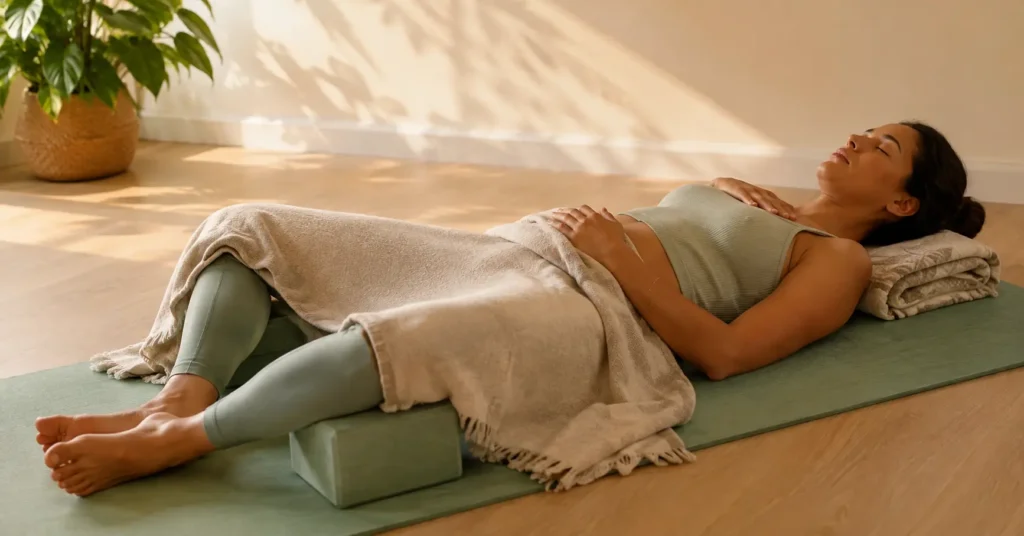
Lie on your back Bring the soles of your feet together and allow your knees to fall open to the sides Place yoga blocks or folded blankets under each knee to fully support the weight of your legs — this is essential, not optional Place a folded blanket under your head for comfort Place one hand on your lower belly and one on your heart Close your eyes and breathe diaphragmatically Feel your inner thighs and groin releasing with each exhale — not through effort, but through the gradual weight of supported gravityHold: 5–10 minutes
Endometriosis-specific note: The knee support is critical. Without blocks or blankets under the knees, the inner thigh muscles must work to hold the position — which prevents the pelvic floor from releasing. Full knee support transforms this from a stretch into a release.
Enhancement: Place a warm heat pad or hot water bottle on your lower belly while in this pose during flare days. The combination of external heat and the internal release created by the pose provides compounded pain relief.
5. Legs Up the Wall (Viparita Karani)
Legs Up the Wall is one of the most powerful restorative poses for endometriosis — combining mild inversion, complete muscular rest, and improved pelvic circulation in a single effortless position.
Why it specifically helps endometriosis: The mild inversion created by elevating the legs above the pelvis has three specific benefits for endometriosis:
Lymphatic drainage: Reverses the pooling of lymphatic fluid in the lower extremities and pelvic region, supporting the immune system’s management of the inflammatory environment around endometrial lesions Reduced pelvic congestion: Relieves the venous congestion that contributes to pelvic heaviness and bloating — common endometriosis symptoms Parasympathetic activation: The supine, legs-elevated position is one of the body’s clearest signals that no threat is present — deeply activating the rest-and-digest responseHow to do it:
Sit sideways next to a wall Swing your legs up the wall as you lower your back to the floor Shuffle your hips as close to the wall as is comfortable Let your legs rest completely against the wall — no muscular holding Place a folded blanket or bolster under your hips if desired — this slightly elevates the pelvis and enhances the inversion effect Arms rest at your sides, palms facing up Close your eyes and breathe naturallyHold: 5–15 minutes
Endometriosis-specific note: Avoid this pose during active menstruation if it increases pain or discomfort. Some women with endo find it deeply relieving during menstruation; others find it aggravating. Trust your body’s signal.
Contraindication: Avoid with glaucoma, very high blood pressure, or recent abdominal surgery. Always consult your healthcare provider if you have had recent endo-related surgery before practicing inversions.
6. Reclined Spinal Twist (Supta Matsyendrasana) — Gentle Version
A gentle supine twist supports endometriosis recovery by stimulating digestive organ function, releasing the muscles of the outer hip and lower back, and creating a mild massage effect for the pelvic organs.
Why it specifically helps endometriosis: Endometriosis frequently involves the bowel — either through direct lesion involvement or through the inflammatory environment affecting digestive motility. Gentle supine twists stimulate peristalsis (the muscular contractions that move food through the bowel), reducing the bloating and digestive discomfort that commonly accompany endo flares. The twist also releases the piriformis and quadratus lumborum — muscles that refer pain to the pelvic region when chronically tight.
How to do it:
Lie on your back with knees bent, feet flat Draw both knees to your chest and hold them briefly Let both knees fall slowly to the RIGHT — keeping them stacked on top of each other Place a folded blanket or bolster under your knees if they don’t comfortably reach the floor — this removes any strain from the lower back Extend your left arm out to the left at shoulder height, palm up Keep both shoulders grounded on the floor — do not force the twist Breathe slowly — feel the left side of your lower back and outer hip releasing with each exhale Stay for 10–12 slow breaths, then draw knees back to center and repeat on the LEFTHold: 10–12 breaths each side (approximately 5 minutes total)
Endometriosis-specific note: Keep this twist extremely gentle. You are not trying to create a deep rotational stretch — you are inviting a passive release of the muscles surrounding the pelvic cavity. Prop the knees generously and let gravity do all the work.
Avoid if: The twist creates any increase in pelvic or abdominal pain. Return to Constructive Rest and breathe.
7. Supported Bridge Pose (Setu Bandha Sarvangasana — Passive Version)
Supported Bridge — with a block under the sacrum — is the gentle inversion that most directly benefits the endometriosis pelvic environment without any of the risks associated with full inversions like Shoulderstand.
Why it specifically helps endometriosis: The passive elevation of the pelvis in Supported Bridge creates gentle traction through the pelvic floor, decompresses the sacroiliac joints (commonly irritated in endo), and improves circulation to the uterus and ovaries. Unlike active Bridge Pose (which strengthens the glutes and hamstrings), this supported version is entirely passive — the block does all the work.
How to do it:
Lie on your back with knees bent, feet flat on the mat hip-width apart Press gently through your feet to lift your hips a few inches Slide a yoga block under your sacrum (the flat triangular bone at the base of your spine — just above the tailbone) Lower your hips onto the block — find the height that feels comfortable: low, medium, or high Let your arms rest at your sides, palms up Allow your body to completely surrender to the support of the block Breathe diaphragmatically — feel your lower belly softening with each exhaleHold: 5–10 minutes
Endometriosis-specific note: The sacrum block height matters. Start on the lowest setting and only increase if the low setting feels comfortable. Higher settings create more traction but also more pressure — which may not be appropriate during active flares.
Avoid if: You have had recent laparoscopic surgery for endometriosis. Wait for your surgeon’s clearance before practicing any inversion, even passive ones.
8. Happy Baby Pose (Ananda Balasana) — Modified
Happy Baby creates a passive, gravity-assisted stretch through the inner groins, sacrum, and pelvic floor — directly targeting the tension patterns most associated with endometriosis-related pelvic pain.
Why it specifically helps endometriosis: The combination of hip external rotation, sacral grounding, and gentle traction through the inner thighs in Happy Baby creates what pelvic health physiotherapists describe as a “decompression” of the pelvic cavity. This reduction in intra-pelvic pressure directly reduces the sensation of pelvic congestion and heaviness.
How to do it:
Lie on your back and draw both knees toward your chest Open your knees wider than your torso Flex your feet — soles facing the ceiling Hold your outer ankles, outer shins, or the backs of your thighs — whichever is reachable without strain Gently draw your knees toward your armpits — only as far as is comfortable with zero pain Allow your lower back to soften and flatten against the mat Optional: rock very gently side to side — 1–2 cm in each direction — for a gentle sacral massageHold: 10–15 breaths (3–4 minutes)
Endometriosis-specific modification: If drawing the knees toward the armpits creates any pelvic pain, hold the backs of the thighs instead and keep the knees higher — reducing the depth of the hip flexion significantly. The pose should feel like a gentle opening, never a compression.
9. Butterfly Pose / Bound Angle (Baddha Konasana) — Seated Forward Fold
The seated Butterfly Pose combines inner thigh release with a gentle forward fold — stimulating the vagus nerve through abdominal compression while passively opening the groin and hip adductors.
Why it specifically helps endometriosis: The inner thigh muscles (adductors) are directly connected to the pelvic floor through fascial chains. In endometriosis, chronic pelvic pain causes protective tension in these muscles that perpetuates pain even when the inflammatory trigger is temporarily reduced. Butterfly Pose releases this tension passively and progressively with each held breath.
How to do it:
Sit on your mat — place a folded blanket under your hips if your pelvis tilts backward Bring the soles of your feet together and allow your knees to fall open Hold your feet or ankles with both hands Inhale and lengthen your spine Exhale and hinge gently forward from your hips — keeping your spine long rather than rounding Rest your forearms on the mat in front of you, or on your feet Let your head drop naturally if that feels comfortable Breathe slowly — with each exhale, notice your inner thighs releasing fractionally moreHold: 10–15 slow breaths (3–5 minutes)
Endometriosis-specific note: Do not force the knees toward the floor. The inner thigh release should be completely passive — driven by gravity and breath, never by muscular pressure on the knees. Forcing the knees down in this pose can actually increase pelvic floor tension, which is the opposite of what is needed.
10. Seated Forward Fold (Paschimottanasana) — Supported
The seated forward fold is one of yoga’s most powerful parasympathetic-activating postures — and in its supported version (with a bolster across the thighs), it becomes one of the most restorative poses available for chronic pelvic pain.
Why it specifically helps endometriosis: The forward fold position stimulates the vagus nerve through gentle abdominal compression. Higher vagal tone directly reduces systemic inflammation — one of the core pathological drivers of endometriosis. The supported version removes all muscular effort, allowing the nervous system to fully receive the parasympathetic signal without any competing muscular demand.
How to do it:
Sit with your legs extended straight in front of you Place a bolster or folded blanket across your thighs Inhale and lengthen your spine Exhale and hinge forward from your hips — let your torso rest on the bolster Rest your forehead on the bolster — this is the key: forehead support deepens the relaxation response significantly Let your arms rest wherever is comfortable — alongside the bolster or on the mat Breathe slowly and completely surrender the weight of your torso to the bolsterHold: 15–20 slow breaths (5–7 minutes)
Endometriosis-specific note: The forehead support in this pose is not optional — it is what converts a hamstring stretch into a deeply restorative nervous system intervention. Invest in a bolster or use a firm pillow. The difference in therapeutic effect is significant.
11. Yoga Nidra / Body Scan (Savasana-Based)
Yoga Nidra is not a physical pose — it is a guided lying-still meditation that induces a brain-wave state between waking and sleeping. For endometriosis, it is one of the most important practices in this entire guide.
Why it specifically helps endometriosis: Chronic pain conditions like endometriosis are associated with central sensitization — a state in which the central nervous system becomes hypersensitized to pain signals, amplifying the perception of pain beyond the level generated by the tissue itself. Yoga Nidra has been shown to reduce central sensitization by downregulating the pain-processing pathways of the brain and restoring more balanced nervous system function.
Additionally, the psychological burden of endometriosis — the grief, anxiety, anger, and isolation that accompany chronic illness — is directly addressed by the non-judgmental, body-inclusive awareness that Yoga Nidra cultivates.
How to do it:
Lie in Savasana — flat on your back, arms slightly away from the body, palms up Place a bolster under your knees for lower back comfort Cover yourself with a blanket — body temperature drops during deep relaxation Close your eyes and take 5 slow, deep breaths Begin a slow body scan — bring your awareness to each body part in sequence, consciously releasing:Body Scan Sequence:
Right foot → right calf → right thigh → right hip Left foot → left calf → left thigh → left hip Lower belly → uterus/pelvic region (send warmth and compassion here, not analysis) Lower back → middle back → upper back Right hand → right arm → right shoulder Left hand → left arm → left shoulder Throat → jaw → face → forehead → crown After completing the scan, rest in open awareness — not trying to sleep, not trying to stay awake If emotions arise — grief, frustration, sadness — allow them without resistance. They are part of the healingHold: 15–30 minutes
Endometriosis-specific note: When the body scan reaches the pelvic region, many women with endo experience a complex mix of physical sensation and emotion. This is not a problem to be solved — it is the practice working. Simply acknowledge what is present (“I notice pain here,” “I notice grief here”) and continue the scan without forcing release or change.
12. Supported Corpse Pose (Savasana — Fully Propped)
The closing pose of every endometriosis yoga session. In its fully supported form — bolster under knees, blanket over the body, eye pillow on — Savasana becomes a deeply restorative intervention for the fatigued nervous system of someone living with chronic pain.
Why it specifically helps endometriosis: Endometriosis fatigue is one of the most debilitating and least understood symptoms of the condition. It is driven not just by the physical demands of managing pain, but by the chronic hyperactivation of the sympathetic nervous system — which is exhausting at a cellular level. A fully supported, extended Savasana allows the nervous system to move into the deepest available rest state outside of actual sleep.
How to do it:
Lie flat on your back Place a bolster or firm pillow under your knees — this releases the lower back and reduces any sensation of pelvic pressure Cover your body with a light blanket Place an eye pillow or folded cloth over your eyes Let your feet fall open naturally Arms rest at your sides, palms facing up — slightly away from the body Consciously release every muscle — starting from the face and working downward Breathe naturally — no direction, no counting. Simply rest.Hold: 10–20 minutes minimum. There is no maximum.
Endometriosis-specific note: Many women with endo have a complicated relationship with rest — chronic pain often creates guilt around “doing nothing.” Reframe this: Supported Savasana is active healing. The nervous system is doing profound regulatory work during this time. Staying is the practice. Resting is the medicine.
Complete Endometriosis Yoga Sequence
Flare Day Sequence (15–20 Minutes — Minimal Movement)
For days when pain is high — focus on nervous system regulation only:
| 1 | Diaphragmatic Breathing | 5 min | Immediate pelvic floor release |
| 2 | Constructive Rest | 10 min | Psoas release, pain reduction |
| 3 | Reclined Butterfly (propped) | 10 min | Pelvic floor release |
| 4 | Yoga Nidra / Body Scan | 20 min | Central sensitization reduction |
| 5 | Supported Savasana | 10 min | Nervous system restoration |
Maintenance Phase Sequence (40–50 Minutes — Moderate Days)
For days between flares — focus on circulation, flexibility, and prevention:
| 1 | Diaphragmatic Breathing | 4 min | Parasympathetic activation |
| 2 | Constructive Rest | 5 min | Psoas release |
| 3 | Child’s Pose (wide knee) | 5 min | Pelvic floor + vagal tone |
| 4 | Reclined Butterfly (propped) | 7 min | Inner thigh + groin release |
| 5 | Legs Up the Wall | 10 min | Lymphatic drainage, circulation |
| 6 | Gentle Spinal Twist | 5 min | Digestive support + hip release |
| 7 | Supported Bridge | 7 min | Pelvic decompression |
| 8 | Happy Baby | 4 min | Sacral + pelvic release |
| 9 | Butterfly Forward Fold | 5 min | Inner thigh + vagal tone |
| 10 | Seated Forward Fold | 5 min | Deep parasympathetic |
| 11 | Supported Savasana | 10 min | Full integration |
Breathwork for Endometriosis: 3 Techniques
1. Extended Exhale Breathing (4:6 or 4:8 Ratio)
Best for: Acute pain, anxiety, flare days Inhale for 4 counts, exhale for 6–8 counts. The extended exhale directly activates the vagus nerve — reducing cortisol and pelvic floor tension within minutes. Practice for 5–10 minutes before any physical practice.
2. Belly Breathing with Pelvic Floor Awareness
Best for: Pelvic floor hypertonicity (chronic tightness) On each inhale — belly rises, pelvic floor descends and releases. On each exhale — belly falls, pelvic floor gently lifts. This conscious coordination of breath and pelvic floor movement is the most direct available tool for releasing chronic pelvic floor tension. Practice 10 cycles daily.
3. Nadi Shodhana (Alternate Nostril Breathing)
Best for: Hormonal balance, anxiety reduction, nervous system regulation Closes right nostril, inhale left. Close left, exhale right. Inhale right. Close right, exhale left. One cycle. Repeat 10 times. Nadi Shodhana balances the left and right branches of the autonomic nervous system — supporting hormonal equilibrium relevant to estrogen-dependent conditions like endometriosis.
What the Research Says: Yoga and Endometriosis
While dedicated research on yoga for endometriosis specifically is still emerging, the evidence base from related areas is strong:
Yoga and chronic pelvic pain: Multiple studies show yoga reduces perceived pain intensity and pain-related disability in women with chronic pelvic pain — the primary symptom of endometriosis.
Yoga and systemic inflammation: Research confirms yoga reduces inflammatory markers including IL-6 and TNF-alpha — cytokines directly implicated in endometriosis lesion growth and pain generation.
Yoga and cortisol: Yoga practice significantly reduces salivary and serum cortisol — directly addressing the stress-endometriosis connection outlined above.
Yoga and quality of life in chronic illness: Consistent evidence across multiple chronic pain conditions shows yoga improves quality of life, reduces anxiety and depression, and improves sleep — all dimensions significantly affected by endometriosis.
Research published by the National Center for Biotechnology Information confirms yoga’s role in autonomic nervous system regulation with direct implications for inflammatory conditions. (Read the research)
Yoga for Endometriosis: Lifestyle Considerations
Yoga is most effective for endometriosis when combined with broader lifestyle approaches:
Nutrition: An anti-inflammatory diet (reducing processed foods, refined sugar, and trans fats; increasing omega-3 fatty acids, leafy greens, and antioxidant-rich foods) complements the anti-inflammatory effects of yoga practice.
Sleep: Poor sleep amplifies pain perception in all chronic pain conditions. The yoga poses for sleep outlined in our Yoga Poses for Sleep guide directly support the sleep quality improvements that reduce endo pain sensitivity.
Stress management: Beyond formal yoga practice, reducing chronic stress through boundaries, nature exposure, and mindfulness supports the hormonal balance that endo management requires.
Medical care: Yoga is a complementary practice — not a replacement for medical management. Continue working with your gynecologist, endometriosis specialist, or pelvic health physiotherapist alongside your yoga practice.
Conclusion
Endometriosis asks something difficult of the people who live with it: to keep showing up for a body that sometimes feels like it is working against them.
Yoga — specifically the gentle, restorative, breath-centered yoga described in this guide — is one way to begin changing that relationship. Not by ignoring the pain or pushing through it. Not by pretending the condition is not real or that movement is always easy.
But by offering the body something it rarely receives when it is in chronic pain: stillness, warmth, breath, and the unhurried signal that it is safe.
The psoas can release. The pelvic floor can soften. The cortisol can drop. The nervous system can find its way back to rest.
This does not happen in one session. It happens over weeks and months of consistent, compassionate practice — ten minutes on the hardest days, forty minutes when the body allows.
You do not need to be flexible. You do not need to be well. You need a mat, some blankets, and the willingness to breathe.
Begin where you are. Your body will meet you there. Visit TheShivYoga.com and practice with us.
Medical Disclaimer: This article is for informational and educational purposes only. It does not constitute medical advice and is not a substitute for professional medical care. Endometriosis is a complex medical condition requiring diagnosis and management by a qualified healthcare provider. Always consult your gynecologist, endometriosis specialist, or pelvic health physiotherapist before beginning any new exercise or yoga practice. If any yoga pose increases your pain, stop immediately and rest.
FAQ Section
Q1: Can yoga cure endometriosis?
No — yoga cannot cure endometriosis. Endometriosis is a chronic condition requiring medical management. Yoga is a complementary practice that can meaningfully reduce pain perception, lower systemic inflammation, release pelvic floor tension, and improve quality of life alongside medical treatment. Always continue working with your gynecologist or endometriosis specialist.
Q2: Which yoga poses should I avoid with endometriosis?
Avoid hot yoga, fast-paced vinyasa, intense core strengthening (Boat Pose, intense Plank), full inversions during menstruation (Headstand, Shoulderstand), and any pose that causes pelvic pain. During flare days, limit practice to diaphragmatic breathing, Constructive Rest, Reclined Butterfly, and Yoga Nidra. Always exit any pose that increases pain immediately.
Q3: Is restorative yoga or yin yoga better for endometriosis?
Both are highly effective — for slightly different reasons. Restorative yoga (with full prop support) is better for flare days and acute pain because it requires zero muscular effort. Yin yoga (long-held floor poses without full prop support) is better for maintenance phases because it targets the fascial restrictions caused by adhesions. Ideally, use both — restorative during flares, yin between flares.
Q4: How often should I practice yoga for endometriosis?
Daily practice delivers the greatest benefit for endometriosis — even 10–15 minutes of diaphragmatic breathing and Constructive Rest on flare days. On moderate days, a 30–40 minute maintenance sequence 4–5 times per week is ideal. Consistency matters more than duration. Short daily practice outperforms occasional long sessions for chronic pain management.
Q5: Can yoga help with endometriosis-related fatigue?
Yes — yoga specifically addresses endometriosis fatigue through two mechanisms: it reduces the sympathetic nervous system hyperactivation that drives adrenal fatigue, and it improves sleep quality through the bedtime yoga practices covered in our Yoga Poses for Sleep guide. Yoga Nidra in particular is one of the most restorative practices available for chronic illness fatigue — inducing a deeply restorative brain-wave state during wakeful rest.
























.jpg&h=630&w=1200&q=100&v=c0f97a310e&c=1)