Alternate Nostril Breathing (Nadi Shodhana): Complete Guide to Benefits, Technique and Science
⚡ Quick Answer BoxAlternate nostril breathing — known in Sanskrit as Nadi Shodhana pranayama — is a yogic breathing technique […]
 Hollif

⚡ Quick Answer Box
Alternate nostril breathing — known in Sanskrit as Nadi Shodhana pranayama — is a yogic breathing technique in which you inhale through one nostril, close it, then exhale through the other, alternating sides with each breath cycle. It balances the left and right hemispheres of the brain, activates the parasympathetic nervous system, reduces cortisol, lowers blood pressure, and significantly improves mental clarity and emotional regulation. Research confirms measurable reductions in anxiety, heart rate, and blood pressure within a single 10-minute session.
Most people breathe the same way every day — automatically, shallowly, and without any awareness of which nostril is doing more of the work.
What if changing which nostril you breathe through — in a specific, alternating pattern — could measurably calm your nervous system, sharpen your focus, lower your blood pressure, and balance the electrical activity of your brain within minutes?
This is not a metaphor. Alternate nostril breathing — one of the most researched pranayama techniques in yoga — produces these results through documented physiological mechanisms that modern science continues to validate.
Whether you are new to breathwork and looking for your first pranayama practice, or an experienced yogi wanting to deepen your understanding of Nadi Shodhana, this guide covers everything: the ancient framework, the neuroscience, the complete step-by-step technique, the specific benefits, common mistakes, and a structured daily practice plan.
What Is Alternate Nostril Breathing? Definition and Origin
Alternate nostril breathing is a controlled pranayama (yogic breath regulation) practice in which the breath alternates between the left and right nostrils in a specific sequence — using the fingers of one hand to close one nostril at a time.
In Sanskrit it is called Nadi Shodhana (नाडी शोधन) — a compound word meaning:
Nadi = energy channel or pathway (the subtle channels through which prana, or life force, flows in the body) Shodhana = purification or cleansingThe literal translation is therefore: “purification of the energy channels.”
Nadi Shodhana appears in several classical yogic texts including the Hatha Yoga Pradipika (15th century) and the Gherand Samhita — where it is described as one of the most important pranayama practices for purifying the 72,000 nadis (energy channels) of the subtle body and preparing the practitioner for deeper meditation.
Alternate Nostril Breathing vs Anulom Vilom: Are They the Same?
This is one of the most common questions about this practice — and the answer requires a clear distinction:
| Basic technique | Alternate nostril breathing | Alternate nostril breathing |
| Breath retention (Kumbhaka) | Includes internal breath retention | No breath retention |
| Complexity | Intermediate to advanced | Beginner-friendly |
| Ratio | 1:4:2 (inhale:hold:exhale) | 1:0:1 (inhale:exhale only) |
| Best for | Advanced pranayama practice | Beginners and daily practice |
| Sanskrit tradition | Classical Hatha Yoga | Modern yoga teaching |
In practical terms: Anulom Vilom is alternate nostril breathing without breath retention — making it the version covered in this guide and the most appropriate starting point for beginners and most practitioners. The term “Nadi Shodhana” is used throughout this guide as it is the most widely recognized name, but the technique described is the beginner-accessible version without kumbhaka (breath retention).
The Science Behind Alternate Nostril Breathing
Understanding the physiology makes the practice more compelling — and the results more predictable. Here are the primary scientific mechanisms through which alternate nostril breathing produces its documented effects.
The Nasal Cycle: Your Brain’s Built-In Rhythm
Most people do not realize that the human nose operates in a continuous alternating cycle — known as the nasal cycle — in which one nostril dominates airflow for approximately 1.5–4 hours before switching to the other.
This nasal cycle is controlled by the autonomic nervous system and corresponds to alternating activity between the left and right cerebral hemispheres:
Right nostril dominant: Activates the left brain hemisphere and the sympathetic nervous system — associated with logical thinking, verbal processing, alertness, and increased energy Left nostril dominant: Activates the right brain hemisphere and the parasympathetic nervous system — associated with creative thinking, spatial awareness, relaxation, and emotional processingAlternate nostril breathing consciously regulates this natural cycle — using deliberate breath alternation to bring both hemispheres into balance simultaneously rather than allowing one to dominate.
Ida and Pingala Nadis: The Yogic Framework
In yogic anatomy, the two nostrils correspond to two of the most important nadis (energy channels) in the subtle body:
| Ida | Left nostril | Moon (Chandra) | Cooling, receptive, calm | Parasympathetic |
| Pingala | Right nostril | Sun (Surya) | Heating, active, energizing | Sympathetic |
| Sushumna | Central channel | Fire | Balance, transcendence | Balanced |
When Ida and Pingala are balanced — as Nadi Shodhana is specifically designed to achieve — prana (life force energy) moves into the central channel (Sushumna), creating the conditions for clear awareness, emotional equilibrium, and deep meditation.
This ancient framework maps remarkably well onto modern neuroscience’s understanding of bilateral brain hemisphere balance — a convergence that has made Nadi Shodhana one of the most studied pranayama practices in contemporary research.
The Neuroscience: What Research Shows
Brain hemisphere balance: A study published in the International Journal of Yoga found that alternate nostril breathing produced significant improvements in spatial memory and verbal performance simultaneously — tasks associated with right and left hemisphere function respectively — suggesting genuine bilateral activation and balance.
Autonomic nervous system regulation: Research confirms that alternate nostril breathing activates the parasympathetic nervous system (via vagal stimulation) while simultaneously preventing the excessive sympathetic suppression that can cause drowsiness — producing a unique state of calm alertness that few other interventions can achieve.
Blood pressure and heart rate: A study in the Journal of Ayurveda and Integrative Medicine found that 10 minutes of Nadi Shodhana significantly reduced both systolic and diastolic blood pressure and lowered heart rate in hypertensive participants.
Cortisol and stress markers: Research published by the National Center for Biotechnology Information confirms that pranayama practices including alternate nostril breathing activate the parasympathetic nervous system — directly reducing cortisol and its downstream effects on anxiety, inflammation, and immune suppression. (Read the research)
Respiratory function: Alternate nostril breathing significantly improves forced vital capacity (FVC), forced expiratory volume (FEV1), and peak expiratory flow rate — markers of lung function and respiratory efficiency.
The Complete Benefits of Alternate Nostril Breathing
1. Reduces Anxiety and Stress Within Minutes
Alternate nostril breathing reduces anxiety faster than almost any other non-pharmaceutical intervention available. The mechanism is direct: the alternating nasal airflow stimulates the olfactory bulb and the hypothalamus, which sends immediate calming signals to the amygdala — the brain’s threat-detection center.
Within a single 5–10 minute session, measurable reductions in:
Perceived stress and anxiety Heart rate Skin conductance (a physiological marker of anxiety) Cortisol levelsThis makes it one of the most practical acute anxiety interventions available — accessible anywhere, at any time, with no equipment required.
2. Balances Left and Right Brain Hemisphere Activity
The brain’s two hemispheres process information differently and are active at different intensities throughout the day. Chronic dominance of one hemisphere — typically the left (analytical, verbal, stress-oriented) in modern adults — is associated with rumination, anxiety, difficulty accessing creativity, and difficulty entering restful states.
Alternate nostril breathing creates measurable bilateral hemisphere balance within minutes of practice. This produces the characteristic mental state practitioners describe: simultaneously clear and calm, focused and creative, alert and at ease. This state is neurologically distinct from either pure relaxation (parasympathetic dominance) or pure alertness (sympathetic dominance).
3. Lowers Blood Pressure
Alternate nostril breathing is one of the most researched natural interventions for blood pressure management. The mechanism involves three simultaneous effects:
Vagal activation — stimulation of the vagus nerve reduces heart rate and peripheral vascular resistance, directly lowering blood pressure.
Cortisol reduction — chronic cortisol elevation causes arterial stiffness and sodium retention. Reducing cortisol through pranayama reduces both.
Nitric oxide production — nasal breathing (both nostrils) stimulates nitric oxide production in the nasal sinuses. Nitric oxide is a potent vasodilator — it relaxes the smooth muscle of blood vessel walls, reducing vascular resistance and lowering blood pressure.
4. Improves Focus, Clarity and Cognitive Performance
The calm-alert state produced by alternate nostril breathing is the neurological ideal for sustained focus, problem-solving, and creative work. Research shows improvements in:
Sustained attention — reduced mind-wandering, improved task engagement Working memory — improved short-term information holding and manipulation Cognitive flexibility — improved ability to shift between tasks and perspectives Spatial reasoning — improved right hemisphere-dependent visual-spatial processingThis makes a 5–10 minute Nadi Shodhana session one of the most effective pre-work or pre-study practices available.
5. Improves Sleep Quality
Left nostril breathing specifically activates the parasympathetic nervous system and has been shown to reduce core body temperature — one of the physiological prerequisites for sleep onset. Practicing Nadi Shodhana in the 30–60 minutes before bed — ending on a left nostril exhale — transitions the nervous system from the sympathetic-dominant state of the waking day into the parasympathetic-dominant state of sleep preparation.
Combined with the yoga poses covered in our Yoga Poses for Sleep guide, alternate nostril breathing forms the most complete natural sleep preparation protocol available through yoga.
6. Supports Immune Function
Alternating nasal breathing increases the production of nasal nitric oxide — a potent antiviral and antibacterial agent produced by the nasal mucosa. The alternating warming and humidification of each nostril also directly supports the mucosal immune defense of the upper respiratory tract — the primary entry point for respiratory pathogens.
As detailed in our Yoga to Increase Immune System guide, regular pranayama practice produces measurable improvements in natural killer cell activity, salivary immunoglobulin A (IgA), and inflammatory cytokine regulation.
7. Balances Hormones and Supports the Endocrine System
The hypothalamus — the master regulator of the endocrine system — is directly stimulated by the olfactory signals produced by alternating nasal airflow. The hypothalamus governs the production and regulation of cortisol, estrogen, testosterone, thyroid hormones, and melatonin.
Regular Nadi Shodhana practice supports hypothalamic regulation — contributing to more balanced cortisol rhythms, improved thyroid function, and better melatonin production (directly supporting sleep quality and immune function).
8. Purifies the Respiratory System
The mechanical effects of alternate nostril breathing include:
Improved mucociliary clearance — the nasal cilia (tiny hair-like structures that sweep pathogens and debris from the nasal passages) are stimulated by the alternating airflow Improved sinus drainage — the alternating pressure changes in the nasal passages stimulate drainage of the paranasal sinuses, reducing the risk of sinusitis Increased vital capacity — with regular practice, the lungs develop greater capacity and efficiency Reduced mouth breathing — establishing nasal breathing as the default pattern, which filters, warms, and humidifies inhaled airHow to Do Alternate Nostril Breathing: Complete Step-by-Step Guide
What You Need
A comfortable seat — on a yoga mat, meditation cushion, or chair Quiet environment — external stimulation interrupts the attentional focus that amplifies the practice’s effects Empty or light stomach — practice at least 1–2 hours after eating 5–20 minutes of uninterrupted timeThe Hand Position: Vishnu Mudra
Alternate nostril breathing uses a specific hand gesture called Vishnu Mudra with the right hand:
Hold your right hand in front of your face Fold your index finger and middle finger toward your palm (or rest them on your forehead between the eyebrows) Your thumb will close the right nostril Your ring finger (and optionally little finger) will close the left nostril Your left hand rests on your left knee — palm facing up in a mudra of receptivity, or in Gyan Mudra (thumb and index finger touching)Why Vishnu Mudra: The gentle pressure of the thumb and ring finger on the nasal passages is sufficient to direct airflow without blocking it completely — maintaining the awareness of nasal sensation that is central to the practice.
The Complete Technique: Step by Step
Preparation (2 minutes)
Sit comfortably with your spine tall — either cross-legged on the floor or in a chair with both feet flat Rest your left hand on your left knee Close your eyes Take 3–5 natural breaths — allowing your breathing to settle and your mind to arrive in the present moment Bring your right hand into Vishnu MudraThe Basic Alternate Nostril Breathing Sequence
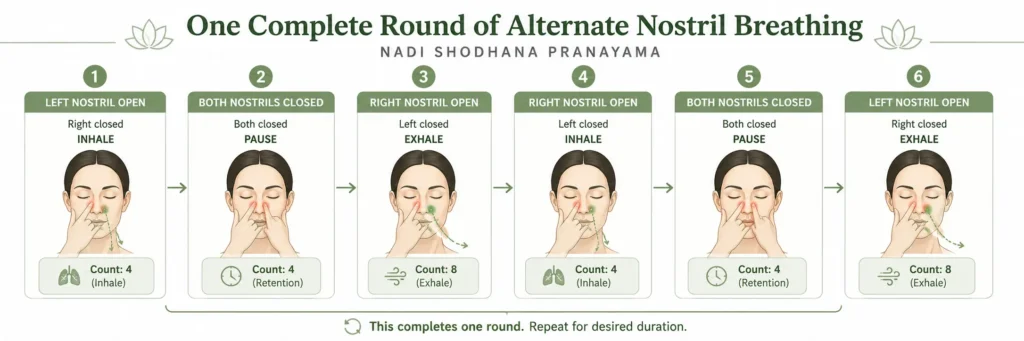
Round 1 (and all subsequent rounds):
Step 1: Close your right nostril with your right thumb. Inhale slowly and completely through your left nostril — count 4 counts.
Step 2: At the top of the inhale — close both nostrils momentarily (no breath retention for beginners — simply pause for 1 count).
Step 3: Release your right nostril (keep left closed with ring finger). Exhale slowly and completely through your right nostril — count 4 counts.
Step 4: Without pausing — inhale through the right nostril — count 4 counts (left nostril remains closed).
Step 5: At the top — close both nostrils for 1 count.
Step 6: Release your left nostril (keep right closed with thumb). Exhale slowly through the left nostril — count 4 counts.
This completes ONE full round of alternate nostril breathing.
Summary Pattern (Easy Reference)
Close RIGHT → Inhale LEFT (4 counts) Close BOTH → Pause (1 count) Open RIGHT, close LEFT → Exhale RIGHT (4 counts) Inhale RIGHT (4 counts) Close BOTH → Pause (1 count) Open LEFT, close RIGHT → Exhale LEFT (4 counts) = 1 Complete RoundHow Many Rounds to Practice
| Complete beginner | 5 rounds | 3–4 min | 4:0:4 (no retention) |
| Beginner (week 2+) | 10 rounds | 6–8 min | 4:1:4 |
| Intermediate | 15 rounds | 10–12 min | 4:2:6 |
| Advanced | 20+ rounds | 15–20 min | 4:4:8 |
Always begin with 5 rounds and build gradually over weeks — not days.
Advanced Variation: With Breath Retention (Kumbhaka)
Once the basic technique is comfortable (typically after 4–6 weeks of daily practice), you can introduce Antara Kumbhaka — internal breath retention after the inhale.
Classical ratio: 1:4:2
Inhale: 4 counts Retain: 16 counts Exhale: 8 countsPractical beginner approach to retention:
Inhale: 4 counts Retain: 4 counts Exhale: 8 countsImportant: Never strain during breath retention. If you feel any discomfort, urge to gasp, or tension in the face or throat — the retention is too long. Shorten it significantly.
Avoid breath retention if: You have high blood pressure, heart conditions, anxiety disorders, glaucoma, or are pregnant.
Common Mistakes in Alternate Nostril Breathing
❌ Breathing Through the Mouth
Every breath — both inhale and exhale — must be through the nose. Mouth breathing in Nadi Shodhana completely defeats the purpose, bypassing the olfactory, nasal mucosal, and nitric oxide mechanisms that produce the practice’s effects.
❌ Blocking the Nostril Too Hard
The finger and thumb should close the nostril just enough to redirect airflow — not create a complete hermetic seal that requires significant pressure. Heavy pressing causes tension in the face and neck that counteracts the relaxation response.
❌ Rushing the Breath
The breath in Nadi Shodhana should be slow, smooth, and silent. If you can hear your own breath across the room — it is too fast. The inhale and exhale should be long enough that you genuinely cannot rush them without effort.
❌ Counting Too Fast
The count should be approximately one second per count — making a 4-count inhale last approximately 4 seconds. Beginners often count much faster than this. Use a clock or metronome once to calibrate your count accurately.
❌ Practicing Immediately After Eating
The diaphragmatic movement and vagal activation of pranayama are significantly impaired by a full stomach. Practice on an empty or light stomach — at minimum 1 hour after a light meal, 2–3 hours after a full meal.
❌ Tensing the Shoulders and Face
The non-practicing arm, the face, and the jaw should be completely relaxed throughout. A common beginner pattern is to raise and tense the right shoulder during the practice — actively release it at the start of each round.
❌ Practicing in the Wrong Position
Lying down during Nadi Shodhana changes the dynamics of nasal airflow and reduces the clarity of nostril alternation. Always practice seated with the spine upright — this allows the full respiratory movement needed for effective pranayama.
When and How Often to Practice Alternate Nostril Breathing
Best Times to Practice
Early morning (Brahma Muhurta — 4:00–6:00 AM) The classical yogic time for pranayama. The mind is naturally quiet, the stomach is empty, and the atmospheric energy supports deep practice. Even 10 minutes of Nadi Shodhana at this time produces the most potent effects.
Before meditation Alternate nostril breathing is one of the most effective meditation preparation practices available. It brings the mind to the calm-alert state that allows meditation to deepen quickly — replacing the typical 10–15 minutes of mental settling most beginners experience at the start of a session.
During work — as a focus reset A 5-minute Nadi Shodhana practice between tasks or before a challenging meeting resets the nervous system, sharpens focus, and clears mental residue from the previous activity.
Before bed A 10-minute practice — ending on a left nostril exhale — transitions the nervous system toward the parasympathetic-dominant state of sleep preparation. More effective than most sleep supplements and completely drug-free.
During anxiety or stress response Nadi Shodhana is one of the fastest available interventions for acute anxiety. Even 5 rounds (3–4 minutes) produces measurable reductions in anxiety and heart rate — making it practical during stressful situations.
Daily Practice Recommendation
| General wellbeing | Daily | 10 min | Morning |
| Anxiety management | 2× daily | 5–10 min | Morning + before bed |
| Blood pressure support | Daily | 15–20 min | Morning |
| Sleep improvement | Daily | 10 min | 30–60 min before bed |
| Meditation preparation | Before each sit | 5–10 min | Anytime |
| Focus enhancement | As needed | 5 min | Before work/study |
Alternate Nostril Breathing for Specific Conditions
For Anxiety
End every round on a left nostril exhale — left nostril exhalation maximally activates the parasympathetic nervous system (via Ida nadi). During acute anxiety, begin immediately with 10 rounds regardless of time of day.
For High Blood Pressure
Practice daily for a minimum of 15 minutes — without breath retention. The blood pressure-lowering effect is cumulative and builds over 4–8 weeks of consistent practice. Never replace medication without consulting your doctor.
For Poor Sleep
Practice in a dimly lit room 30–60 minutes before your intended sleep time. End the session on a left nostril exhale. Follow immediately with Yoga Nidra or Yoga Poses for Sleep for compounded effect.
For Focus and Cognitive Performance
Practice 10 rounds before beginning focused work. End on a right nostril exhale — right nostril exhalation activates the sympathetic nervous system mildly, increasing alertness while maintaining the clarity produced by the practice.
For Immune Support
Combine with Bhramari pranayama (humming breath) immediately after Nadi Shodhana — the combination of bilateral nasal activation from Nadi Shodhana and the nitric oxide surge from Bhramari creates the strongest available pranayama-based immune response. See our Yoga to Increase Immune System guide for the complete protocol.
How to Build a Complete Pranayama Practice Around Nadi Shodhana
Alternate nostril breathing does not exist in isolation — it is most powerful as part of a structured pranayama sequence:
Beginner Daily Pranayama Sequence (15 Minutes)
| 1 | Natural breath observation | 2 min | Arrive in the present moment |
| 2 | Diaphragmatic breathing (4:6 ratio) | 3 min | Activate vagal tone |
| 3 | Nadi Shodhana / Alternate Nostril | 8 min | Balance and clarity |
| 4 | Bhramari (humming breath) | 2 min | Deepen parasympathetic |
Intermediate Daily Pranayama Sequence (25 Minutes)
| 1 | Diaphragmatic breathing | 3 min | Foundation |
| 2 | Kapalabhati (30 rounds × 3) | 5 min | Cleanse + energize |
| 3 | Nadi Shodhana with light retention | 12 min | Balance + depth |
| 4 | Bhramari | 3 min | Integration |
| 5 | Stillness / Meditation | 5 min | Rest in the effect |
Nadi Shodhana in the Context of the 8 Limbs of Yoga
In Patanjali’s classical eight-limbed yoga system (Ashtanga), pranayama is the fourth limb — positioned between the physical postures (asanas) and the inner practices of withdrawal (pratyahara), concentration (dharana), meditation (dhyana), and absorption (samadhi).
This positioning is not coincidental. Pranayama is the bridge between the outer, physical dimension of yoga practice and the inner, meditative dimension. It is through conscious breath regulation — and specifically through practices like Nadi Shodhana — that the practitioner begins to work with prana directly, gradually developing the capacity to withdraw attention from external objects and sustain it internally.
Practical implication: If you currently practice physical yoga (asanas) and want to develop a meditation practice, Nadi Shodhana is the most important single practice to add. It provides the neurological and energetic bridge between the two.
Contraindications and Safety Considerations
Alternate nostril breathing is one of the safest pranayama practices available — but the following guidelines apply:
Avoid or modify if:
Severely blocked sinuses or nasal congestion: Wait until nasal passages are clear. Attempting Nadi Shodhana with fully blocked sinuses creates pressure that can worsen congestion or cause sinus pain. Acute respiratory infection: Rest is more appropriate than pranayama during active respiratory illness. Return to practice during recovery. High blood pressure (uncontrolled): Practice without breath retention only. Breath retention elevates intrathoracic pressure temporarily, which is not appropriate for uncontrolled hypertension. Glaucoma: Avoid breath retention. The intraocular pressure increase during kumbhaka can aggravate glaucoma. Pregnancy: The basic technique (without retention) is generally considered safe during pregnancy. Avoid kumbhaka entirely. Always consult your midwife or healthcare provider. Anxiety disorders: The basic technique is excellent for anxiety. Avoid breath retention until the basic practice is very well established — kumbhaka can temporarily increase anxiety in sensitive practitioners. Recent nasal surgery: Wait for clearance from your surgeon.Stop immediately if you experience:
Dizziness or lightheadedness (reduce breath length and pace) Tingling in hands or face (sign of over-breathing — slow down significantly) Any pain in the sinuses, ears, or chest Significant increase in anxiety or heart rateConclusion
There is something quietly revolutionary about alternate nostril breathing.
It requires no equipment. No experience. No strength or flexibility. No particular time of day. Just your hands, your nose, and five minutes of willingness to pay attention to something you have been doing unconsciously every moment of your life.
And yet — in those five minutes — something genuinely changes. The mind becomes clearer. The shoulders drop. The jaw unclenches. The breath slows into a rhythm that feels, somehow, more like yours than the shallow, anxious breathing that preceded it.
This is what the ancient yogis described as purification of the nadis — the clearing of the channels through which life force moves. And while modern neuroscience uses different language — autonomic balance, bilateral hemisphere activation, vagal tone, cortisol reduction — it is describing exactly the same phenomenon.
The channels clear. The energy flows. The mind finds the balance it has been searching for.
Five rounds. Right now. Close your right nostril, and begin.
Your practice is waiting — visit TheShivYoga.com for guided pranayama sessions, breathwork courses, and a community that breathes together.
Disclaimer: This article is for informational and educational purposes only. It does not constitute medical advice. If you have high blood pressure, heart disease, respiratory conditions, glaucoma, or are pregnant, consult your healthcare provider before beginning any pranayama practice. Never replace prescribed medication with breathing exercises without medical guidance.
Key Takeaways
Alternate nostril breathing (Nadi Shodhana) is a pranayama technique that alternates breath between left and right nostrils, balancing the brain hemispheres, autonomic nervous system, and the yogic Ida and Pingala nadis simultaneously. The nasal cycle — the body’s natural alternation of dominant nasal airflow — directly corresponds to alternating brain hemisphere and autonomic nervous system activity. Nadi Shodhana consciously regulates this cycle. Left nostril breathing activates the parasympathetic nervous system and right brain hemisphere — calming, receptive, creative. Right nostril breathing activates the sympathetic nervous system and left brain hemisphere — energizing, alert, analytical. Alternate nostril breathing together produces a uniquely balanced state of calm alertness that neither nostril alone can achieve. Research confirms measurable improvements in anxiety, blood pressure, heart rate, cortisol, lung function, and cognitive performance within 8–12 weeks of daily practice. The Vishnu Mudra hand position uses the thumb to close the right nostril and the ring finger to close the left — with just enough pressure to redirect airflow, never creating tension. Begin with 5 rounds (3–4 minutes) and build to 15–20 minutes daily over 4–6 weeks. Avoid during nasal congestion, uncontrolled hypertension, or active respiratory illness. The basic technique (without breath retention) is appropriate for most practitioners including beginners. Nadi Shodhana is the bridge between physical yoga and meditation — practicing it before sitting transforms the quality of meditation more reliably than any other preparation.FAQ Section
Q1: How long should I practice alternate nostril breathing each day?
Beginners should start with 5 minutes (5 rounds) daily for the first week, increasing to 10 minutes (10 rounds) in week 2, and 15–20 minutes after 4–6 weeks. Daily consistency matters more than session length. Even 5 minutes of Nadi Shodhana practiced every day produces measurable autonomic and cognitive benefits within 4–8 weeks.
Q2: Can I do alternate nostril breathing if I have a blocked nose?
No — practice only when nasal passages are reasonably clear. Attempting alternate nostril breathing with blocked sinuses creates pressure and reduces the practice’s effectiveness. Use saline nasal rinse (Jala Neti) to clear the nasal passages before practice, or wait until congestion clears. Steam inhalation 10 minutes before practice can also help open the nasal passages.
Q3: What happens if I practice alternate nostril breathing every day?
With daily practice of 10–15 minutes over 8–12 weeks, research documents: reduced resting heart rate, lower systolic and diastolic blood pressure, reduced cortisol and anxiety scores, improved lung function markers (FVC, FEV1), improved sleep quality, and improved scores on cognitive tests of attention, memory, and spatial reasoning. Many practitioners also report improved emotional regulation and a reduced startle response to stress.
Q4: Is it better to practice alternate nostril breathing in the morning or at night?
Both times offer distinct benefits. Morning practice produces the calm-alert state ideal for focused work, creative thinking, and meditation — it sets the neurological tone for the entire day. Evening practice (ending on left nostril exhale) transitions the nervous system toward sleep preparation. For maximum benefit — practice both. If you can only choose one: morning practice for general wellbeing, evening practice if your primary goal is sleep improvement.
Q5: Can alternate nostril breathing help with high blood pressure?
Research supports alternate nostril breathing as a complementary (not standalone) intervention for high blood pressure. Studies show significant reductions in both systolic and diastolic BP after consistent practice. The mechanism involves vagal activation, nitric oxide-mediated vasodilation, and cortisol reduction. Always continue prescribed medication and consult your doctor before modifying treatment. Never replace antihypertensive medication with pranayama alone.