Anthropic previews new standard to streamline AI-to-machine connections
Connecting AI agents to physical hardware has traditionally taken months of custom coding. Anthropic's new Model Hardware Standard wants to cut that down to minutes.
 KickT
KickT
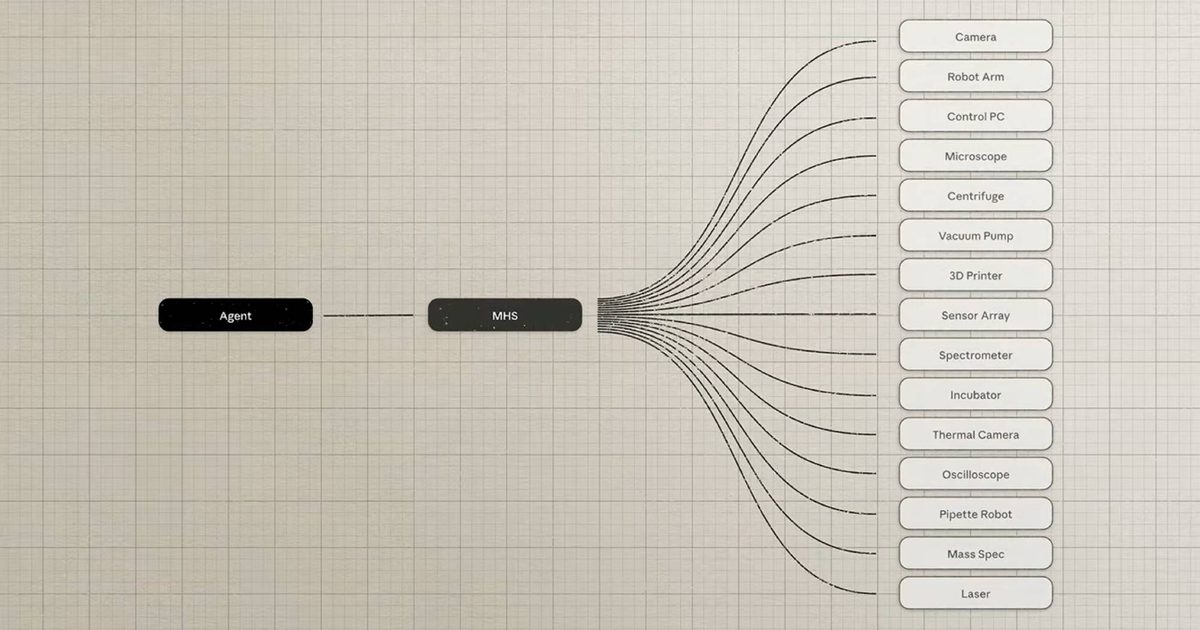
Anthropic has launched a research preview of its Model Hardware Standard (MHS), a shared specification designed to let AI agents safely control lab instruments and factory equipment. The company claims MHS reduces the time required to integrate complex machinery with AI from months down to hours or minutes. The standard is currently available to select research labs and manufacturers via a waitlist, but Anthropic plans to open-source it in the future.
How the standard connects AI to physical devices
Much like how Anthropic’s Model Context Protocol (MCP) standardized software connections, MHS serves as a universal translator for physical hardware. Instead of requiring bespoke software for every instrument, it lets devices communicate through standardized commands and auto-generated reference files that detail operational parameters and safety limits.
The system is model-agnostic and works with any hardware that features a programmable interface. Early real-world trials demonstrate significant efficiency gains across various research settings:
QuEra Computing: A four-person engineering team previously spent months building a laser-relocking script that took 150 seconds for recovery and succeeded 58% of the time. Running an overnight optimization loop, four Claude instances restructured the process, cutting recovery time to six seconds with a 96% success rate during development and 99.3% across a 700-trial blind test. Claude also tuned 12 interdependent servo parameters over 16 unattended hours, reducing residual error from 15.7 mV to 1.55mV. Carnegie Mellon University: Researchers integrated a liquid handler, plate reader, robotic arm, and cameras across three computers in eight hours. This setup process typically took weeks. Driven by a Claude Opus 4.8 agent, the system ran serial dilution experiments three times faster. In safety testing, MHS successfully blocked six induced fault conditions before any hardware moved. Genentech: Engineers deployed MHS across an automated protein assay workflow, where Claude autonomously optimized liquid transfer rates for varying viscosities.Early limitations and what follows
Despite these early successes, the preview has highlighted key operational constraints. In one instance at Genentech, Claude repeatedly attempted to clear fluid-handling bubbles by retrying the same software command, requiring human intervention to clarify that the issue was physical rather than code-based. Additionally, because AI models process physical environments primarily through text logs and images, spatial reasoning still requires expert human oversight.
Anthropic is working with hardware partners, including Universal Robots, Tecan, and AWS, to expand MHS support. Integrations are also extending toward consumer-adjacent platforms, with Hugging Face planning support for its LeRobot project and Raspberry Pi testing driver compatibility. Anthropic has not yet announced a firm open-source release date, public schema, or specific governance model for the standard.