How Agencies Turn Email Marketing Into a High-Margin Service
Email marketing for agencies should be a highly profitable service. But too often, it’s packaged as another deliverable added to a broader retainer, leaving agencies to absorb the strategy, production, platform, and reporting work without charging for its full...
 BigThink

Email marketing for agencies should be a highly profitable service. But too often, it’s packaged as another deliverable added to a broader retainer, leaving agencies to absorb the strategy, production, platform, and reporting work without charging for its full value.
The reality of that approach is it’s leaving revenue on the table for what could be a high-margin service that drives significant ROI for clients.
For clients, email drives leads, sales, and long-term customer value. For agencies, email creates recurring revenue, expansion opportunities, and stronger retention. The problem is typically how the service is positioned and operated.
To maximize profit, agencies need to treat email as a product of its own: priced around value, delivered through scalable systems, supported by margin-friendly technology, and designed to prove ROI early. This article explains how to build that model — from packaging and platform selection to automation, deliverability, performance monitoring, and client reporting.
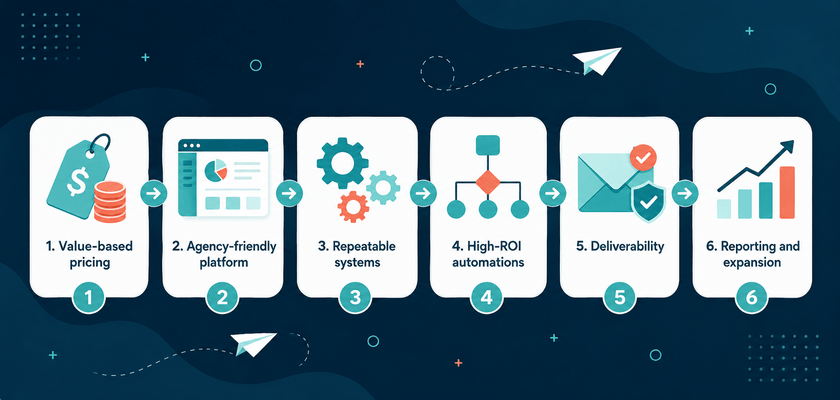
The Email Marketing for Agencies Profit Model
The pricing model should begin with what the agency is actually selling. An agency sells growth, strategy, and execution, and if the pricing doesn’t say so, margin is left on the table.
Here’s the formula for pricing email marketing services:
Monthly Retainer = Base Service + Add-Ons + Managed platform fee
Two or three tiers simplifies the buying decision while giving clients clear upgrade paths. For example, three tiers could be:
Foundation tier at $500-$1,000 a month covering a couple of campaigns, one landing page, basic list management, and a monthly report Scale tier at $1,200-$2,500 with four to six campaigns, starter automations, branded templates, and biweekly reporting Full Lifecycle tier running $3,500 to well past $10,000 for SaaS and high-volume ecommerce clients who need unlimited campaigns and landing pages, advanced flows, full creative, A/B testing, segmentation strategy, and custom dashboardsHowever, the retainer is only part of the picture. Well-scoped add-ons can carry a higher effective margin than recurring campaign production. For example, agencies can offer:
Seasonal promotions and new product launch campaigns billed at $300-$3,000 New automation buildouts billed at a flat $800-$5,000 per flow Strategy sprints billed at $750-$3,000 Standalone copy packages billed per email, campaign, or other assetAnd then there’s the software markup. Instead of an agency eating a $100+ per month software cost, they can bill $150-$200 for managing it – especially if it’s a white-label email marketing platform that looks like custom in-house software. It might seem like only a little bit of extra revenue, but this can add up across dozens of clients over many months.
The Right Platform Protects Margins
Many agencies work inside email accounts their clients already own, so the platform isn’t always the agency’s call. But when it is, the choice can impact margins.
Platform costs quickly erode margins when an agency manages numerous users, brands, and high-volume contact databases. Plus, there’s often the cost of having to pay extra for necessary add-ons or buy another third-party tool.
It’s best to start with an agency-friendly platform that supports growth without imposing sharply higher costs each time a new client, employee, or contact list is added.
The most important capabilities include:
Multi-brand management, so each client has its own sub-account under one dashboard Shareable templates shared across accounts, helpful when managing clients in the same industry so templates get recycled with minimal branding updates Access control based on roles (the designer who edits templates probably shouldn’t be able to send campaigns or download customer list) Pricing that scales with contacts or sends, instead of users or brands White-label options to have the agency’s logo and domain on the platform, which conveniently also justifies a software markup Built-in email validation to avoid using another third-party toolThe right platform depends on the clients an agency serves:
Klaviyo is the leader for e-commerce clients. It integrates natively with Shopify, WooCommerce, and BigCommerce to sync purchase data. That data powers cart recovery flows, predictive analytics, and revenue tracking tied directly to sales. The tradeoff is that costs climb fast as client lists grow. BigMailer is the strongest fit for agencies serving publishers, media brands, and SMBs in a specific industry. It checks every box on the checklist above and is one of the most budget-friendly options, with no per-user or per-brand fees. The downside is that it lacks native integrations, so it’s not ideal for e-commerce. ActiveCampaign works best for agencies serving SaaS, B2B, and enterprise clients. Its advanced automations, plus an optional CRM add-on, help nurture leads through long sales cycles. Annual contracts (even for monthly plans), a steep learning curve, and top-tier pricing for full white-labeling make it better suited to established agencies than ones just starting out.Repeatable Systems and Niche Expertise Cut Delivery Costs
Labor is the highest cost in any agency. So after pricing, offering scalable services is the biggest lever left.
The simplest way to do this is to specialize in a specific niche. This makes it easy to reuse the same strategies, campaigns, and templates over and over again, which is much more efficient than starting from scratch when serving multiple niches.
Consider an agency serving eight restaurant clients. A Mother’s Day campaign that outperformed for one client can easily be adopted and adapted for the seven other clients in an afternoon. Because restaurants share the same seasonal rhythms and customer objections, the next new client costs a fraction of what the first one did to serve.
Systems like these are worth building once and reusing across client accounts:
A shared template library, organized by industry and campaign type, so the team adapts proven designs instead of starting from a blank canvas. Include merge tags and dynamic blocks that fill in each client’s names, locations, and logos automatically. A niche campaign calendar mapped to the industry’s busiest days for driving sales. A campaign playbook documenting the promo and re-engagement plays that have worked in the past, written so any team member can run them for a new client without reinventing the strategy. Clear production roles for team members to own tech setup, copy, design, QA, and final approval, so campaigns don’t stall in review while three people wait on each other. A pre-send checklist worth keeping sacred: include checks for broken links, missing alt text, errors in the subject line, and merge tags.Building repeatable systems and assets once saves hours exponentially for every campaign launched and as a client roster grows.
High-ROI Automations Increase Client LTV
To have a stickier email marketing service, clients need to see ROI fast.
The fastest way to deliver it is to build automations first, before starting the regular monthly campaigns. Automated sends generate roughly 3x more revenue than one-off campaigns, and they keep running without extra labor once built.
Here’s the order for launching high-ROI automations:
Welcome sequences to introduce the brand, set expectations, and prompt a first action. These pull about four times the opens and five times the clicks of standard campaigns, and that early engagement boosts deliverability for future campaigns. Lead nurture series use a steady drip of useful content to keep subscribers warm between campaigns and move them toward a purchase. Abandonment and reminder flows, like cart reminders and RSVP nudges, recover revenue that was previously almost won, and are usually some of the strongest performers in almost any account. Win-back campaigns for old leads and ex-customers that reach out with a simple “still interested?” message can revive a cold subscriber or be a sign to remove them from the main list if they don’t engage. Both outcomes are useful.These campaigns alone can easily pay for themselves, making it easier for clients to keep paying invoices and be upsold for future campaigns.
Strong Deliverability Foundations Protect ROI (Skipped Often, Regretted Always)
It doesn’t matter how good a campaign’s copy, design, and sequencing is if the emails don’t land in recipients’ main inbox.
Deliverability is easy to overlook because setting it up isn’t glamorous work. But neglecting it means campaigns land in spam, clients see no ROI for their retainer, and satisfaction falls off a cliff.
Agencies carry extra risk here if they’re on shared sending infrastructure. One client’s bad list can drag down inbox placement for every client.
These steps are worth setting up at onboarding, before the first campaign ever sends:
Authentication records (SPF, DKIM, and DMARC) configured for each brand, since inbox providers treat unauthenticated mail as suspicious An isolated sub-account per client, so lists, senders, and reporting never cross-contaminate List validation on every inherited list — bounce rates should stay under 2%, ideally under 1%, and Google now expects complaint rates below 0.1%, with 0.3% as a hard ceiling Suppression lists that keep unsubscribes, bounces, and spam complainers permanently excluded. Most ESPs handle this automatically, but best to confirm. A regular check of Google Postmaster Tools to track a sender’s spam complaint rate, domain reputation, and authentication errors for email sent to Gmail.Agencies that want to go deeper can work through established email deliverability best practices.
Educating clients is part of protecting deliverability, too. For example, a client might buy a list of 50,000 contacts thinking it’s a shortcut to growth. In reality, purchased lists produce weak engagement, spike spam complaints, and can even get a sending account suspended by an ESP.
It’s worth explaining early on that permission-based lists are what actually reach inboxes and drive revenue. That vetting starts at client intake: asking where every list came from and for proof of opt-in before anything sends.
Monitor Performance and Prove ROI
The more clearly an agency can improve performance behind the scenes and explain the value in front of the client, the more valuable (and harder to replace) the relationship becomes.
Before those results reach a client report, agencies need a reliable way to monitor performance internally. A centralized dashboard makes it easier to compare campaigns across accounts, track revenue per send, spot falling engagement, and catch problems before they become client-facing issues.
That centralized view also helps teams identify patterns. If one subject-line approach, segmentation strategy, or automation consistently performs well across similar accounts, the agency can apply that lesson elsewhere without starting every optimization process from scratch.
On the client side, reports should be short, and ordered around what the client actually values. Usually, that’s revenue and conversions at the top, while replies, opens, and clicks provide supporting context.
However, numbers alone don’t retain clients. A useful report explains what changed and why, such as a rise in signups driven by a nurture sequence or a seasonal campaign that exceeded its previous benchmark.
Each result should lead naturally to a recommendation, and recommendations often lead to more billable work: a strategy sprint, another automation build, stronger segmentation, or a larger campaign launch.
Wrapping Up
Agencies that profit from email treat it like a product that’s priced on value, delivered through systems that repeat, sequenced so clients see ROI early, and protected underneath by unglamorous deliverability work.
When those pieces operate together, email becomes easier to scale, more valuable to clients, and less dependent on additional billable hours. That’s what turns it from another agency deliverable into a durable profit center.










![Here’s Why Integrated Marketing Is So Effective [+ Best Practices]](https://www.hubspot.com/hubfs/Untitled%20design%20%2830%29%20%281%29.jpg)