How to Get Cited by AI Search: Your Website Is Only Half the Strategy
Most advice about earning citations in AI search starts with your own website. Add concise answers beneath your headings. Improve crawlability. Use clear tables. Keep your facts current. Make each section easy to understand without the rest of the...
 KickT
KickT
Most advice about earning citations in AI search starts with your own website.
Add concise answers beneath your headings. Improve crawlability. Use clear tables. Keep your facts current. Make each section easy to understand without the rest of the page.
That work matters, but it addresses only the part of the web you control.
When someone asks ChatGPT, Perplexity, Gemini or Google about your category, the cited pages may belong to review platforms, forums, industry publications, news outlets and even competitors. A technically excellent website can therefore rank well and still be absent from the answer.
To build a realistic AI citation strategy, you need to know which sources appear for different questions, which of those sources you can influence and where your next quarter of effort is most likely to matter.
1. Search Rankings and AI Citations Are Not the Same Thing
It is tempting to assume that AI citations follow conventional rankings. Rank well, get cited.
The relationship is not that simple.
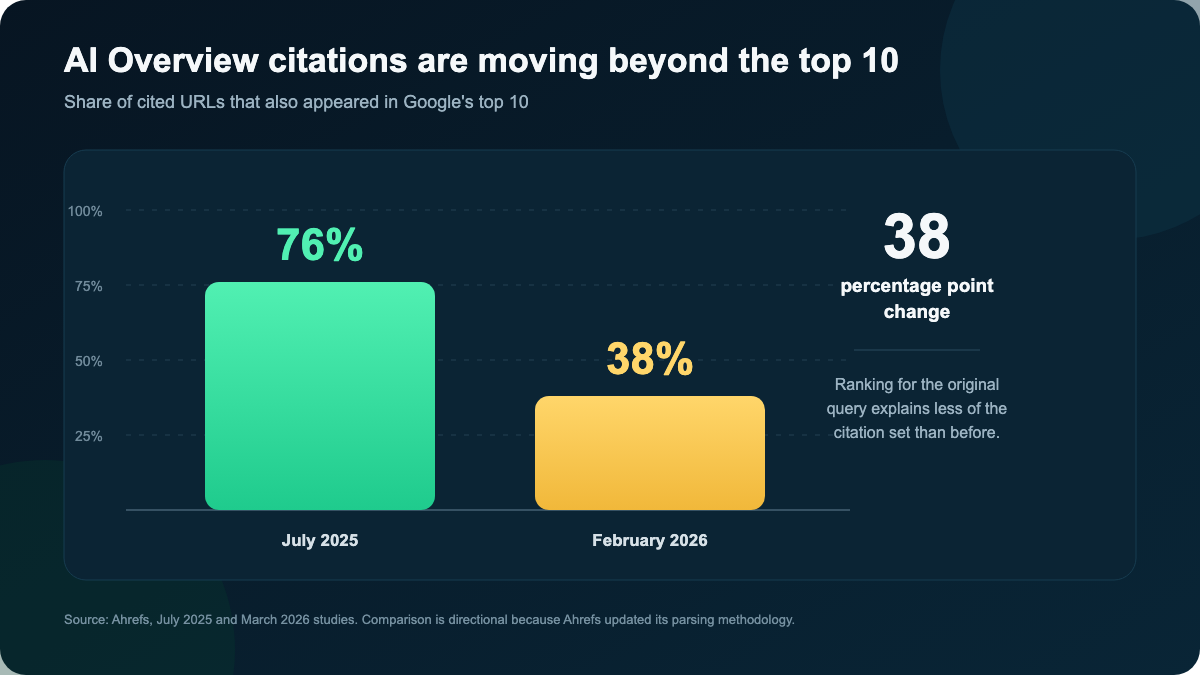
Ahrefs analyzed 863,000 keyword results and found that 38% of URLs cited in Google AI Overviews also appeared within the first 10 result blocks. In an earlier July 2025 study, that figure was approximately 76%.
Another Ahrefs analysis of 15,000 prompts compared citations from ChatGPT, Gemini, Copilot and Perplexity with Google and Bing results. On average, only about 12% of cited URLs appeared in Google’s top 10 for the original prompt, while roughly 80% did not rank in Google’s top 100 for that exact query. Perplexity showed closer alignment with search rankings than the other assistants.
These findings do not prove that search and AI systems use completely separate content pools. They do show that ranking for the user’s original wording is not enough to explain which sources receive citations.
One reason is query expansion. Google says its AI features may use a technique called query fan-out, issuing multiple related searches across subtopics and data sources before composing a response. A page can therefore become relevant through one of those related searches even if it does not rank for the original query.
The overlap between top-10 rankings and AI Overview citations has narrowed as Google’s retrieval methods have evolved.
2. What an AI Answer Is Actually Assembling
Traditional search presents a ranked list. An answer engine produces a synthesis.
Depending on the platform and prompt, the system may retrieve several pages or passages, evaluate their relevance and use selected material to construct a response. The links shown beside that response become the visible citation set.
This changes the unit of competition. You are not always trying to make one page the single best result. You are trying to make a specific fact, explanation or comparison easy to retrieve and support.
It also explains why citations can change when the same prompt is repeated. AI answers are probabilistic, retrieval methods differ by platform and the system may search several variations of the original question.
The practical lesson is straightforward: optimize your pages, but also pay attention to the wider set of pages an AI system may consult when answering questions about your brand.
3. The Question Determines the Source
There is no universal list of websites that every AI engine prefers. Source selection changes with the user’s intent.
Omniscient Digital analyzed 23,387 citations generated from 240 branded prompts across multiple AI platforms. Its findings show a sharp difference between reputation questions and factual product questions.
When users asked what customers thought about a brand, earned sources supplied 82% of citations. For functionality and integration questions, the brand’s own content was the most common source, accounting for about 50%.
That produces four useful question categories:
| Reputation | What do customers say about this tool? | Review platforms, forums, editorial coverage and social discussions |
| Product fact | Does it integrate with Shopify? | Product pages, documentation, pricing pages and help centers |
| Category comparison | What are the best tools for local SEO agencies? | Listicles, review sites, comparison pages and specialist publications |
| News and change | What did the company launch or announce? | News publications, company announcements and syndicated coverage |
Platform choice changes the mix again.
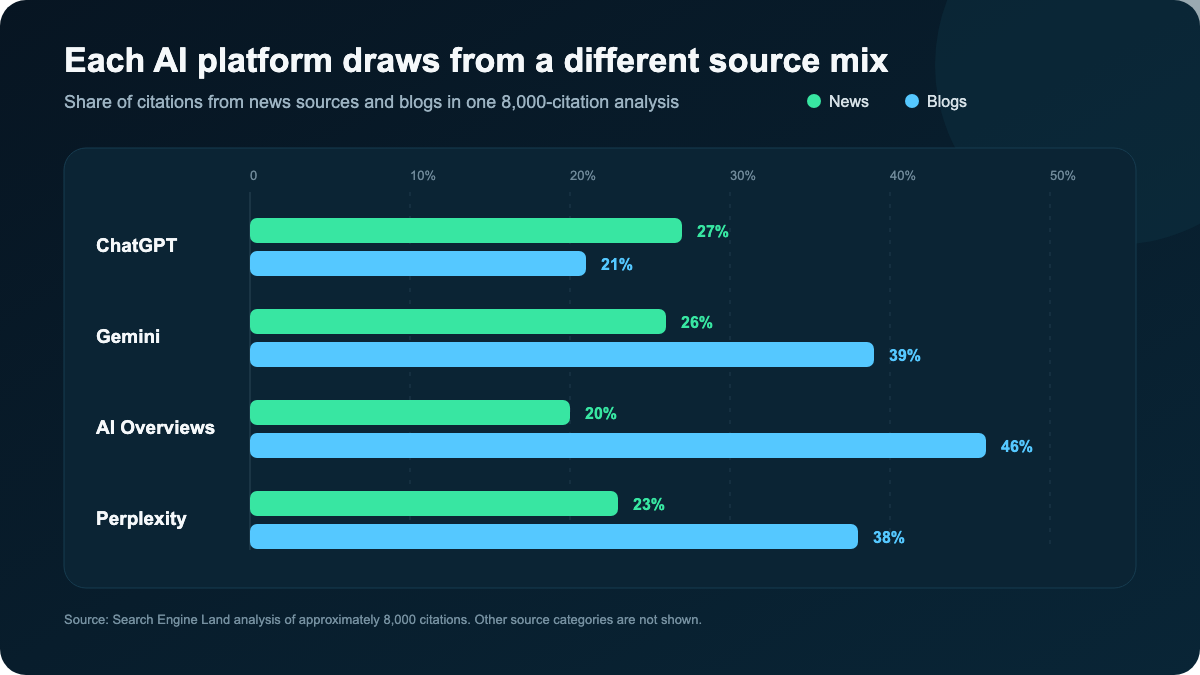
An analysis published by Search Engine Land examined roughly 8,000 citations. In that dataset, approximately 27% of ChatGPT citations came from news sources and 21% from blogs. Google AI Overviews leaned more heavily toward blogs, at approximately 46%, with news sources accounting for about 20%.
These percentages should be treated as observations from a defined sample, not permanent rules. They still demonstrate why a blog-only strategy may miss the sources used for reputation, comparison or news-driven prompts.
Different AI platforms can produce very different source mixes for similar questions.
4. Strengthen the Pages You Own
Your website remains the foundation, especially when the user wants a fact that only you can authoritatively confirm.
Start with these areas:
Allow the Crawlers That Match Your Goal
For ChatGPT search inclusion, make sure you are not blocking OAI-SearchBot. GPTBot is associated with potential model training and is controlled separately, as explained in OpenAI’s guidance for publishers.
For Google Search and its AI features, Googlebot is the relevant crawler. Google’s crawler documentation states that Google-Extended does not determine whether a page can appear or rank in Google Search.
Check your robots.txt file, firewall, content delivery network and bot-protection settings. A crawler that is allowed in robots.txt can still be blocked by a security layer.
Lead With a Direct Answer
Open important sections with a concise answer that makes sense on its own. Forty to sixty words can be a useful editorial target, but clarity matters more than hitting an exact length.
Use Descriptive Headings
Write headings that clearly identify the question or subject being answered. Avoid clever headings that require the reader to interpret what the section contains.
Make Comparisons Easy to Parse
Put structured comparisons into real HTML tables. Use descriptive column headings and keep each cell focused on one comparable attribute.
Make Claims Traceable
Name the source of each statistic, link to the original research and include a publication or update date. If a fact has changed, update the surrounding explanation rather than changing the date alone.
Keep Structured Data in Perspective
Structured data can help systems understand a page, but Google says there is no special schema requirement for appearing in AI Overviews or AI Mode. The same technical and quality fundamentals used for Google Search still apply.
The same caution applies to llms.txt. It may be useful as an experimental convention, but it is not a substitute for crawlability, indexing, useful content or third-party visibility.
5. Build the Citation Surface You Do Not Own
In Omniscient Digital’s branded-query research, earned sources accounted for 48% of citations, commercial content published by other brands accounted for 30% and the named brand’s own website accounted for 23%.
The total reaches 101% because the published figures are rounded, but the strategic conclusion is clear: most citations came from outside the brand’s domain.
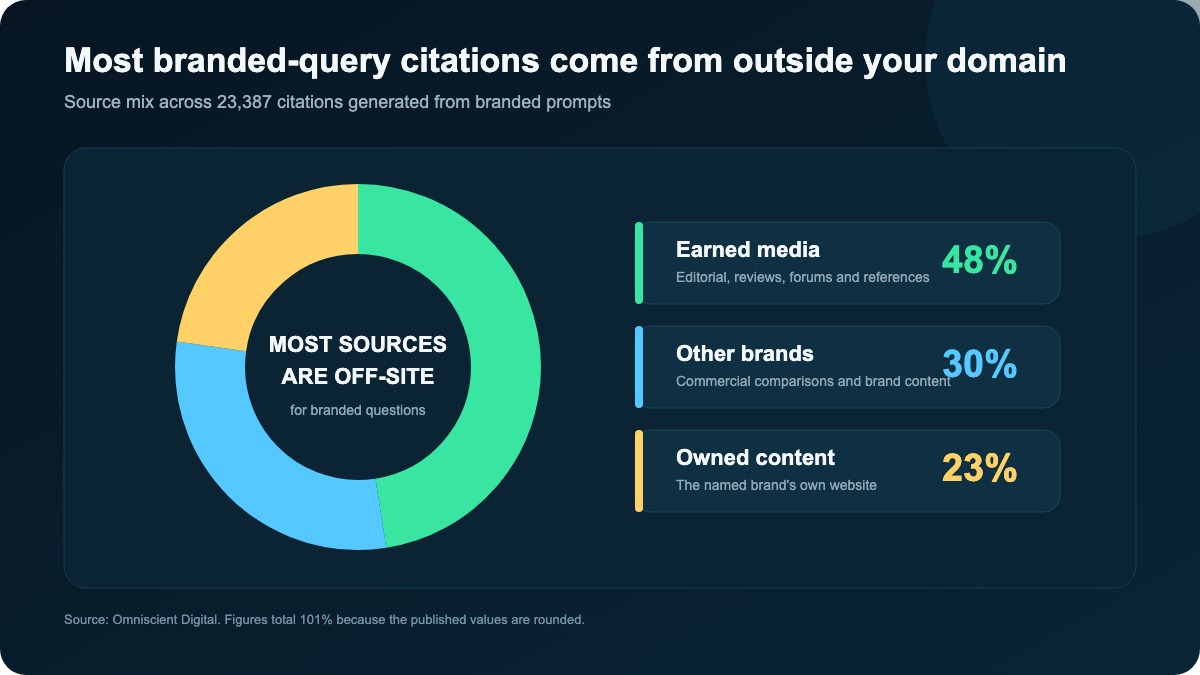
In this study, most citations for branded questions came from pages the named brand did not own.
Those external surfaces serve different purposes.
Community Platforms
Forums and community platforms are especially relevant to questions about customer sentiment, everyday use and product limitations. They contain language and experiences that rarely appear on a polished company website.
Do not manufacture discussions or fill communities with promotional replies. Monitor recurring questions, correct material inaccuracies when participation is appropriate and use genuine customer feedback to improve the information on your own site.
Review and Comparison Sites
Review platforms, specialist directories and editorial comparison pages often appear when users are choosing among products.
Keep your profiles accurate, respond constructively to reviews and make sure pricing, integrations, product categories and screenshots are current. The best platforms to prioritize are the ones already appearing for your target prompts, not necessarily the largest review sites overall.
Editorial and Syndicated News
News coverage is most useful when the underlying information is genuinely new and tied to a date. Examples include launches, partnerships, funding, original research, geographic expansion, major appointments and product milestones.
A well-written announcement can place a verifiable fact on several crawlable news pages. That gives search and answer systems more opportunities to discover the information than a release published only in your own newsroom.
This is where a distribution service such as EdgeNewswire has a practical advantage. It can expand the number of accessible locations where a timely company development appears while your website remains the primary source for the full details.
Press release distribution is a valid and viable way to acquire off-site citations.
The distinction matters. Syndicated copies are not automatically independent reporting, and search or retrieval systems may consolidate substantially similar pages. Distribution creates discoverability and potential coverage. It does not guarantee indexing, citation or endorsement.
To make a distributed announcement more useful, include:
A specific and newsworthy development Clear dates, locations and named organizations Attributable quotes from relevant people Original numbers or evidence where available A link to the most complete primary source Consistent facts across the release and your websiteNews distribution is not the right tool for every question. A press release will not tell an AI engine what customers genuinely think of a product. It is better suited to category presence, company developments and facts that need a clear date and source.
6. Decide Where to Spend the Next Quarter
Few teams can improve every citation surface at once. A focused audit can reveal where the largest gap sits.
Step 1: Collect Real Prompts
Start with at least 10 questions that buyers, customers or stakeholders genuinely ask. Include reputation, product, comparison and news-oriented questions.
Step 2: Record the Cited Domains
Run each prompt across the AI platforms your audience uses. Record every cited URL and classify it as owned content, community content, review or comparison content, or news and editorial coverage.
Repeat important prompts more than once. AI answers can change between runs, so a single screenshot should not be treated as a stable ranking.
Step 3: Identify the Influenceable Gap
Look for sources that appear repeatedly and ask what can realistically be improved within a quarter.
You might update product documentation, correct review profiles, pitch original research to an industry publication or distribute a genuinely newsworthy announcement. You cannot directly control an independent editor or community, but you can improve the accuracy, usefulness and availability of the source material they encounter.
Step 4: Choose One Primary Surface
Prioritize the surface that overlaps with your most valuable question type. If product facts are wrong, fix owned pages first. If comparison prompts omit you, focus on the publications and review sites that already receive citations. If the market has no record of recent developments, strengthen news and editorial visibility.
7. Measure Whether the Work Had an Effect
No single metric captures AI visibility, so use several layers of evidence.
Referral Traffic
Track referrals from ChatGPT, Perplexity and other AI platforms in GA4 or your analytics tool. Referral traffic confirms that people clicked, although many citations will not produce a visit.
Server Logs
Check whether relevant crawlers can access the pages you want surfaced. Look for OAI-SearchBot, Googlebot, PerplexityBot and other applicable user agents. Treat crawler activity as evidence of access, not proof that a page has been indexed or cited.
First-Party Reporting
Bing Webmaster Tools introduced an AI Performance report that shows citation totals, cited pages and sampled grounding queries across supported Microsoft AI experiences. This provides useful first-party evidence about which pages are being referenced, but the data does not represent every AI platform.
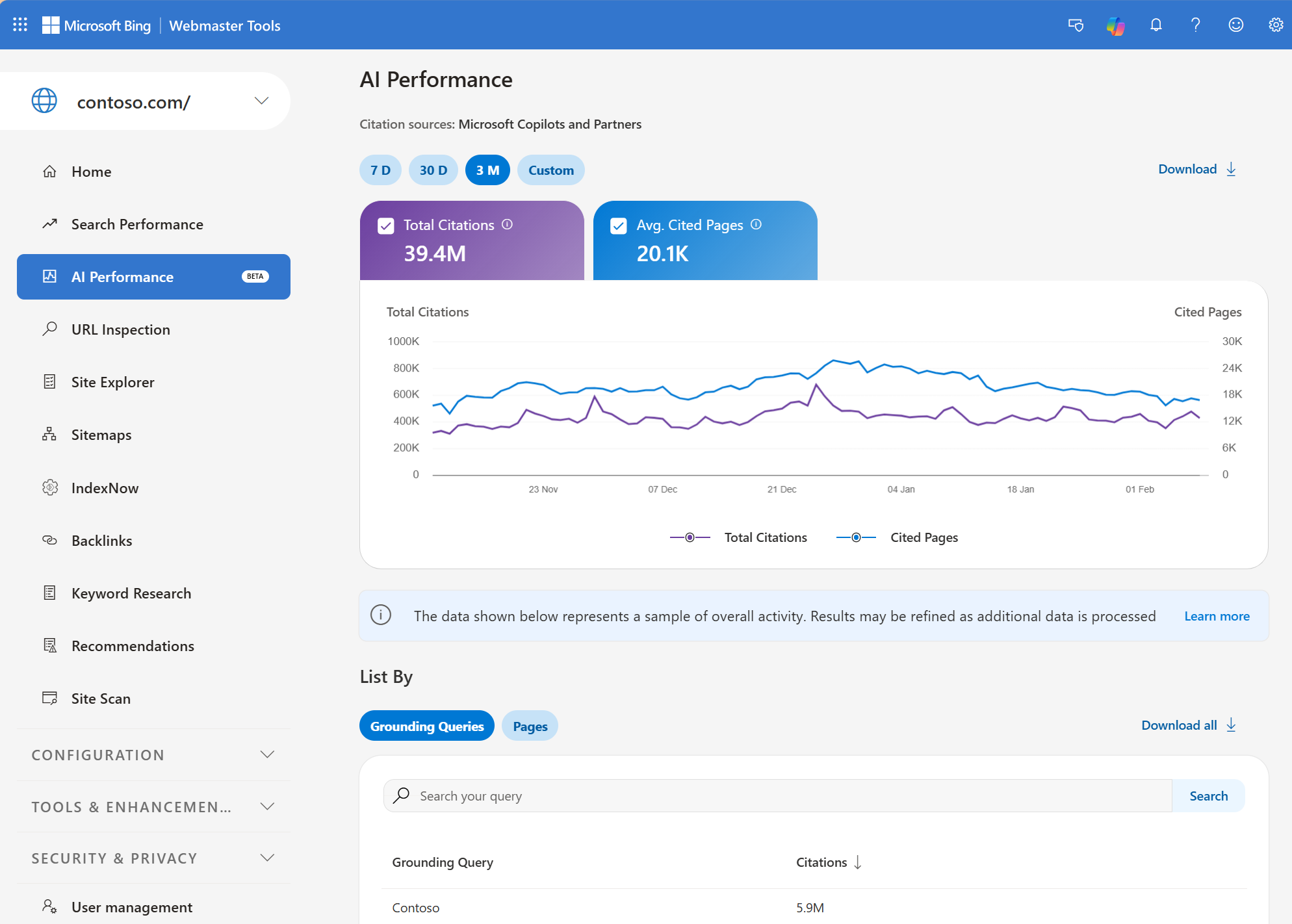
While Google Search Console also contains AI impressions, Bing Webmaster Tools provides more details for better performance analysis.
Cross-Platform AEO Tracking
Bing’s report is useful, but it only covers supported Microsoft AI experiences. For a broader view, an AEO tracking platform such as SurgeGraph can monitor selected prompts across ChatGPT, Perplexity, Gemini, Google AI Mode and Google AI Overviews.
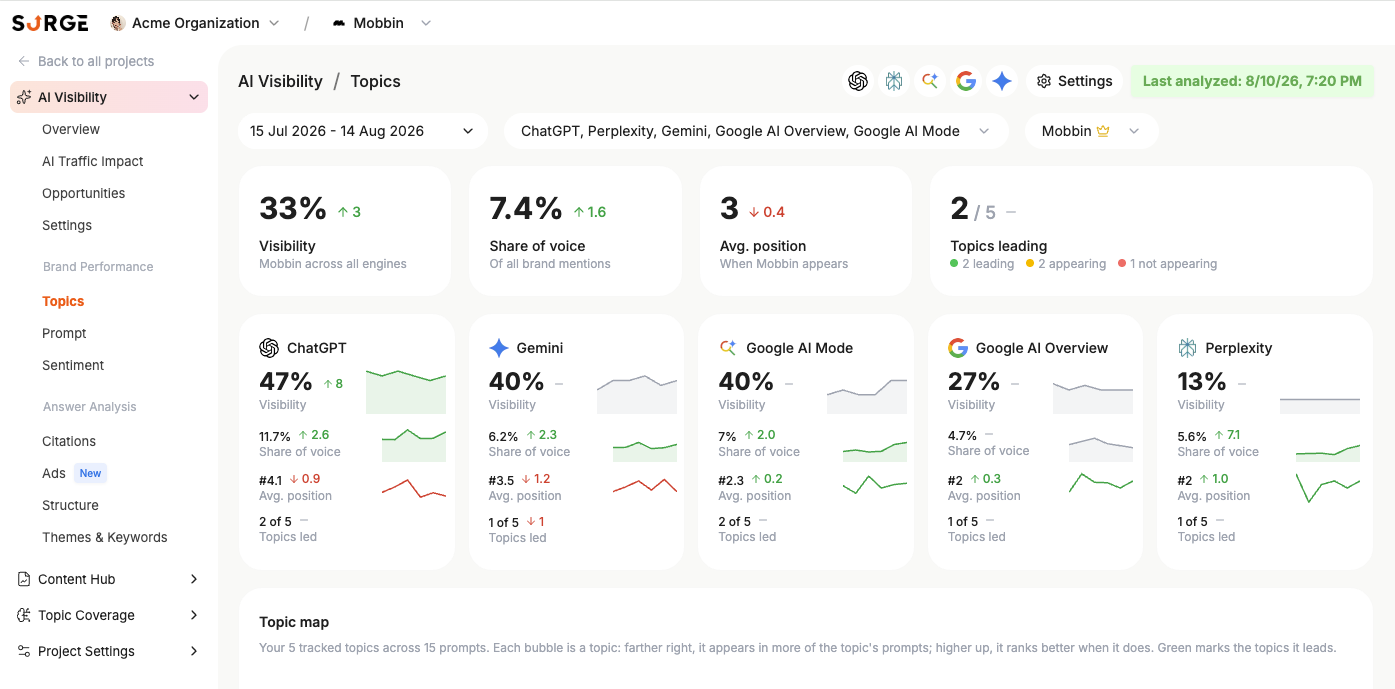
A 3rd-party AEO tracker can help monitor your citation performance on platforms other than Google and Microsoft Copilot.
SurgeGraph brings mentions, citations, prompt rankings, sentiment, share of voice and competitor gaps into one reporting layer. That makes it useful for identifying which questions repeatedly exclude your brand, which competitors appear instead and which cited sources deserve closer attention. Its workflow also connects those visibility gaps with content optimization, rather than stopping at measurement.
Treat third-party visibility scores as directional metrics, not universal market-share figures. Results depend on the prompts, locations, platforms and tracking frequency configured in the project. Keep the prompt set stable, retain the underlying citation data and manually verify important changes before presenting them as a trend.
Repeated Prompt Tracking
Re-run your priority prompts on a consistent schedule and record the cited domains, brand mentions and factual accuracy of the answers. Measure patterns across multiple runs instead of treating one response as definitive.
The useful question is not simply, “Are we cited?” It is, “Are the right sources presenting accurate information when buyers ask the questions that matter?”
Final Thoughts
On-page optimization remains essential because your website should be the clearest source for facts you control.
But your website is only one part of the citation environment. Reviews shape reputation questions. Comparison pages shape category decisions. Community discussions reveal real experiences. News and editorial pages document developments beyond your own newsroom.
Start with the prompts. Identify the sources that AI systems already use. Then decide whether the most important gap is on a page you own or somewhere else on the web.
That is a more durable AI citation strategy than applying the same checklist to every page and hoping the answer engines notice.
Frequently Asked Questions
How Long Does It Take for a Change to Appear in an AI Answer?
There is no dependable universal timeline. A change may surface within days on a frequently crawled platform or take much longer, depending on discovery, indexing, retrieval frequency, query demand and the platform involved. Measure at regular intervals instead of promising a fixed number of weeks.
Can a Company Pay to Be Cited in AI Search Results?
Major answer engines do not offer guaranteed organic citation placement. A company can pay for content creation, public relations or news distribution that makes accurate information available on crawlable pages, but that does not guarantee inclusion in an AI answer.
Does Domain Authority Determine Whether a Page Gets Cited?
Authority can influence whether a source is considered trustworthy, but no third-party authority score determines citation selection. Relevance, clarity, freshness, supporting evidence, retrieval context and platform-specific systems can all affect which page appears.
Should a Small Website Invest in AI Visibility?
Yes, if its audience uses AI tools during research or purchasing. Smaller businesses can compete by becoming the clearest primary source for niche facts and by earning accurate visibility in the specific third-party sources their customers consult.
What Is the Difference Between AEO and GEO?
The terms overlap and do not have universally accepted boundaries. Answer engine optimization, or AEO, generally focuses on being extracted, mentioned or cited in direct answers. Generative engine optimization, or GEO, is often used more broadly for visibility across generative search and assistant experiences. In practice, both involve clear content, technical accessibility, credible evidence and a strong presence beyond your own website.
Updated: 16 August 2026

About Yi Yun
Yi Yun is an inbound marketer who specializes in UI/UX. He is constantly in search of new knowledge to quench his thirst for 'how things work'.








![AI Overviews: We Reverse-Engineered Them So You Don’t Have To [+ What You Need To Do Next]](https://www.searchenginejournal.com/wp-content/uploads/2025/04/featured-438.png)