Is it safe to visit Japan? Latest advice after earthquake strikes near the Philippines
Tsunami warnings have now been downgraded in Japan following the earthquake
 Hollif

A 7.8-magnitude earthquake that struck off the coast of the Philippines has killed at least 16 people and injured more than 200.
Tsunami warnings were issued for the Philippines and Japan, but both have now been downgraded. Authorities have warned that aftershocks could continue to rock affected areas.
Buildings, bridges and other structures have been significantly damaged in the coastal city of General Santos in the Philippines, while Sarangani province has experienced power and telecommunications disruptions.
Meanwhile, people in Japan have been warned to stay away from the shore and the ocean along much of its Pacific coast and islands.
Where did the earthquake hit?
The earthquake occurred on Monday morning around 7.37am PST with a magnitude of 7.8. Its epicentre was off the coast of the Philippine island Mindanao, 32km west of Maasim, Sarangani, with a depth of 33km.
The highest reported intensity was in the Philippines’ General Santos City, with ground shaking felt as far as Leyte.
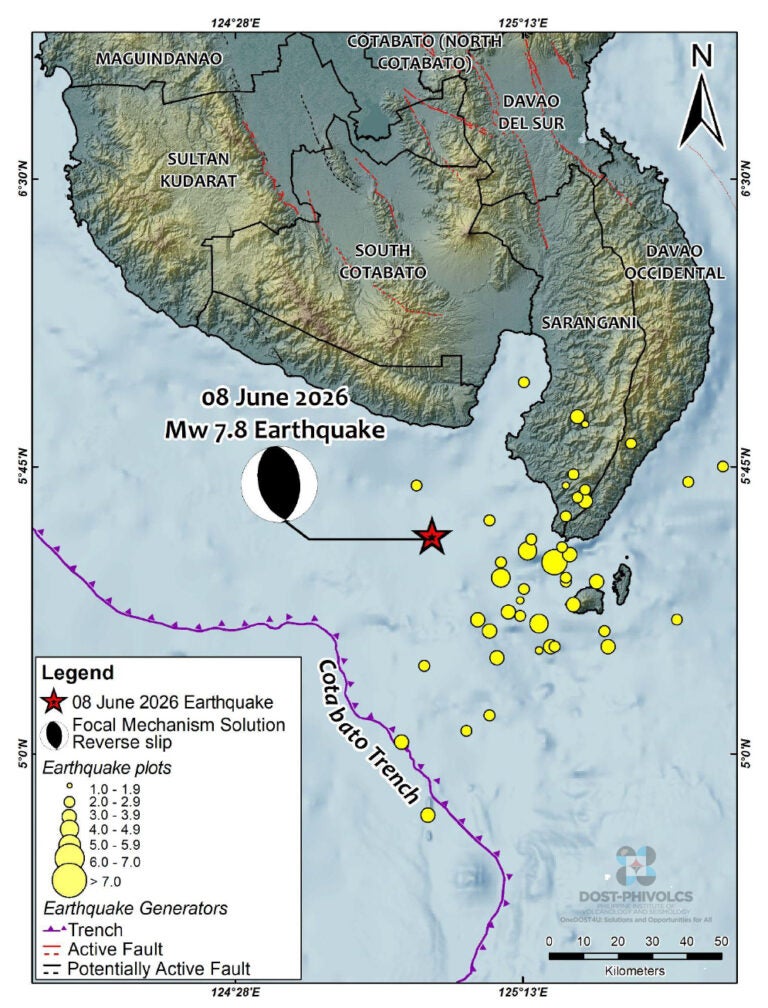
The Philippine Institute of Volcanology and Seismology (PHIVOLCS) has reported smaller tremors with very low magnitudes following the initial earthquake. It added that aftershocks could persist for several days to weeks.
Did the earthquake trigger a tsunami?
Tsunami waves were recorded in the Philippines along the coasts of Kiamba and Maasim, Sarangani, and Kalamansig, Sultan Kudarat, with a height of approximately one metre.
PHIVOLCS issued a tsunami threat immediately after the earthquake and advised residents and visitors in affected coastal areas to evacuate to higher ground. The agency has now said that the tsunami threat for the Philippines has largely passed.
In Japan, tsunami warnings were in place for most of the south Pacific coast, but they have been downgraded to a “tsunami forecast”, which warns of slight sea level fluctuations.
The tsunami forecast is in place from Ibaraki to Okinawa prefectures, along with the country’s islands in the Pacific Ocean.
Indonesia and Malaysia also issued tsunami alerts for some nearby coastal areas.
Will my Japan holiday be cancelled?
As the FCDO has not warned against non-essential travel to Japan, there will be no special circumstances in place to be able to cancel a trip for a full refund.
The conditions for cancelling your trip will be dependent on your holiday provider, so it’s best to contact them if you’re looking to postpone.
There is no obligation for companies to refund bookings if you want to cancel, and you will not be able to claim on your travel insurance due to safety concerns unless government advice changes.
If you do have travel insurance, some policies include natural disaster cover for an event that prevents you from reaching your holiday destination. Check your insurance policies and speak to your insurer to see where you stand.









.jpeg?trim=49,0,49,0&width=1200&height=800&crop=1200:800)