Just Love
In this article, we share a beautiful conversation with Anh Huong, the first member of the Order of Interbeing in the West.
 FrankLin
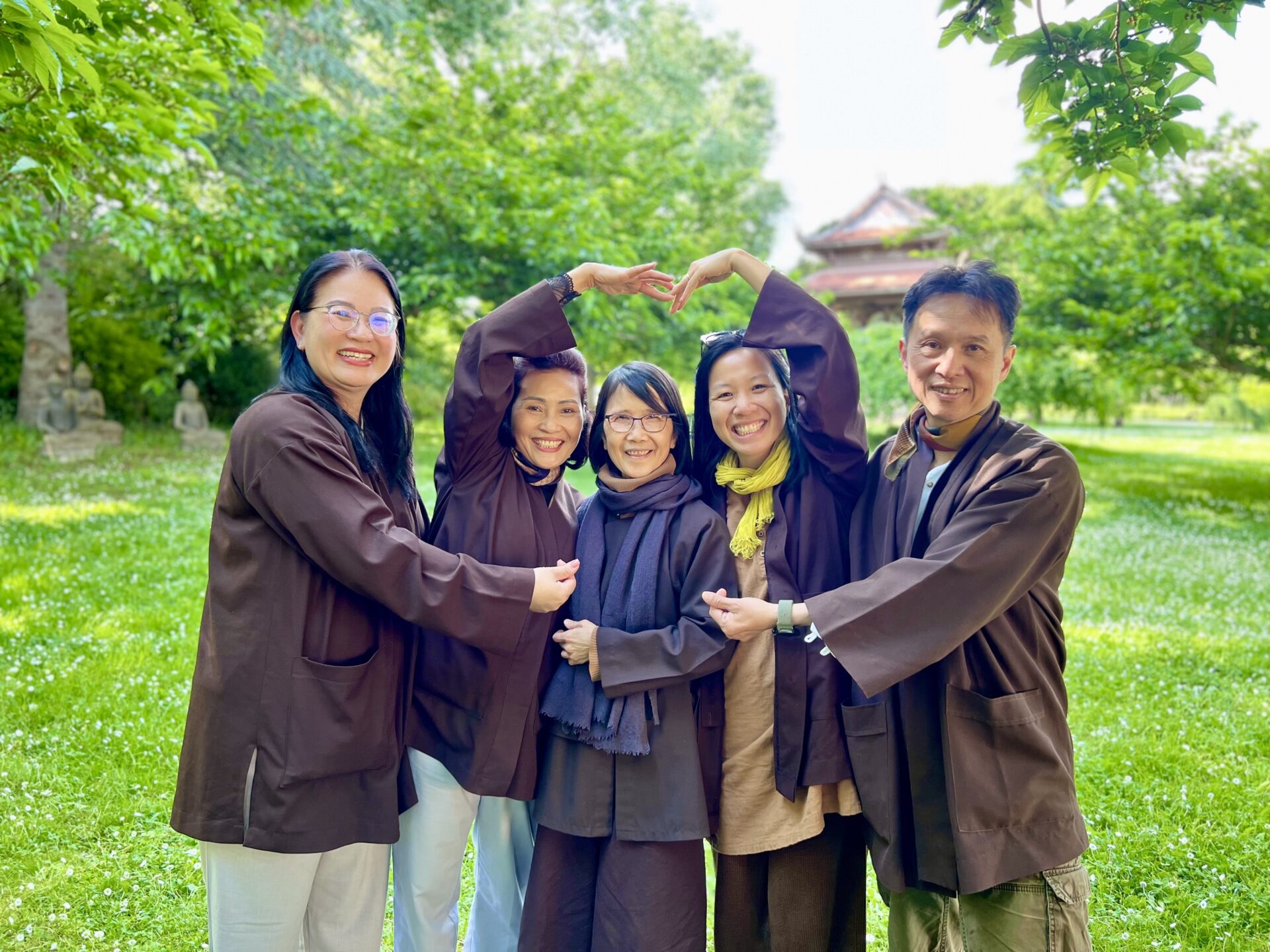
In this article, we share a beautiful conversation with Anh Huong, the first member of the Order of Interbeing in the West. This interview was held in Plum Village, France, during the May 2025 retreat for OI members.
Originally in Vietnamese, it was translated by Sister Trang Mai Thon
This is our fourth offering in our monthly series in which we feature articles written by an OI member, as we lead up to our June Retreat, celebrating 60 years of the Order of Interbeing.
This post features an excerpt from an interview originally published in the Mindfulness Bell, No. 97.
The Beginning of Continuation
Sister Tai Nghiem: You were the first person to whom Thầy transmitted the Fourteen Mindfulness Trainings in the West since he left Vietnam in 1966. Could you share the circumstances and how you felt?
Anh Huong: In 1981, my younger brother, Đức, and I visited Thầy in France. Thầy is my father’s younger brother. After spending a few days at Phương Vân (Fragrant Cloud) Hermitage, cô Phượng (later Sister Chân Không) drove us to Sơn Cốc, the hermitage where Thầy lived. I feel such gratitude for cô Phượng. It was a long drive, and she was the only one who could drive. Whenever she got sleepy, she sang to keep herself awake.
Every morning, we went to the backyard to garden—such happiness! Thầy planted vegetables, watered flowers, cut grass, chopped wood, dried firewood, and stacked the wood near the kitchen stove for cold mornings and evenings. Thầy also wrote, printed, and bound books there—including his own—by hand.
About a week before we were to return to America, after Thầy’s midday rest, Thầy called me to sit beside him, handed me some printed papers, and said, “Read this, my dear.” I read them from beginning to end. They were the text of The Fourteen Mindfulness Trainings. Thầy sat still, solid as a mountain, while I read.
A few minutes later, Thầy asked, “What do you think, my dear?” “It’s wonderful, Thầy,” I answered. Thầy had touched my bodhicitta, opening the path for me to step forward in service within the Order of Interbeing (OI).
Something entirely new and fresh was unfolding within me. After a few moments of silence, Thầy briefly recounted the history of the Order. Then, we went out for a walk. The next morning, while the mist lingered, Thầy went outside with a pair of scissors. I followed to see what Thầy was doing. Thầy cut a rose and placed it in a vase on the altar. Then Thầy called cô Phượng and said, “Today, Anh Hương will receive The Fourteen Mindfulness Trainings.” After reading each training, Thầy asked, “Do you vow to receive, study, and practice this training?” “Yes, I do,” I replied. That was August 20, 1981. When Thầy had an intention, Thầy acted on it right away.
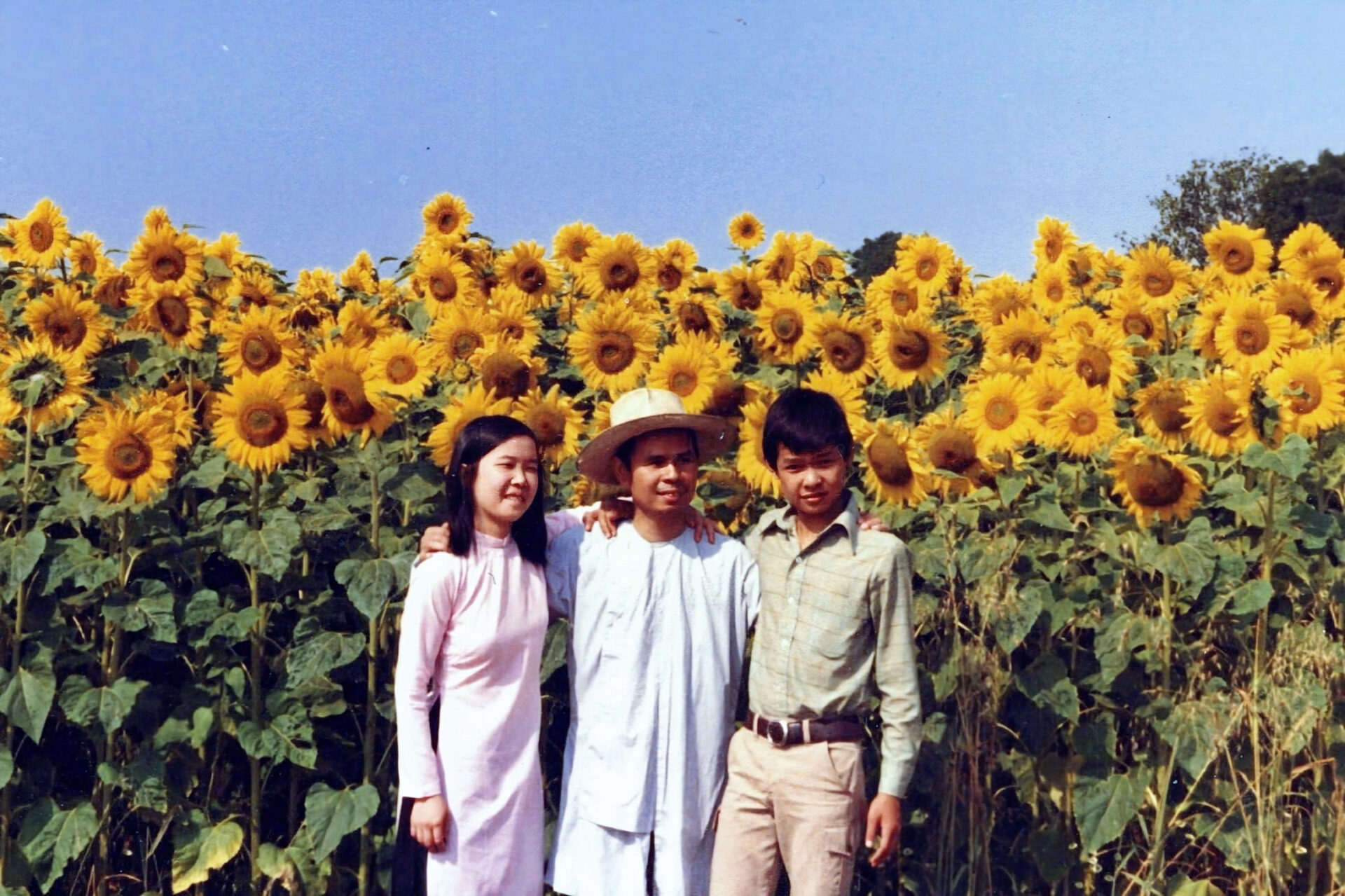 Anh Huong, Thay, and her younger brother Đuc in summer 1981, (Photo courtesy of Anh Huong)
“JUST LOVE!”—A Mantra for the Path
TN: Practicing for more than forty years, what is your reflection about the Order of Interbeing and Engaged Buddhism? What do you think Thầy wants us to continue?
AH: The Fourteen Mindfulness Trainings are the concrete expression of our bodhicitta—the deep aspiration to dedicate our energy to practice and to help others. Sangha is the soil that nourishes and protects this aspiration. Engaged Buddhism, as embodied in the Order of Interbeing, is the path of deep understanding and fierce compassion. This bodhisattva path is sustained by the energy cultivated through the practice of precepts, mindfulness, concentration, and insight.
Since Plum Village’s first Summer Opening in 1982, Thầy consistently emphasized the practice of mindfulness in everyday life and in sangha building. Thầy called the sangha a “community of resistance” that resists the collective momentum of greed, anger, and ignorance.
Through investigation and deep looking, we recognize that what is happening in the world and within the sangha is also happening within ourselves. Non-blaming is the secret to maintaining genuine compassion. When our inner suffering is not yet cared for, we often project and vent it into our relationships with family, sangha, and our activism.
We stand now at a crossroads of how Buddhism will evolve in this country and on this planet. As members of the Order of Interbeing, our challenge is to live our daily lives so that the bodhisattva ideal is truly embedded in the fabric of our existence. How do we find peace, stillness, nourishment, and healing while still engaging deeply with social, political, and environmental issues?
Seeing the danger of activists burning out due to a lack of deep spiritual training, Thầy shifted the emphasis from “Engaged Buddhism” toward “Applied Buddhism” and sangha building. Thầy’s calligraphies—such as “I have arrived, I am home,” “Peace in oneself, peace in the world,” and “The way out is in”—serve as essential reminders of the importance of individual practice as the foundation for collective awakening. This is the essence of Applied Buddhism.
I can still hear Thầy saying, “This is a happy moment!” If we are not peaceful and happy right now, how can we truly be present for our loved ones, much less those who are suffering and crying for help?
Thầy is happy to see his students practicing wholeheartedly—healing wounds, nurturing siblinghood, and building sangha everywhere. As Thầy once said, “You are all Thầy’s continuation. You are bringing Thầy into the future; in whatever you do, Thầy is always there beside you, walking with you.” Wherever there is a Sangha, there is the Buddha, the Dharma, and Thầy.
These days, our local sangha practices the mantra, “Just love!” We don’t need to strain or try hard to love—because understanding is love.
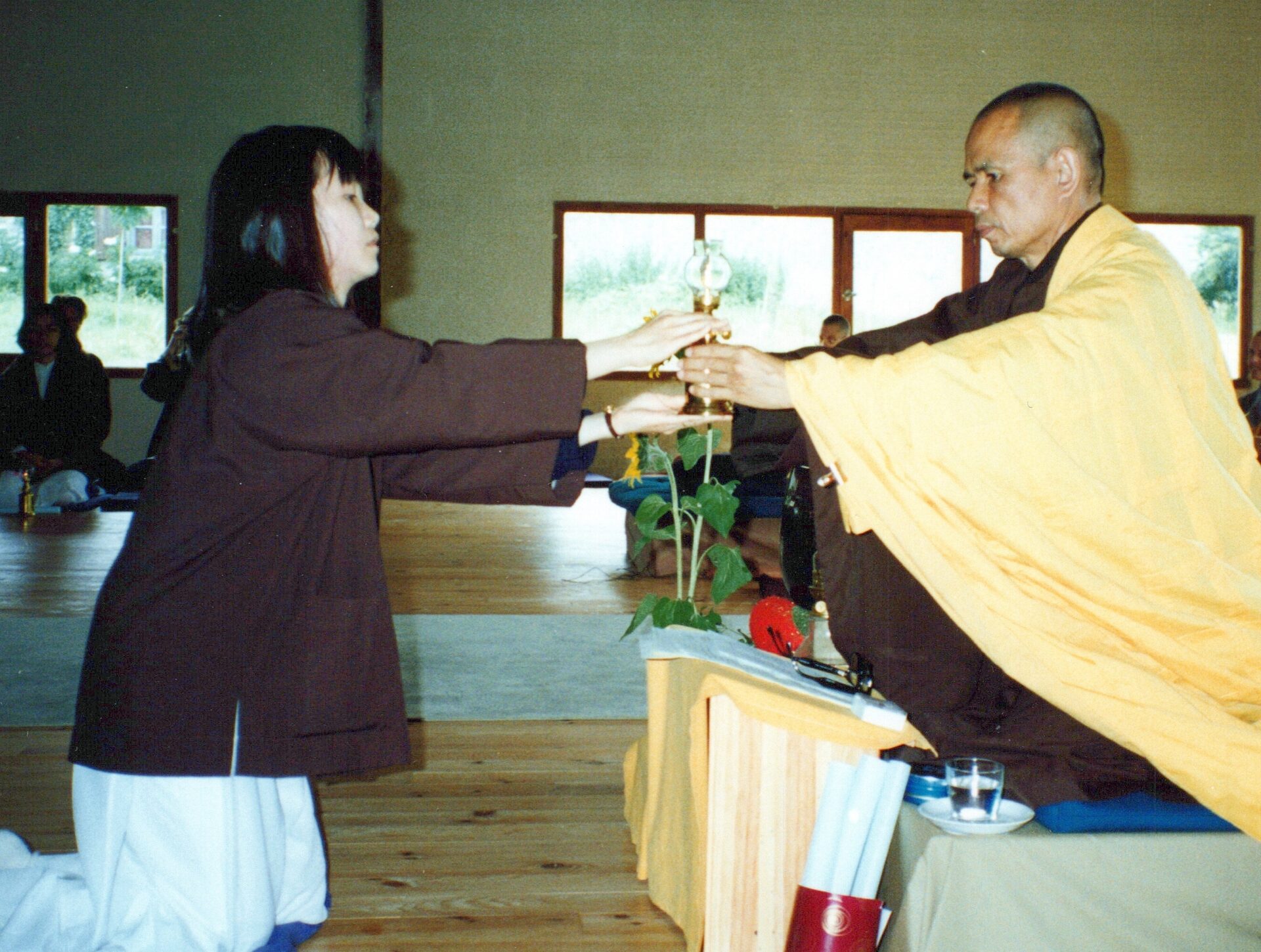 Receiving the Lamp Transmission from Thay in 1992 (Photo courtesy of Anh Huong)
Oases in the Desert
TN: Do you have a wish for the OI family on its sixtieth anniversary?
AH: Order of Interbeing sanghas are like oases in a scorching desert—a vital place for us to return to for refuge and renewal.
Recently, I shared this with our young OI members: building sangha and walking the bodhisattva path is deeply engaged spiritual practice. The sangha door is wide open to all; it excludes no one and makes no distinction based on background, identity, or political orientation. A true sangha cultivates loving speech and deep listening, creating a safe space for everyone to share their views—even when they differ from our own.
Where I live, one of my neighbors has a sign on their front lawn: “Hate doesn’t have a home here.” I tell my friends that even the mind of hatred can have a place to rest in the sangha. The collective energy of mindfulness and all-embracing love is what makes the sangha a safe place for those who come.
We must continually renew the sangha. No matter how healthy the seed of bodhicitta may be, if the soil is not fertile and nourishing, the seed cannot sprout—it will wither away.
The very heart of The Fourteen Mindfulness Trainings is understanding and love. When our collective mindfulness is fragile, small frustrations can unfortunately spiral into cycles of justification and conflict, sometimes even leading to the weaponizing of precepts to assign blame. Suffering is not a problem to be solved; it is a wound to be tended with the medicine of understanding and love. Thầy often reminded his students, “You have the right to suffer. You do not have the right not to practice!”
Thầy’s simple yet profound calligraphy, “The way out is in,” calls us to turn inward, recognizing that the root of our distress always lies within. Our practice is to listen deeply and care for the pain we find inside. This internal work is mirrored in the community practice of Beginning Anew, which is vital for the well-being of our sangha. By renewing ourselves, we naturally renew our bonds with our siblings. Our ability to live harmoniously and lovingly with one another—especially those we find challenging—is the measure of our practice’s success.
Throughout Thầy’s life—even after his stroke, until his final days at the root temple—Thầy never stopped nurturing the bonds of teacher and students, of brotherhood and sisterhood. Thầy reassured us, “Each of you is a continuation of Thầy. When you care for, love, and support one another, you are nourishing Thầy.”
In the midst of an increasingly complex and challenging world, my deep wish is for us to prioritize coming together, nurturing siblinghood, and caring for our OI family.
With every moment, every day, we dedicate ourselves to spiritual growth, moving forward as a sangha—a beloved community, a peace movement where healing, happiness, and compassion are palpable in the light of interbeing. Our local sanghas are like creeks, sustaining life wherever they flow.
Thầy told us many times that siblinghood is the most precious of all. It is the loving threads that weave our sangha blanket, keeping us safe and warm during the acute weather of global challenges. As this blanket expands, it offers comfort and relief to those in desperate situations.
Thầy is still walking in front of us and with us always. Who is walking behind us? What legacy are we leaving for the next generation? The younger generations, our children and grandchildren, are watching how we live and how we treat one another. As their blood and spiritual ancestors, we must live in a way that can help them discover the true meaning of their existence and move forward on the path of love and beauty as a beloved community.
To truly be Thầy’s continuation means keeping the stream of love flowing. The powerful energy of Thầy’s compassion once touched our hearts so deeply; now, it is our turn to practice in a way that the younger generations can feel closer to us—and touch that same love within themselves. True transmission is only possible through true continuation.
Celebrating love, understanding, and good spiritual friendsWe invite you to read the full interview in the Mindfulness Bell, No. 97 and to enjoy more articles from that most recent edition here.