Love Without Limits
Sister Tue Nghiem on how the practice of true love helps us nourish happiness, alleviate suffering, and discover the freedom of the awakened heart. The post Love Without Limits appeared first on Lion’s Roar.
 MikeTyes

In Buddhism, love is not just an emotion. It’s a way of being, an experience of openness, kindness, and presence. Love gives us strength. It nourishes our happiness and protects our sanity. When our hearts are filled with love, we are deeply peaceful, happy, and alive.
The Buddha taught that true love has four qualities. In the Theravada tradition they’re called the four brahmaviharas (divine abodes). In the Mahayana traditions, the same set of virtues is called the four immeasurables, or four immeasurable minds, with a slightly different emphasis shaped by the bodhisattva vow. These qualities are loving-kindness, compassion, sympathetic joy, and inclusiveness or equanimity.
Loving-kindness is the heartfelt wish to bring happiness to others. Compassion is the capacity and deep desire to remove their suffering. Sympathetic joy is the ability to rejoice in the happiness and success of others as if it were our own. And inclusiveness or equanimity is the inclusiveness of the heart, an accepting mind that does not cling, judge, or exclude.
These qualities are called “immeasurable” because true love cannot be measured. It knows no condition, no limit. It’s boundless like the sky, and when it flows through us, we touch the freedom of the awakened heart and find a deep sense of purpose. How can we bring the four immeasurable minds into our daily lives, so that true love is not just an idea, but a living reality?
For me, the practice always begins with myself. I have learned that if I cannot love myself, it will be very difficult to truly love others. To love myself, I must first understand myself—why I suffer the way I do, what habits keep me caught, and what patterns prevent me from being happy and free. As my teacher, Zen master Thich Nhat Hanh, often reminded us: True love is only possible when there is understanding. When I truly understand myself, acceptance arises naturally, and—from that acceptance—genuine love that starts with myself is born in my heart.
Each day, I make time to come home to myself, sometimes early in the morning, sometimes in the quiet of the evening. I breathe, relax, and listen deeply to my body and mind. I become aware of the tensions, restlessness, pain, or whatever is present, and I hold them gently, with a smile. This is the practice of total acceptance—letting go of judgments, ideas, and expectations—just being present, with tenderness and awareness, to bear witness to whatever unfolds.
Everything has its causes and conditions. When I look deeply, I begin to see the roots of my suffering, and with that understanding comes transformation. Understanding opens the door to true loving-kindness for myself. It gives me the strength to embrace and transform my pain, rather than be overwhelmed by it.
I may not be able to change something right away. But even the simple act of smiling to my suffering, of saying, “I am here for you. I see you, and I accept you,” already brings relief, joy, and freedom. This is true love for myself. And only when I can love and understand myself in this way do I have the capacity to recognize and embrace the suffering of others with compassion.
To practice the four immeasurables—true love—with others, begin with listening. Not just ordinary listening, but deep, compassionate listening. This is not simply listening with the ears, but also with the heart. We don’t judge or react; we simply offer our presence.
When we listen in this way, we’re truly there for the other person. We listen to the words being spoken and also to what is left unspoken—the hidden pains, the unexpressed hopes, the quiet struggles of the heart. By listening deeply, we can begin to touch and understand both their strengths and their sufferings. Moreover, we can glimpse the causes and conditions that created their sufferings.
This kind of listening is already an act of true love. It can ease another’s pain and bring them relief, simply because they feel seen, heard, understood, and accepted. And when our listening is nourished by understanding, the words we speak will naturally be kind. Such words—born from compassion—have the power to bring healing, joy, and reconciliation.
One time, a fellow nun was verbally unkind to me over something irrelevant and unrelated to what was happening between us. Instead of getting triggered and angry, I stopped, returned to my breathing, and simply listened to her accusations.
I could see the deeper wounds in her—wounds that may have been inflicted long ago in her childhood, shaped by her upbringing or even passed on from her ancestors. Her reaction perhaps came from how she perceived herself and from her misunderstanding of me. By staying quiet, I stopped the growth of any budding sprouts of anger or unkind words in both of us.
It was a chance for me to listen to myself and to the pain her words triggered in me. I saw that I was not holding a grudge or passing judgment. I accepted her and gave her space to be with herself. In time, I hoped for a peaceful occasion to communicate about this situation. But even if that moment never arrived, my silence and nonreaction had already become a bell of mindfulness for her to reflect on her behavior and her hurtful speech.
I realized it was through understanding, accepting, and loving myself that I could offer that space of nonreaction, nonjudging, and acceptance to her. This also allowed me to see my own contribution to the problem, even if it was not obvious at first.
Practicing the four immeasurables may sound easy, yet it requires us to go beyond wishful thinking and focus our intention deeply in daily life. Instead of seeing conflicts and difficulties as obstacles, we view them as opportunities to experience the four immeasurables—loving-kindness, compassion, sympathetic joy, and equanimity. Approaching our lives in this way, we begin to discover the practice of true love.
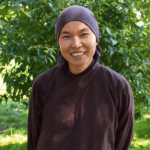
Sister Tue Nghiem became a fully ordained Buddhist nun in 1996. She enjoys learning about neuroscience, knitting socks, listening to Mozart, and making samosas.