No Borders, No Boundaries
In Tarthang Tulku’s vision of mind, the boundaries we take to be real are conventions that can be seen through. The post No Borders, No Boundaries appeared first on Tricycle: The Buddhist Review.
 FrankLin
Consider various spaces—the space that surrounds and contains all physical structures; the space established by a coordinate system; the space that makes maps possible; the space that separates stars and planets; even the space that allows us to separate our thoughts as distinct from one another. Could they all be pointing to a more fundamental space? —Tarthang Tulku, Lotus Body
As I write this, two NASA astronauts are ‘stuck in space’. Their eight-day mission has already turned into a forty-five-day journey and is likely to continue for several months more. Fortunately, they have enough food and water, and they are well-trained to stay healthy and balanced. Yet, how ironic the situation seems. There they are in vast, unbounded space, trapped in a small spaceship-prison, circling around and around, without knowing when they can go home.
What an apt metaphor for our situation. The regime [of our mental conditioning] keeps us stuck in the small, tight spaces of ‘I’, ‘me’, ‘mine’, and ‘mind’, while we actually dwell—if only we knew it—in the vast, open space of being. Not knowing how to be free, we circle round, imprisoned in our thought-patterns, and chained in an emotional dungeon that may not be real.
Regime-Space
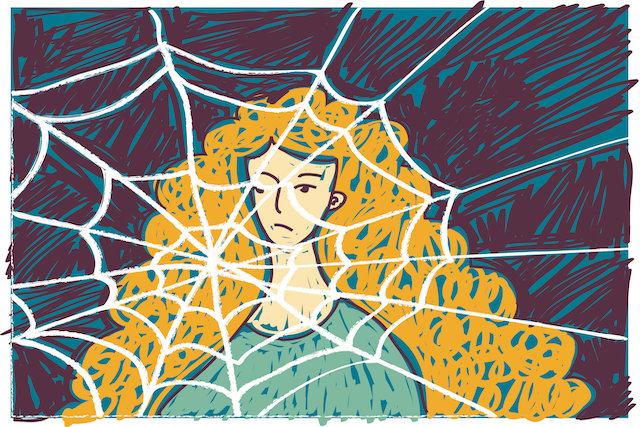
As it does with time, the regime presents us with a framework for space that limits and pressures us. We are as much at the mercy of regime-space as we are of regime-time. Regime-space tells us we are tied to this body, and this body has borders that can’t be breached, borders that keep us separated from everyone and everything around us. Regime-space tells us that within the body, there is a mind, and within the mind, there is a self, and that self—the ‘me’ I am—is somehow ‘located’ in a particular place. Generally, we assume this is the forehead, presumably because we equate mind with brain.
So, there ‘I’ am, squeezed into the space between my eyes—a tiny area of ‘I-space’ within body-space and mind-space. To pressure me further, and make me feel even more cramped, ‘I’ am then squeezed into the thoughts and feelings that ‘I’ have: each one supposedly bordered by a real boundary; as though anger, sadness, joy, awe, and all the many other feelings that arise, are separate circles, with an absolute shape and form—bubbles with a bubble border, each distinct. Now ‘I’ am trapped in one, and then in another.
Where is the room to breathe in regime-space? No wonder we cannot find happiness for more than a bubble-moment. We are living in a tiny closet in the middle of a huge mansion. How painful that is. We are creatures born to move, to ramble and explore, to create, to roam—even to fly. How can we be all that we can be if we are contained by borders and boundaries, by language rules and emotional walls? It’s no wonder we punish each other with stays in prison. If you’ve ever been under lock and key, even for a short time, you’ve experienced the suffering of ‘not-free.’
Some Misconceptions
What can we say about mental space—not from a scientific view, but by considering the unexamined assumptions we maintain about the mind that shape our everyday lives? If we look more closely at our notions, we may find ourselves able to expand the space of our being and knowing. We’ve seen how knowledge is the key to transformation. Opening up our current understanding of inner space may unlock the doors of our mental prison. It may even reveal that our inner prison never was, and never can be, real.
In Tarthang Tulku’s Lotus Body, the characters begin by dialoguing about space. Very quickly, they unveil two significant misconceptions most of us hold about space:
• In the outer environment, we think of space as a backdrop, something like the canvas on which an artist paints. Our eye goes to the object; the space has no color, shape, or form, so it disappears from view. Artists call this ‘negative space’.
This understanding of space creates a sense that matter is important, and space is not. But this can’t be right. Without the canvas, how can a painter paint? Without space, how can anything exist? Objects need a place to appear, a space in which to be. So, space is not merely a backdrop; it is the means by which the presence of matter is possible. This makes space and matter equally necessary for our world to appear. That we tend to focus only on matter is unfortunate; it leaves us knowing only half of what is so, blind to the whole picture.
• In our inner environment, we are even more unaware: we ignore space entirely. Objects, in the form of thoughts and emotions, capture our attention completely. We’re mesmerized.
But, as with the outer world, inner space must be present to allow thought-objects to appear. How could it be otherwise? Thoughts need a place to present, just as matter does. We ignore the space that surrounds thought, the space above, behind, below, and within thought. And so, we suffer from the malady of too-much-focus-on-thought and not enough spaciousness—from cramped inner conditions that are painful because we don’t understand the nature of inner space.
Experiencing Through ‘Difference’
It seems obvious that things that exist must exist somewhere; they must have a space in which to be. When we ignore that space, we suffer the consequences. But we hold another and even more unfortunate misconception. This has to do with borders and boundaries.
Let’s once again consider our notions about space in our outer environment and our inner world—although we will see later that the very division into ‘outer’ and ‘inner’ may itself be a misunderstanding.
In the outer environment, we see a world full of objects with boundaries that seem definite and real. The boundaries define and separate objects from every other object. So, for example, we see the outline of our own skin as defining ‘my body’— the boundary between ‘me’ and everything else. We see boundaries around trees, lamps, clocks, tables, dogs, and cats; by those boundaries we locate and label what is inside the boundary—a ‘tree’, ‘lamp’, ‘clock’, ‘table’, ‘dog’, or ‘cat’—and locate and label what is outside the boundary: not-tree, not- lamp, etc.
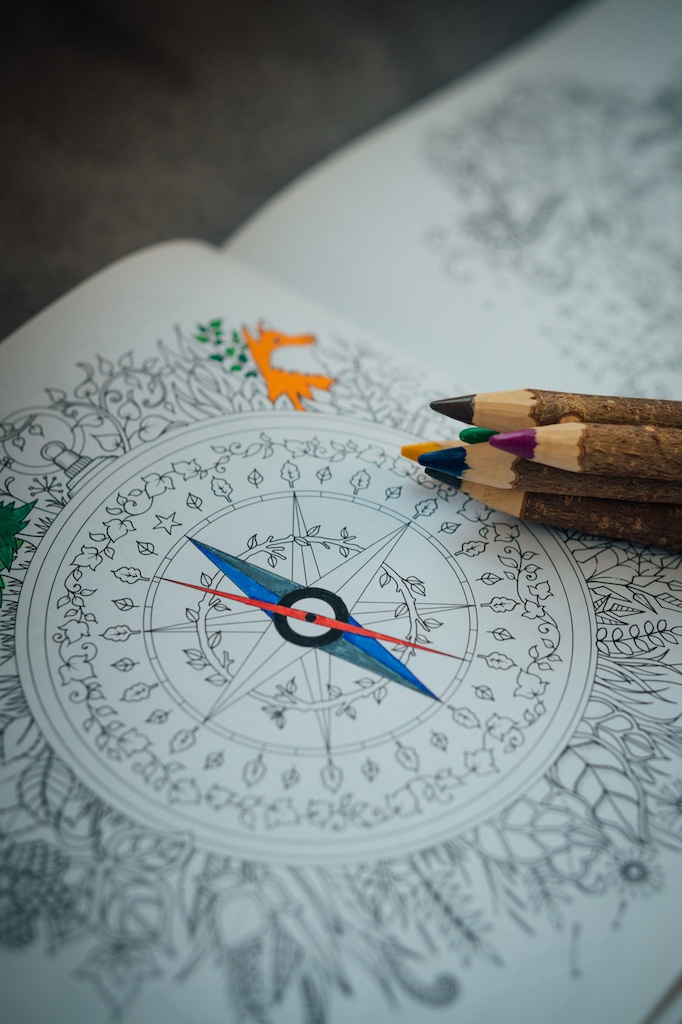
It’s a little bit like living in a coloring book filled with thick black lines that distinguish the form of one thing from another—house from sky from grass. The regime takes on the task of giving each form a name so it can express the difference between forms. It is difference, not sameness, that the regime of mind emphasizes. ‘I’ am not ‘you’. A tree is not a dog. A taste is not a sound.
In our inner environment, we also experience through difference, seeing boundaries around mental objects that distinguish one from another. The regime labels ‘anger’, ‘sadness’, ‘guilt’, ‘impatience’, ‘pain’, ‘this thought’, and ‘that thought’, as though each is a discrete thing, separated by a definite boundary from everything else. The regime names what is inside the lines under the assumption that there really is a difference, a border between inside and outside, between anger and not-anger; between love and everything else which is ‘not-love’.
Assuming Borders
One result of assuming there are absolute borders between everything is efficiency in communication. I can locate objects and describe them to myself and to you quickly. But another result is not so useful: everything, inner and outer, becomes separated—a dense grid of lonely silos, one of which is ‘me’ with ‘my positions’, ‘my feelings’, ‘my senses’, and ‘my thoughts.’
When we know only through difference, the senses focus on what is different on either side of a perceived border. In the case of objects, this means color, form, light, darkness, texture, etc. In the case of thought or language, it means sounds or written symbols. Focusing on the difference between objects, or the difference between symbols, we fail to see the connection between them. For not a single ‘outer’ object, and not a single ‘inner’ symbol, actually stands alone. The space outside each of them, the space within them, and the space between them, above them, below them, and around them is pervasive and continuous; it constitutes a unified field. Space must be pervasive and continuous, or we would experience gaps, holes in space that we would fall into, holes we would have to traverse, or bridge, for the extension and continuity of the world to be possible—including ourselves.
Yes, we speak of ‘this’ or ‘that’, ‘inside’ and ‘outside’, ‘tree’ and ‘lamp’, but this way of conceptualizing does not capture the essence of what is so—the very nature of space, which unites everything. That we typically understand me and my senses, this and that, you and I, to be forever apart is due to the particular way the regime has been trained to see and know.
Playing in Space
What does this mean for our lives and our experience? It means that all of the effort we put into getting and keeping objects, to holding on to certain named mental states like ‘love’ and ‘happiness’, to grasping after particular feelings and thoughts, to clinging to the separate space of ‘I’, ‘me’, ‘mine’, and ‘mind’, may be a waste of time. If the space inside any form and the space outside it are continuous, there are no absolute borders between things. So, when we grasp, we touch only space.
Perhaps we can usefully think of our situation like this: Each presentation of what we call ‘experience’ is like a painting in air. We can play with these, dance with them, enjoy them for what they are, but in the end, their nature is to fade away like yesterday’s dreams. There’s little point in grasping objects as though they are solid and bounded—heavy rocks. We are only unhappy when we find we cannot do it. Sisyphus was condemned to spend eternity rolling a giant rock uphill. Is our fate similar? Always attempting an impossible task?
Rinpoche said to [his students]: “There are many manifestations, but there may not be borders or betweens, positions, or gateways. If you really know how to play, what shows up could be very interesting.”
Three Practices
The first two exercises were offered by Rinpoche to potential teachers of the Lotus Trilogy, a three-volume series designed as a progressive curriculum at Rinpoche’s Nyingma Institute. The third exercise is from Gesture of Great Love: Light of Liberation. I present them here because they can guide all of us to interrogate space and boundaries in new ways.
Body’s Balance Point
Does the human body have a center point, a place of perfect balance and rest? Many yogic disciplines encourage an inner experience of balancing perfectly on a point; but perhaps the purpose of this is not quite what we imagine it to be. Perhaps the balancing itself is a kind of journey.
Begin by sitting quietly, breathing easily, your feet on the ground, hands relaxed on your lap.
Now, focus on an imagined point in your abdomen, just below your belly button. Allow your awareness to draw in toward it. Now, imagine that your whole body is resting effortlessly on this point, as if you were a giant rock, perfectly balanced on a tiny fulcrum. Remain aware of hands and feet as part of this balance.
Let your feeling gradually sink deeper and deeper towards this ‘sense of the center’. As you go deeper, your balance becomes more perfect, more precise. Notice the tiny wobbles and regard them as ripples, which gradually subside.
Ask yourself: have you found the center of the center of that center point? Could you keep going further? Keep going. Relaxation and balance may not have a final resting place.
Borders and Difference
Take note of your hands and whatever they are touching. Where do they end? Where does what they are touching begin? How do you know? How do you know they are your hands?
Sky Breath
This exercise is especially nice to do outside. Sit comfortably, or you can do this lying down on your back if you prefer. Relax the body and become aware of the breath, lightly noticing your inhale and exhale. Now, imagine a place far away with a beautiful, clear blue sky. It might be some place you have been to in the past, or perhaps a place you have always wanted to visit—a beach or a mountaintop, a lakeshore or a meadow. As you bring this place to mind, let each breath come from that distant sky, and each exhale return there, connecting you to that clear, beautiful spaciousness.
That’s all. There is nothing else you need to do; simply breathe.
♦
Adapted from The Undreamed Self, by Robin Caton. © 2026 Dharma Publishing. Reprinted with permission.