Songs of the Living and the Dead
Two award-winning writers from the Vietnamese diaspora on navigating life with mixed identities and the role of poetry in connecting with our ancestors. The post Songs of the Living and the Dead appeared first on Tricycle: The Buddhist Review.
 Troov
Troov
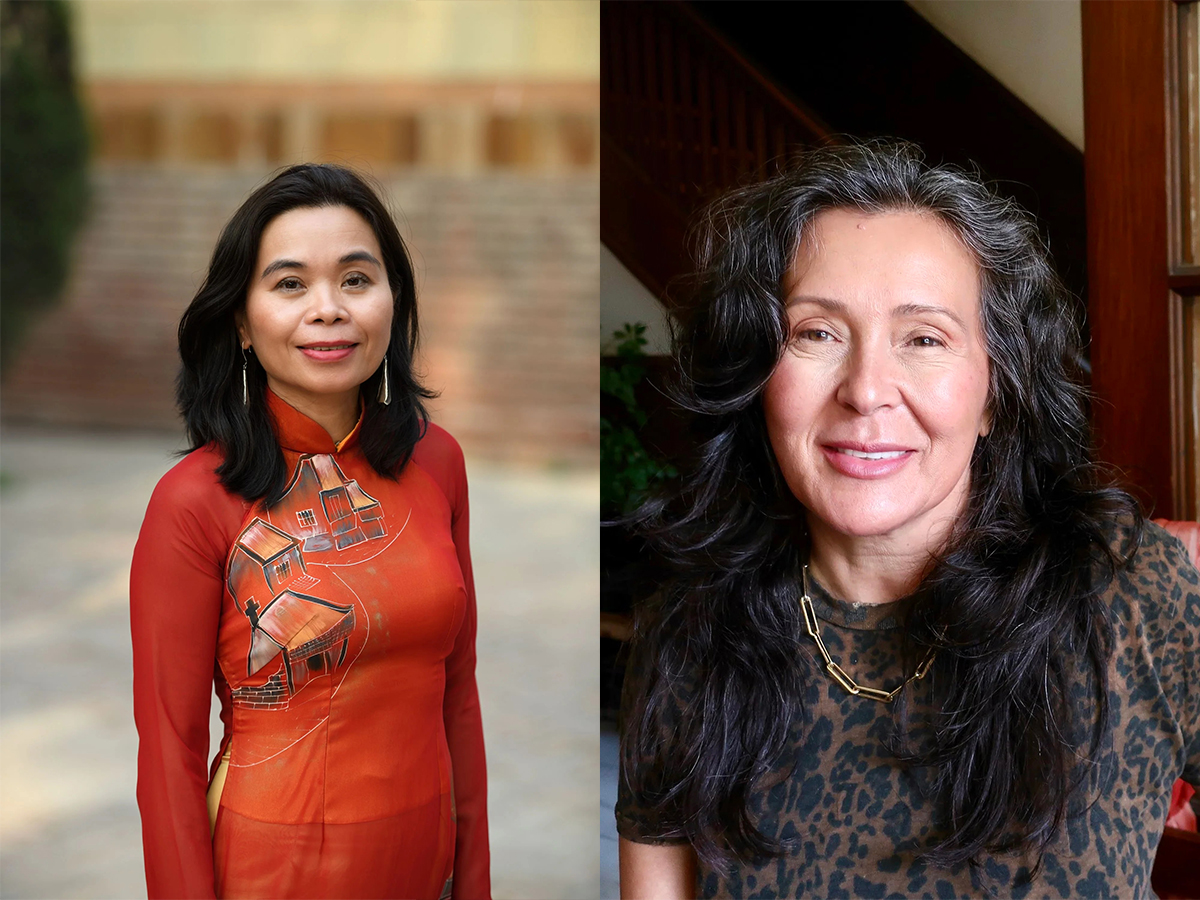
The following excerpt is from The Cleaving: Vietnamese Writers in the Diaspora, the first anthology of writings by Vietnamese diasporic writers. Consisting of eighteen dialogues among thirty-seven writers from around the world, the book explores themes of history and memory, the ongoing legacies of colonialism and war, and the role of art in reckoning with the realities of diaspora and displacement. This conversation is between poets Nguyễn Phan Quế Mai and Hoa Nguyen.
Quế Mai: So you were born in Việt Nam. How old were you when you went to the States, and how?
Hoa: I was just younger than 2. I’m Eurasian. My mother is Vietnamese, and my father is a white American man who worked for the US government; they met there, had me, married, and left Việt Nam in 1968.
Quế Mai: Do you consider yourself a refugee?
Hoa: Growing up, I did not feel that my experience had much in common with people who arrived in North America after “the Fall.” My exit, my family’s leaving, was informed by war—even as it was my parents making a life together and seeking a more certain, less violent future. I’ve since asked my mother this very question: Do you consider yourself a refugee? And she said, no, she does not consider herself a refugee. Maybe because our story doesn’t fit the typical refugee narrative. Ours is a different narrative even as it is also affected by colonialism and war. It could never be considered historically neutral. We “voluntarily” left—it wasn’t under the same pressure as other Vietnamese families who were leaving. I would say that the refugee experience inflected my experience. I think that might be another way of putting it. Our leaving was absolutely part of a larger context, a significant historical moment in the Vietnamese diaspora. It utterly marks my experience growing up in the United States in the 1970s as a mixed Vietnamese American person.
How about you? Did you have to move your home as a child, and how did the experiences shape you?
Quế Mai: I was born in 1973 in a small village in Ninh Bình, in the northern region of Việt Nam. I grew up witnessing the war’s devastation. Since life was extremely difficult, my family had to leave our village and move south in 1979. Our new home was in Bạc Liêu, a small town on the southern tip of the Mekong Delta. The North and the South had been two different countries just a few years before that, so it felt like we were moving to another country. I remember the move very vividly. At 6 years old, I had never traveled outside of my village. And then my father came home and said we had to uproot ourselves. He told me that in the South, girls wore their hair short. I loved my long hair and I sat there in the yard, crying when my father used a big pair of scissors, cutting my hair so it hung above my neck. I think he had my interest at heart, and he wanted to help me fit into the South. I believed him and thought I was prepared, but I wasn’t.
The evening that we arrived, we were eating dinner when a big rock hit the tin roof of our new house, exploding like a bomb above our heads. The rocks exploded often at night, for years to come. There were no streetlights. We rarely had electricity and we never knew who threw those rocks. Worse than the rocks was the taunting I received on the street or at school. Southern kids were singing “Bắc Kỳ nó ăn rau muống nó lỳ như trâu” [Northerners eat so much water spinach, they are as stubborn as buffaloes]. I was called all types of names. I didn’t understand why I was hated. My parents were secondary school teachers, and their salaries were so little that we had to do all types of jobs to survive. We worked almost every day on our field to plant rice, beans, and sesame; we grew and sold vegetables in the market. After school hours, I walked the many streets of Bạc Liêu, selling cigarettes. Life was difficult and my parents didn’t want to talk about the resentment we faced. I think they were trying to convince themselves, my two brothers, and me that the move was good for us.
I missed my village, and I was sure that my parents had made a huge mistake. But now, looking back over the years, I know that without growing up in Bạc Liêu, I wouldn’t be the person I am today. Without growing up in the South, I wouldn’t have understood the division among our people, the division that still runs deep. When I was growing up, many Southerners considered Northerners as those who invaded their land, taking away jobs. They were angry because many important positions at schools or factories were occupied by Northerners who had been appointed by the new government. In my neighborhood there were Southern women who were alone with their kids, because their husbands were at reeducation camps. I was told that these men had volunteered to go to these camps, and it was good for them. But later, I learned that it wasn’t the truth.
In Bạc Liêu sometimes my classmates would just disappear. Whispers said that they had escaped in secret with their families. Bạc Liêu is near the coast, where many Chinese Vietnamese lived. As the border war between China and Việt Nam broke out in 1979, Chinese Vietnamese were “encouraged” to leave. They had to pay large sums of money or gold to be able to get on small boats, entrusting their lives to the vast ocean. Southern Vietnamese whose properties had been nationalized by the government or who had faced persecution started to become boat people too. Until today, I still don’t know what happened to my classmates who disappeared. I grew up in the middle of that turmoil but had to pretend that everything was normal, because it was forbidden to talk about such sensitive issues such as reeducation camps, boat people, the nationalization of assets, resentment between the North and the South, etc.
Hoa: How did your early and ongoing experiences influence your sense of history and narrativity?
Quế Mai: My childhood experiences taught me that our history is much more complex than what’s available in textbooks and made me curious to hear the oral accounts from people I met throughout my life. Via my research and writing, I want to discover the truth and honor people’s memories. I grew up with too many secrets around me. Secrets that people still hold inside their hearts. There’s too much pain for many people to let go of their secrets, and there’s danger too. I face that danger, but I feel the need to write about the experiences of my countrymen, otherwise certain aspects of our history are lost or forgotten.
I’d like to write about the experiences of Vietnamese people, from both North and South Việt Nam. When someone asks whether I am Northern or Southern Vietnamese, it’s hard for me to answer. With my writing, I want to claim my identity as a Vietnamese who is not divided into either North or South. I especially want to write, with empathy and understanding, about the lives of those who might have thrown rocks onto my house’s roof and of those who had taunted me. I feel that there are still too many unresolved issues among the Vietnamese community, inside and outside Việt Nam. These issues need to be written and talked about so that we can start to break down the invisible walls among us. Somehow I feel that that wall is getting higher and thicker as time goes on. In that aspect, I think the work of DVAN [Diasporic Vietnamese Artists Network] is critical. With DVAN’s facilitation, we can come together, exchange our honest views and work together to foster understanding and reconciliation.
How about you, Hoa? How have your childhood experiences and your mixed identity affected your writing so far?
Hoa: I grew up during a time of intense protest regarding the American war in Việt Nam—and there was, as now, prejudice against racialized difference, white supremacy, and xenophobia. As a mixed-race Vietnamese person in a mostly white context, I felt this, and it troubled my childhood. My family experienced racism. My mother remembers being shunned and snickered at in public. And worse. As a child, I felt it, heard it, was subjected to it. It influenced my mother’s desire to assimilate. And because we arrived early in the formation of Vietnamese diasporic communities in the United States, I experienced the rupture or the separation inside of this assimilation as complete: I lost a whole language and sense of place, everything I knew, even memories. It happened and wasn’t spoken of. It was an inchoate rupture.
My mother was not interested in transferring language or culture to me—she focused on her life, her white American husband, and being “American.” She shed her skin like a snake: She was born in the Year of the Snake, a Silver Snake, and so when we settled in the Washington, D.C., area in 1969, we became an English-only household. She left the old behind and transformed into the new. I have long since felt that I write poems to bridge or address that rupture, to language it.
Quế Mai: I’m sorry to hear about the racism you faced and the loss you endured. Do you consider that your writing helps you heal?
For me, the act of writing is connected to a kind of shamanic practice that I have come to locate in a deep sense of kinship and lineage.
Hoa: Yes, I suppose it has; I believe that finding and bringing language to experiences helps us heal and offers ways to create meaningful narratives. It allows for new perspectives and possibilities. I tend to avoid thinking of creative writing as a therapeutic method, but of course it also can be therapeutic. For me, the act of writing is connected to a kind of shamanic practice that I have come to locate in a deep sense of kinship and lineage. Like the elevated Buddhist state of oneness and absorption in contemplation. The word for this in Sanskrit, samadhi, translates into “to collect” or “bring together.”
Quế Mai: Yes, to heal and to “bring together” is what we all need. I think that as part of your healing journey, you returned to Việt Nam?
Hoa: I finally returned in 2018, fifty years later—visiting Hà Nội. I came back with a clearer and deeper version of myself. I went to or rather returned to Việt Nam as a mature artist practicing my art, an art of language that is part of the language-loss of my original language. To share poems within a diasporic context with a group of literary people interested in poem-making within that multinational context was powerful.
Quế Mai: That’s great because you didn’t go to Việt Nam as an orphan searching for a home that she had lost.
Hoa: Exactly. I think that was the big emotional barrier that prevented me from returning previously. My mother refused to return to Việt Nam, her home for twenty-seven years. So the idea of facing my return was a proposal of aloneness, or I thought so. But it wasn’t that; instead, it was a return not as the Forever Exiled Orphan but as the mature Seeker on a journey that also leads inward.
Quế Mai: I am so sorry your mother couldn’t return. I read the poems you wrote during your return trip and saw her in those poems. You honor her so beautifully with your writing, Hoa. When my order of your poetry collection A Thousand Times You Lose Your Treasure arrived, I was delighted to see a picture of your mother on her stunt motorcycle, and she looked impressive. In those poems Việt Nam appears so vividly, so achingly. I remember that you wrote about tree shrines and I love that. A lot of Vietnamese believe that ghosts inhabit certain types of trees. That’s why we have altars there. The tree you described is called bồ đề. And I love how you honor those ghosts by poetry—one of the finest forms of the art. I think that the poet’s task is to grow words so that they become roots of trees.
Hoa: Yes, and trees have deep wisdom and knowledge. They are sacred and offered us a panorama of time; their messages were about the nature of time and how our modern understanding of time is too simple, based on a colonial structure. They remind us that we are part of a vast web partially visible, that if you were to draw it into space, it would be interrelated spirals.
I’ve been thinking a lot about what that would mean to write with language that mimics the actual structure of time. Related to this, I think shrine-making in trees is a way to appeal or speak to unsettled ghosts and ancestors. This is a reminder to me: that of the dead in literal and figurative terms and how poems can address and include a multiplicity of voices including the voice of the dead. I’m interested in talking with the dead in poems to connect across time and generations, across lineages of kinship. I want writing that exposes its own troubles, that self-problematizes and risks uncertainties to sculpt language with an ear to that including how language might slide and slip as a ghost might: between sound, sense, meaning, and contexts.
How does the idea of the dead inform your writing?
Quế Mai: A lot actually. One of my poems is about my grandma who died in the Great Hunger of 1945, which killed around two million Vietnamese. When I was born, both of my grandmothers had died. I always felt like I wanted to talk to them. So I talked to one of them via this poem:
The Poem I Can’t Yet Name
My hands lift high a bowl of rice, the seeds harvested
in the field where my grandmother was laid to rest.
Each rice seed tastes sweet as the sound of lullaby
from the grandmother I never knew.
I imagine her soft face as they laid her down into the earth,
her clothes battered; her skin stuck to her bones;
in the Great Hunger of 1945, my village
was starved for graves to bury all the dead.
Nobody could find my grandmother’s grave,
so my father tasted bitter rice for sixty-five years.
My two feet cling to the mud.
I listen to the burning incense of my grandmother’s soul spread,
joining the earth, taking root in the field,
where she quietly sings lullabies, calling the rice plants to blossom.
Lifting the bowl of rice in my hands, I count every seed,
each one glistening with the sweat of my ancestors,
their backs bent in the rice fields,
the fragrance of my grandmother’s lullaby alive on each one.
I wrote this poem originally in Vietnamese, then translated it into English with the help of the poet and Vietnam War veteran Bruce Weigl.
Hoa: That was gorgeous. I see that voice is important for your writing. How does feminism inform your writing or practice? What other issues are important for you?
Quế Mai: Feminism is a pillar on which I build my work, actually. I aim to write back to colonialism and the male gaze. Many novels written by white male writers and many Hollywood films have presented Vietnamese women as naive, shallow, opportunist, and stupid. We are much more complex than that. In my second novel, Dust Child, I have my Vietnamese female characters oppose the male gaze on them. I also write back to the white gaze by including the viewpoint of Dan, a traumatized helicopter pilot. Dust Child also writes back to the gender discrimination that is deeply imbedded in the Vietnamese culture too. In the book my female characters challenge such sexist proverbs as “đàn bà đái không qua ngọn cỏ” [women can’t pee higher than the top of grass blades], or “đàn ông nông nổi giếng khơi, đàn bà sâu sắc như cơi đựng trầu” [when naive, men still seem as profound as a deep well; when thoughtful, women are no deeper than a flat-bottomed betel leaf container]. Just a few days ago, I was reading a social media post where a woman commented about the ongoing Men’s World Cup and a man told her off by saying “đàn bà đái không qua ngọn cỏ” [women can’t pee higher than the top of grass blades]. This still happens in 2022 and I am enraged!
How about you, Hoa? How have you transferred feminist practices into your work? How about trauma? I’m interested to know the pathway for you to present trauma in your work.
Hoa: Putting together my early collection of poetry (Red Juice: Poems 1998–2008), I was amused to see how many poems have feminist themes. I’ve long called myself a proud feminist, and my work and teaching are an extension of that. And in my engagement with the diasporic materials—in my sense of connecting or yoking together experience, I continue to be interested in how writing connects to my sense of speaking with the dead—with the world that is alive itself. Looking at the animistic practice in Việt Nam aligned with speaking with the dead—shamanic practices—led me to understand how my interest in poetry and making poems is bound up in something essential for me: the numinous, time, and transfiguration. I consider the ways that my work attempts to language a retrieval of lost energy (or soul) from traumatic events.
Quế Mai: When we write about Việt Nam, it’s almost impossible to avoid the issue of trauma, isn’t it? The trauma of our war is inherited and passed on from one generation to the next.
To write as a poet is to see that the songs of the living and the dead resonate inside of everything. They are there already, and we can sing with them, even when we don’t know the name for the song.
Hoa: Yes, epigenetics confirm what we have known—collective and individual trauma is carried in the body. To write as a poet is to see that the songs of the living and the dead resonate inside of everything. They are there already, and we can sing with them, even when we don’t know the name for the song.
Quế Mai: The concept of the same songs being sung together by the living and the dead is breathtaking. I am amazed to hear that you talked to your ancestors. I did the same thing. When I was growing up, my parents were strict, and I couldn’t tell them about certain things. So I would go to the altar, burn incense, and talk to my grandmothers. My novel The Mountains Sing is told in the voices of a grandmother and her granddaughter. They take turns telling stories about their family. The novel opens with this line: “My grandmother used to tell me that when our ancestors die, they don’t just disappear, they continue to watch over us.”
Hoa: So that we call “time” is more complicated than how we imagine it and experience it in its assigned linear concept of past, present, and future. I know that it is vaster and more complex in its dimensionality and structure. This might be a good time for me to read you the poem that I wrote in Hanoi. It’s called “Ficus Carica Sonnet,” named after the large classification of trees, the fig family of which the banyan is part.
Ficus Carica Sonnet
Cinched belt tugged tight around the heart
5 or 6 aerial roots dangling A strangler fig
Do homeless ancestors live inside the tree?
Child of noise Hold the loosened ends You
may miss the moon or fall in love with it Embrace
ashes I too am far removed A thirst that wanders
thirsting And I could never ask the name of the boy
who died A baby boy who died but what could you do
and maybe words hang in sinew and care Writer
of dead words or living words and life’s hammer
Encase the host tree and erase it I don’t know
the folk songs on farms far from here The dead buried
and gone To dig the grave Who dug the graves Darling The sea widens for you tonight and deepens
Quế Mai: What a stunning poem. While listening to it, I could feel the pain of loss, of separation, of wandering that has been experienced by so many Vietnamese people.
Hoa: I want to return to lullabies, especially in reference to your poem and your grandmother’s lullabies. Something I want to do for my next project is to encounter and record them in the southern delta region, to make field recordings of lullabies.
Quế Mai: This project sounds so important as not many Vietnamese people sing lullabies anymore. I feel the need to hold on to lullabies and that’s why I always feature lullaby singing in my novels. The first novel in English that I attempted to write is called Rice Lullaby, actually. In the novel my main character saves a boy’s life with her singing. It’s fate that we have met, Hoa. We have so many things in common!
Hoa: It does feel like fate: lullabies and all.
♦
From The Cleaving: Vietnamese Writers in the Diaspora, edited by Isabelle Thuy Pelaud, Lan P. Duong, and Viet Thanh Nguyen. Reprinted by permission of University of California Press.



















.jpg&h=630&w=1200&q=100&v=c0f97a310e&c=1)