
Peace and Metta in West Orange
The New Jersey iteration of an international Buddhist conference asks monastics and laypeople how they can put wisdom into practice. Tricycle contributor Georgia Good reports from the scene. The post Peace and Metta in West Orange appeared first on...
 JimMin
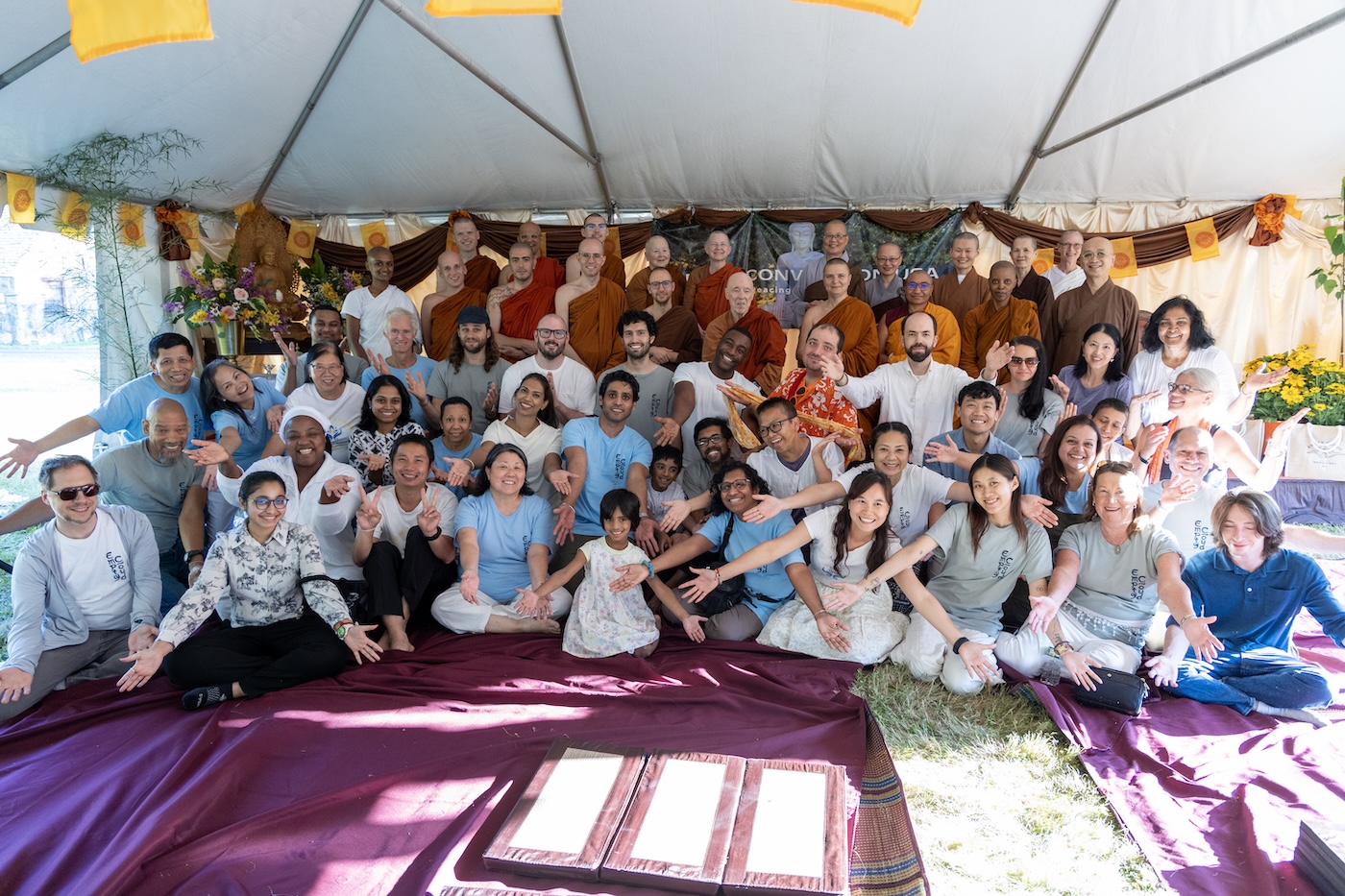
At Empty Cloud Monastery, the clouds were not empty: They were fit to bursting, and they poured. On July 18–19, beneath the sound of rain on a tent roof, monastics and laypeople gathered to talk about peace.
We were there for the inaugural Metta Convention USA—organized by Metta Centre, and hosted in partnership with Buddhist Insights at its affiliate monastery, Empty Cloud, New Jersey.
Metta Centre is a Buddhist nonprofit based in Sydney, Australia. Buddhist Insights is a nonprofit founded in New York. Their shared goal: to foster connection across Buddhist traditions, and make Buddhist teachings accessible and relevant to all. Each year in Australia, Metta Centre hosts the Metta Convention—a nonsectarian Buddhist conference that brings together teachers, monastics, and practitioners to share teachings, dialogue, and meditation practice. This year, for the first time, the convention went international. Enter: Empty Cloud.
 Metta Convention USA | Photo courtesy Clark Jones
Once a Catholic monastery, the medieval-style property is tucked away on a leafy cul-de-sac in the town of West Orange. Cofounded by Bhante Suddhaso and Ayya Soma, Empty Cloud is a gender-inclusive monastery rooted in the Theravada tradition. “It’s an island of peace and serenity amid the busyness of the New York-New Jersey area,” said Ven. Sobhana, who leads the resident community. Its lawns roll seamlessly into a public park, where sycamore trees grow tall, a sense of peace echoing through the grass.
And peace was the convention’s theme: “Peacing it Together.” Monks and teachers, from across traditions and the world, shared wisdom in an open tent, adorned with flowers. Guests of all generations came, and more joined via a livestream. The weekend was free and open to all, and ran seamlessly thanks to volunteers. For lunch, amazing spreads of food appeared, as if by magic. The sky offered the whole spectrum of an East Coast summer: from Saturday’s downpours to clear blue skies on Sunday. As the venerables spoke, we were invited to participate throughout—from guided meditations, to Q&As, to sessions in small groups, scattered across the monastery.
***
As the weather cycled through its many forms, wisdom flowed through our tent, and certain teachings on peace emerged, again and again.
To create peace in the world, we must first cultivate peace within ourselves. All life has challenges, and change is inevitable, Ven. Sobhana said—but it’s how we respond that determines the degree of our peace. We can focus on the negativity, or take challenges as blessings. We can “use them to grow,” says US-based teacher Ven. Revata, like fertilizer—or like the rain, pouring down as he spoke. Ven. Soma quoted a Zen proverb: “Obstacles do not block the path. They are the path.
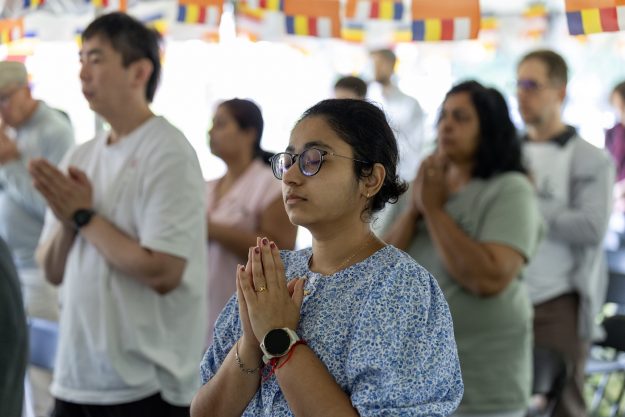 Participants at Metta Convention USA | Photo courtesy Clark Jones
On that theme, Rev. Doyeon Park—who advises on Buddhism for the United Nations, Columbia University, and New York University—shared a story of meeting a psychic in New York City. The psychic offered to solve a problem that she had, but she shook her head; the psychic might have helped, but Rev. Park knew that more problems would arise. The real solution was to be comfortable with that. Ven. Sudhamma, founder of the Charlotte Buddhist Vihara, North Carolina, put it well: “I don’t have faith I’ll get everything I need, but I have faith I’ll be OK no matter what.”
To cope with more, Ven. Courtin said—to practice more compassion—you must work on your own mind first.
By practicing mindfulness and loving-kindness, we can move toward that state of mind. Ven. Tejassi, cofounder of Mexico’s La Gracia sanctuary, noted how that generates a sense of joy, lightness, buoyancy—“a lack of affliction, within and without.” In fact, said the world-touring dharma teacher Ven. Courtin, it helps us avoid burnout: “Your burnout isn’t caused by your compassion but by your attachment.” When you witness suffering, your attached self responds with anger, sadness, and aversion—often culminating in burnout. By letting go of attachment, we can avoid these emotions, and act more compassionately. Equally, we must know what we can and cannot cope with. To cope with more, Ven. Courtin said—to practice more compassion—you must work on your own mind first.
***
Then, go out into the world. Inner peace must translate to real-world action. As Rev. Park observes, there’s often a disconnect: People want peace but make daily choices that have the opposite effect. And yet “it’s what we do in our daily lives that matters.” Just as a bird needs two wings, we need both wisdom and compassion. Meditating, to cultivate inner peace and wisdom, is our “meditation wing”; by putting that wisdom into practice, we show compassion, our “action wing.”
In their own lives, the venerables stretch both wings, practicing compassion in myriad ways. Ven. Sudhamma works with addicts in North Carolina, and Ven. Courtin founded the Liberation Prison Project. Ven. Bikkhu Bodhi, a leading translator of the Buddha’s discourses, cofounded the nonprofit Buddhist Global Relief. In a mobile monastery—a camper van—Ven. Clear Grace provides outreach to communities facing systemic oppression, through her nonprofit the Traveling Nunk. There are many more examples.
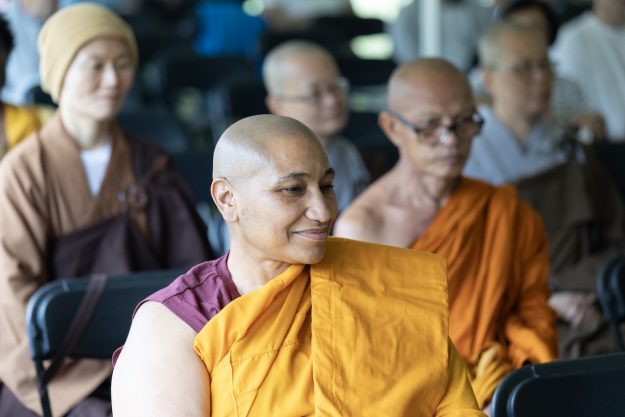 Ven. Clear Grace at Metta Convention USA | Photo courtesy Clark Jones
Walking can be part of that practice. So much of the Buddha’s own life was walking—sharing the dharma, from village to village. When monks walk, they invite curiosity, especially in the West. Orange-clad, “we are like goldfish,” smiles Ven. Sumitta, founder of nonprofit Dhamma USA. “An advertising tool for loving-kindness.” Ven. Clear Grace remembered how, in the civil rights movement, walking was a powerful expression of nonviolence. For her, walking as a Buddhist in the Bible Belt—from Mississippi Main Streets to confederate trailer parks—became, again, “a sacred act . . . to heal the land in places that need it most. When the world is on fire, to see someone walking for peace is an invitation.”
That idea extends to all forms of practice. “I come from a Southern Baptist family of thirteen, and to this day, they think I’m in a cult,” said Ven. Satima. She can’t preach about it back home in Arkansas, but she can practice generosity, loving-kindness, and mindfulness. People don’t get so defensive, then—just curious. Ven. Sanathavihari, too, notes the importance of not just hearing your teacher’s words but seeing how they interact with other people. In short: The best way to share the dharma is to live it.
***
Though we gathered on an island of peace, the convention was not an escape from the world: Talk of peace was inextricable from our political landscape. There in West Orange, close to Wall Street, Washington D.C., and so many centers of power, Ven. Sudhamma asked: “Any greed, hatred, or delusion anyone’s noticing at the moment?”
Ven. Bhikkhu Bodhi reflected on the day’s headlines, its litany of conflicts—Ukraine, Iran, Palestine. What would it mean, he asked, if all nations observed the five precepts? It would mean no killing, no stealing territory, no propaganda. He imagined all nations adopting policies of total disarmament, having accepted that war can no longer settle conflict. He imagined trillions of dollars disinvested from the military, used to transform our economic, social, and environmental systems. “When you adopt the five precepts,” he said, “you give immeasurable safety, security, and well-being to countless beings.”
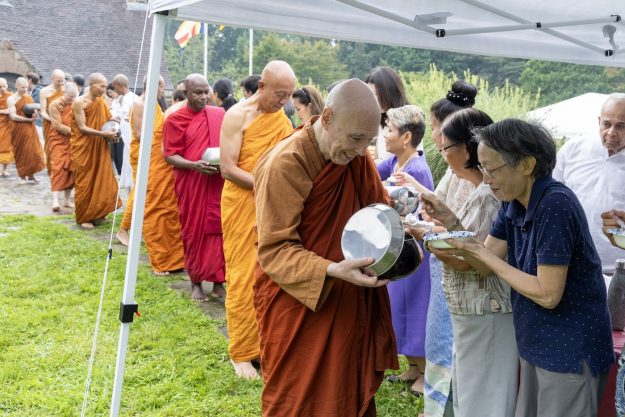 Bhikkhu Bodhi leading the alms round at Metta Convention USA | Photo courtesy Clark Jones
“We might not be able to solve all the problems of war,” Ven. Bhikkhu Bodhi continued, “but if we observe the five precepts ourselves, we become sources and ambassadors of peace to the rest of the world.” And that extends to the political sphere. As he reminded us, we can vote. We can participate in citizen’s groups, like Indivisible and MoveOn, including Buddhist groups like One Earth Sangha and the Buddhist Coalition for Democracy. “This is not politicizing Buddhism but taking conscientious action based on Buddhist principles,” he says. That’s how systemic peace is achieved.
***
Here, our compassion must extend to all beings—including those doing harm. We readily have compassion for those who are most vulnerable, living in poverty, sickness, or war zones—as Ven. Courtin put it, “a few animals and a few children.” But we must feel compassion, too, for their oppressors—the serious criminals, and the rich and powerful. We should meet them with wisdom and compassion. We could say, for example, “ ‘Thank you, Mr. President, for showing me how not to act,’” Ven. Courtin suggested. “Then put wisdom into practice.”
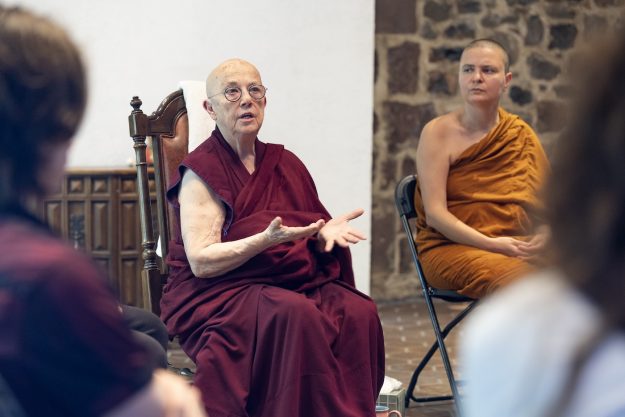 Ven. Robina Courtin at Metta Convention USA | Photo courtesy Clark Jones
Leading a forgiveness meditation, Ven. Zhai invited us to forgive those who’ve wronged us: All sentient beings are Buddhas, to be respected with an open heart. We’re not perfect, patient, and kind all the time, Ven. Suddhaso reminds us—so why expect perfection from others? Instead, we should focus on their goodness, and recognize that they’re trying. And even monastic communities have conflicts, Ven. Soma says. But most of the time, “it’s over silly things, like where to put the pots. Who cares?” We should try to pay attention to what matters.
Ven. Sudhamma, meanwhile, suggested that when you’re criticized, first ask if there’s truth in it. We all have blind spots, after all. “If we demonize the other side,” she went on, “we close off all possibilities of finding common ground. But if we listen with an open mind, we might find tiny jewels of truth in what they’re saying, and find some common ground.” Try directing loving-kindness at someone you don’t like, even for a few minutes a day. When they do behave badly, she said, take action. “Before you do, tell them, ‘I love you.’ And then get ’em.”
***
“Often, Western people have a McDonald’s attitude [toward] Buddhism,” Ven. Satima said: “We want a drive-through approach to enlightenment.” We want a lot, fast, for not very much. But cultivating peace can take a lifetime; inner calm and world peace require deep faith, and might feel way beyond reach. Acknowledging this, many speakers made their teachings feel accessible, actionable, and manageable. For them to work, Ven. Courtin emphasized, “the most important thing is to put them down to earth”—to understand “the nuts and bolts of karma.”
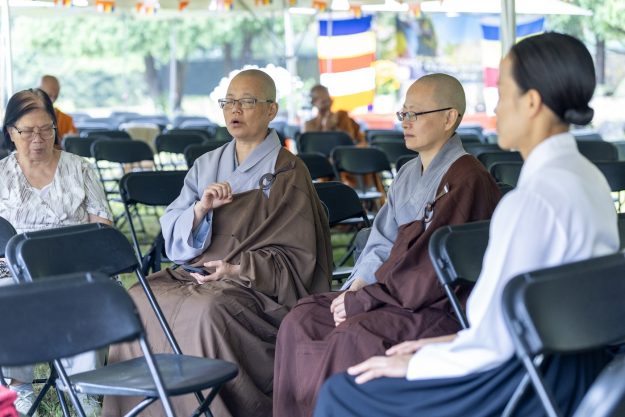 Mahayana monastics chanting at Metta Convention USA | Photo courtesy Clark Jones
Even if it’s for a minute a day, Ven. Satima suggested, close your eyes, say a few words of the Metta Sutta, and mean it. Ven. Nanda, president of the Long Island Buddhist Meditation Center, suggested reciting the line—“May all beings be well and safe”— before you leave home in the morning. Put it on your dashboard, or on the front door. Ven. Nisabho, founder of Washington’s Clear Mountain Monastery Project, likened meditation to brushing your teeth—daily mental hygiene, cleaning out the mind. “So often, the slightest splinter of annoyance will make its way out in a relationship,” he said. “If you sense anger, don’t speak. Wait ten or fifteen minutes. Then speak from a place of loving-kindness.”
As time passes, you might start to see a difference in your life: “Joy and happiness,” Ven. Nanda joked, “100 percent guaranteed.”
***
Rain or shine, events like the Metta Convention matter. They’re powerful reminders that the dharma comes in many forms, and it’s for all of us; that inner and outer peace nourish each other, like twin springs; that, as Ven. Sobhana said, “there’s no security or stability in the world, but there is at the end of this path.”
This was a unique gathering, generous, energizing, and rich. We gathered in the pouring rain, sharing umbrellas and homemade food. We spread out across sunlit grass, when the sky finally cleared. We were just one group, in one small New Jersey town—but as Ven. Nanda reminded us, “If we’re all peaceful and mindful, we can build this up—to our friends, family, society.” Our hearts and actions will ripple out, toward the peaceful world that Ven. Bikkhu Bodhi envisioned.
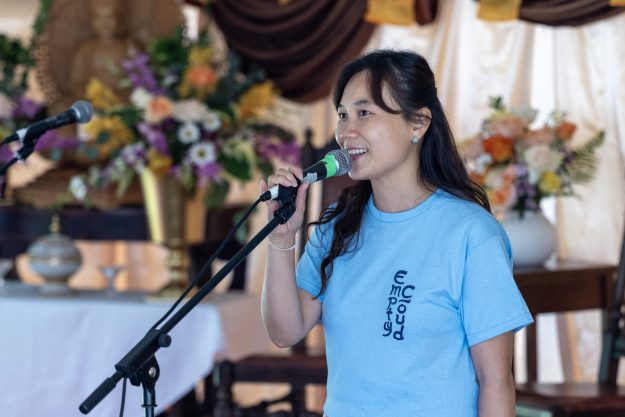 Tina Ng at Metta Convention USA | Photo courtesy Clark Jones
Will the Metta Convention return to the US? “That’s up to the community, here in America,” says Tina Ng, Metta Centre founder. “If there’s a desire for gatherings like this to continue, Metta Centre will do our part to make that happen, and help the network grow.” By bringing temples, teachers, and communities together, in innovative ways like this, the dharma can spread exponentially, across the globe.
In tribute to the event’s Australian roots, let’s end with a line of classic clipped Aussie wisdom from Ven. Courtin: “Every day, rejoice and delight, use it for good, help yourself and others, and then you’ll die. It’s very simple.”
She’s right. And with simplicity, comes peace.





















.jpg&h=630&w=1200&q=100&v=7abd35f457&c=1)


.jpg&h=630&w=1200&q=100&v=7abd35f457&c=1)


![The Trust Signals That Get Your Brand Cited By AI Overviews, Just Like Freshpet [Webinar] via @sejournal, @hethr_campbell](https://cdn.searchenginejournal.com/wp-content/uploads/2026/08/ap-3-846.png)