Restoring Myself, Touching the Earth
Ten years after her mother’s death, a Plum Village monastic turns to nature to hold and transform her grief. The post Restoring Myself, Touching the Earth appeared first on Tricycle: The Buddhist Review.
 JaneWalter

Today, ten years after Ma’s death, I walk to the top of Plum Hill next to the plum orchard and look down on Plum Village’s New Hamlet in France and over the distant rolling hills beyond the buildings. I want to spend a day outdoors, from morning until evening, simply savoring the beauties of nature, absorbing the rare autumn sunlight, and allowing my body and mind to be embraced and healed by Mother Earth. I want to have a day of not doing anything—not talking to anyone and not thinking about the past, present, or future. I want it to be a quiet day without distractions so I can feel my emotions, so I can touch my deep thoughts and dreams. This is my lazy day, and I relish the chance to be alone to touch the beauties and wonders around me and to look within to see them manifested inside, to understand the workings of my mind. I want to open my senses wide and feel the breeze caressing my cheeks, smell the sweetness of the flowers, listen to the birds chorusing among the trees, watch the dancing sunlight on the fields and valleys, and touch the softness and the solidity of the earth underneath my feet.
Touching the earth is an important practice in the Plum Village tradition. It is a practice of taking refuge in something that is solid, patient, and loving. Many Buddhists practice touching the earth by bowing before an altar and touching their palms and forehead to the ground as an expression of reverence and respect. Some may stretch out fully, or, kneeling, take a child’s pose. What makes the practice powerful is not the form but the remembrance that Mother Earth is not an inanimate object—Mother Earth is a living bodhisattva who is always there for us. Thich Nhat Hanh (Thay) called Mother Earth “Bodhisattva Gaia,” mother of all beings. She brings us into the world, nourishes us, sustains us, and welcomes us back when it is time for us to leave our physical, bodily existence.
Mother Earth witnesses everything that happens and has ever happened on the face of the earth. Mother Earth has retained everything that has ever happened on this planet and has preserved the deep compassion, insight, peace, and happiness of the Buddha and all ancestral teachers in her body. I often wonder whether Bodhisattva Gaia suffers to see her children killing each other and slowly poisoning, polluting, and killing her body, the earth. The answer I always hear is, “Yes, Mother Earth is suffering.” But, being a bodhisattva, her love is relentless and her patience is formidable—she continues to wait for her children to wake up, to understand that harming her is harming ourselves.
Mother Earth witnesses countless great, enlightened beings walking on earth with peace, love, and freedom. Mother Earth witnesses our presence on earth and feels our steps. Every time we walk with peace and stability, we imprint these wholesome energies on the earth. Mother Earth feels our peace and stability. Mother Earth nourishes and heals herself through the peace, love, and stability we imprint on her body. When we make mindful, loving, and peaceful steps, we do it not just for our own healing and nourishment, but for Mother Earth, for our parents, our ancestors, and all beings. I see them all rejoicing with each mindful step I take, see their smiles, their hands throwing flowers and waving to us, as our parents used to do when we were babies taking our first steps.
When we make mindful, loving, and peaceful steps, we do it not just for our own healing and nourishment, but for Mother Earth, for our parents, our ancestors, and all beings.
With each step today, I touch Mother Earth in deep gratitude. The soles of my feet feel warm and alive. I can feel the healing presence of Mother Earth flowing through my body and mind, and I can send this healing energy to Ma, now one with the elements and the earth itself. I breathe in and out with every step, saying silently, “I am here for you” with my in-breath, “I am grateful to you” with my out-breath.
Today, I miss Ma very much. I sit on the plum orchard hill, looking out over the rolling hills and distant villages. The clouds drift gently in the blue, autumn sky, changing continuously, a display of impermanence right in front of my eyes. One moment, the sun shines. The next, it is raining, and the sky darkens. The clouds change shapes and colors on their way to a faraway land. I send my peace and love to Ma with the clouds so I can feel this peace and love embracing her.
M a had always held a deep reverence for Buddhist monastics and Buddhist practices, even when I was a child. She devoted a large part of her life to spiritual practice and living with monks and nuns. One day when we were living together in Deer Park before her stroke, Ma came to my window in Clarity Hamlet in the long, gray robe that she wore for formal activities like sitting meditation. I was sitting and reading at a desk in my room, which I shared with another nun.
“Do you want to go touch the earth to the Buddha with me?” Ma asked. She was inviting me to join her in the practice of touching the earth, in which we stand in front of an altar and then kneel and touch our foreheads and the palms of our hands to the floor in gratitude and humility.
“Sorry Ma, I’m busy now. Maybe another day. I’m studying right now,” I responded.
“Okay, I will go by myself.” Ma said, smiling approvingly to see me diligent in my study. She headed toward the nuns’ meditation hall, which was across from my room. I could see her through the window, opening the door and bowing as she entered the hall. Ma touched the earth before the Buddha with devotion every day. She found such comfort in coming into contact with the buddhas and bodhisattvas through this simple practice she could do with her whole body and soul.
Later that afternoon, we walked together on our usual stroll in the oak grove as the day became cooler. Ma shared, “Every time I breathe in as I touch the earth before the Buddha, I see a lotus blossoming in my heart. When I breathe out as I touch the earth, I smile to the Buddha.” In this way, Ma offered her wholehearted love toward the buddhas—the awakened ones who live in perfect compassion and wisdom—of the past, present, and future.
When I lived with Ma in Deer Park, I was either busy participating in the sangha’s activities or spending time with Ma. In fact, when Ma went alone to touch the earth in our meditation hall, it was a chance for me to have a little time alone. Now, Ma is unable to touch the earth, but I can do it for her. On the hill above New Hamlet, I touch the earth to transmit peace and love to Ma. I touch the earth as a practice of beginning anew with myself and for Ma so her suffering can be transformed. Transforming myself is transforming Ma.
I touch the earth as a practice of beginning anew with myself and for Ma so her suffering can be transformed. Transforming myself is transforming Ma.
Another restorative practice related to touching the earth is to call on the presence of our ancestors. One time, I was in deep pain after a sister, who was also a dear friend of mine, got angry with me for something that was beyond my power to change. She refused to talk to me or interact with me for days. Reconciliation seemed impossible. Although I appeared calm and composed, I was deeply wounded. One night, I got out of bed to go for a walk to embrace my heavy heart. I loved walking at night in the field around the nunnery’s lotus pond. In the dark, I was not distracted by anything. I could really look inside myself, recognize what was happening, and embrace the pain and hurt. I needed the support of someone and something bigger and stronger than me to help me and show me how best to deal with the disharmony between me and my friend.
I called on the presence of a spiritual ancestor, the Venerable Shariputra, one of the original students of the historical Buddha. Venerable Shariputra was the Buddha’s most beloved disciple and assistant, and he aided the Buddha in organizing and caring for his original sangha. He was also known for his great wisdom and compassionate guidance of his monastic siblings. Thay always spoke about the Venerable Shariputra as if he were alive and living among us. Thay admired, loved, and respected the figure of the Venerable Shariputra deeply as an elder brother to all who follow the monastic path. Influenced by Thay’s love and admiration for the Venerable Shariputra, I had a deep appreciation and connection to this spiritual ancestor.
That night, I called on the Venerable Shariputra as an elder brother to support me in embracing the hurt and pain I was experiencing. I walked mindfully as if I were in the presence of the Venerable Shariputra, while saying silently, “Dear elder brother Shariputra, please shed light on me so I can have clarity to embrace and understand my pain.” I touched the earth wholeheartedly and mindfully with my feet. After some time practicing walking meditation in that way, recollecting the name and feeling the presence of the Venerable Shariputra, I felt my mind become clear, as if a light had suddenly gone on in its darkness. All the pain and hurt I had felt moments before was completely gone. Clarity and joy were the only things present. There on so suddenly that I felt Venerable Shariputra was present, shedding light on me. I felt Venerable Shariputra was not outside of me, was not someone who lived more than twenty five centuries ago, but was alive in my heart.
I’d heard Thay say countless times, “Whatever you are looking for is already inside of you, including the Buddha.” Yes, Venerable Shariputra was there; I was a continuation of Venerable Shariputra. The most worthy action, the way forward that was deserving of my full humanity, was to accept, forgive, and love my sister just as she was, without any resentment, judgment, or blame. I smiled in the dark night and walked back to my room full of lightness and joy—encountering Venerable Shariputra had transformed my hurt, heaviness, and pain. This experience healed me, and it helped heal my relationship with my sister. Without trying to resolve the issue or confront her over it, I changed. When I did, I noticed she also changed.
We cannot exist alone. Everything is in us. We are in everything.
Our ancestors and Mother Earth are always there for us. Earth is not just underneath our feet. She is in us. She is us. We are made of Mother Earth. It is the same with my mother. She is not just outside of me. My mother is in me. I am made of her, made of all her sufferings, joys, and life experiences. I carry her into the future. When I am healed, she is healed. When I am happy, her happiness in me becomes alive. This is the insight and the beauty of interbeing. This is our true nature. We cannot exist alone. Everything is in us. We are in everything. At moments of difficulty or darkness, we can call on the love and strength of our beloved ones to embrace and take care of suffering for us. Touching the earth, we are reminded that the earth is in us, that our beloved ones are in us. We are the earth. We are our mother. We are our ancestors.
In the last few days of my solitary retreat in New Hamlet, I touch the earth for Ma every day. I breathe in and bring my palms to my forehead and heart while recollecting the name of a buddha or bodhisattva. I breathe out and smile while bending down to touch the earth. I breathe in and out three more times while resting on the earth in a child’s pose. With another in-breath, I rise. With another out-breath, I stand up straight. Ma is touching the earth with me.
♦
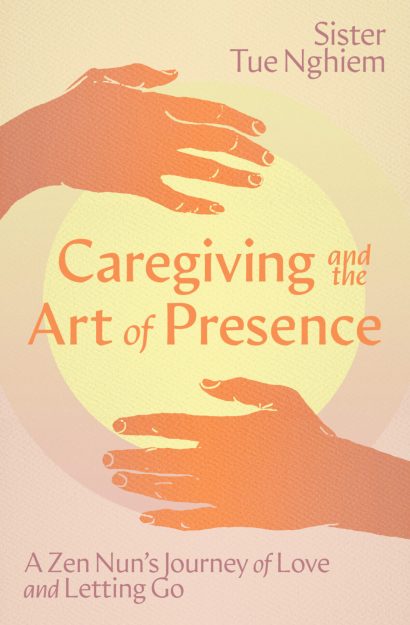
From Caregiving and the Art of Presence: A Zen Nun’s Journey of Love and Letting Go (2026), courtesy of Parallax Press, parallax.org.