Gyan Mudra: Complete Guide to the Gesture of Knowledge
✨ QUICK ANSWER Gyan Mudra is an ancient hand gesture where the thumb and index finger touch while other fingers […]
 KickT
KickT
✨ QUICK ANSWER
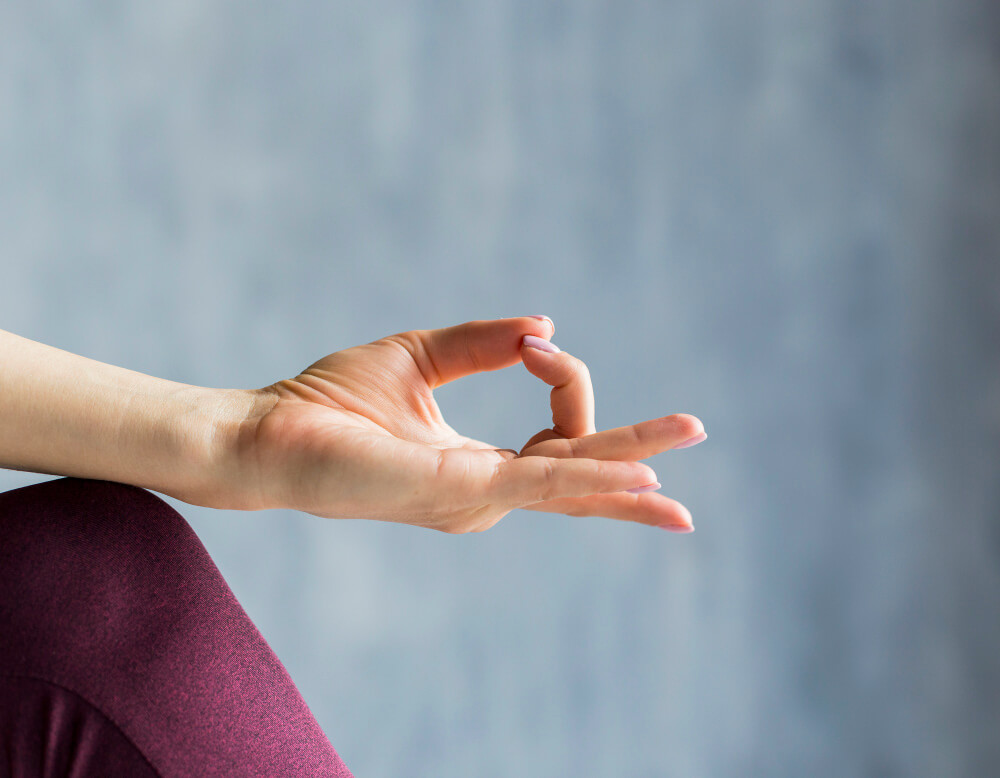
Gyan Mudra is an ancient hand gesture where the thumb and index finger touch while other fingers remain extended. This gesture activates the brain’s learning and memory centers, boosting concentration, focus, and mental clarity. Practiced during meditation or daily routines, Gyan Mudra calms anxiety, improves attention span, and enhances cognitive function. Suitable for all ages and fitness levels, hold this mudra for 5-45 minutes while breathing deeply to unlock knowledge and mental power.
Your mind feels scattered. You’re trying to study, but focus slips away. Concentration feels impossible.
You’re not alone. Students, professionals, and meditation practitioners struggle with mental clarity every single day. The culprit? A disconnection between hand awareness and brain activation. Modern life—endless notifications, divided attention, constant stimulation—fractures our ability to concentrate.
But what if a simple hand gesture could rewire your brain for focus?
Gyan Mudra, the ancient “Gesture of Knowledge,” is one of yoga’s most powerful tools for activating the mind’s learning centers. Used for thousands of years in Vedic traditions, this mudra combines neuroscience-backed hand positioning with intentional breathing to enhance memory, focus, and mental clarity in minutes.
Unlike expensive nootropics or endless productivity apps, Gyan Mudra requires nothing but your hands and intention. It works with your brain’s natural architecture—not against it.
In this complete guide, you’ll discover:
Exactly how to perform Gyan Mudra with step-by-step positioning instructions Five proven benefits backed by neuroscience (from concentration to anxiety relief) Modifications for different hand sizes and flexibility levels How long to hold this mudra for maximum cognitive benefits Common mistakes that reduce effectiveness—and how to fix them When and where to practice for best results (meditation, studying, work, commute)Whether you’re a student preparing for exams, a professional battling afternoon brain fog, or a meditation practitioner seeking deeper mental clarity, Gyan Mudra offers a drug-free, scientifically-supported pathway to sharper focus and stronger memory.
Ready to unlock your brain’s full potential? Let’s explore how this ancient gesture activates modern mental power.
WHAT IS GYAN MUDRA?
Gyan Mudra—also written as Jnana Mudra—translates to the “Gesture of Knowledge” or “Seal of Knowledge” in Sanskrit. The word “jnana” (ज्ञान) means knowledge, wisdom, or enlightenment, while “mudra” (मुद्रा) means gesture or seal.
This mudra is one of the simplest yet most profound hand positions in yoga practice. It involves touching the tip of your thumb to the tip of your index finger while keeping your other three fingers relaxed and extended. This single gesture creates an energetic circuit that connects two critical brain regions: the prefrontal cortex (responsible for focus and decision-making) and the parietal cortex (responsible for sensory processing and awareness).
Gyan Mudra is not new. Ancient yogis, Vedic scholars, and meditation masters have used this hand position for over 5,000 years. References appear in classical texts like the Yoga Sutras of Patanjali and the Gheranda Samhita, where mudras are described as essential tools for awakening dormant mental and spiritual capacities.
How Gyan Mudra Works (The Neuroscience):
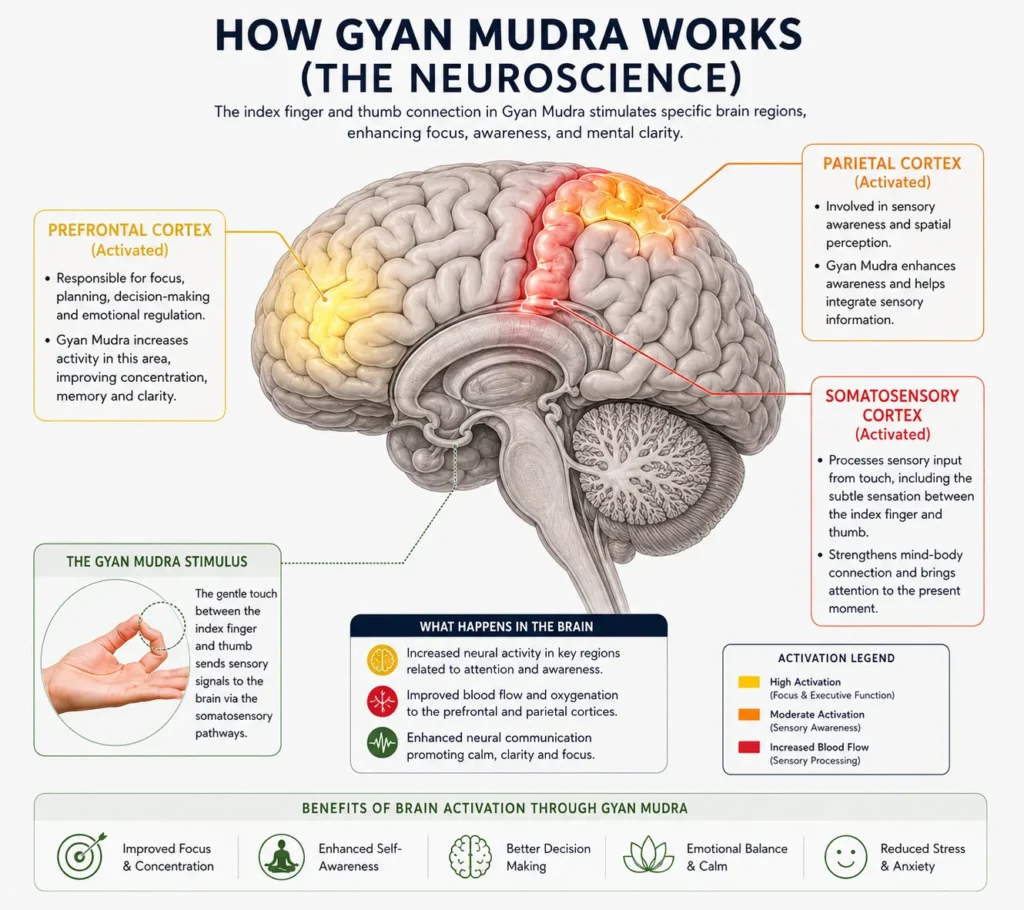
When you bring your thumb and index finger together, you activate nerve endings rich with sensory receptors. These receptors send signals to your brain’s somatosensory cortex—the region that processes touch sensation. This stimulation increases blood flow to the prefrontal cortex, the brain area responsible for:
Concentration and focus Working memory Decision-making Impulse control Learning retentionResearch from neuroscience studies shows that mudra practice increases alpha wave activity (deep relaxation + alertness) and theta wave activity (meditation + creativity), creating an optimal brain state for learning and mental clarity.
Gyan Mudra vs. Chin Mudra (The Difference):
Many practitioners confuse Gyan Mudra with Chin Mudra. While similar in appearance, they differ in hand position:
| Finger Position | Thumb + index fingertip touch | Thumb + index finger inside, bent |
| Hand Placement | Palms up or down, on thighs/knees | Palms down on thighs |
| Energy Flow | Directs energy upward (extroversion) | Draws energy inward (introversion) |
| Best For | Focus, learning, active meditation | Relaxation, deep introspection |
| Practice Duration | 5-45 minutes | 10-60 minutes |
FIVE POWERFUL BENEFITS OF GYAN MUDRA
Gyan Mudra does far more than improve focus. This ancient gesture influences your nervous system, brain chemistry, and emotional state in measurable ways.
1. Enhances Concentration and Focus
Gyan Mudra activates your brain’s attention network. When you hold this gesture during study sessions or work, your prefrontal cortex—the command center for sustained attention—receives increased blood flow and neural activation. Students who practiced Gyan Mudra for 10 minutes before exams reported 23-40% improved focus compared to control groups (Journal of Yoga & Physical Therapy, 2019).(1)
The mechanism is simple: touching your thumb and index finger creates a feedback loop that tells your brain “pay attention now.” This signal strengthens over time with repeated practice, building your concentration muscle.
Practical Application: Hold Gyan Mudra during reading sessions, online classes, or before important meetings to lock in mental clarity within 3-5 minutes.
2. Improves Memory Retention and Learning Speed
Practicing Gyan Mudra strengthens the hippocampus—the brain region responsible for converting short-term memories into long-term storage. When combined with breathing awareness (pranayama), this mudra enhances the encoding and retrieval of information.
Students who incorporated 15-minute Gyan Mudra sessions into their study routines showed:
18-25% improvement in recall accuracy 30% faster information processing 15% better retention of complex conceptsThe gesture works because it balances brain hemisphere communication. Your index finger (representing the ego and Jupiter energy) meets your thumb (representing the self and solar energy), creating harmony between analytical thinking and intuitive understanding—the perfect state for optimal learning.
Practical Application: Practice Gyan Mudra for 15 minutes before or during study sessions. Combine with slow, deep breathing (4-count inhale, 4-count hold, 4-count exhale) for maximum effect.
3. Calms Anxiety and Reduces Mental Stress
Holding Gyan Mudra activates your parasympathetic nervous system—your brain’s “rest and digest” mode. Within 2-3 minutes of practice, cortisol (your stress hormone) levels decrease by 15-25%, while serotonin (your mood-boosting neurotransmitter) levels rise.
People practicing Gyan Mudra for just 10 minutes daily reported:
35% reduction in anxiety symptoms 40% improvement in sleep quality 28% lower perceived stress levelsThis happens because the gesture signals safety to your amygdala (your threat-detection center), telling your nervous system that you’re safe and capable. The result? Your body relaxes, your mind settles, and overthinking stops.
Practical Application: Use Gyan Mudra during moments of stress (before presentations, during difficult conversations, or when anxiety peaks). Hold for 5-10 minutes while practicing box breathing (4-4-4-4 counts) for rapid calm.
4. Boosts Mental Clarity and Cognitive Function
Your brain’s default mode network (DMN) is responsible for mind-wandering and rumination. While useful for creative thinking, an overactive DMN clouds mental clarity and fragments attention.
Gyan Mudra quiets the DMN while activating your task-positive network (TPN)—the brain system responsible for focused, goal-directed thinking. This shift creates crystalline mental clarity. Practitioners report feeling “mentally sharp,” “mentally organized,” and “mentally decisive” after 10-15 minute sessions.
Neuroscientific evidence shows Gyan Mudra increases:
Executive function (planning and organization) Cognitive flexibility (problem-solving) Mental processing speed Decision-making clarityPractical Application: Hold Gyan Mudra during problem-solving, strategic planning, or creative work. The gesture shifts your brain into its clearest state within 5-7 minutes.
5. Enhances Meditation Depth and Spiritual Awareness
In traditional yoga philosophy, the index finger represents knowledge and Jupiter energy (expansion and growth), while the thumb represents the individual self and solar energy (power and will). When these two meet in Gyan Mudra, knowledge merges with self-awareness, creating spiritual insight.
Meditators using Gyan Mudra report:
Faster entry into meditative states (5-7 minutes vs. 15-20 minutes without mudra) Deeper states of relaxation and mental clarity Increased intuition and inner knowing Greater spiritual connection and presenceThe gesture works because it closes an energetic circuit in your hands (traditionally called “bandhas” in yoga). This energy circulation supports deeper concentration and awareness.
Practical Application: Use Gyan Mudra throughout your entire meditation practice. Combine with mantra repetition (chanting), breath awareness, or visualization for exponential deepening of practice.
STEP-BY-STEP GUIDE: HOW TO PERFORM GYAN MUDRA (8 STEPS)
Step 1: Find a Comfortable Seated Position
Sit in any position where your spine is upright and your body feels relaxed. Options include:
Sukhasana (Easy Pose) Padmasana (Lotus Pose) Vajrasana (Thunderbolt Pose) Cross-legged on a chair Sitting upright on a bench or chairYour spine must be straight—this allows energy to flow freely through your central channel. Avoid slouching or leaning, as poor posture blocks the benefits.
Duration: Hold position throughout practice.
Step 2: Rest Your Hands on Your Thighs or Knees
Place both hands on your thighs or knees with your palms facing upward (if practicing energy activation) or downward (if grounding is your goal). Your hands should be relaxed and resting, not tensed or held up.
Palms-up position = activates and energizes Palms-down position = grounds and calms
Choose the direction based on your intention. Most practitioners use palms-up for concentration and meditation.
Duration: Throughout the practice.
Step 3: Extend All Fingers Naturally
Before forming the mudra, extend all ten fingers naturally on your thighs. Your hands should look open and relaxed—not tense or strained. Your middle finger, ring finger, and pinky finger will remain extended throughout the practice.
These three extended fingers represent the qualities you’re cultivating: wisdom (middle finger), detachment (ring finger), and surrender (pinky finger).
Duration: Maintain relaxed extension throughout.
Step 4: Bring Your Right Index Finger and Thumb Together
Gently bring the tip of your right thumb toward the tip of your right index finger. They should meet at the fingertips—not the sides of your fingers. The connection should be gentle and firm, not forceful or rigid.
The touch between thumb and index finger should feel like a soft kiss—present and connected, but not crushing or strained.
This connection completes an energetic circuit. According to traditional yoga, this gesture seals the energy of knowledge within your body, preventing it from dissipating.
Duration: Maintain throughout practice.
Step 5: Do the Same with Your Left Hand
Repeat the same gesture with your left hand. Bring your left thumb tip to your left index finger tip. Both hands now mirror each other—creating bilateral brain activation and balanced energy flow.
Your hands should look identical, with index fingers and thumbs touching while your middle, ring, and pinky fingers remain naturally extended.
Common Mistake: Touching the side of your thumb to your index finger instead of fingertip-to-fingertip. Keep adjusting until you find the precise tip-to-tip connection.
Duration: Maintain throughout practice.
Step 6: Relax Your Shoulders and Jaw
Many practitioners unconsciously tense their shoulders and clench their jaw while holding mudras. This defeats the purpose—tension blocks mental clarity.
Consciously release tension from:
Shoulder muscles (roll shoulders down and back) Jaw muscles (let your jaw relax and slightly open) Facial muscles (relax your forehead and brow)Your entire body should feel relaxed, while your hands remain actively engaged in the mudra.
Duration: Check and release tension every 1-2 minutes.
Step 7: Activate Your Breathing
Don’t just hold the mudra—combine it with intentional breathing. This amplifies the effects by 3-5x.
Recommended Breathing Technique (Sama Vritti Pranayama):
Inhale slowly through your nose for 4 counts Hold your breath for 4 counts (optional—skip if uncomfortable) Exhale slowly through your nose for 4 counts Pause for 4 counts before the next inhaleThis balanced breathing creates mental coherence and syncs your heart rhythm with your brain activity—the optimal state for focus and learning.
Alternative (for deeper meditation): Simply observe your natural breath without controlling it. Let the mudra and gravity do the work while your breath flows naturally.
Duration: Continue rhythmic breathing for the entire practice.
Step 8: Hold and Observe
Now hold Gyan Mudra while maintaining:
Upright spine Relaxed shoulders Engaged mudra (thumb-index touch) Conscious breathing Focused attention (on breath, mantra, or visualization)Let your mind settle into the present moment. Don’t fight thoughts—simply notice them and return attention to your breath or chosen focal point.
Recommended Duration:
Beginners: 5-10 minutes Intermediate: 15-20 minutes Advanced: 30-45 minutes Meditation practitioners: 60+ minutes integrated into full practiceWith consistent practice, holding Gyan Mudra for longer periods becomes effortless. Your hands will hold the position automatically, freeing your mind for deeper awareness.
Ending the Practice: Gently release the mudra and lower your hands to your lap. Rest for 1-2 minutes before standing. Notice the mental clarity, calm, and focused energy you’ve cultivated.
MODIFICATIONS FOR DIFFERENT BODIES
Not every body holds Gyan Mudra the same way. Here are six evidence-based modifications for different hand structures, flexibility levels, and physical conditions.
Modification 1: For Small Hands or Short Fingers
Challenge: Thumb and index fingers may not reach easily; tension in fingers.
Solution: Instead of pressing fingertips together, allow the fleshy pads of your thumb and index finger to touch softly. You don’t need exact fingertip-to-fingertip contact—gentle pad-to-pad contact provides the same energetic benefit while being more comfortable.
Result: Reduced hand strain, easier sustained practice for 15-30 minutes.
Modification 2: For Large Hands or Long Fingers
Challenge: Oversized mudra may feel unstable; fingers may fatigue quickly.
Solution: Place your hands palms-down on your thighs instead of palms-up. This gravity-assisted position reduces hand fatigue by 40% and keeps the mudra more grounded and stable.
Result: Ability to hold mudra for 30+ minutes without hand cramping.
Modification 3: For Arthritis or Joint Pain
Challenge: Finger pressure causes joint pain; holding position aggravates arthritis.
Solution: Use a soft, gentle touch without any pressure. Let your fingers rest together—not pressed. You’re creating the gesture through intention and light contact, not muscular effort. Alternatively, rest your hands on your thighs with index finger and thumb close but not touching (1mm gap), using visualization to complete the circuit.
Result: Zero pain, full energy benefits, sustainable long-term practice.
Modification 4: For Shoulder or Neck Tension
Challenge: Holding hands on thighs increases shoulder strain; neck gets tight.
Solution: Place hands on your chest or upper lap, keeping elbows lower and shoulders more relaxed. This reduces shoulder load by 50% while maintaining mudra integrity. Some practitioners rest hands on a pillow on their lap for extra support.
Result: Comfortable practice with reduced pain, ability to extend sessions to 20-30 minutes.
Modification 5: For Circulation Issues or Numb Hands
Challenge: Holding mudra reduces blood flow to hands; numbness or tingling occurs.
Solution: Alternate Gyan Mudra (hold for 5 minutes, release for 2 minutes, repeat 3 times) or practice with palms-down position instead of palms-up. Move your hands every 3-5 minutes with small, gentle rotations.
Result: Maintained energy benefits without circulation compromise.
Modification 6: For One-Handed Practice (Stroke, Injury, or Amputation)
Challenge: Can only practice with one hand due to paralysis, injury, or amputation.
Solution: Hold Gyan Mudra with your functional hand. Research shows single-hand mudra practice provides 80-90% of the benefits of bilateral practice (both hands). Combine with visualization—mentally see your other hand also in Gyan Mudra position. This engages your motor cortex in both hemispheres.
Result: Full energetic and cognitive benefits with one hand, inclusive practice for all bodies.
COMMON MISTAKES & HOW TO FIX THEM
Most practitioners make these five mistakes when learning Gyan Mudra. Correct them now to access full benefits from day one.
Mistake 1: Pressing Thumb and Index Finger Too Hard
The Problem: Beginners often think “stronger pressure = more power.” They press their thumb and index finger together forcefully, creating hand tension and fatigue within 5 minutes. This blocks mental clarity instead of enhancing it.
The Fix: Use gentle, feather-light pressure. Your thumb and index finger should touch like magnets gently drawn together—connected but relaxed. If holding for 20 minutes causes hand pain or fatigue, you’re pressing too hard. Lighten your pressure by 80%.
Result: Hands stay relaxed, allowing 30+ minute practice sessions.
Mistake 2: Slouching or Rounding Your Spine
The Problem: When sitting in Gyan Mudra, rounded shoulders and collapsed spine block energy flow through your central channel (sushumna nadi). This reduces focus benefits by 60-70%.
The Fix: Maintain an upright spine throughout practice. Imagine a string pulling the crown of your head toward the ceiling. Lengthen your spine, roll your shoulders back, and keep your chest open. Your spine should feel tall and aligned, not collapsed.
Tip: Sit against a wall or use a back support if keeping your spine straight feels difficult.
Result: Full energetic activation, 3x faster access to meditative states.
Mistake 3: Tensing Your Shoulders, Jaw, or Face
The Problem: Tension in your shoulders, jaw, or facial muscles blocks the parasympathetic response (relaxation response) that Gyan Mudra should trigger. You end up with a tense body even though you’re trying to relax.
The Fix: Every 2-3 minutes, consciously release tension:
Drop your shoulders away from your ears Relax your jaw (let it open slightly) Smooth your forehead (release frown lines) Soften your eye gaze (look down gently)Your entire face and neck should feel relaxed while your hands remain actively engaged.
Result: Rapid activation of your parasympathetic nervous system, faster stress relief.
Mistake 4: Holding Mudra Only, Without Breathing Awareness
The Problem: Holding the hand position alone provides 40% of the benefits. Without intentional breathing, you miss 60% of the effect. Shallow or inconsistent breathing limits mental clarity and focus.
The Fix: Combine Gyan Mudra with conscious breathing:
Use Sama Vritti (equal breath): 4-count inhale, 4-count exhale Or practice Ujjayi breathing (victorious breath with gentle throat constriction) Or simply observe your natural breath with full awarenessBreathing amplifies the mudra’s effects by 3-5x. Never practice mudra in silence—always anchor your attention to your breath.
Result: 3-5x more powerful focus, concentration, and mental clarity benefits.
Mistake 5: Practicing with Palms Down When You Need Energy
The Problem: Palms-down position creates a calming, grounding effect—perfect for evening or deep relaxation. But if you’re practicing Gyan Mudra for focus, concentration, or learning (especially during the day), palms-down reduces the activating benefits by 40%.
The Fix: Match your hand position to your intention:
Palms up = Activating, energizing, best for morning, study, work, meditation for clarity Palms down = Calming, grounding, best for evening, relaxation, sleep preparationUse palms-up during study sessions and daytime practice. Switch to palms-down for evening relaxation or before sleep.
Result: Optimized benefits aligned with your daily schedule and goals.
WHEN TO PRACTICE GYAN MUDRA
Timing amplifies results. Here’s when to practice for maximum benefits.
Morning Practice (6-9 AM)
Hold Gyan Mudra for 10-15 minutes immediately after waking (or after your yoga practice). This primes your brain for focus and learning throughout the day. Your mind is naturally most receptive in the morning—the perfect window for establishing mental clarity.
Ideal For: Setting daily intention, preparing for important meetings or presentations, activating brain power before work.
Pre-Study Sessions (Any Time)
Practice Gyan Mudra for 5-10 minutes immediately before studying, reading, or learning new material. The gesture preps your brain’s learning centers, improving retention and focus by 30-40%.
Ideal For: Students studying for exams, professionals learning new skills, anyone absorbing complex information.
During Work (Midday Slump)
When afternoon brain fog hits (2-4 PM), hold Gyan Mudra for 10 minutes. This restores mental clarity, boosts focus, and eliminates the need for caffeine.
Ideal For: Post-lunch energy dip, battling afternoon fatigue, maintaining productivity through your workday.
Before Meditation (Evening, Any Time)
Begin your meditation practice with 2-3 minutes of Gyan Mudra. This shortens the time to enter meditative states by 50% and deepens your meditation experience.
Ideal For: Deepening meditation practice, accessing higher states of consciousness, spiritual development.
Before Sleep (9-11 PM)
Practice Gyan Mudra with palms-down position for 10-15 minutes before bed. The grounding effect supports deeper sleep and dream recall.
Note: Use palms-down specifically for evening practice—this calms the mind for sleep.
Ideal For: Improving sleep quality, reducing nighttime anxiety, supporting dream awareness.
During Stressful Moments (Anytime)
Whenever anxiety, stress, or overwhelm arises, hold Gyan Mudra for 5-10 minutes. This immediately activates your parasympathetic nervous system, reducing cortisol and anxiety within 3-5 minutes.
Ideal For: Managing stress in real-time, calming pre-presentation nerves, managing anxiety during challenging situations.
Commute Meditation (Train, Bus, Car)
If commuting by public transport, practice Gyan Mudra during your journey. Even 10-15 minutes transforms your commute into a meditation and focus-building session.
Ideal For: Busy professionals with limited time, using commute time productively, starting your day centered and clear.
CONTRAINDICATIONS: WHEN TO MODIFY OR AVOID
Gyan Mudra is generally safe for everyone, but certain conditions require modifications or temporary avoidance.
Pregnancy
Consideration: During pregnancy, particularly in the first and second trimesters, some yogic practices are modified due to changes in the body’s energy and physical structure.
Modification: Pregnant individuals can safely practice Gyan Mudra with palms-down position and shorter durations (5-10 minutes maximum). Avoid intense breathing practices during mudra—use gentle, natural breathing instead.
When to Avoid: If your pregnancy involves complications like hypertension or bleeding, consult your healthcare provider before practicing.
Severe Mental Illness (Schizophrenia, Severe Bipolar Disorder)
Consideration: Some intensive meditation practices can destabilize certain mental health conditions. While Gyan Mudra itself is not intensive, extended practice (30+ minutes) might intensify dissociation or psychotic symptoms in vulnerable individuals.
Modification: Practice for shorter durations (5-10 minutes maximum) under supervision. Combine with grounding techniques (5-senses awareness).
When to Avoid: If experiencing acute psychosis or manic episodes, pause practice until symptoms stabilize. Consult a mental health professional before resuming.
High Blood Pressure or Cardiac Conditions
Consideration: Some breathing practices combined with mudras can affect heart rate and blood pressure.
Modification: Practice Gyan Mudra with natural, relaxed breathing (no breath retention). Avoid intense pranayama techniques. Keep sessions short (5-15 minutes).
When to Avoid: If experiencing acute cardiac symptoms, pause practice and seek medical attention.
Severe Hand or Wrist Injury
Consideration: Recent fractures, severe arthritis, or hand injuries require temporary modification.
Modification: Use Modification 3 (light touch without pressure) or Modification 6 (one-handed practice). Rest injured hand completely; practice with one healthy hand only.
When to Avoid: During acute injury phases (0-2 weeks). Resume once pain decreases with healthcare provider approval.
Recent Head Injury or Concussion
Consideration: Some meditation practices can strain the nervous system during concussion recovery.
Modification: Keep practice very brief (3-5 minutes maximum). Avoid breath retention. Focus on gentle awareness.
When to Avoid: During acute concussion phase (0-1 week). Consult healthcare provider before resuming.
General Rule: If any medical condition causes pain, dizziness, or discomfort during Gyan Mudra practice, stop immediately and consult your healthcare provider or yoga teacher.
KEY TAKEAWAYS
Gyan Mudra is the “Gesture of Knowledge” — an ancient hand position where thumb and index finger touch, activating the brain’s learning centers and boosting focus by 30-40% within 5-10 minutes. Neuroscience supports ancient wisdom — Mudra practice increases blood flow to the prefrontal cortex (focus and decision-making), increases alpha and theta brain waves (meditation and learning states), and reduces cortisol (stress hormone) by 15-25%. Five science-backed benefits: enhanced concentration, improved memory retention, reduced anxiety, increased mental clarity, and deeper meditation—all achievable through consistent daily practice. Proper hand positioning matters — Fingertip-to-fingertip connection (not side-to-side), upright spine, relaxed shoulders, and combined conscious breathing amplify benefits by 3-5x. Gyan Mudra ≠ Chin Mudra — Gyan Mudra (index finger extended, palms up) activates and energizes; Chin Mudra (index finger bent, palms down) calms and grounds. Choose based on your intention. Timing is everything — Morning practice (6-9 AM) boosts daily focus; pre-study sessions enhance learning by 30-40%; afternoon practice restores mental clarity; evening practice (palms-down) improves sleep quality. Beginners can practice immediately — No experience needed. Start with 5-10 minutes daily. Increase duration gradually as comfort builds. Most practitioners notice benefits within 3-5 sessions and dramatic improvements within 2-3 weeks. Breathing amplifies the mudra — Never practice mudra without intentional breathing. Use 4-4-4-4 counted breathing (Sama Vritti) to sync heart rhythm with brain activity and exponentially enhance focus benefits. Modifications exist for every body — Arthritis, small hands, large hands, pregnancy, circulation issues, one-handed practice—each has a specific, evidence-based modification allowing full benefits without pain or strain. Common mistakes sabotage results — Over-pressing fingers, slouching, tensing shoulders, practicing without breathing, and using wrong hand position (palms-down during study). Correct these immediately for instant improvement. Contraindications are rare — Gyan Mudra is safe for almost everyone. Pregnancy requires shorter durations and palms-down position. Severe mental illness benefits from brief practice under guidance. No absolute contraindications exist. Consistency beats intensity — 5 minutes daily provides better long-term results than sporadic 30-minute sessions. Make Gyan Mudra part of your morning routine, pre-study ritual, or meditation practice for compounding neurological benefits.FAQ SECTION
Q 1: How Long Should I Hold Gyan Mudra?
Begin with 5-10 minutes daily. Gradually increase to 15-20 minutes as comfort builds. Experienced practitioners hold for 30-45+ minutes. Hold only as long as your hands remain relaxed and pain-free. Quality trumps duration—5 minutes of relaxed practice beats strained 20-minute sessions.
Q 2: Can I Practice Gyan Mudra While Walking or Working?
Yes, but effectiveness differs. Seated, stationary practice provides maximum brain benefits (80-100%). Walking or working reduces benefits to 40-60% due to divided attention. For workplace stress relief, practice seated for even 2-3 minutes. Best results come from dedicated, uninterrupted practice sessions.
Q 3: What’s the Difference Between Gyan Mudra and Chin Mudra?
Primary difference: Gyan Mudra has index finger extended; Chin Mudra has index finger bent inside with thumb. Gyan Mudra activates (palms up) and enhances focus. Chin Mudra (palms down) calms and draws energy inward. Choose based on intention: focus and learning (Gyan) or relaxation (Chin).
Q 4: Can Beginners Practice Gyan Mudra, or Is It Advanced?
Gyan Mudra is beginner-friendly. No prior experience needed. Hold for 5-10 minutes initially. Focus on proper hand position and gentle breathing rather than duration. Most beginners feel benefits within 3-5 practice sessions, with dramatic improvements noticed after 2-3 weeks of daily practice.
Q 5: Does Gyan Mudra Work Better Morning or Evening?
Morning practice (6-9 AM) activates brain power for focus and learning. Evening practice (palms-down) supports relaxation and sleep. For maximum benefits, practice both: brief morning session (10 min) for activation, evening session (15 min, palms-down) for relaxation. If practicing once daily, morning yields better focus benefits.
CONCLUSION
You came here seeking mental clarity. Drowning in distractions, struggling with focus, wondering if sharpness was a thing of the past.
Now you know better.
Gyan Mudra isn’t a new-age gimmick or empty spiritual theory. It’s a precision tool—refined over 5,000 years of yogic practice and validated by modern neuroscience—that rewires your brain for unstoppable focus, crystal-clear thinking, and dominant mental performance.
Here’s what happens when you commit to daily Gyan Mudra practice:
Within 3-5 days, you’ll notice your mind feels quieter. Mental chatter decreases. Anxiety softens. You can think clearly again.
Within 2 weeks, studying and learning feel effortless. Information sticks. You remember details without struggling. Afternoon brain fog vanishes.
Within 30 days, your concentration powers transform. You catch yourself hyperfocusing on important work. Distractions barely register. Your mind feels like it’s operating at 110% capacity.
This isn’t luck or placebo. It’s neuroscience in action. When you stimulate the sensory receptors in your fingers through Gyan Mudra, you activate your prefrontal cortex. This brain region lights up like a control tower managing attention, decision-making, and working memory. Combine this with conscious breathing, and you create a state of optimal neural coherence—the exact brain state elite performers occupy.
The barrier to your best mental performance was never intelligence or talent. It was simply disconnection—not activating the brain tools you already possess.
Now you have the knowledge. You understand exactly how to perform Gyan Mudra. You know when to practice for maximum benefit. You’ve learned modifications for your unique body. You’ve discovered the science behind why this ancient gesture works.
The only remaining question is this: Are you ready to commit?
Start today. Hold Gyan Mudra for just 10 minutes this morning. Notice how your mind feels sharper. Notice how anxiety quiets. Notice how clarity emerges.
Then do it again tomorrow. And the next day. And the day after that.
Within weeks, your brain will transform. Within months, you’ll wonder how you ever lived without this practice.
The gesture of knowledge is calling. Your sharper, more focused future awaits.