The Flowing Nature of Being Nice
Recalling a story from his youth, a Zen teacher imparts a lesson on one of the universal foundations of spiritual practice The post The Flowing Nature of Being Nice appeared first on Tricycle: The Buddhist Review.
 Troov
Troov

Recalling a story from his youth, a Zen teacher imparts a lesson on one of the universal foundations of spiritual practice
 Image by Alissa Kennedy
One warm late summer evening, in a popular Upper East Side Manhattan steak house in the early 1940s, I was in youthful high spirits. My father had brought me along to dinner with his friends and business associates, jovial, confident, and good-humored men. I could see that they enjoyed being with my dad and I was getting a lot of attention.
Shortly after cocktails arrived, one of my father’s friends asked me, “So, young man, what are you going to be when you grow up?” I answered, “Nice.” He explained, “I mean, don’t you want to be a doctor or a lawyer or an engineer or an architect or a businessman like your father?” I sat in silence, gazing at the bubbles rising in my ginger ale, too young to imagine what it might be like to work in any of the professions he suggested. But I did know what “nice” felt like. I was eight or nine at the time.
New York is known for its crowds and busyness. People bump into each other and get in each other’s way. Subways and buses don’t have orderly queues; instead, there is pushing and shoving to get on even before exiting passengers can get off. The resulting bottlenecks last less than a few seconds with no flow in either direction. Yet in that brief time, the results can be friction, anger, and tension.
New Yorkers are also polite and considerate. I often heard “Pardon me,” “Good morning,” and “Please go ahead.” When politeness was expressed, I felt the world ebb and flow with a natural rhythm, without conflict, relaxed.
Nice has a universal meaning that extends beyond everyday courtesies. Social conventions are needed to sustain a functional community, but they are limited in reach, touching only the surface of relationships. Our practice asks us to take nice to the next level, to make it inclusive beyond casual greetings and expand our motive from courtesy to empathy and taking care.
Our practice asks us to take nice to the next level, to make it inclusive beyond casual greetings and expand our motive from courtesy to empathy and taking care.
Buddhism orients our lives toward the elimination of worldly suffering, and we start with paying attention to the ways we relate with one another, focusing on who and what are in front of us. Relieving suffering, in ways large and small, is continuous. It’s not an activity we turn on like a light switch only when needed, forgetting about it when suffering isn’t apparent. Relieving suffering is an attitude that continues without a break.
In Zen practice, the emphasis on taking care of ordinary activities is illustrated by the following story:
Two monks are on pilgrimage, traveling from temple to temple, visiting and studying with well-known teachers to expand their practice and understanding. Walking beside a creek, they approach a well-known monastery. A vegetable leaf appears, floating downstream. The monks pause in dismay, and prepare to turn around and retrace their steps. Suddenly another monk comes out of a side door, running toward the creek with a long pole. He stops at the edge of the water, reaching out to retrieve the truant leaf. The two monks smile and quickly resume their journey to the temple.
The foundation of spiritual practice is a commitment to creating a world permeated by nice, what Suzuki Roshi meant when he referred to our “inmost desire.” The world of nice is a world of no separation, a world of caring and flowing. We have a long tradition of creating such an environment.
More than twenty years ago, a member of Kannon Do wrote the following poem:
Those who flow as life flows
Need no other force
They feel neither wear nor tear.
May I flow like
Silk thread on a sharp needle
Through soft cloth.
♦
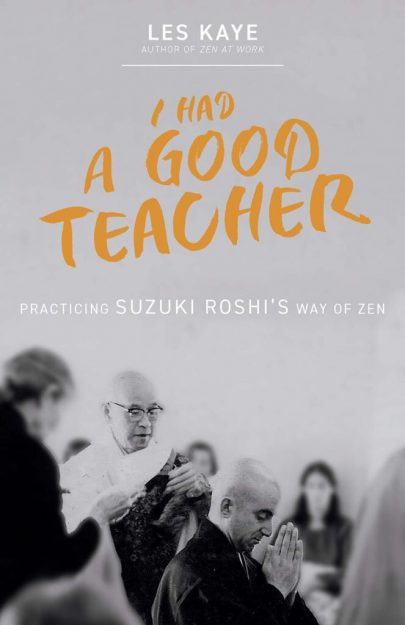
From I Had a Good Teacher: Practicing Suzuki Roshi’s Way of Zen © 2025 by Les Kaye. Reprinted with permission from Monkfish Book Publishing Company.

Thank you for subscribing to Tricycle! As a nonprofit, we depend on readers like you to keep Buddhist teachings and practices widely available.
This article is only for Subscribers!
Subscribe now to read this article and get immediate access to everything else.
Already a subscriber? Log in.






















.jpg&h=630&w=1200&q=100&v=c0f97a310e&c=1)