The Verse of Repentance
A woman becomes a thousand seas and a thousand mountains The post The Verse of Repentance appeared first on Tricycle: The Buddhist Review.
 Astrong
The following chapter is from Reading the Heart Sutra by Hiromi Ito, originally published in Japanese in 2010 and translated into English below for the first time by Jeffrey Angles. A renowned poet, Ito first came to national prominence in Japan in the 1980s for her groundbreaking writing about pregnancy, childbirth, and female sexuality. In Reading the Heart Sutra, she examines a number of Buddhist texts and reflects on them in the context of her own life as she navigates motherhood, loss, and caring for her aging parents. Over the course of the next year, Tricycle will be publishing the English translation of the book serially, with one chapter released each month.
***
When a person lives to the ripe, old age of 50, lots of bad stuff happens.
Well, maybe not just people. Trees and tortoises also live past 50, so I suppose they also see and hear all sorts of bad stuff too. Human beings can’t be alone in this.
When I talk about “bad stuff,” I mean sometimes bad stuff happens to us, and sometimes we do bad stuff to others.
When I’m the one doing something bad, it tends to stick in my mind much more than if something bad happens to me. My own actions cause me the most regret.
I’m most likely to find pools of regret bubbling up in the back of my brain when I’m doing simple tasks. Maybe watering the plants. Maybe making the same meals in the kitchen I’ve been making for the last thirty years.
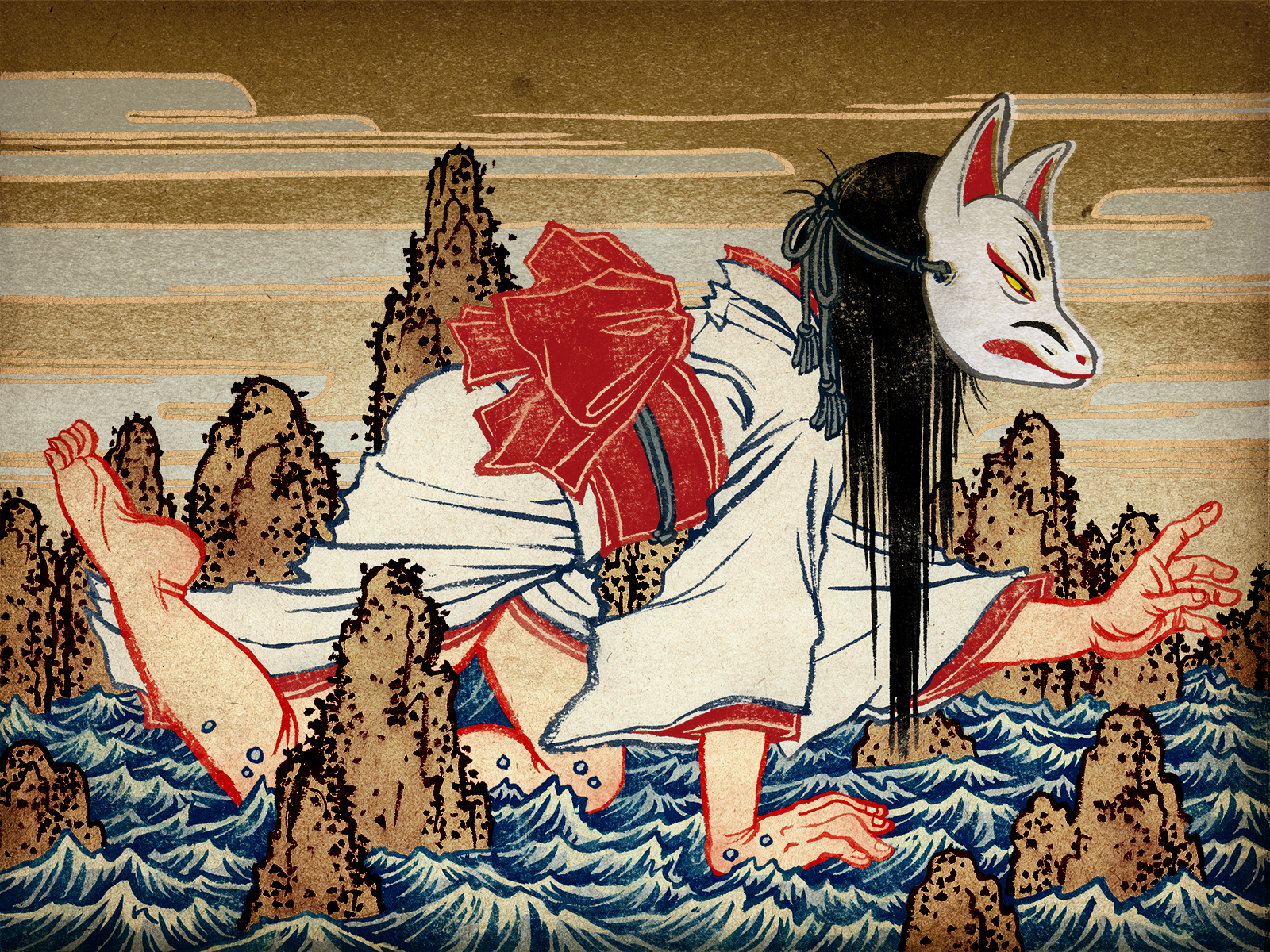
There’s an expression in Japanese umi-sen yama-sen that literally means “a thousand seas, a thousand mountains,” but which is used metaphorically to mean a sly, old fox—a worldly, crafty, cunning figure who has crossed countless landscapes while navigating life’s many challenges. This expression fits me perfectly. I feel less like a human being than some strange creature hardened by everything I’ve encountered over the years.
And yet, when the regrets rise up, I react instinctively. It’s like a gust of wind blows over me or I hear an ambulance is howling outside. My hand stops chopping the cucumber; my face turns red, and I start muttering my own makeshift spells to clear my anxiety away.
Today, I said to myself, “I really don’t care.” Yesterday, “Cut it out.” Before that, “Gimme a break.” And before that, “Leave me alone already.” In the last one, the word already is key. Just saying it makes me feel like I’m letting all the tense bravado flow out of my shoulders while heaving a sorrowful sigh and turning my eyes to the heavens. Here, I imagine Frank Sinatra crowing out “That’s Life!” while gazing out at the audience with his pretty blue eyes.
None of the spells I’ve shared so far are really that aggressive. If anything, I feel as if I’m rubbing my hands together, stepping back, and putting on a humble expression, trying to avoid my worries as best as I can. Really what I want is for my worries to simply go away.
You might notice two of the sentences above are in italics. That’s because I said them in English, not in Japanese. Why? That’s the language I use day-to-day in my life in California. I’ve got a heavy accent, and I’m terrible at reading and writing, but I’m fluent enough to express most of what I need.
It doesn’t matter how heavy my accent is. If I say something out loud, the meaning gives it weight, pulling me down. It’s like the little demons in Tolstoy’s short story “Ivan the Fool” have come to drag me into a hole in the earth. All that would be left behind is the hole, but what then would happen to me?
I’m a sly, world-weary fox who has crossed a thousand seas and a thousand mountains, so I know holes represent problems. Each hole is a problem or a worry in our lives. Sometimes we don’t encounter any holes, but sometimes they open right in front of us. Sometimes the holes aren’t so terrible, but sometimes they’re awful.
These days, I’ve started muttering the word chikushō to myself.
I may now be a sly, world-weary fox who has crossed a thousand seas and a thousand mountains, but in my previous life, I was a good girl who listened to my parents. I never used this swear word; in fact, I never even remember anyone uttering it in my presence. Eventually, though, I learned it. But that wasn’t all. I found out there are lots of other swear words out there too.
I spend my days surrounded by English—the only language my partner speaks, making him a linguistic minority in our otherwise bilingual family. I hear him cursing all the time.
Shit! Damn! Jesus!
Each time he swears, the air trembles, and the earth rumbles. He spits out flames of anger. A dragon spitting out fire.
The words do have a special effect. They’re all short, so as soon as they roar up in flames, they quickly burn out. Every time he swears, I sense a wave of unpleasant energy leaving him. Swearing seems to extinguish something in him. That’s why I thought I’d start cursing too, but English isn’t my native language, so borrowing the same words didn’t feel natural at all.
I’ve got two daughters who are now adults, and they use different swear words.
Oh, my God! What the hell!! Shit!
Sometimes, they might also exclaim, Fuck! But even I know that’s a bad word, so I’ve warned them I don’t want to hear it in the house.
My youngest daughter doesn’t have quite the same degree of courage, so when she’s upset, things are a little softer.
Oh, my gosh! What the heck! Shoot!
Everyone seems to have their own special, favorite way of cursing. So, I decided I needed one too. That’s how I adopted the word chikushō.
Lots of English swear words come from a Christian context. Chikushō, however, comes from Buddhism. Literally, it means “beasts”—birds, animals, fishes, worms, and the like—creatures traditionally believed to be worse off than humanity in the cycle of rebirth. Saying chikushō is a bit like saying “damn it to hell” in that it alludes to coming back in a different, lower, compromised form in the next life. It’s perfect for when I want to break taboos and express how much something is bothering me.
It’s short enough to say in a single breath. Plus, it is only used for swearing—not part of regular speech—so I don’t have to think about the literal meaning too deeply.
These days, I’ve started whispering it to myself every five minutes or so.
Chikushō. Chikushō. Chikushō.
The more I whisper it, the more I sense the suffering that clings to me. No, the suffering doesn’t go away. A word this small isn’t enough to take away suffering for real, but with every repetition, the weight on my shoulders does grow a little lighter. However, almost right away, the weight returns, so I have to say it all over again. Chikushō. The word is so short I can say it all day long.
There’s a sutra passage that really appeals to me these days.
我が昔しゃく所しょ造ぞう諸しょ惡あく業ぎょう
皆かい由ゆう無む始し貪とん瞋じん癡ち
從じゅう身しん語ご意い之し所しょ生しょう
一いっ切さい我が今こん皆かい懺さん悔げ
All the bad karma we have created in the past
Stems from beginningless greed, anger, and delusion
And arises following body, speech, and thought—
All it, we now avow and repent
I found this passage a while back when doing some research on the net. I was writing a modern version of an ancient Japanese story about a monk who had committed the sin of having sex, and so I was looking for something he might use to express his repentance. In the story, the monk didn’t sleep with a woman but with a statue. The local villagers found that night after night, he’d been embracing a statue of the Buddha and ejaculating on it, but at first, his attitude was like “So what? It’s an expression of my love.” I began to wonder what a monk might say if he were to repent in such a situation. As I was scouting around, I found the passage above.
It is called the “Verse of Repentance,” and it’s just one short part of the very long Flower Garland Sutra. It’s something you read before a sutra recitation, sort of like a warm-up exercise before a race. These warm-up exercises also involve turning toward the Buddha and making sure everything is good and right in front of you, while reflecting on the core Buddhist notion that cause and effect are fundamentally related. Meanwhile, you take stock of your own profane nature and powerlessness. This type of humility can be found in just about every religion.
The household I grew up in wasn’t religious at all. My mother and father lost all their beliefs during the war. As the economy took off at a breakneck rate in the postwar period, consumerist materialism crept into every fiber of their being, leaving them thinking about little other than themselves. They spent their lives in one little corner of the big city, rarely ever thinking about temples, graves, or the like.
When there was a funeral, a Zen priest would come. It didn’t matter if the death was on my mother’s side or my father’s side. Both families had burial plots in Zen temples, but both grandfathers had grown up with Nichiren Buddhism. My grandfather on my father’s side had heard that a couple of generations back, the families had a close, personal relationship with a certain priest, so they went ahead and set up a family plot with him. It was just happenstance that the priest belonged to the Zen sect. Even so, my maternal grandfather did have a particular fondness for Nichiren. His wife—my grandmother, in other words—practiced Nichiren Buddhism and prayed a lot; however, the most important object of her faith had nothing to do with Nichiren at all. Instead, she prayed to the Thorn-Pulling Jizō in Sugamo, which, according to local legend, removes the “thorns” of suffering from worshippers.
My family didn’t pay a lot of attention to the family graves. I remember my paternal grandfather telling me that when he went looking for it, there were so many graves with the names “Katō” and “Itō” that he ended up getting lost and coming home without ever finding the right one. No one seemed to be thinking about religion very much.
Before I knew it, my uncles, aunts, and cousins—more of them than I could count—started passing away, one after another. But even so, I didn’t go to any of their funerals. Not for forty years. You’d think I’d abandoned religion and my family too.
So, you know the short sutra passage I just shared? I’ve never heard it read out loud.
The first time I heard a sutra recitation was a long time ago, back when I was still married. I was with my husband, visiting the mountain village in Okayama where his family grave is located. The temple was so creepy that it was used as a set for filming the murder mystery The Village of Eight Graves. The locals seemed awfully proud.
I was still a newlywed who hadn’t yet crossed a thousand seas or a thousand mountains. Heck, I hadn’t even crossed a thousand anything yet. My husband kept dragging me into things against my will—not just the service at the temple, but our marital relations as well.
So, there I was, seated on a hard, wooden floor in a dark, gloomy temple on a mountain top. When the priest came in and started reciting, my mother-in-law and the others opened their own copies of the sutra and joined in, reciting in indistinct, mumbling voices as they gazed downward.
It was beautiful.
I suddenly forgot all my marital woes and all my efforts to improve my position in his family’s eyes. I simply listened.
It was the Heart Sutra. After returning to Tokyo, I bought a copy and read it. That first exposure made me fall in love with the sutras. Many more years would go by before I finally encountered the Verse of Repentance.
Ask me what I enjoy most about the sutras, and I’d say it’s the way they record the sound right there as part of the text. When you look at the passage I’ve quoted above, you’ll see the main text consists of classical Chinese, but over every kanji character, there are little phonetic hiragana letters giving the pronunciation in Japanese. The people who wrote these down for us were teaching us how to read it aloud, assuming we didn’t know a thing.
What’s interesting is that the pronunciations don’t sound like any language in particular. They don’t represent the way Chinese people would read it. They don’t even sound like the words we Japanese ordinarily use from day to day. It’s like you took the Chinese translation of a Sanskrit text and put another translation on top of it, piling one voice on top of another. The text isn’t understandable from sound alone. The only things the sound of the words convey are emotions—sorrow and repentance.
There were some phrases in the middle of the passage that weren’t very clear to me. When I looked up 貪瞋癡, the dictionary said 貪 means “a mind that greedily craves for more,” 瞋 means “a mind that grows angry when things don’t go as one wishes,” and 癡 means “a foolish mind that doesn’t understand the true nature of things.” So, greed, anger, delusion. Also there’s the expression 身語意, a combination of the words meaning “body,” “speech, language,” and “consciousness, will, intention.” I hear that different sects sometimes use an alternative version of this: 身口意, meaning “body, mouth, consciousness.” I learned this while looking the phrase up, but my first encounter with this phrase on the web was the one with the word 語 meaning “speech, language” in it, which seems more direct and to the point. I suppose I’m a little like a greylag goose. Right after hatching, a greylag chick assumes the first moving thing it sees is its mother, so it starts following it around loyally, never letting the first impression go.
According to the dictionary the word 懺悔, meaning “repentance,” only took on the modern reading of zange in the Edo period. Another dictionary told me this reading is due to the influence of Christianity. This text dates back well before that, so it’s pronounced sange here. I also learned the first kanji 懺 means to cut away at one’s heart—in other words, to suffer pain while chopping your well-being to bits.
The word 無始 means “having no beginning.” For instance, when you think about the unfolding of karma, there’s no end to how far you can keep tracing it back over the eons. Karma keeps on unfolding and unfolding since the dawn of time. At least, that’s what the dictionary suggested. I’m reminded of the way Buzz Lightyear kept shouting in the movie Toy Story, “To infinity and beyond!” but here, we’re talking about going in the opposite direction, I think.
One of the people I have the hardest time forgetting was a professor of mine. He’s the one to whom I most wish I could apologize. I was so indebted to him there’s no way I could possibly return the favor. Every time I tried to thank him, he’d say, “Life is about passing things on. Instead of thanking me, return the favor to someone younger.” When he died, however, I didn’t go to his funeral. I didn’t see him often before his death either. I was living really far away at the time, and I felt lost along the pathway of life. I didn’t feel like I fit in anywhere, and so I wandered around lost, dragging my daughters along the whole time. I was supposed to protect my children, but they also struggled, lost in society. I didn’t have enough bandwidth at the time to handle a funeral. At least, that’s the excuse I used. Sometimes I now find myself cutting away at my heart, feeling deep regret.
Once in my wanderings, I ended up at the home of an old Native American woman in a New Mexico pueblo. A lot of different people intervened to help me get to her house there in the middle of the desert. She invited me to spend the night, so I did. She made dinner for me, and we spent the evening deep in conversation. The next morning, I continued my journey. After I got back to Japan, I kept thinking I ought to write her a thank-you note, but I never did. I doubt she’s still alive. I regret that and wish I could apologize.
Then there was the time some American poetry magazine emailed me and asked me to submit some poems. I wanted to respond, but the very thought of writing in English fills me with dread, so I kept putting it off, one day after the next. A day went by, then another, then another. Every morning, I’d wake up thinking, I’ll do it today, but before I knew it, it was evening, and I laid down to sleep, thinking I’ll do it tomorrow. Right when the guilt was becoming unbearable, I got another email saying, “Please respond.” My feelings of guilt gave way to something more akin to fear, so I did my best to put it out of my mind. Now, I wish I could apologize to them too.
And then there are the hundreds of new year’s greeting cards I never responded to. Now that we use email, we can get away without sending new year’s cards. All bad deeds, stemming from beginningless greed, anger, and delusion.
I’ve forgotten lots of things I should have remembered. I forgot and didn’t do things I should have done. This, that, all kinds of things. There were things I should have done that I avoided on purpose. I closed my eyes. I pretended not to see even though I was well aware.
All this, due to foolishness.
When I was young, I had lots of love affairs with men who had wives and children. They suffered, and I suffered. I made their wives cry and my parents worry. Even so, we broke up in the end. All of it was a waste. I regret going so far, especially considering we eventually parted ways. Yes, the men might have been irresponsible, lustful, and wild, but after all the sex we had, it’s hard for me to be entirely objective about it. In some ways, I suppose we were evenly matched. However, sometimes when I find myself cutting at my heart, I feel regret. But that’s not all. I’m ashamed of the younger version of me who couldn’t see beyond her ignorance and indifference. I’m ashamed of the version of me that was so recklessly guided by lust.
It all stemmed from beginningless greed, anger, and delusion, but especially that state of mind that greedily craves for more.
I regret destroying families. Even though they were the ones under attack, they were the ones who bore the brunt of the suffering. I wounded them so badly that I’m surprised they made it out alive. As the person responsible for all it, I’m so overcome with regret I hardly know what to do with myself.
Wanting something so much comes from a mind that greedily craves more.
Following one’s desires faithfully is fundamental to what it means to be alive. I always, always tried to live in a way that was honest with myself. I never tried to deceive myself. True, I may not have deceived myself, but along the way, I did tons of things I now regret.
If I look back at the path I have traveled, it’s littered with corpses.
There are all kinds of things I’d like to apologize about to my former husband, but trying to express my remorse now would just make an even bigger mess of things. Even if the opportunity presents itself, I doubt I’d apologize for anything. Probably better to leave things as is, I suppose.
Yes, I greedily craved for more. I was also angry when things didn’t go my way. I wanted and coveted things all the time, and when I didn’t get what I wanted, I lost my temper.
I’ve never regretted having my daughters. I did my best to raise them right, but if you were to ask me if I did a good job, I’d probably have to admit I didn’t. There were things I couldn’t do for them. There were things I didn’t get to—so many of them that I feel stupid just remembering. If I had to pay penance for all of them, we probably never would have made it as a family.
If a stranger looked at me now, they’d probably assume I’ve abandoned my parents. That’s what any middle-aged Japanese person would think anyway. I’m an only child and my parents are elderly, but I’ve left them to live in far-away America, taking their grandkids too. In the process, I made them and my children suffer needlessly. Now, my daughters have put down roots and are more Japanese American than Japanese.
In my family, there’s one person who can’t speak Japanese at all, one person who can speak Japanese falteringly, one person who can speak but can’t read or write at all, and one person who can speak, read, and write; however, their reading level isn’t much beyond the level of manga and their writing level is only enough for basic memos. The dog, however, can understand as much Japanese as any dog in Japan. She understands English too. If anyone, she’s the true bilingual in the family.
My parents are old and don’t have anyone to rely on. I’m constantly flying back and forth across the Pacific to help them, but not everything goes as I’d like. “We want you to come back,” they tell me on the phone. “We’re in pain . . . we’re lonely . . . we’re having a tough time . . . we want you by our side . . .” It takes me three days. That’s as quick as I can get there. Old people often die sudden deaths. What would happen if that fate befell them? By the time I got there, it would be the morning of the funeral. However, I’m their only daughter, so I bear all the responsibility. They couldn’t hold the funeral until I got there. No, it wouldn’t do for me to be late.
It’s clear as day that my parents are getting old. There’s no chance they’ll get any younger. I grew up knowing that in Japanese culture, only daughters are supposed to watch over their parents, but for some reason, it never sunk into me. I didn’t realize when I fled my previous life in Japan, I’d never go back.
I remember hearing an old rakugo story in which a habitual drunk declares, “No matter where you go, the sun in the sky and bowls of rice will always follow you around,” but then he finds out life isn’t quite as easy as he thought. I suppose there are idiots everywhere, no matter the time and the place.
And so, that’s where things stand now. All these worries stem from greed, anger, and delusion, especially my inability to understand the nature of things.
When I pile my natural foolishness on top of this, my sin feels all the heavier. Everyday, I cut away at my heart, full of regret.
And still, there’s more. There are all kinds of things I would never dare tell anyone. I’m so embarrassed I hope you’ll excuse me if I redact some of the details.
For instance, I cheated XXX, I tricked XXX, and I deceived XXX.
I XXXed XXX’s XXX, and I XXXed in XXX. And then, I XXXed XXX. My skin crawls just thinking about it.
On my way home from XXX, I XXXed XXX. Then, I went home like nothing had happened. I’m the worst.
I XXXed. Man, I’m the pits.
I was XXX to XXX. What a hot mess.
I usually XXX with XXX, but I XXXed XXX. Just like a thief. A lost cause.
I’ve killed all sorts of things. XXXs and XXXs too.
And then I threw XXX away.
I forgot to XXX.
I got angry at XXX.
I blew up and screamed at XXX.
I put on airs with XXX. I lied to XXX.
I pretended not to see XXX when I really did. I abandoned XXX.
I was envious of XXX. XXX too. I hated them. I hated them so much that I twisted myself up in knots of suffering.
I XXXed XXX and was XXX. I lost all sense of self-control.
I XXXed XXX too. You think I’d learn my lesson, but I went ahead as if nothing had happened and XXXed XXX. Boy, I suck. What a train wreck. A lost cause.
I XXXed.
I XXXed.
I was XXX.
What a disaster.
All it, I now avow, I now avow, I now avow and repent.
All the various mistakes
I have made
Over these great,
Great expanses of time
Come together to form a great,
Great web,
Growing from
My ravenousness, anger, and foolishness
And manifesting
In my body, words, and consciousness
But now
I solemnly make this vow:
From here on out
I will make every effort
To cut away at my deluded heart
And offer up my repentance
For each
And every act



















.jpg&h=630&w=1200&q=100&v=1a56ad72fe&c=1)