Touching the Earth
A Zen teacher revisits the story of the Buddha’s awakening and what it can teach us about our interconnectedness with the Earth. The post Touching the Earth appeared first on Tricycle: The Buddhist Review.
 AbJimroe
A Zen teacher revisits the story of the Buddha’s awakening and what it can teach us about our interconnectedness with the Earth.
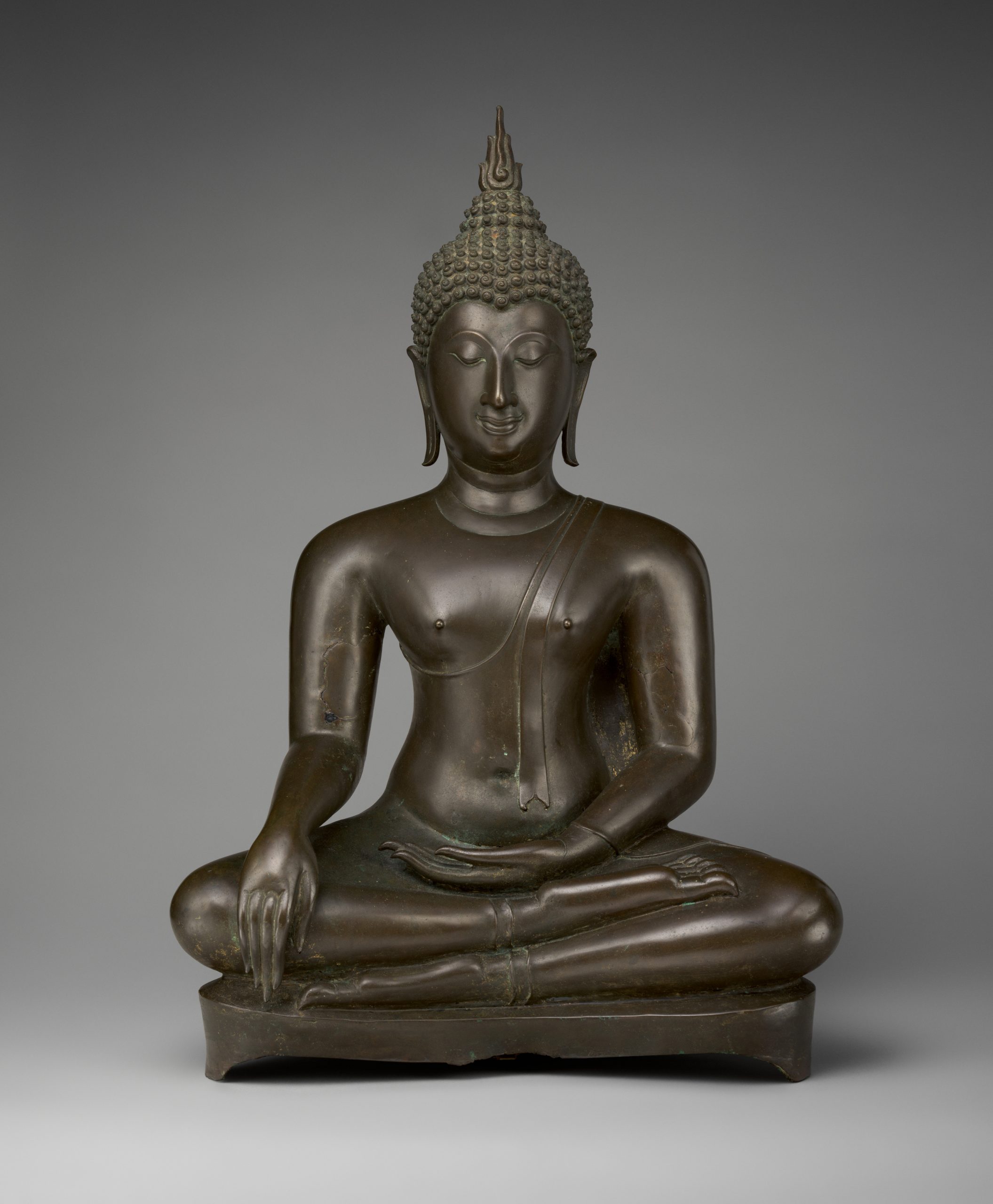
 Seated Buddha, Thailand, 15th century. The Buddha is shown with one finger of his right hand extended to call the earth to witness. | Purchase, The J. H. W. Thompson Foundation Gift and Gifts of friends of Jim Thompson, in his memory, 2002 / Image via The Metropolitan Museum of Art
A popular representation of the Buddha shows him seated crosslegged, with his left hand in his lap, palm up. The right hand overhangs his right knee and touches the ground. This posture, known as the bhumisparsha mudra, the “earth witness” pose, commemorates the Buddha’s victory over a challenge by the demon king Mara. According to the usual account, Mara wanted to distract him from his deep meditation. He tried to intimidate Gautama with armies of demons and monsters, then sent his daughters to seduce him from his meditation seat. When neither ploy worked, Mara claimed that he himself was the one who deserved to sit in the seat of enlightenment.
In response, the Buddha touched the earth, and when the earth roared “I bear you witness,” Mara and his hosts vanished, vanquished. It is a curious story, obviously a myth rather than an historical event. But what does it mean?
This bhumisparsha incident is not found in the earliest Buddhist texts, although it was soon added to the traditional narrative of the Buddha’s quest. The issue is whether Gautama was indeed entitled to sit on the same spot where (according to the story) all previous buddhas had attained their enlightenment.
From our perspective, however, another aspect of the myth becomes important. Notice that the story makes no reference to any “higher” reality that transcends this world. Instead, touching the earth implies awakening to a different relationship with the earth. In place of the usual trope—“rising above” the natural world—this suggests another, opposite metaphor: descending back into the earth, returning to the generative Mother of all life, which is also to settle back into one’s physical body, to become fully embodied. This includes getting in touch with and working through repressed emotions and traumas, thus avoiding what John Welwood calls spiritual bypassing: the “widespread tendency to use spiritual ideas and practices to sidestep or avoid facing unresolved emotional issues, psychological wounds, and unfinished developmental tasks . . . trying to rise above the raw and messy side of our humanness before we have fully faced and made peace with it.”
But can we push the bhumisparsha story a little further? To be more speculative—and perhaps that is exactly what’s needed today—can we say that it is the earth itself that wakes up when someone becomes enlightened? Is that why it roared when Gautama appealed to it? This would answer the old question that the anatta, or “no-self,” teaching of Buddhism raises: If there is no self, then who or what becomes enlightened? As Sufism emphasizes, none knows God but God: We are the mirror by which God contemplates himself and becomes self-aware. Given what is now known about biology, DNA, and the evolution of all life from a single-celled universal ancestor, it doesn’t seem that far-fetched to propose such an answer—in which case touching the earth becomes an evocative symbol for realizing one’s nonduality with the earth. As Joseph Campbell says, “If you will think of ourselves as coming out of the earth, rather than having been thrown in here from somewhere else, you see that we are the earth, we are the consciousness of the earth. These are the eyes of the earth. And this is the voice of the earth.”
According to philosopher of science Ervin Laszlo, this nondual perspective is consistent with an emerging postmaterialist paradigm that also happens to be the traditional premodern paradigm:
At the cutting edge of contemporary science a remarkable insight is surfacing: The universe, with all things in it, is a quasi-living, coherent whole. All things in it are connected. . . . A cosmos that is connected, coherent and whole recalls an ancient notion that was present in the tradition of every civilization: It is an enchanted cosmos. . . . We are part of each other and of nature. We are a conscious part of the world, a being through which the cosmos comes to know itself. . . . We are at home in the universe.
To be at home in the universe—how wonderful! Is that what the mystics are talking about?
This new paradigm also raises the fascinating possibility of understanding evolution in the broadest possible sense as the creative groping of a self-organizing cosmos. In The Universe Story, Thomas Berry and Brian Swimme make the point more poetically: “The eye that searches the Milky Way Galaxy is itself an eye shaped by the Milky Way. The mind that searches for contact with the Milky Way is the very mind of the Milky Way Galaxy in search of its inner depths.”
Shouldn’t that become the role of religion today: not encouraging us to transcend this world, but inspiring us to awaken to our true body?
Shouldn’t that become the role of religion today: not encouraging us to transcend this world, but inspiring us to awaken to our true body? Berry concludes that humans “are the self-consciousness of the universe.”
By bringing forth the planet Earth, its living forms, and its human intelligence, the universe has found, so far as we know, its most elaborate expression and manifestation of its deepest mystery. Here, in its human mode, the universe reflects on and celebrates itself in a unique mode of conscious self-awareness.
To become self-aware, then, is to realize that each of us is what the whole universe—our true body—is doing, right here and now. Could there be a better homecoming?
Finally, one important implication of this needs to be emphasized. For archaic civilizations, humans had an essential role to play in the cosmos. Our sacrifices and ritual activities kept it from collapsing back into chaos. In the modern era, of course, we no longer have any such function, which raises basic questions about the meaning (or meaninglessness) of our lives, both individually and collectively. All we can do, apparently, is enjoy ourselves while we can . . . until the inevitable happens. But if we are not separate from the rest of the biosphere—if humans are, in fact, one way that it becomes self-aware—that implies a meaning and a role for us.
Loving the world as our own body means that the culmination of the spiritual path is not to achieve some blissed-out state but to become fully engaged, with each other and with the earth.
Loving the world as our own body means that the culmination of the spiritual path is not to achieve some blissed-out state but to become fully engaged, with each other and with the earth: contributing to what Judaism describes as tikkun olam, “repair of the world,” or following what Mahayana Buddhism calls the bodhisattva path, vowing to help relieve the suffering of all sentient beings (and now their deteriorating ecosystems).
Are we here to cherish and take care of the biosphere, our larger body? To help it heal? Will that also be our own healing?
♦
© 2026 by David Loy, Loving the World as Our Body: The Nondual Path in a Dangerous Time. Reprinted by arrangement with Wisdom Publications.

Thank you for subscribing to Tricycle! As a nonprofit, we depend on readers like you to keep Buddhist teachings and practices widely available.
This article is only for Subscribers!
Subscribe now to read this article and get immediate access to everything else.
Already a subscriber? Log in.