Wall Street needs a crash course in the token economy ahead of AI IPOs. SpaceX offers a preview
When OpenAI and Anthropic make their IPO prospectuses available to the public, investors are going to have to learn about a whole new economy.
 Koichiko

India's Prime Minister Narendra Modi (L) takes a group photo with AI company leaders including OpenAI CEO Sam Altman (C) and Anthropic CEO Dario Amodei (R) at the AI Impact Summit in New Delhi on February 19, 2026.
Ludovic Marin | Afp | Getty Images
When OpenAI and Anthropic eventually exit the confidential IPO filing phase and make their prospectuses public, investors are going to be inundated with references to a term that remains unfamiliar to many on Wall Street: tokens.
They're the new currency in artificial intelligence. They're how the big model companies get paid. They're how developers now work, using tokens to build apps. But translating tokens into dollars — the currency that investors understand — is complicated, and investors are going to have to quickly get up to speed.
"It's a work in progress for all of us navigating this new terrain," said D.A. Davidson tech analyst Gil Luria. He covers companies including Amazon, Microsoft and Alphabet, which have sprinkled references to tokens into remarks on earnings calls in the past year.
OpenAI said on Monday that it confidentially filed its prospectus with the SEC, a week after Anthropic did the same. Along with SpaceX's IPO slated for this week, they could be the largest offerings on record, which makes an understanding of tokens crucial. Just like the emergence of cloud computing over two decades ago ushered in a move away from software licenses and toward a new business model of subscriptions, the AI era is fundamentally changing how companies pay and get paid for what's rapidly become critical technology.
Any time a user of ChatGPT, Claude or another AI service builds a spreadsheet, generates an image or vibe codes an app through text prompts, a certain number of tokens are required to complete the task. A token is equivalent to about three-quarters of one word.

Model developers sell subscriptions that include token quotas, and they provide users access to their APIs, which involves billing customers by token usage.
OpenAI allows some free use of coding models through its Codex app, which can handle more complex tasks, while Anthropic offers its Claude Code tool for paying subscribers. Both companies sell individual subscriptions that go as high as $200 a month per user. When people blow through their token allotment, they can pay more for additional tokens.
OpenAI and Anthropic list model prices on their websites. For its most powerful model, GPT-5.5, OpenAI charges $5 for 1 million tokens of input, which is a user's inquiry, and $30 for 1 million tokens of output, or the model's response. Anthropic's pricing is similar for its Claude Opus 4.8 model, though it charges $25 for 1 million tokens of output.
It's a complex equation for the uninitiated. Fortunately for Wall Street veterans, who wish to grasp the new digital economy, chipmaker Cerebras and rocket operator SpaceX, owner of xAI, published extensive commentary on tokens in their recent IPO filings. Cerebras' prospectus mentioned tokens 23 times, and there are 62 references in SpaceX's filing, including in the glossary.
In defining the term, SpaceX said a token "refers to the basic units of text or images processed and generated by an AI model, used to measure AI."
Later in the filing, the company said a token "represents the fundamental unit of data consumed and produced by modern AI models, for example corresponding to words, images, audio, or other modalities. It serves as the atomic unit through which models read, reason, and generate output."
'Useful directional metric'
While SpaceX, which is slated to hit the Nasdaq on Friday, provides some discussion of tokens, they're not that significant to the company's financials. Roughly 70% of SpaceX's first-quarter revenue came from its Starlink satellite internet business, and the company's space division accounted for another 13%. AI made up the remaining 17% of revenue, though that unit is bleeding cash and is responsible for the majority of total capital expenditures.
SpaceX's AI division is a niche player in a market dominated by OpenAI, Anthropic and Google. Its Grok 4.3 and Grok Build 0.1 aren't among the most widely used models on OpenRouter, a startup that gives developers access to hundreds of models.
Because of Google's position in the market, tokens are an increasingly important metric for the search company. Consumers and corporate workers use them in Gemini products, and developers use them through Google's cloud infrastructure, which competes with Amazon Web Services and Microsoft Azure.
On the company's quarterly earnings call in April, CEO Sundar Pichai said Google's models "now process more than 16 billion tokens per minute via direct API use by our customers, up from 10 billion last quarter." Pichai added that over the past year, 330 cloud clients "processed over 1 trillion tokens," while "35 reached the 10 trillion token milestone."
Scott Breitenother, co-founder and CEO of AI startup Kilo Code, said that what's lacking in the chatter about tokens is what kind of return on investment companies are getting from their use.
"Token volume is a useful directional metric, but businesses ultimately care about impact and ROI," Breitenother said.
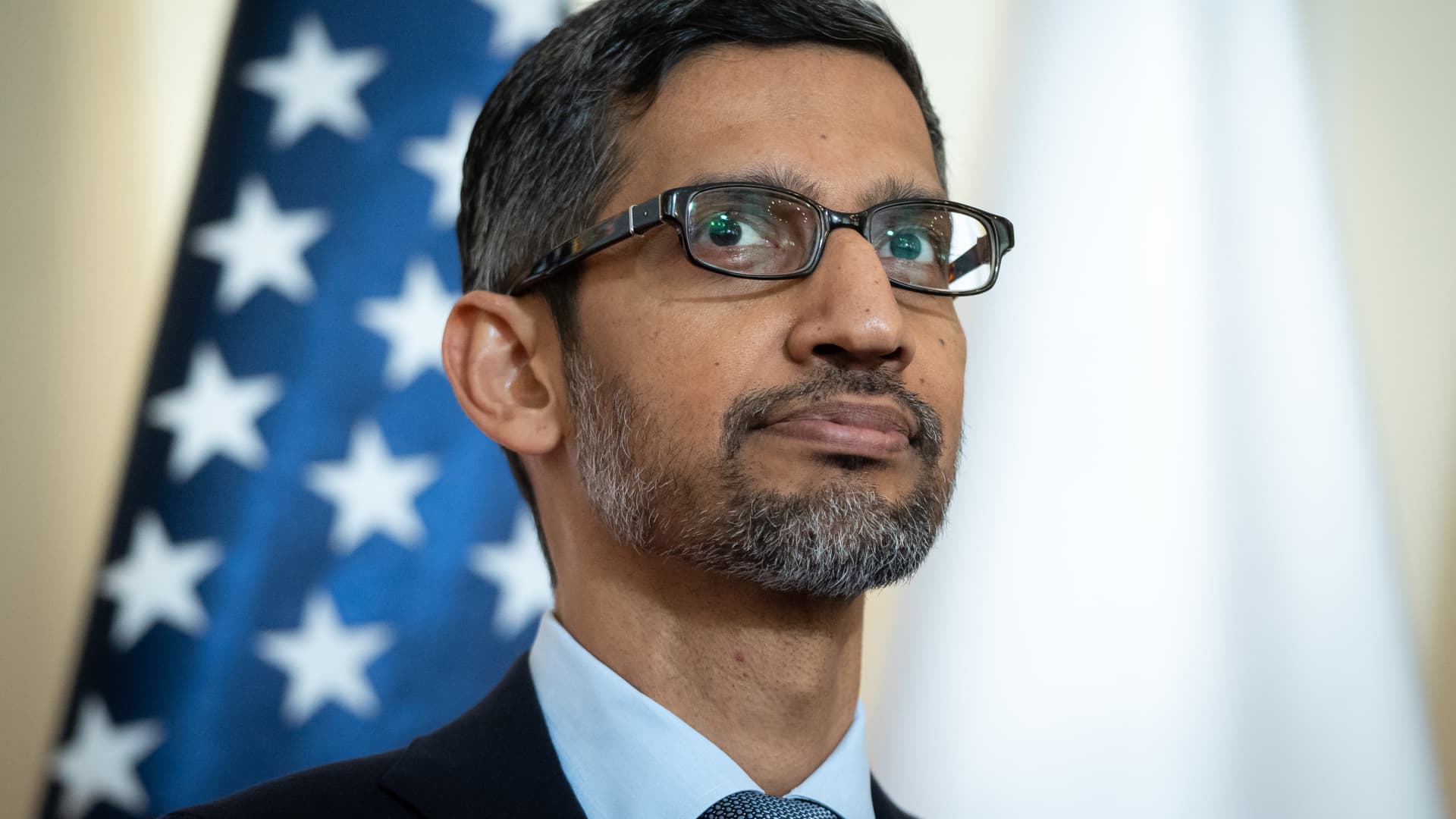
Alphabet CEO Sundar Pichai during the Google I/O Developers Conference in Mountain View, California, May 19, 2026.
David Paul Morris | Bloomberg | Getty Images
Google doesn't directly connect token use to revenue, but the company's cloud business is on a tear. Revenue in the unit soared 63% in the first quarter from a year earlier to $20 billion, accelerating from 28% growth in the same quarter of 2025. Operating income, meanwhile, more than doubled to $6.6 billion.
The results are instructive, as they show booming demand for AI services. However, they don't mean much for OpenAI and Anthropic, because those companies don't sell cloud infrastructure. Rather, they pay heavily for it to host the AI models they provide to customers.
Cerebras' IPO filing can be helpful for investors. The chipmaker, which competes against Nvidia in a certain corner of the AI industry, went public in May, giving the market its first real taste of a pure-play AI company.
As a hardware company, Cerebras is in the token generation business. It competes with other chipmakers to build the most advanced systems for computing. The company says its current chip is 58 times larger than an Nvidia processor called the B200, carrying 19 times more transistors and 250 times more memory.
Here's how Cerebras explains the role of tokens in its prospectus:
Smarter models combined with fast inference makes AI more productive. And since tokens are how AI converts compute into intelligence, token consumption is growing exponentially. And because Cerebras generates tokens faster, we believe we are extraordinarily well-positioned to win in this market.
Cerebras' job is to build hardware good enough that companies like OpenAI and Anthropic are willing to use it for exotic purposes. In January, Cerebras signed a deal to provide over $10 billion worth of compute to OpenAI through 2028. Only those with high-end monthly subscriptions can try the Codex Spark research preview that utilizes Cerebras chips.
For the business models of OpenAI and Anthropic to work, the companies have to be able to generate enough revenue from token usage to pay for all the hardware and systems supplied by Nvidia, Cerebras and the cloud providers, and have enough money left over to pay for everything else. At the moment, the math is nowhere close to working out.
SpaceX said in its prospectus that its operating success will come down to how effectively it uses its available computing power. The company says it currently enjoys "a token cost advantage," in part thanks to rapid infrastructure deployments. Unlike OpenAI or Anthropic, SpaceX has its own massive data centers, with two running in the area in and around Memphis, Tennessee.
SpaceX describes its vertically integrated approach as "shovels to tokens," saying it can "train and iterate our frontier models at lower cost and higher velocity, accelerating development cycles, eliminating external bottlenecks, and driving rapid, continuous improvements in model performance."
But whatever benefit the company sees from that strategy will have to come in the future. For now, SpaceX is opting to lease data center capacity on top of using it for its own models. In May, Anthropic committed to paying SpaceX $1.25 billion a month for three years for capacity at xAI's Colossus 1 facility. And last week, SpaceX said Google will pay $920 million a month until mid-2029 to use 110,000 Nvidia GPUs.
SpaceX is renting out its capacity even as it offers Grok 4.3 at a much lower price — per million tokens of input and output — than flagship offerings from OpenAI and Anthropic. Regarding Grok, Kilo Code's Breitenother said, "that doesn't mean demand isn't there."
"But it does suggest there are still use cases where organizations may prefer other frontier models despite the higher cost," he said.
SpaceX didn't respond to a request for comment.
— CNBC's Lora Kolodny and Ashley Capoot contributed to this report.
WATCH: AI Tokens or humans? The new debate reshaping corporate budgets