97 Switch on Agentic Workflows: Connecting AI to Business Outcomes
How 97 Switch combines AI-powered execution with human strategy to help businesses turn automation into measurable impact. “AI makes execution more accessible, but strategy, judgment, and accountability remain essential.” Jeremy Greenberg, CEO & Founder at 97 Switch As AI...
 Troov
Troov
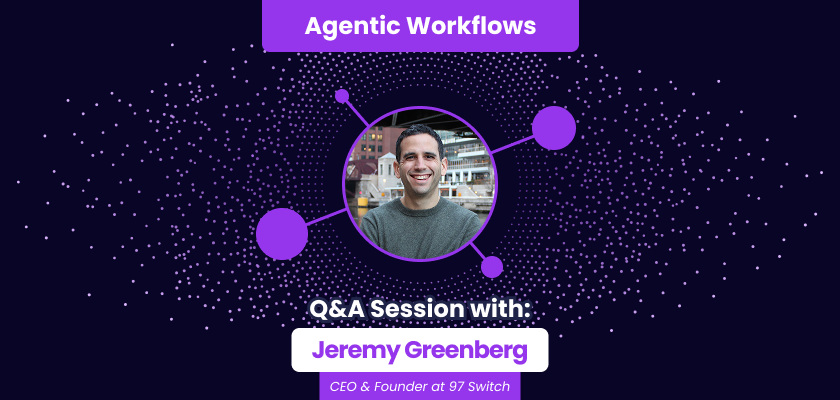
How 97 Switch combines AI-powered execution with human strategy to help businesses turn automation into measurable impact.
“AI makes execution more accessible, but strategy, judgment, and accountability remain essential.”
As AI tools become more capable, creating content, analyzing data, and automating workflows is becoming increasingly accessible to businesses of every size.
But easier execution doesn’t automatically lead to better outcomes.
Organizations still need to determine which opportunities deserve attention, how technology supports business objectives, and whether AI-generated recommendations actually align with customer needs.
For 97 Switch, this distinction defines the future of agentic AI.
Rather than viewing automation as the destination, the agency sees it as a foundation that enables teams to move faster while allowing experienced strategists to focus on the decisions that create meaningful business impact.
Agency Snapshot
🧠 Agentic Maturity
Human-guided agentic workflows supporting research, analysis, content development, and workflow automation.
⚙️ Primary Use Cases
Content marketing, SEO optimization, research, and business workflow automation.
🌍 Industries
E-commerce & Retail, SaaS & Tech, Finance & Fintech
🧩 Core Tech Stack
OpenAI (GPT-4o, o1, etc.), Anthropic (Claude 3.5 Sonnet/Opus), Google (Gemini 1.5 Pro/Flash)
Where Agencies Are in Their Agentic AI Journey
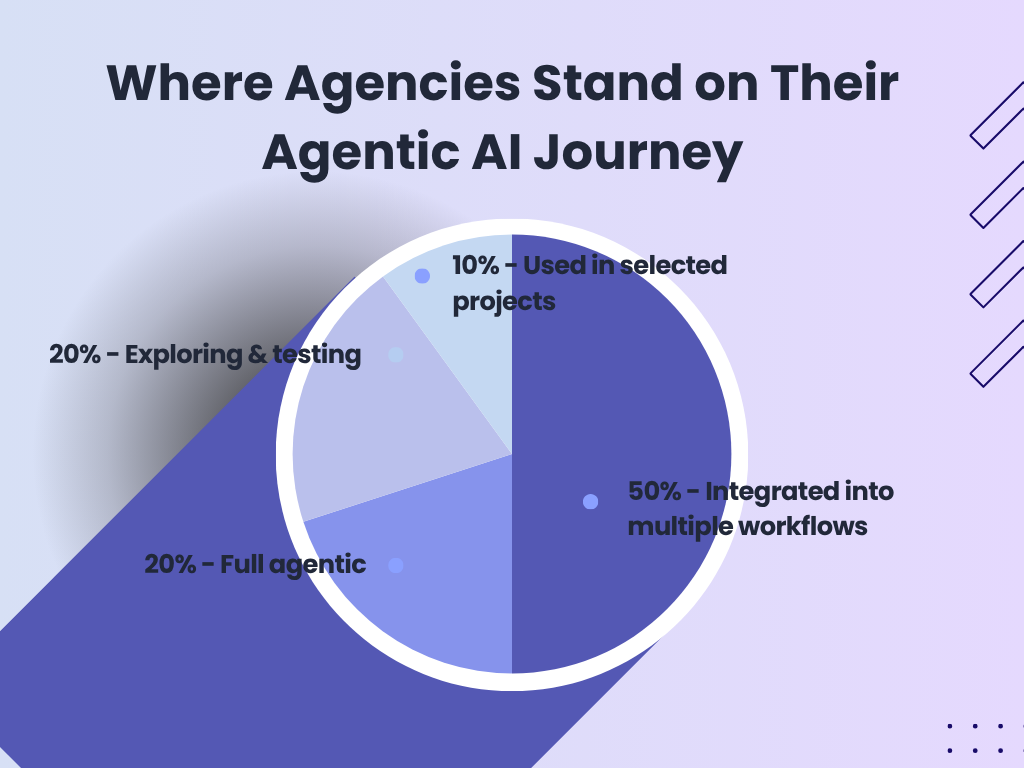
While adoption continues to accelerate, many agencies are still transitioning from individual AI experimentation to structured, organization-wide workflows—a shift reflected in 97 Switch’s human-guided approach.
How Agentic Workflows Are Structured at 97 Switch
97 Switch has adopted a human-guided framework where AI accelerates execution while experienced consultants maintain strategic ownership throughout every engagement.
Within this model, AI supports research, analysis, content development, and workflow automation, helping teams process information and generate initial outputs more efficiently. Human specialists then provide strategic direction, quality assurance, and final approval before deliverables reach clients.
Rather than separating AI from human expertise, the agency combines both into a collaborative workflow designed to improve efficiency without sacrificing business context or accountability.
Inside the Workflow: From Input to Output
Each engagement begins with AI-powered research and information gathering.
From there, intelligent workflows analyze search intent, identify opportunities, generate initial content, and recommend optimization strategies based on available data.
Once these foundations have been established, the workflow shifts to the human team.
Consultants review recommendations, refine messaging, validate strategic alignment, and ensure every deliverable reflects the client’s business objectives before publication or implementation.
By combining AI-assisted execution with human decision-making, the agency creates a workflow capable of scaling production while preserving quality and consistency.
The Role of Human Oversight
For 97 Switch, human oversight is not simply a quality-control mechanism.
It is where business value is created.
AI can process information at remarkable speed, but understanding organizational priorities, customer expectations, and commercial objectives still requires human experience.
The agency therefore positions strategists at the center of every workflow. Not because AI lacks capability, but because successful marketing ultimately depends on connecting technology to meaningful business outcomes.
A Real-World Use Case
One of 97 Switch’s strongest implementations of agentic AI supports its content marketing process.
The workflow begins with AI-driven research that identifies emerging topics, analyzes search intent, and uncovers content opportunities.
Specialized workflows then generate initial drafts while simultaneously evaluating SEO opportunities and identifying areas for optimization.
Before publication, the agency’s team reviews, refines, and aligns every piece of content with client goals, brand positioning, and overall business strategy.
This collaborative process has reduced content production time by more than 50%, while improving consistency, scalability, and operational efficiency without compromising quality.
Rather than replacing editorial expertise, AI enables the team to spend more time strengthening ideas and less time assembling first drafts.
Key Advantages of Agentic Workflows
97 Switch believes the greatest value of agentic AI lies in its ability to improve operational efficiency while maintaining strategic quality.
By automating research, analysis, and repetitive production tasks, teams gain additional capacity to focus on customer experience, business planning, and long-term growth initiatives.
The result is not simply faster execution—but better allocation of human expertise.
Challenges and Limitations

As AI capabilities continue to expand, 97 Switch believes organizations face a growing temptation to confuse automation with strategy.
Generating recommendations has become increasingly straightforward.
Knowing which recommendations deserve action—and why—remains significantly more difficult.
Without business context, customer understanding, and experienced decision-making, AI-generated outputs risk becoming efficient but ultimately ineffective.
This is where the agency believes human expertise continues to provide its greatest value.
How Agentic AI Is Reshaping Agency Models
97 Switch believes the role of agencies is shifting away from execution and toward strategic leadership.
As AI makes production increasingly accessible, organizations will look to agencies for guidance that extends beyond technology implementation.
Future agency value will be defined by the ability to connect AI capabilities with customer experience, digital strategy, and measurable business outcomes—not simply by producing deliverables more efficiently.
In this environment, agencies become strategic partners responsible for helping businesses understand not only what AI can do, but what it should do.
Conclusion
For 97 Switch, agentic AI is not about replacing expertise with automation. It is about enabling experts to spend more time where they create the greatest value.
By combining AI-powered workflows with strategic leadership and human accountability, the agency demonstrates that the future of marketing belongs not to those who automate the most—but to those who connect automation with meaningful business outcomes.