How to Build AI Employees to Get Work Off Your Plate
Want to move beyond basic AI prompting and build AI employees that actually run parts of your business? Wondering how to train AI to match your standards and schedule it to work autonomously? In this article, you'll discover how...
 UsenB
UsenB
Want to move beyond basic AI prompting and build AI employees that actually run parts of your business? Wondering how to train AI to match your standards and schedule it to work autonomously?
In this article, you'll discover how to build, train, and schedule AI employees that take manual work off your plate and free you and your team to focus on strategy and creativity.
This article was co-created by Callan Faulkner and Michael Stelzner. For more about Callan, scroll to the end of this article.
Why Most Teams Aren't Actually Using AI to Its Full Potential
Most business owners hear the same thing from their teams: “We're using AI every day.” But Callan Faulkner sees a different reality when she looks under the hood.
A sales rep gets off the phone and opens Claude or ChatGPT to build a proposal. They prompt back and forth for an hour and end up with something solid. The next time they need a proposal, they do the exact same manual process from scratch. They don't save a reusable set of instructions. They don't build a knowledge base of past proposals, winning approaches, or objection-handling frameworks. They aren't training AI to be a repeatable system that supports the proposal process every time.
Anyone can open a chat window and get a one-off result. Building an AI employee is a different skill set entirely. Callan defines an AI employee as a trained, reusable AI system that performs a specific business function as well as or better than a human, and every AI employee works for a human, activating them to their higher potential, moving people out of repetitive tasks and into strategic, creative work that lights them up.
The payoff for building AI employees, rather than just using AI casually, is significant. Callan's company, The Uncommon Business, is on pace for roughly $40 million in revenue with about 50 human employees. That ratio would have required a much larger team, even a few years ago. But the goal isn't fewer humans. Callan has never fired a person because of AI.
However, the gap between AI-trained and non-trained employees is already showing up in hiring. Callan describes a friend who brought on a marketer with no AI training. The marketer took weeks to deliver sales pages and simple images. Meanwhile, the company's AI-trained employees were producing 10 times as much work in a single day.
The marketer ultimately had to be let go, not because AI replaced the role, but because the role still required a human who could direct AI to execute at speed. The company still needed someone in that position to serve as the strategic visionary and bring the messaging to life. AI wasn't the problem; the refusal to adopt it was.
#1: Three Foundational Concepts for AI Employees
Before building a single AI employee, two concepts and one asset need to be in place.
Concept 1: Shortcut-Seeking Is the New Work Ethic
Many professionals prove their worth by doing everything themselves. That instinct is now a liability. Callan's philosophy is that finding the fastest path to an A-plus output is the new competitive advantage.
The key distinction is that shortcuts don't mean cutting corners. Callan's team used to spend days getting Instagram carousels designed in Canva. After building a skill inside Claude Design that references screenshots of their best past carousels, Callan can generate a polished carousel in eight minutes from a transcript. Ten carousels in thirty minutes. The output quality stayed the same. The time and energy costs collapsed.
Concept 2: Training Equals Output Quality
Anyone can ask Claude to write a LinkedIn post. The result, without training, is predictable: generic content that sounds like every other AI-generated post on the platform.
The fix is documenting the standards that matter: the goal of the LinkedIn post, the brand tone and voice, and what a great post looks like for that specific company. If those details aren't documented and fed into AI, there's nothing for AI to operate on. Callan points to her own podcast production as an example. Every detail of the process should be documented because AI employees need that information to even begin doing the work at the right standard.
For 90% of how a business operates, including HR, operations, finance, sales, and marketing, building AI employees is not a technical skill. It comes down to two things: communication, meaning the ability to clearly articulate what's needed, and creativity, meaning the resourcefulness to push AI past its first mediocre attempt.
Marketers Are Learning AI Alone
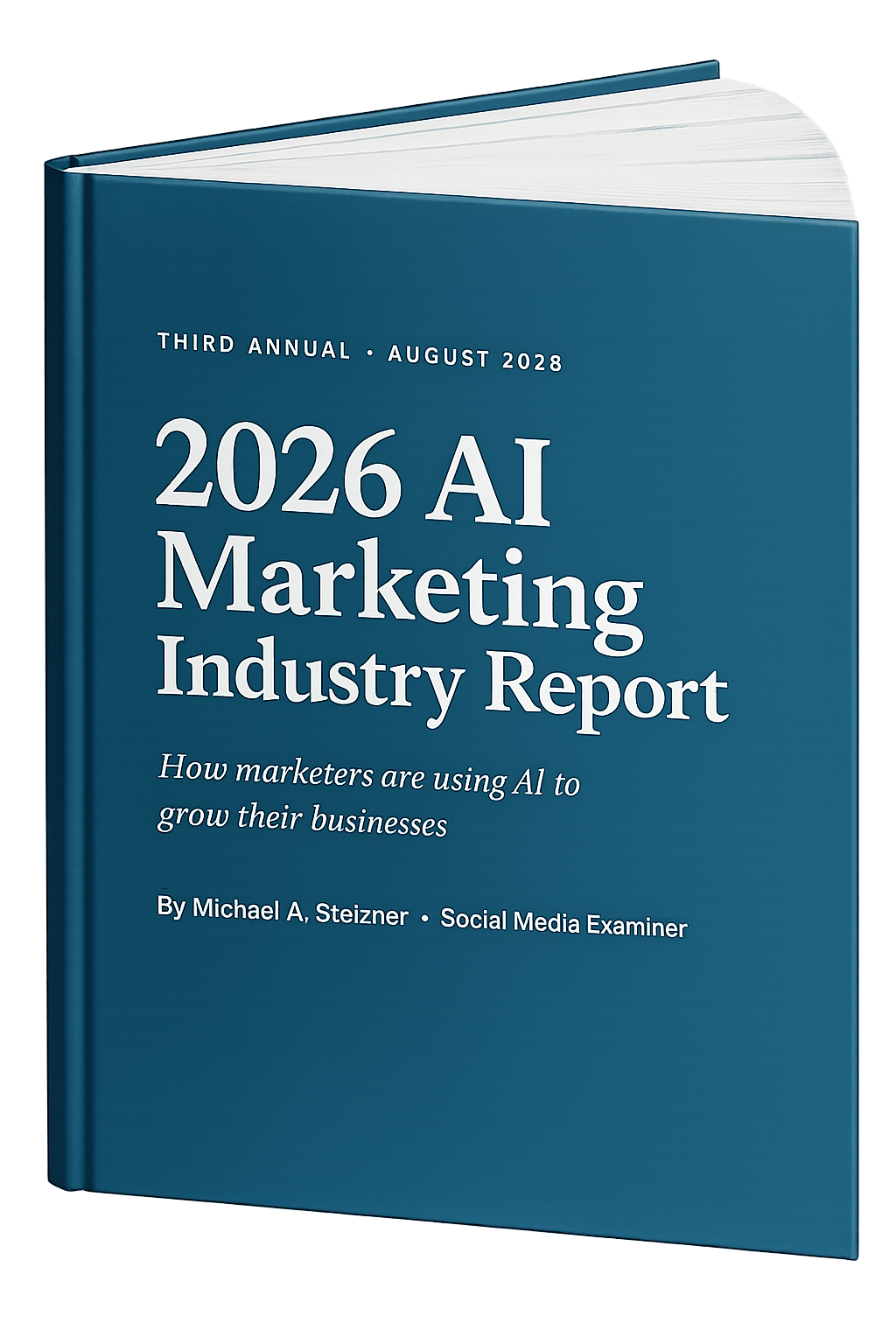
Sound familiar? 85% of marketers learn AI by experimenting on their own, just 7% get company training, and more than half spend their own money on tools.
Our third annual AI Marketing Industry Report surveys 681 marketers and distills everything into 32 clear charts — what's working, what platforms marketers rely on, and what to learn next.
The Asset: Your Business Brain
A business brain is a centralized, organized repository of the most important documentation about a business: pricing, processes, standards, brand voice, ideal client profiles, past wins, and more.
Why is this important?
A brilliant new hire who started on Monday and needed to get up to speed in thirty minutes would have to rely entirely on what's documented. If the documentation falls short for a human, it falls short for AI, too. AI employees are only as good as the data they can access. The days of getting away with a messy Google Drive are over.
#2: How to Build an AI Employee From Scratch
Start With a Self-Audit
The process begins by watching how time is actually spent. Callan recommends identifying every task done daily, weekly, or monthly that makes money but doesn't light the person up, or that falls below $50 an hour.
The list might include designing and editing content, building presentation outlines, generating sales proposals, or writing email newsletters.
Callan's employee Nick, a human copywriter, went through this exact process. He spent most of his time writing sales pages. So he started documenting how he thinks about sales pages, reverse-engineered the details of their best-performing pages, and began building AI employees to handle the production side. Now, Nick manages a roster of AI copywriters, QA reviewers, and hook generators while focusing on strategy and creative direction.
Pro Tip: Even tasks where someone feels genuinely excellent should be examined. Callan found that after training AI on processes she thought she was best at, the AI output was sometimes better than her own. The shift becomes moving from creator to editor, which is a more leveraged use of time. And the reason the AI performs so well is precisely because the person who trained it brought years of expertise to the training process.
The AI Interview Method
Once the task is identified, Callan recommends opening a new chat in Claude and describing the situation in detail: who they are, what the company does, what specific task they want AI to handle, and what excellent output looks like. Then, before diving in, they ask Claude to interview them with a series of five high-impact questions to extract their exact process.
My name is Mike, and I run a company called Social Media World. We are planning this upcoming conference. One of the things I'm excellent at is generating sponsorship packages and sponsorship proposals. I really want to create an AI employee to help me create all the sponsorship packages for my conference. I want it to be able to send emails to potential sponsors and research potential sponsors. Let's start with the first task. I want to take a stab at you doing this extremely well. But before we start, I want you to interview me with a series of five high-impact questions to extract my exact process. And we'll work together in this chat to complete this task. Once I see you do it extremely well, then we will package all of that up and turn that into either one Claude skill or multiple Claude skills, depending on your recommendation.Callan strongly favors voice input for this step because AI needs rich context to deliver excellent output, and speaking naturally provides that context faster. Tools like Wispr Flow allow users to speak their responses rather than type them. The advantage is that verbal processing often captures more nuance and detail than typing, where people tend to self-edit and shorten their responses.
Which AI Moves Actually Matter?
That's what every marketer is wrestling with now. New AI strategies, new tools, new takes every week — but no clarity. Most marketers and business owners are trying to figure out AI alone.
The AI Business Society is your trusted guide. Get expert-led training you can put to work immediately. Plus a community of marketers sharing what's actually working.
Use the Board of Directors Technique
For complex decisions or unfamiliar territory, Callan uses Claude to assemble a team of three to five thought leaders who are experts in the relevant domain and have them debate the best approach.
For example, when Callan needed to build executive compensation packages for the first time, including bonus structures, pay bands, and KPIs, she asked Claude to bring in frameworks from leaders like Mark Cuban and Sara Blakely. The result was coaching grounded in established business thinking rather than generic search results.
Turn Your Chat Into a Reusable Claude Skill to Create Your AI Employee
After working back and forth with Claude to produce excellent output on a task, the next step is to save it as a Claude skill. In Callan's framework, a skill is a saved, reusable set of instructions that's available anytime and connected to Claude. It functions as a prompt on steroids: a single command that triggers a complex, trained process. As Callan puts it, “A skill is an AI employee.”
Callan's process after creating a skill is to ask Claude directly:
What information or data would you need to increase and improve the output of this skill? What files would you want in a perfect world?The answers typically point toward building a Claude Project, which is a workspace where knowledge files, instructions, and skills live together. For a sales proposal skill, that project might include past winning and losing proposals, all pricing information, and the top 15 objections, with exactly how to handle each one.
The final layer is connectors. If the workflow involves external tools, such as saving a proposal to a CRM or emailing it through Salesforce, Claude's connectors enable the skill to communicate directly with those platforms.
A fully built AI employee operates as a skill running on top of a knowledge base, with relevant connectors enabled, and the entire team trained to use it.
#3: How to Train and Text AI Employees to Give You A-Plus Output
Once a skill exists, the real work begins. Callan's advice is blunt: test the living daylights out of every skill.
Most people settle for a B-minus or C-plus output from AI because they accept whatever comes back. Callan recommends pushing back hard. When Claude delivers something mediocre, she'll tell it directly that she knows it can do better and ask it to try again as if its performance depended on it. The output from that push is often exactly what she wanted in the first place.
Her voice copywriter skill, one of her most valuable AI employees, took fifteen hours to get right. That investment makes sense when compared to training a human. It took three months of working with her human copywriter multiple times a week before he could write in her voice. Yet many people give up on AI training after forty-five minutes and conclude it can't capture their style.
The testing process follows a specific pattern. Callan runs the skill, reviews the output, and then manually rewrites the parts that don't match her standard. She brings those corrections back to Claude with a specific prompt:
Here's the paragraph you wrote [COPY]. This is how I would write it [COPY]. Update the skill file to reflect the correction and explain what mistake in the current instructions prevented the correct output.Another useful technique is to ask Claude mid-conversation, “What have you learned from my interactions?” and then tell it to update the skill to ensure those lessons stick.
Tips for Managing Changes to Skills and Memory
A critical technical detail: when working inside Claude Projects, skills and memory can fall out of sync. Claude may update its memory based on a conversation without updating the underlying skill. Callan recommends explicitly telling Claude to update the skill itself and then manually pressing the save button to confirm the change.
Projects also have their own invisible project-level skills that can conflict with workspace-level skills. When creating a skill that should work across all projects, specifying “workspace skill” or “main skill” ensures it's accessible everywhere rather than trapped inside a single project.
Pro Tip: For teams building skills at scale, Callan's company copies every skill into a Notion database that tracks who built it, when it was built, the version, and its purpose. They even have a skill that audits their skills database for overlaps. Each department owns its skill repository, and skill management is a standard part of every quarterly review. The expectations are direct: show the AI employees that have been built, demonstrate how the job has been automated, and confirm that skills are up to date.
#4: Scheduling AI Employees to Run Autonomously With Claude Co-Work
Once a skill has been manually tested and refined to a high standard, it can be put on a schedule to run without human initiation.
The current limitation is that the computer running Claude must be on for scheduled tasks to execute. Callan's workaround is a dedicated office computer logged into the company's Claude account. Any employee who wants to schedule a skill logs into the company account on that machine.
Callan uses Claude's scheduled tasks feature via the Claude Cowork desktop app. The options include choosing the day, time, and frequency at which a skill runs. There's no limit on how many scheduled tasks can be active.
One of Callan's scheduled skills is an Instagram Researcher. Every Monday morning at 6 AM, it visits competitor Instagram accounts, identifies what content is going viral in the AI education space, analyzes the angles and hooks being used, pulls in transcript content from the previous week, and drops content ideas directly into a Notion database.
Her social team logs in on Monday morning and manually approves the ideas they want to move forward with. What used to be a manual Monday morning task for the social team now runs autonomously.
Another scheduled skill runs every hour, pulling meeting transcripts from Granola and filing them into a Notion database that feeds her second brain.
Other Notes From This Episode
Connect with Michael Stelzner @Stelzner on Facebook and @Mike_Stelzner on X. Watch this interview and other exclusive content from Social Media Examiner on YouTube.Listen to the Podcast Now
This article is sourced from the AI Explored podcast. Listen or subscribe below.
Where to subscribe: Apple Podcasts | Spotify | YouTube Music | YouTube | Amazon Music | RSS
✋🏽 If you enjoyed this episode of the AI Explored podcast, please head over to Apple Podcasts, leave a rating, write a review, and subscribe.
Stay Up-to-Date: Get New Marketing Articles Delivered to You!
Don't miss out on upcoming social media marketing insights and strategies! Sign up to receive notifications when we publish new articles on Social Media Examiner. Our expertly crafted content will help you stay ahead of the curve and drive results for your business. Click the link below to sign up now and receive our annual report!
Discover Proven Marketing Strategies and Tips
Want to go even deeper with your marketing? Check out the Social Media Marketing Podcast! Publishing weekly since 2012, the Social Media Marketing Podcast helps you navigate the constantly changing marketing jungle, with expert interviews from marketing pros.
But don’t let the name fool you. This show is about a lot more than just social media marketing. With over 650 episodes and millions of downloads each year, this show has been a trusted source for marketers for well over a decade.








![Here‘s Everything I’ve Learned About Internet Marketing [Data + Expert Tips]](https://www.hubspot.com/hubfs/internet-marketing-1-20250128-2273831.webp)


![The Usability Testing Playbook [Expert Tips & Sample Questions]](https://www.hubspot.com/hubfs/usability-testing-1-20250305-3357250.webp)