Hatha Yoga: Benefits, Poses & Complete Beginner’s Guide
✨ QUICK ANSWER Hatha yoga is a traditional yoga practice focusing on physical postures (asanas), breathing techniques (pranayama), and meditation. […]
 Tekef
Tekef
✨ QUICK ANSWER
Hatha yoga is a traditional yoga practice focusing on physical postures (asanas), breathing techniques (pranayama), and meditation. Unlike faster vinyasa or power yoga, hatha yoga emphasizes holding poses longer for proper alignment and body awareness. The practice builds strength, improves flexibility, calms the nervous system, and forms the foundation for all yoga styles. Beginners can start immediately with simple poses and simple breathing practices.
Hatha yoga is often called the “yoga of effort”—and for good reason. While many modern practitioners assume all yoga is the same, hatha yoga represents the most foundational and widely taught approach to yoga practice. It’s the style you’ll find in most beginner yoga classes, at yoga studios across India, and recommended by physical therapists for injury recovery.
But here’s the challenge: most people don’t understand what makes hatha yoga different from vinyasa, power yoga, or other modern styles. They show up to their first class, struggle to hold a pose, feel frustrated, and think they’re “not flexible enough” for yoga.
The truth is simpler: hatha yoga isn’t about extreme flexibility or speed. It’s about deliberate, mindful movement—building strength, improving alignment, and connecting breath with body awareness.
This complete guide covers everything beginners need to know about hatha yoga: what it actually is, its proven benefits, the 12 foundational poses you should master first, how to practice safely with modifications for every body type, and how often you should practice to see real results.
By the end, you’ll understand whether hatha yoga is right for you—and exactly how to start practicing today.
WHAT IS HATHA YOGA?
Hatha yoga is a traditional branch of yoga that emphasizes physical postures (asanas) and breathing techniques (pranayama) as preparation for meditation. The word “hatha” breaks into two Sanskrit roots: “ha” (sun) and “tha” (moon), representing the balance of opposing energies within the body.
In practice, hatha yoga is:
Slower-paced than vinyasa or power yoga (poses held 30 seconds to 2 minutes) Alignment-focused with emphasis on proper body positioning Beginner-friendly because instructors provide detailed alignment cues Foundation-building since all yoga styles draw from hatha principles Flexibility and strength work done simultaneously rather than separatelyUnlike vinyasa (which flows continuously between poses) or power yoga (which aims for intense strength), hatha yoga allows time to understand each pose deeply and adjust alignment before moving on.
Common Misconception Corrected: Many people think hatha yoga is “just stretching” or “too easy.” In reality, holding poses for longer periods requires significant core engagement, leg strength, and mental focus—making hatha yoga challenging despite its slower pace.
PROVEN BENEFITS OF HATHA YOGA
Hatha yoga delivers measurable physical, mental, and emotional benefits backed by peer-reviewed research.
Physical Strength and Flexibility
Holding poses for 30+ seconds forces muscles to work harder, building functional strength in the legs, core, shoulders, and back. Research from the Journal of Physical Therapy Science (2016) found that consistent hatha yoga practice increased hamstring flexibility by 15-20% within 8 weeks.
Key muscles developed:
Legs: Quadriceps, hamstrings, calves (standing poses) Core: Abdominals, obliques, deep stabilizer muscles (plank variations, boat pose) Upper body: Shoulders, chest, triceps, back (downward dog, chaturanga) Stabilizers: Smaller muscles around joints improve alignment and reduce injury riskNervous System Regulation (Vagal Tone)
Hatha yoga’s emphasis on controlled breathing (pranayama) directly activates the parasympathetic nervous system—the “rest and digest” response. Studies show that 15-20 minutes of pranayama practice reduces cortisol (stress hormone) by 15-25% within a single session.
Practical outcomes:
Lower resting heart rate Reduced blood pressure Better sleep quality Decreased anxiety and depression symptoms Improved emotional regulationImproved Posture and Spinal Alignment
Modern life (desk jobs, phone scrolling) creates poor posture, leading to back pain, neck tension, and headaches. Hatha yoga’s emphasis on alignment corrects postural imbalances:
Forward head posture → corrected through upward-facing dog and shoulder retractions Rounded shoulders → opened through chest-opening poses (camel, fish pose) Lower back strain → relieved through hip opening and core activation Spinal compression → decompressed through forward folds and child’s poseWithin 4-6 weeks of consistent practice, most practitioners notice measurably better posture and fewer pain symptoms.
Weight Loss and Metabolic Support
While hatha yoga isn’t as cardiovascular as HIIT training, it builds lean muscle mass, which increases resting metabolic rate. Research in the Journal of Alternative and Complementary Medicine found that 6 months of hatha yoga practice led to average weight loss of 2-4 kg in sedentary adults.
Mechanism:
Builds muscle mass (increases calorie burn at rest) Reduces stress-related eating Improves digestion through specific twists and forward folds Supports hormonal balanceMental Clarity and Cognitive Function
The meditative aspect of hatha yoga improves focus, memory, and executive function. Brain imaging studies show that regular yoga practitioners have increased gray matter density in areas associated with attention and emotional regulation.
Practical benefits:
Better concentration at work Improved memory retention Faster reaction time Enhanced creative thinking Reduced mental fogEmotional Release and Stress Relief
Hip openers and gentle backbends release stored emotional tension (hips store emotional stress). Many practitioners report feeling lighter, more calm, and emotionally balanced after consistent practice.
HOW HATHA YOGA DIFFERS FROM OTHER YOGA STYLES
Understanding the key differences helps you choose the right practice for your goals.
| Pace | Slow, mindful | Flowing, continuous | Fast, intense | Very slow (5+ min holds) |
| Pose Duration | 30 sec – 2 min | 5-10 seconds | 5-15 seconds | 3-5+ minutes |
| Breath | Deliberate pranayama | Breath-movement sync | Varies | Deep, meditative |
| Fitness Level | All levels | Intermediate+ | Intermediate+ | All levels |
| Strength vs. Flexibility | Balanced both | Both (cardio emphasis) | Strength focus | Flexibility focus |
| Best For | Beginners, alignment, foundation | Athletes, cardio | Strength training | Deep stretching, yin energy |
| Injury Recovery | Excellent | Moderate | Not recommended initially | Good (if modified) |
Key Takeaway: Hatha yoga is the best starting point because it teaches proper alignment, builds foundation strength, and allows transitions to other styles safely.
THE FOUNDATION: 12 ESSENTIAL HATHA YOGA POSES
These 12 poses form the foundation of hatha yoga practice. Master these first before progressing to advanced asanas.
Standing Poses (Foundation)
1. Tadasana (Mountain Pose)
Purpose: Establishes proper alignment foundation for all standing poses.
Step-by-step:
Stand with feet hip-width apart (hips aligned under shoulders) Press all four corners of feet firmly into ground Engage thigh muscles (kneecaps lift naturally) Draw in lower abdomen gently Roll shoulders back and down Let arms hang at sides with palms forward Stack head directly over shoulders (chin parallel to floor) Hold 8-10 deep breathsAlignment cues:
Weight evenly distributed between both feet No arching of lower back Shoulders relaxed away from ears Gaze straight aheadCommon mistake: Locking knees. Instead, maintain soft microbends in knees.
2. Uttanasana (Standing Forward Fold)
Purpose: Stretches hamstrings, calves, lower back; calms nervous system.
Step-by-step:
From mountain pose, inhale and extend arms overhead Exhale and hinge from hips (not spine), bringing torso toward thighs Let arms hang freely or grasp opposite elbows Relax head and neck completely Press feet firmly into ground Hold 1-2 minutes, breathing deeplyAlignment cues:
Forward fold from hips, not rounding spine Knees slightly bent if hamstrings are tight Weight balanced between both feetCommon mistake: Forcing deeper stretch by pulling head down. Instead, allow gravity to deepen the fold naturally over time.
3. Virabhadrasana I (Warrior I)
Purpose: Builds leg strength, opens hips, improves balance.
Step-by-step:
From mountain pose, step left foot back 3-4 feet (lunge distance) Angle left foot 45° outward Bend right knee until aligned over ankle Square hips forward (both hip bones face front) Inhale and raise arms overhead, shoulder-width apart Gaze forward (or up if comfortable for neck) Hold 5-8 breaths, then repeat on opposite sideAlignment cues:
Front knee stacked over ankle Back heel pressed into ground Hips square (hardest part—use yoga block against hip if needed) Core engagedCommon mistake: Turning hips too much outward. Instead, keep back heel grounded and rotate hips gradually.
4. Trikonasana (Triangle Pose)
Purpose: Stretches inner thighs, hamstrings, calves; strengthens legs and core.
Step-by-step:
From mountain pose, step left foot back 3-4 feet Turn left foot 45° outward Rotate torso to face left side Straighten both legs completely Inhale, then exhale as you hinge forward from hips Place right hand on shin, block, or floor (wherever alignment allows) Extend left arm up toward ceiling Gaze toward left hand or down (avoid neck strain) Hold 5-8 breaths, repeat opposite sideAlignment cues:
Both legs remain straight Chest rotates open to side Shoulders stack verticallyCommon mistake: Forcing hand to floor. Instead, use a yoga block to keep proper alignment.
Core and Balance Poses
5. Navasana (Boat Pose)
Purpose: Activates deep core muscles, improves balance, builds digestive fire.
Step-by-step:
Sit on mat, knees bent, feet on floor Lean back slightly, engage core Press feet into ground, then lift feet to shins parallel to floor Straighten legs if possible (or keep knees bent for modification) Extend arms forward, parallel to ground Chest lifts (don’t collapse toward navel) Hold 5-10 breaths, rest, repeat 2-3 timesAlignment cues:
Spine stays long (don’t round forward) Chest lifts toward ceiling Shoulders relaxed downCommon mistake: Rounding spine to engage core more. Instead, maintain neutral spine while engaging deep abdominals.
6. Plank Pose (Phalakasana)
Purpose: Builds full-body strength, core stability, shoulder strength.
Step-by-step:
Lie facedown on mat Place hands under shoulders Tuck toes, press into ground Push torso up until arms straighten Body forms straight line from head to heels Engage core (draw navel in without holding breath) Press shoulders away from ears Hold 20-60 seconds, rest, repeat 2-3 timesAlignment cues:
Straight line from head to heels Elbows close to ribs (not splayed out) Core engaged without holding breath Shoulders externally rotated (rotate upper arms outward)Common mistake: Sagging hips or raising them too high. Instead, use wall/mirror to check alignment.
Hip Opening Poses
7. Baddha Konasana (Bound Angle/Butterfly Pose)
Purpose: Opens hips, stretches inner thighs, improves hip mobility.
Step-by-step:
Sit on mat with legs extended Bend both knees, bringing soles of feet together Draw heels toward groin (comfortable distance—not forced) Clasp hands around toes or ankles Lengthen spine (slight forward fold from hips if flexible) Gently press knees toward floor using elbows (no forcing) Hold 1-2 minutes, breathing deeplyAlignment cues:
Chest forward (not rounding spine) Knees only press down gently Sitting bones groundedCommon mistake: Forcing knees down aggressively. Instead, use gravity and consistent practice—flexibility improves over weeks.
8. Pigeon Pose (Eka Pada Rajakapotasana Prep)
Purpose: Deep hip opener, releases piriformis muscle, emotional release.
Step-by-step:
From tabletop, bring right shin forward behind right wrist Right hip opens to right, left leg extends back Square torso forward as much as feels safe Gentle forward fold if desired (only if back leg stays extended) Hold 1-2 minutes, then repeat on opposite sideAlignment cues:
Both sitting bones grounded (use block if needed) Right shin angle varies based on flexibility No forcing—this pose deepens over timeCommon mistake: Forcing hip opener too aggressively, causing knee pain. Instead, modify by using blocks, straps, or reducing depth.
Backbend Poses
9. Bhujangasana (Cobra Pose)
Purpose: Strengthens back muscles, opens chest, energizes nervous system.
Step-by-step:
Lie facedown on mat, legs extended, tops of feet on mat Place hands under shoulders (elbows hugging ribs) Press tops of feet, thighs, and pelvis into mat On exhale, push through hands to lift chest Elbows remain slightly bent (not fully straightened like upward dog) Shoulders roll back and down Gaze slightly forward (don’t crank neck back) Hold 15-30 seconds, rest, repeat 2-3 timesAlignment cues:
Arms support 50-60% of weight (don’t rely entirely on back muscles) Pelvis stays on mat Shoulders externally rotatedCommon mistake: Overarching lower back. Instead, engage core while lifting through chest.
10. Dhanurasana (Bow Pose)
Purpose: Intense backbend strengthening back, shoulders, and opening hip flexors.
Step-by-step:
Lie facedown on mat Bend both knees, bringing heels toward glutes Reach back and clasp outside ankles with both hands On inhale, kick heels away (resisting with hands) This action lifts chest and thighs off mat Gaze down to maintain neutral neck Hold 15-30 seconds, release, rest 1 minute, repeatAlignment cues:
Thighs stay hip-width apart Knees don’t splay outward Chest lifts evenlyCommon mistake: Lifting only from upper back (neck strain). Instead, focus on hip flexor stretch and even lift.
Forward Fold and Restorative Poses
11. Paschimottanasana (Seated Forward Fold)
Purpose: Deep hamstring stretch, calms nervous system, introspective practice.
Step-by-step:
Sit on mat, legs extended in front (spine long) Press sitting bones into mat, feet flex (toes toward shins) Inhale and lengthen spine Exhale and fold forward from hips (not rounding spine) Hands can rest on shins, ankles, or floor (based on flexibility) Relax head and neck completely Hold 1-3 minutes with deep breathingAlignment cues:
Fold from hips, not rounding spine Knees slightly bent if needed Hamstrings gradually lengthen over timeCommon mistake: Forcing torso to touch legs. Instead, maintain neutral spine and let flexibility develop gradually.
12. Balasana (Child’s Pose)
Purpose: Restorative, stretches hips/back, calms nervous system, rest position.
Step-by-step:
Kneel on mat with big toes together, knees wide (hip-width or wider) Exhale and fold torso forward between thighs Forehead rests on mat or block Arms can extend forward or rest alongside body Shoulders relax away from ears Hold 1-3 minutes with deep breathingAlignment cues:
Hips stay over heels Knees comfortable (not pinched) Breathing deep into back bodyCommon mistake: Knees too close together (uncomfortable). Instead, widen knees until comfortable.
STEP-BY-STEP BEGINNER HATHA YOGA PRACTICE (30 Minutes)
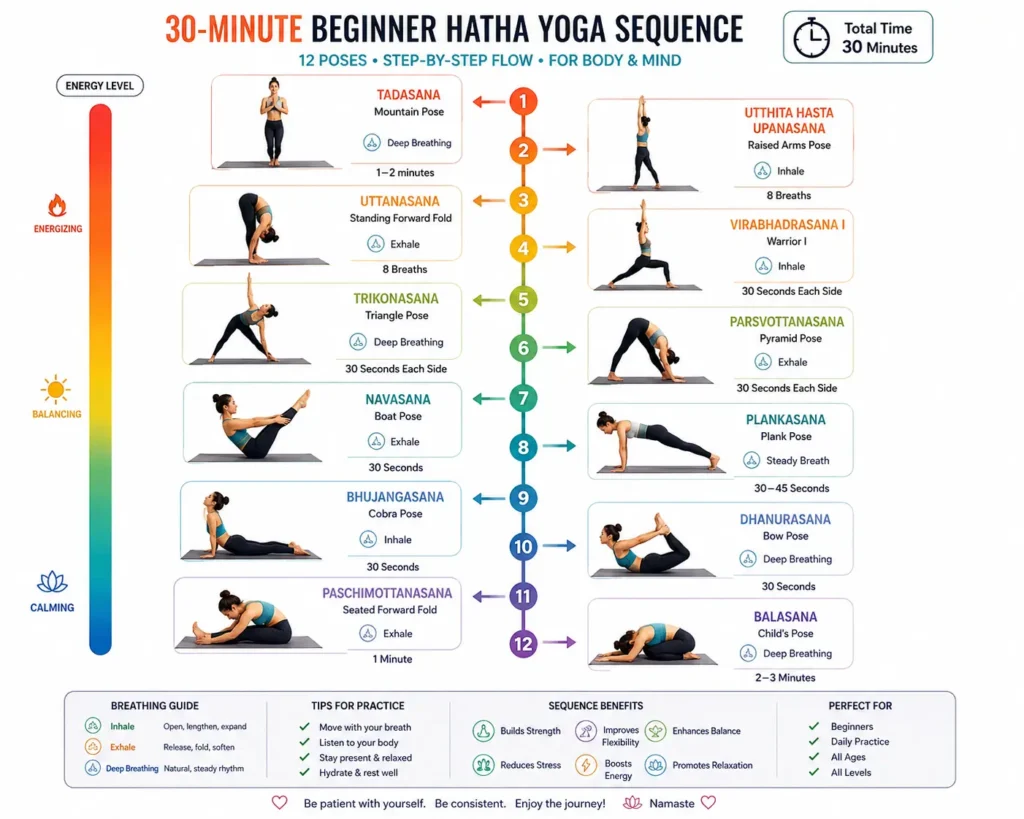
A complete practice sequence beginners can follow immediately.
Preparation (2 minutes):
Sit in easy pose, close eyes Set intention for practice Take 5 deep, centering breathsWarm-up (3 minutes):
Gentle neck rolls (5 each direction) Shoulder rolls backward (5), forward (5) Cat-Cow stretches (5 rounds) Downward dog (5 breaths)Standing Sequence (15 minutes):
Mountain pose (Tadasana) – 8 breaths Forward fold (Uttanasana) – 8 breaths Halfway lift, fold again (2 rounds) Warrior I right side – 8 breaths Triangle right side (Trikonasana) – 8 breaths Warrior II right side – 8 breaths Reverse sequence on left side (24 breaths total) Mountain pose (Tadasana) – 5 breathsCore Strengthening (5 minutes):
Plank pose – hold 30 seconds, rest 1 minute, repeat 2x Boat pose (Navasana) – hold 20 seconds, rest 30 seconds, repeat 3xHip Opening & Forward Folds (5 minutes):
Butterfly pose (Baddha Konasana) – 1 minute Seated forward fold (Paschimottanasana) – 1 minute Child’s pose (Balasana) – 2 minutesBreathing & Meditation (3 minutes):
Sit in easy pose or cross-legged Practice 3-4-6-8 breathing (inhale 3 counts, hold 4, exhale 6, hold 8) – 3 minutes Close with hands to heart, gratitudeTotal time: 30-35 minutes
MODIFICATIONS FOR DIFFERENT BODIES
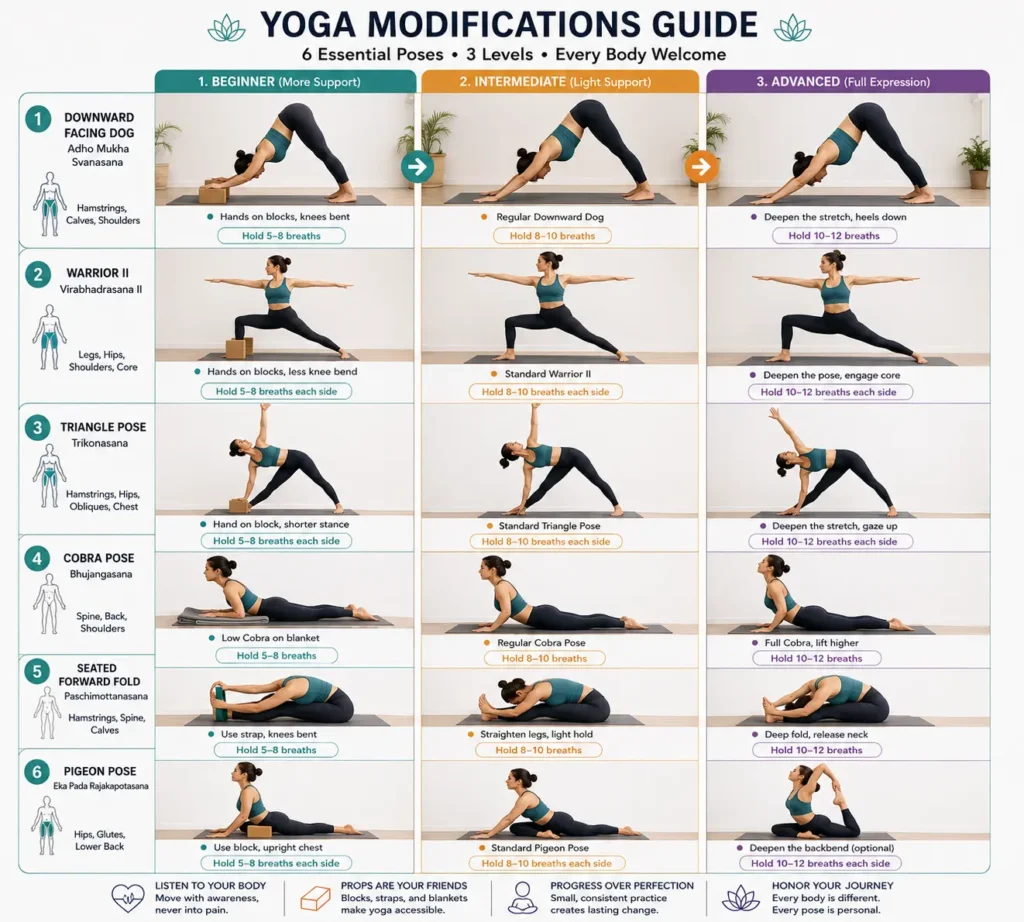
Hatha yoga is inherently inclusive. Every pose has modifications for:
For Tight Hamstrings
Standing forward fold: Bend knees generously, hands on blocks Seated forward fold: Sit on folded blanket to elevate hips, bend knees Pigeon pose: Use blocks under hip to keep torso upright Downward dog: Bend knees slightly to reduce hamstring demandFor Tight Hips
Butterfly pose: Sit on folded blanket, don’t force knees down Pigeon pose: Modify by reducing shin angle, use blocks Warrior I: Reduce front leg bend if hips are too tight Half butterfly: Flex front leg instead of deep pigeonFor Lower Back Pain
Forward folds: Bend knees generously (priority = neutral spine) Warrior I: Reduce depth, maintain neutral pelvis Backbends: Begin with gentle cobra (not full bow), use abdominal support Boat pose: Modify with bent knees, focus on core engagementFor Neck Sensitivity
Backbends: Keep gaze neutral (don’t crank neck back) Forward folds: Support head with hands if needed Avoid: Tilting head back in cow pose or backbends Use: Yoga blocks to reduce range if neededFor Shoulder Issues
Downward dog: Externally rotate shoulders, don’t force full range Plank: Keep elbows close to ribs, avoid wide elbow position Cobra: Keep hands under shoulders, don’t straighten arms fully Use: Wall or blocks to modify depth based on painFor Knee Pain
Standing poses: Avoid deep bends, keep knees aligned over ankles Pigeon: Reduce shin angle to 45° instead of 90° Skip: Poses that hyperextend knees; use props liberally Use: Blanket under knees in kneeling posesFor Pregnancy
First trimester: Avoid deep twists, abdominal poses, intense backbends Second-third trimester: Avoid belly-down poses, replace with supported versions Safe always: Child’s pose (wide knees), forward folds (bent knees), gentle hip openers, supported backbends Best: Take prenatal yoga classes with certified instructorsCOMMON HATHA YOGA MISTAKES & HOW TO FIX THEM
Mistake 1: Prioritizing Depth Over Alignment
Problem: Students force themselves deeper into poses without checking alignment, sacrificing form for appearance.
Fix: Film yourself or use mirror to check alignment. Shallower pose with perfect alignment = better practice than deep pose with poor form. Your future self will thank you.
Red flags: Rounding spine in forward folds, knees splaying outward, torso twisted in standing poses.
Mistake 2: Holding Breath During Practice
Problem: Beginners unconsciously hold breath while concentrating, defeating yoga’s nervous system benefits.
Fix: Match breath to movement: inhale during extensions/backbends, exhale during forward folds/twists. If you can’t breathe smoothly, ease out of pose—breath is your guide.
Technique: Try audible ujjayi breathing (slight throat constriction, creating ocean-like sound) to maintain breath awareness.
Mistake 3: Skipping Warm-Up
Problem: Jumping directly into standing poses without warm-up increases injury risk.
Fix: Always begin with 5-10 minute warm-up: cat-cow stretches, gentle neck rolls, shoulder rolls, downward dog holds.
Science: Muscles warm faster with dynamic movement before static holds, reducing injury risk by 30-40%.
Mistake 4: Ignoring Pain Signals
Problem: Students push through sharp pain thinking “no pain, no gain”—a yoga misconception.
Fix: Understand two sensations:
Good sensation: Gentle stretch pressure, mild muscle fatigue Bad sensation: Sharp pain, shooting pain, burning, intense joint discomfortStop immediately if you feel bad sensations.
Mistake 5: Inconsistent Practice
Problem: Practicing once weekly won’t build strength or flexibility; consistency is required.
Fix: Aim for 3-5x weekly (even 15-20 minutes counts). Consistency beats intensity. One 30-minute session 3x weekly beats occasional 90-minute sessions.
Timeline: Most practitioners see noticeable results within 4-6 weeks of consistent practice.
WHEN & HOW TO PRACTICE HATHA YOGA
Optimal Practice Times
Morning (6-8 AM): Best time for energy, focus, building consistency habit
Energizes body and mind for the day Easier to maintain regular schedule Sun salutations naturally align with sunriseEvening (5-7 PM) before dinner: Good for stress relief and transition from work
Not too close to bed (poses energize nervous system initially) Wait 2-3 hours after heavy meal Combines workout + mental resetAvoid: Late evening (8 PM+) unless practicing restorative/Yin yoga (too stimulating for sleep)
Practice Frequency & Duration
| Beginner | 2-3x weekly | 20-30 min | 4-6 weeks |
| Intermediate | 4-5x weekly | 45-60 min | 2-4 weeks (noticeable) |
| Advanced | 5-6x weekly | 60-90 min | 1-2 weeks (maintenance) |
Key: Even 15 minutes daily beats 60 minutes once weekly. Consistency > Duration.
Best Days to Practice Hatha Yoga
No restrictions — hatha yoga is safe daily. However:
Avoid intense practice on days you’re very tired, sick, or injured (modify to restorative instead) Rest days: One complete rest day weekly helps recovery (active recovery = gentle stretching, short walks)Timing Around Meals
Large meal: Wait 3-4 hours before practice Light meal: Wait 1.5-2 hours Snack: Wait 30 minutes After practice: Wait 30 minutes before eating to avoid digestive interferenceWhy: Digestion diverts blood flow from muscles. Practicing with food in stomach can cause nausea, cramping, bloating.
CONTRAINDICATIONS: WHEN TO MODIFY OR SKIP
Absolute Contraindications (Skip These Poses)
Forward folds if:
Recent spinal surgery or disc injury Uncontrolled high blood pressure Detached retinaBackbends if:
Recent abdominal surgery (wait 6+ weeks) Severe lower back pain (spine instability) Uncontrolled high blood pressureHeadstands/Inversions if:
High blood pressure (uncontrolled) Neck/spine issues Detached retina During menstruation (traditional belief—varies by teacher)Twists if:
Recent abdominal surgery Pregnancy (especially third trimester) Severe spinal conditionsModifications for Special Conditions
Back pain/disc issues:
Use props liberally Shorter holds (20 seconds instead of 2 minutes) Focus on core strengthening (boat pose, plank) Avoid deep forward folds; replace with gentle stretches Consider physical therapy yogaJoint pain (knees, hips, shoulders):
Reduce range of motion Use yoga blocks, straps, blankets Avoid full weight bearing in affected joint Consider therapeutic/restorative yogaHigh blood pressure:
Avoid intense backbends Avoid headstands, shoulderstands Focus on forward folds, gentle twists, pranayama Confirm approval from doctorPregnancy:
Avoid belly-down poses (replace with supported versions) Avoid deep twists Reduce backbend intensity Maintain pelvic floor engagement Take prenatal yoga class (designed specifically for pregnancy)KEY TAKEAWAYS
Hatha yoga is foundational practice — emphasizes alignment, breathing (pranayama), and meditation combined with physical postures Slower pace allows deeper learning — holding poses 30+ seconds enables proper alignment and body awareness versus quick transitions Builds balanced strength and flexibility — standing poses strengthen legs/core while forward folds increase flexibility simultaneously Safe for all fitness levels — modifications available for tight hips, lower back pain, shoulder issues, pregnancy, injuries Nervous system benefits are immediate — pranayama and meditation reduce cortisol by 15-25% within single session Consistency beats intensity — 15-20 minutes daily beats sporadic 60-minute sessions; aim for 3-5x weekly for visible results Proper alignment prevents injury — investment in form prevents repetitive strain injuries; use props liberally without shame Mental clarity improves faster than flexibility — most practitioners notice focus/stress reduction within 1-2 weeks versus 4-6 weeks for flexibility Best starting practice for yoga journey — hatha yoga builds foundation for progressing to Vinyasa, Power Yoga, or other styles safely Teacher certification matters — seek Yoga Alliance certified instructors (200+ hour minimum training) for proper instruction Misinformation warning: “No pain, no gain” is wrong — sharp/shooting pain signals stop position; mild stretch pressure signals correct depth Practice timing is flexible — morning ideal for consistency, evening good for stress relief; avoid late night (too stimulating for sleep)FAQ SECTION
Q1 How long before I notice changes from practicing hatha yoga?
Most beginners notice improvements within 2-4 weeks with consistent practice (3-5x weekly). Flexibility increases noticeably by week 4-6. Mental clarity and reduced stress appear within 1-2 weeks. Physical strength gains show by week 6-8. Long-term benefits (posture improvement, chronic pain reduction) develop over 3-6 months of consistent practice.
Q2 Is it safe to do hatha yoga every day?
Yes, daily hatha yoga is safe and beneficial. However, vary intensity: 3-4 days vigorous practice, 2-3 days gentle/restorative sessions. This prevents overuse injuries and maintains nervous system balance. Even experienced practitioners benefit from one complete rest day weekly for recovery. Listen to your body—modify when fatigued or sore.
Q3 Can hatha yoga help me lose weight?
Yes, but indirectly. Hatha yoga builds lean muscle mass, increasing resting metabolic rate 3-5%. It reduces stress-related eating, improves digestion through twists/forward folds, and supports hormonal balance. Studies show 4-6 kg average weight loss over 6 months with consistent practice plus healthy diet. For faster results, combine hatha yoga with cardiovascular exercise and dietary changes.
Q4 Is hatha yoga suitable for someone with no yoga experience?
Hatha yoga is ideal for beginners. It emphasizes proper alignment, allows longer holds for understanding each pose, and teachers provide detailed cues. Slower pace reduces injury risk. All poses have modifications for different flexibility levels. Most yogis recommend starting with hatha yoga to build foundation before progressing to faster-paced styles like Vinyasa.
Q5 How is hatha yoga different from vinyasa yoga?
Hatha yoga holds poses 30-120 seconds, emphasizing alignment. Vinyasa flows continuously between poses (5-10 seconds each), linking breath with movement. Hatha develops strength and flexibility separately; Vinyasa emphasizes cardiovascular fitness. Hatha suits beginners; Vinyasa requires intermediate fitness. Think of Hatha as building foundation; Vinyasa as applying that foundation athletically.
CONCLUSION
Hatha yoga isn’t trendy or flashy—it’s the timeless foundation that every successful yoga practice rests on. Whether you’re looking to build strength, increase flexibility, reduce stress, or simply reconnect with your body, hatha yoga delivers measurable results within weeks of consistent practice.
The beauty of hatha yoga lies in its accessibility. Unlike faster-paced styles that demand previous fitness, hatha yoga welcomes complete beginners. Its slower pace provides time to understand proper alignment, prevent injury, and develop genuine body awareness. You’re not chasing Instagram-worthy poses or keeping up with a fast-moving class—you’re building sustainable practice that serves your body for decades.
The 12 foundational poses outlined in this guide form the complete toolkit most practitioners need. Master these, practice consistently 3-5x weekly, and watch your body transform. Within 4-6 weeks you’ll notice improved flexibility and strength. Within 2-3 months you’ll see measurable postural improvements and reduced chronic pain. Within 6 months you’ll experience the deeper benefits: improved mental clarity, reduced anxiety, better sleep, and genuine contentment.
Remember these critical principles: alignment trumps depth, consistency beats intensity, and gentle sensation guides proper practice. Use props without shame. Modify poses when needed. Breathe continuously. Listen to your body’s signals.
The yoga journey is personal. Your practice doesn’t need to look like anyone else’s. The only competition is with your former self—and every time you step on your mat, you’re already winning.
Start with the 30-minute beginner sequence provided. Practice it 3-4 times this week. Notice what shifts—in your body, your mind, your energy. Then return next week and practice again. This is how transformation happens: through consistent, humble effort over time.
Your future self will thank you.
Namaste 🙏