How to Use a Yoga Strap (And Which Stretches Actually Work)
If you’ve ever tried to touch your toes and watched your lower back curve like a shrimp, this guide is for you. A yoga strap is a simple prop. It’s a flat cotton strap with a buckle. That’s it....
 MikeTyes

If you’ve ever tried to touch your toes and watched your lower back curve like a shrimp, this guide is for you.
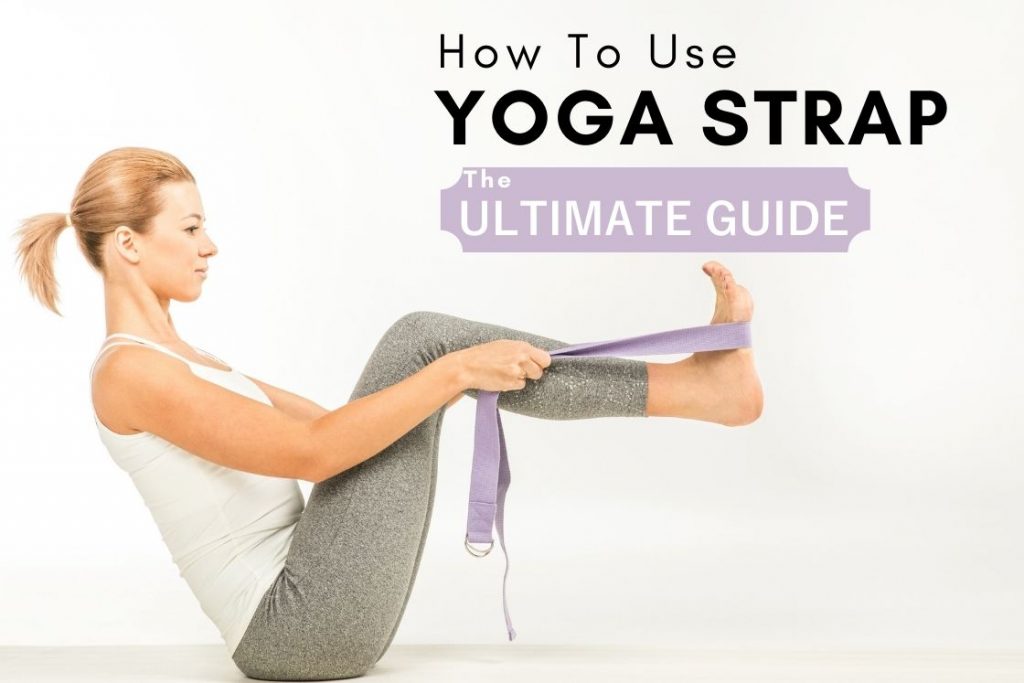
A yoga strap is a simple prop. It’s a flat cotton strap with a buckle. That’s it. But it solves a problem that stops most beginners from getting any real benefit out of stretching: the distance between where your hands are and where they need to be.
When that gap is too big, your body cheats. Your back rounds. Your knees bend. Your neck strains. You’re working hard but not actually stretching the muscle you’re targeting. A strap closes that gap so you can hold a proper position, breathe through it, and let the muscle actually release.
This guide will show you how to pick one, how to use it, and which stretches to start with depending on where you’re tight.
What size should you buy?
Go with an 8-foot strap. Most people do fine with 6 feet, but the extra length gives you flexibility for more poses, especially anything involving your legs straight up in the air. If you’re over 6 feet tall, 8 feet is essentially required.
For material, cotton is the default recommendation. It grips well, doesn’t slip when you’re sweaty, and you can throw it in the washing machine. Nylon lasts longer but gets slippery with moisture. Hemp softens with use and is the most durable long-term, though it starts off stiffer.
Quick guide: who should use a yoga strap?
A yoga strap is helpful for:
Beginners who cannot reach their toes or clasp hands behind the back Anyone with tight hamstrings, hips or shoulders Practitioners wanting to deepen stretches safely People recovering from stiffness due to desk work or long sitting Advanced practitioners refining alignment or exploring deeper variationsThe four types of yoga straps
Simple strap (no buckle). Just a long piece of fabric you knot into a loop. Good if you like simplicity and don’t want hardware. The catch is you need to set the length before you start. If you misjudge it, you’ll be re-knotting mid-stretch. D-ring strap. The most common type in yoga studios. Two metal rings sit at one end. You thread the free end through both rings, fold it back, then pull it through just one ring to lock it. Sounds complicated but you’ll have it in three seconds after doing it once. Easy to adjust for different poses. Cinch buckle strap. Looks like a backpack buckle. You can tighten or loosen it with one hand without stopping what you’re doing. This is useful when you’re moving between poses and need quick adjustments. Pinch buckle strap. Two-prong plastic buckle that clicks audibly when it locks. Same one-handed ease as the cinch buckle. The click tells you it’s secure, which some people find reassuring.1. Simple Yoga Strap (with no buckle or ring)
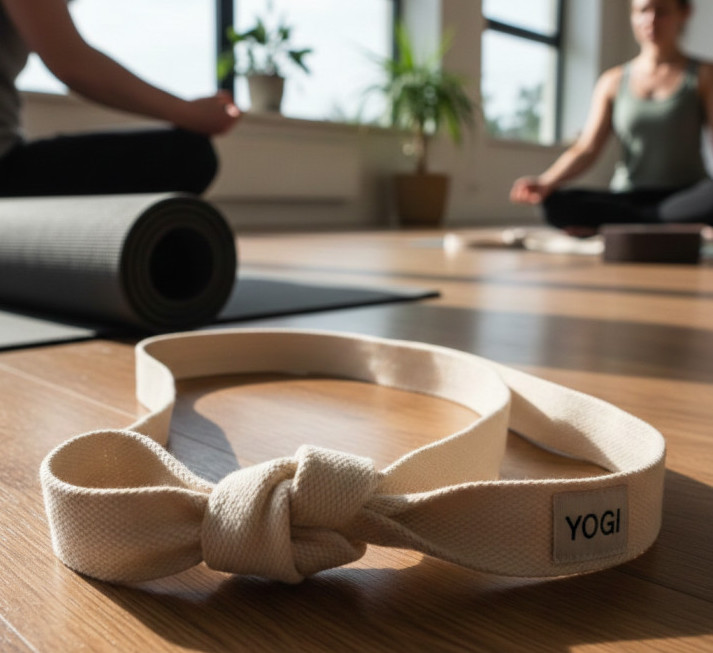
This type of strap has no metal or plastic ring at either end. It is straightforward to use and is often preferred by beginners. Many students choose it because it feels light, easy to handle, and keeps the practice quiet. Since there is no buckle, you avoid the clicking sound that sometimes disturbs the calm of the yoga room.
A simple strap is practical for people who do not want to deal with threading a loop through a ring or adjusting a buckle. You create the loop yourself, so once you set it to the length you need, you can move through your practice without stopping to adjust it again.
The only drawback is that the loop must be tied well before you start. If the knot is loose or not set to the right length, it may affect your alignment during the pose. It takes a little practice to learn how to fasten the strap firmly so it stays in place.
2. D-ring yoga strap
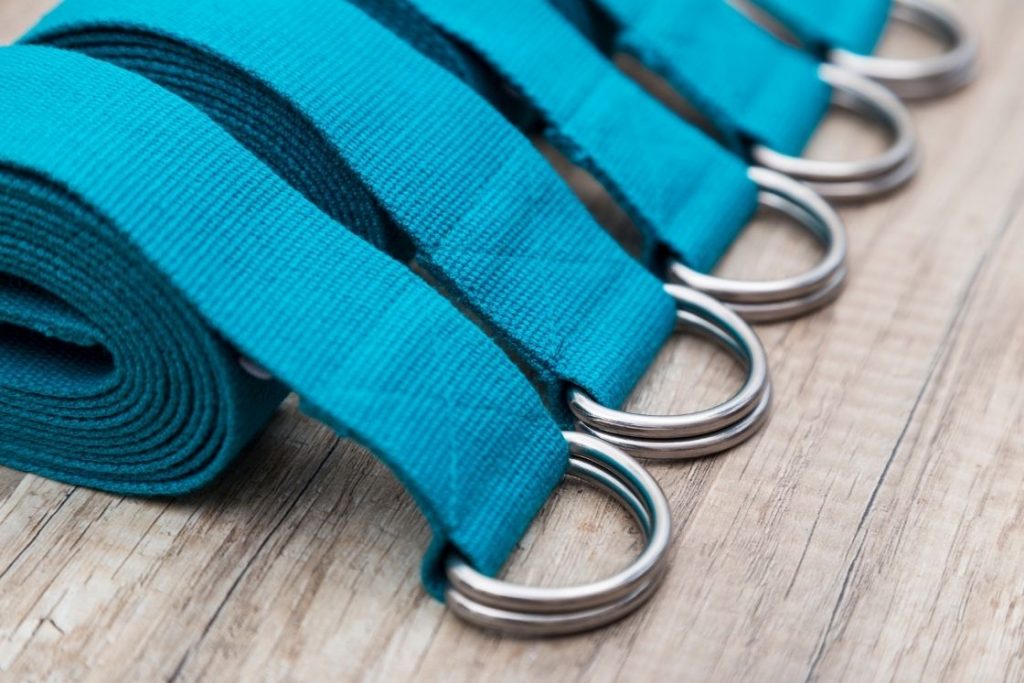
As the name suggests, this strap has metal rings shaped like the letter D. It is one of the most common straps used in yoga classes. A typical D-ring strap has two metal rings on one end, while the other end is plain. The plain end is threaded through the rings to create the loop you need.
To set it up, take the plain end through both D-rings and fold it back over. The free end will now sit on top of the rings. Next, guide this end through only one of the D-rings to tighten the loop. This holds the strap firmly in place.
A D-ring strap is helpful when you want quick and precise adjustments based on the pose you are practising. You can use it to lengthen your reach, support your back, and maintain better posture. It is especially useful for tall practitioners or anyone who needs extra extension during stretches.
Always check that your strap is set up correctly before you start. If the loop loosens or slips during a pose, it may lead to strain or injury.
3. Cinch buckle yoga strap
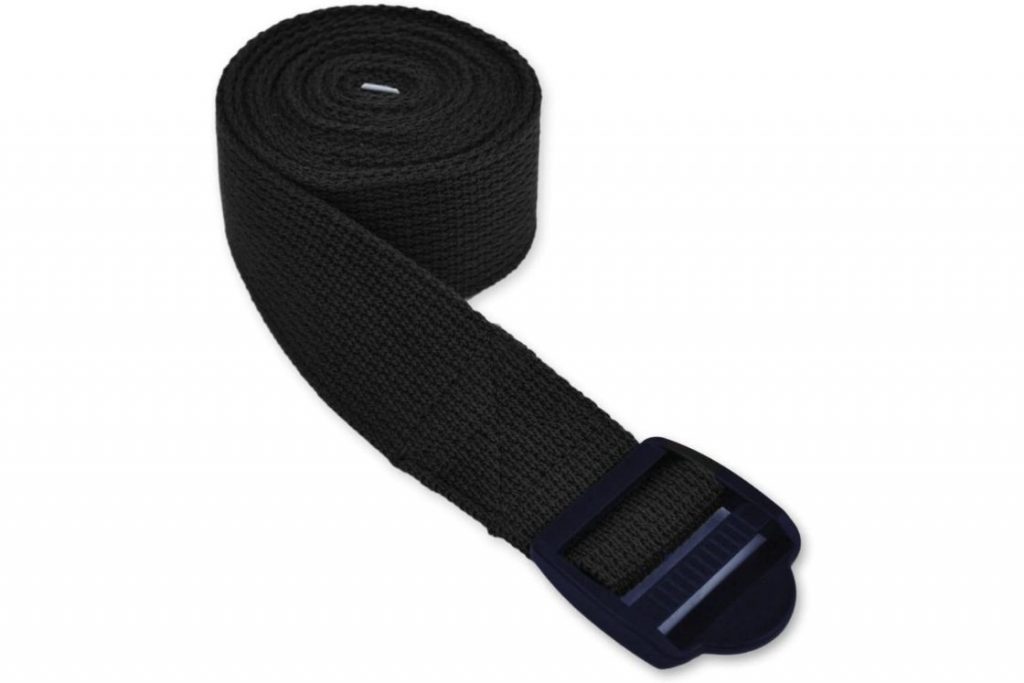
A cinch buckle strap looks similar to the buckles you often see on school bags. Most come with a plastic buckle, though metal options are also available. A cotton strap with a cinch buckle is a popular choice because it is strong, dependable, and easy to handle.
One of its key advantages is that you can adjust it with one hand. This means you can tighten or loosen the loop without breaking your flow in the middle of a pose. The plastic buckle holds the strap firmly in place, as the free end grips securely against the anti-slip design of the cinch.
This type of strap is ideal for practitioners who want quick adjustments during class and prefer a buckle that stays locked without slipping.
4. Pinch Buckle Yoga Strap
This strap uses the familiar black plastic buckle where one end has a hollow slot and the other end has two prongs. The prongs slide into the hollow buckle and lock in place with a firm click, letting you know the strap is secure.
A pinch buckle strap is easy to adjust with one hand, so you can tighten or release the loop without stepping out of your pose. The plastic buckle grips the strap well, holding it firmly in its grooves. This gives you confidence that the strap will stay in place and not loosen during your practice.
Why a strap actually helps
The main thing a strap does is let your spine stay long while your hands reach further. Without it, most people compensate by rounding the back, which feels like a stretch but mostly just loads the lumbar spine. With a strap, you keep the shape of the pose while your body slowly opens into it.
It also helps you hold positions longer. When you’re not white-knuckling your foot trying not to lose your grip, you can actually breathe and let the muscle soften. That’s when flexibility actually improves, not during the moment of maximum effort, but during the held stretch when you relax into it.
A secondary benefit: you’ll notice which side of your body is tighter. This is common and most people have no idea it’s happening until a prop makes it obvious.
Stretches for tight shoulders
Most shoulder tightness in adults comes from the same source: too much time with the arms in front of the body. Driving, typing, cooking, holding a phone. The chest muscles shorten and the upper back gets strained from holding the shoulders forward all day.
1. Shoulder pass-throughs
Hold the strap in both hands, arms straight out in front of you, hands wider than shoulder-width. Raise your arms slowly over your head, then continue bringing them back behind you as far as comfortable. Return to the front. That’s one rep.
Do 8 to 10 reps slowly. With each rep, try to narrow your grip slightly if your range allows it. The goal over time is to bring your hands closer together while keeping your arms straight throughout. If anything pinches or pulls sharply, widen your grip.
This one is worth doing between work tasks if you sit at a desk. Two minutes of it relieves more shoulder tension than most people expect.
2. Shoulder stretch behind the back
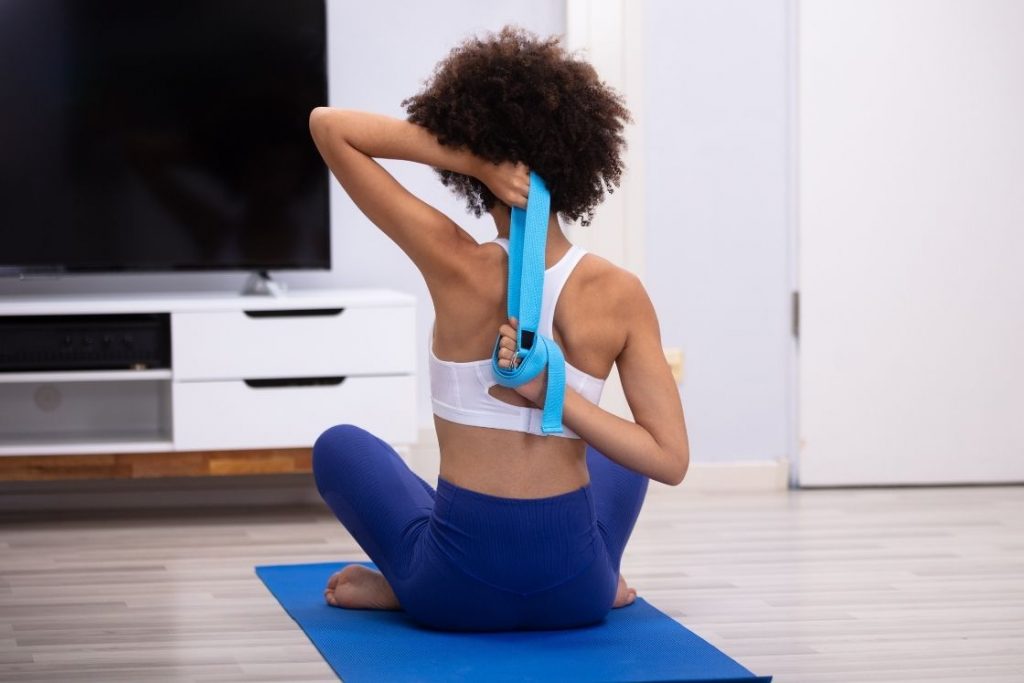
Sit comfortably with your back straight. Hold the strap in your left hand and raise that arm straight up. Bend the elbow and let your left hand drop behind your head. Reach your right arm behind your back from below and grab the dangling end of the strap.
Pull gently with both hands to bring them closer together. The left elbow points up, the right elbow points down. Hold for 30 to 45 seconds, then switch.
Almost everyone is tighter on one side. Don’t skip the hard side. That’s the one that needs the work.
Stretches for tight hamstrings
Hamstrings shorten when you sit with knees bent for hours at a stretch. They don’t become damaged or weak, they just adapt to the position you keep them in. Stretching reverses that over time, but only if you’re actually stretching the hamstring and not your lower back.
1. Seated Forward Fold
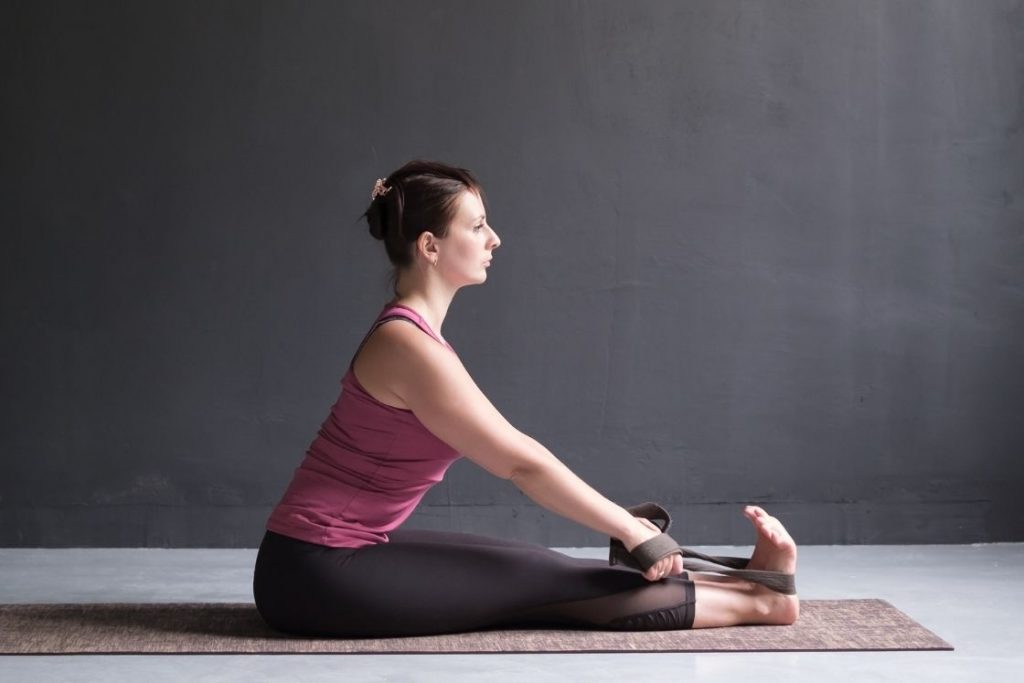
Seated poses rely heavily on the hamstrings because the legs stay straight and the movement comes from the hips. Seated Forward Bend is one of the best postures for stretching the back of the legs. However, when the knees bend or the spine rounds, the stretch becomes less effective.
A yoga strap helps you deepen the hamstring stretch by keeping the legs straight without forcing the body to fold too far. With the support of the strap, you can maintain good alignment and work safely at your own pace.
How to do it:
Sit on your mat and loop the strap around the balls of your feet. Keep your spine straight and begin to extend your legs forward. Flex the feet as you straighten the legs fully. Once your legs are straight, hold the strap with both hands and adjust your grip to find a steady position. With a long spine, hinge from the hips and bend forward gently. You only need to fold as far as you feel a comfortable stretch in the hamstrings. Stay here for at least five breaths or longer if it feels good.You can follow the same steps in Head-to-Knee Pose (Janu Sirsasana) for a focused hamstring stretch on one leg.
2. Reclined hand-to-big-toe pose
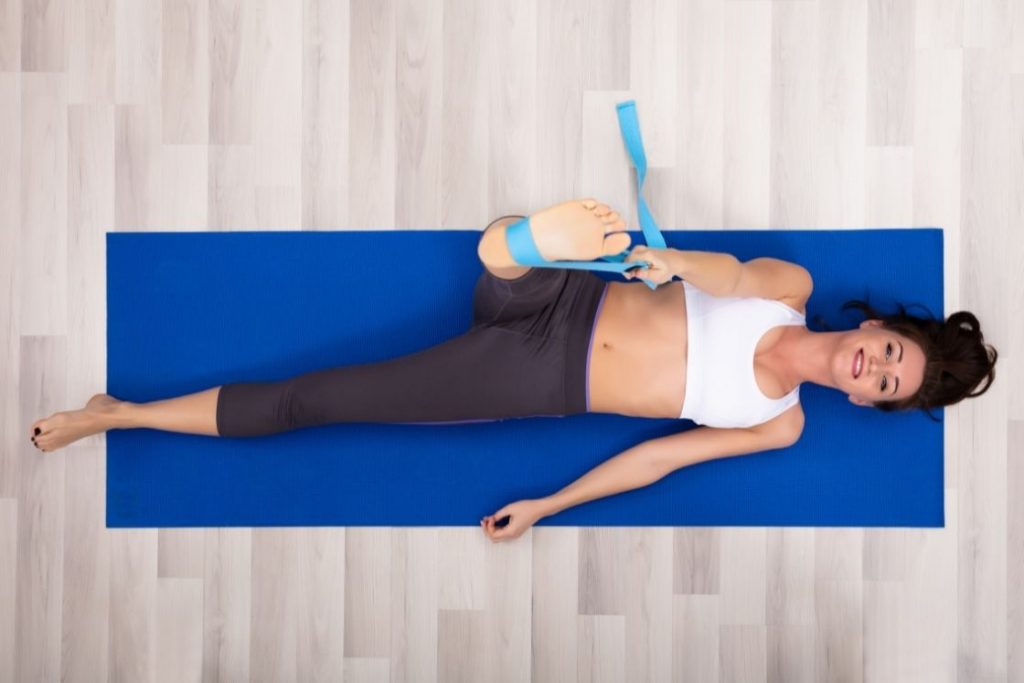
The standing version of this pose challenges balance and core strength while stretching the hamstrings and opening the hips. When practice on the back, it becomes a restorative posture that still offers a deep, controlled stretch.
Without support, many people round the spine as they try to reach the lifted foot, which can strain the neck, shoulders, and lower back. A yoga strap acts as an extended arm so you can keep the back flat on the mat and stretch the leg without bending the knee.
How to do it:
Lie on your back and bend your right knee toward your chest. Loop the strap around the ball of the right foot and hold the strap firmly with both hands. Slowly straighten the leg toward the ceiling until it is perpendicular to the floor, or as close as your body allows. Keep the left leg relaxed on the mat and maintain a long spine. Stay here for five steady breaths, then release and switch sides.To increase the stretch, you can let the lifted leg lower to the right side while holding the strap with one hand. Move only as far as is comfortable and keep the opposite hip grounded.
Stretches for lower back pain
Lower back pain that isn’t from injury is often related to tight hip flexors and hamstrings pulling the pelvis forward, or weak supporting muscles that can’t stabilize the spine properly. These two stretches address both.
1. Bow Pose (Dhanurasana)

Lie face down on your mat. Bend your knees so your feet point toward the ceiling. Form the strap into a U shape, drape it over your shins, and hold both ends behind you.
Begin sliding your hands toward your feet along the strap. As your hands get closer to your feet, press your feet toward the ceiling and lift your chest off the floor at the same time. The chest and legs rise together.
Hold for 20 to 30 seconds. Your gaze should be slightly forward, not craning up. Release slowly.
This pose strengthens the entire back and opens the chest. Most people find the first few attempts feel awkward, and it gets more comfortable quickly.
2. Bound angle pose (Baddha Konasana)
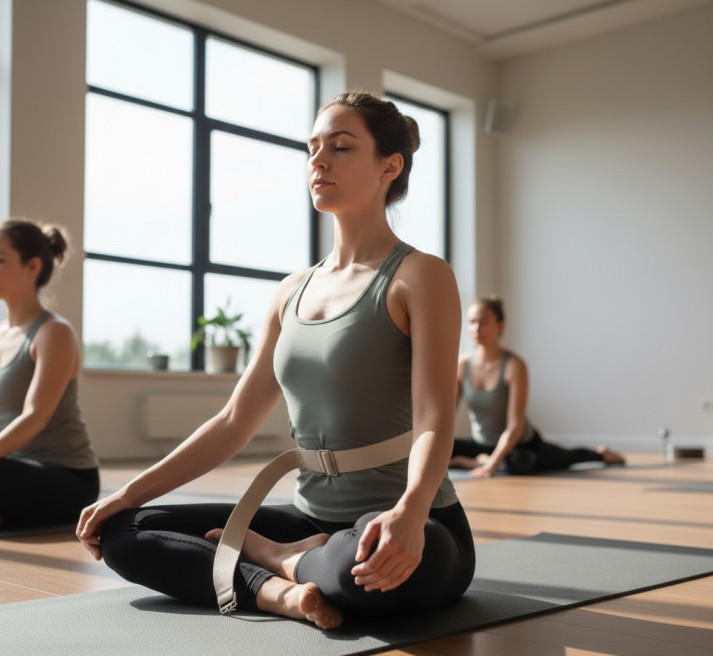
Sit with your legs extended, then bend your knees and bring the soles of your feet together. Wrap the strap around your lower back, bring both ends forward past your hips, and pass them under your feet. Adjust the tightness until your back feels gently held upright.
Rest your hands on your knees or in your lap. Stay here for 2 to 3 minutes and breathe slowly. With each exhale, let your hips sink slightly closer to the floor.
The strap here acts as a brace that holds your lower back in a neutral position while your hips open gradually. It’s a good one to end a session with.
Stretches for tight hips
Hip tightness accumulates from sitting, stress, and not moving the hip joint through its full range regularly. Neither of these poses requires prior yoga experience.
1. Tree Pose (Vrikshasana)
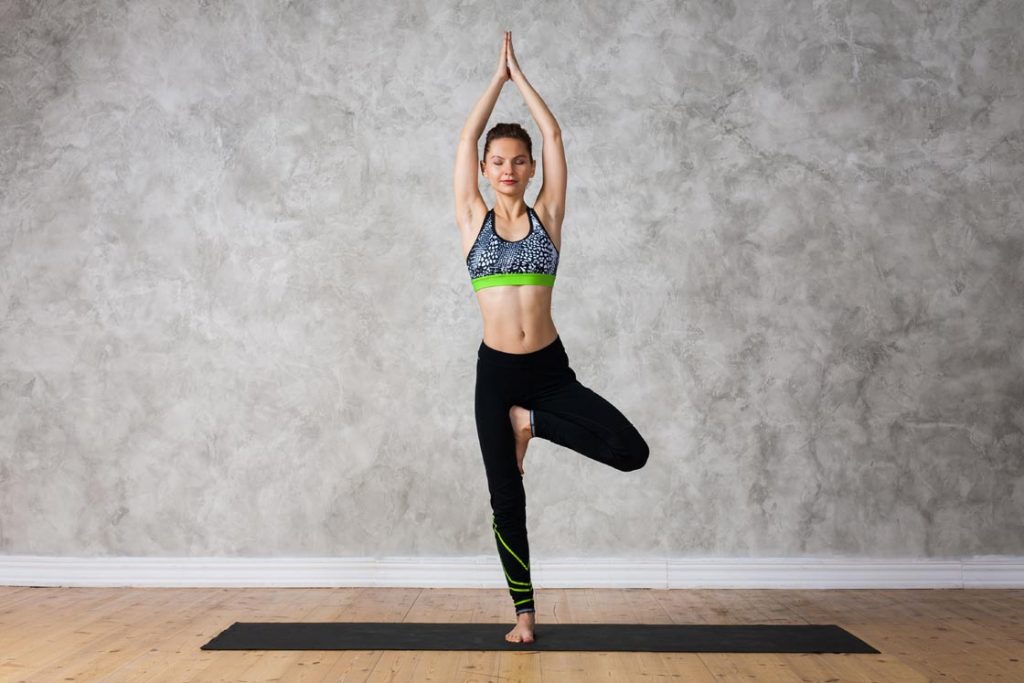 Image Source: Shutterstock
Stand with your feet together. Make a loop in the strap, slip your left foot through it, and hold the free end in your left hand. Shift your weight to your right foot, then use the strap to help lift your left foot and place it against your inner right thigh or calf.
Press the foot into the leg and the leg back into the foot. Hold for 30 to 60 seconds. If balance is difficult, stand near a wall and rest one hand on it lightly.
The strap helps you position the foot at the right height without wobbling around trying to reach it. Switch sides.
2. Triangle pose (Trikonasana)
Stand with feet about 3 feet apart. Turn your right foot to face forward and angle your left foot in slightly. Wrap the strap under your left heel and bring the remaining length across to your upper right thigh, just below the hip crease.
Extend both arms to the sides. Reach your right arm down toward your right shin or the floor, keeping your chest open and facing forward. Raise your left arm straight up. Hold for 5 breaths, then switch sides.
The strap acts as a feedback tool here. If it loosens during the pose, it means your pelvis has drifted forward. Keep it taut and your alignment will stay honest.
Stretches for neck tension
Screen time and phone use shorten the muscles along the front of the neck and overload the ones at the back. These two moves take under 5 minutes and can be done in a chair.
Chin glide. Place the center of the strap behind your head at the base of your skull. Hold both ends and extend your arms slightly forward to create light tension. Slowly slide your head straight back, hold for a breath, then gently forward. It’s a small, controlled movement. Think of your head gliding horizontally rather than tilting. Do this for 60 to 90 seconds.
Side neck stretch. Place the center of the strap against the right side of your head, just above the ear. Hold the strap with your left hand with your elbow bent. Use your forearm to gently guide your head toward your left shoulder. Keep your right shoulder pressed down. Hold 30 seconds each side.
Do these daily and you’ll feel a difference within a week.
Where to start
If you’re new to this, pick one area that bothers you most and do those two stretches daily for two weeks before adding more. Progress in flexibility is slow and then suddenly obvious. Doing less consistently beats doing everything once.
If shoulder tension from desk work is your main issue, start with the pass-throughs and the behind-the-back stretch. If your hamstrings are the problem, the reclined leg raise will show results fastest. Lower back issues almost always improve with consistent hip opener work before anything else.
The strap is just a piece of fabric. What it actually does is remove the excuse that you’re not flexible enough to stretch properly.
.
FAQs
1. Can I use a yoga strap every day?
Yes. Most of these stretches are gentle enough for daily use. Consistency matters far more than intensity when building flexibility.
2. How long should I hold each stretch?
30 to 60 seconds is the minimum to see any benefit. If you want real flexibility gains over time, hold for 90 seconds to 2 minutes in the areas that are tightest. Brief stretches mostly just feel good without creating lasting change.
3. s a yoga strap the same as a resistance band?
No. A resistance band is elastic and meant for strength training. A yoga strap is non-elastic and acts as an extension of your arm or leg. They’re not interchangeable.
4. Is this useful for physical therapy?
Many physiotherapists use strap-assisted stretching, particularly for hamstring and hip rehabilitation. If you’re recovering from an injury, run any new routine by your physical therapist first.
5. How do I clean it?
Machine wash on cold, hang to dry. Don’t put it in the dryer or store it damp.