How to Wake Up the Body’s Seven Chakras: Complete Activation Guide
✨ QUICK ANSWER The seven chakras are energy centers in the body running from the spine’s base to the crown […]
 Kass
Kass

✨ QUICK ANSWER
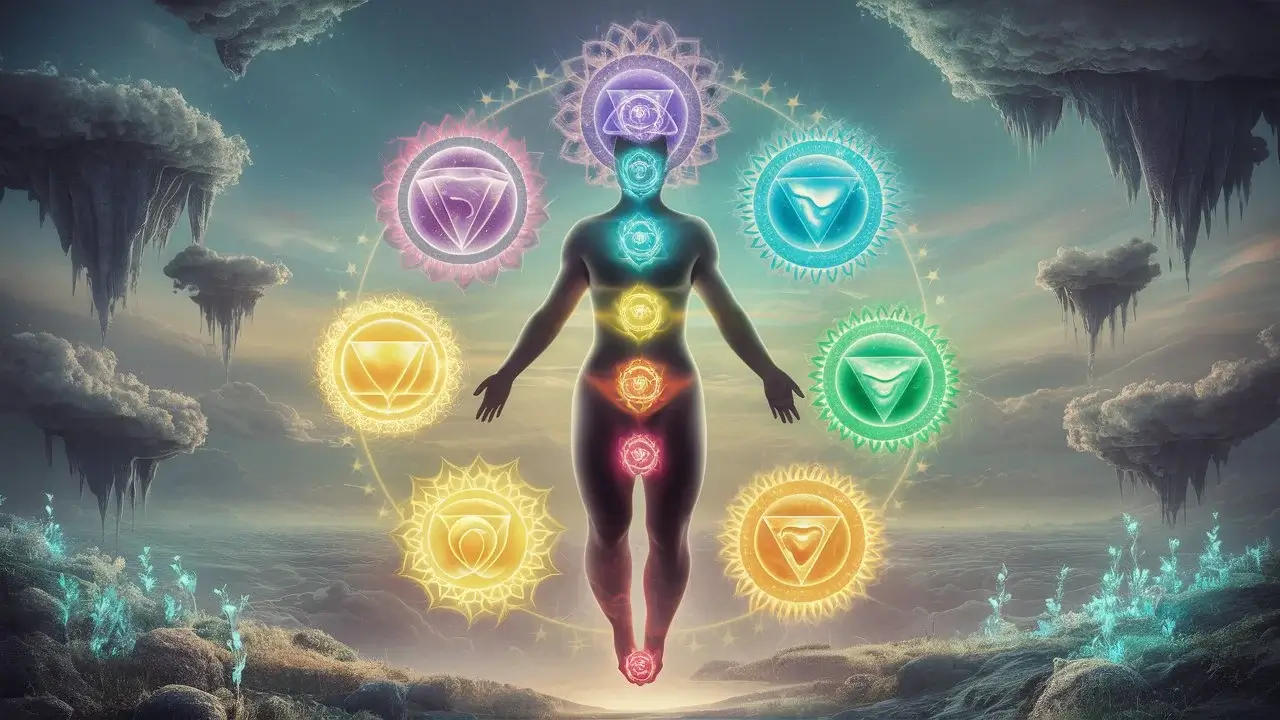
The seven chakras are energy centers in the body running from the spine’s base to the crown of the head. To awaken them, use yoga poses aligned to each chakra, practice chakra-specific meditation and mantras, perform pranayama (breathing techniques), and use hand mudras. Awakening happens gradually through consistent practice—typically 4-12 weeks. Start with root chakra grounding work before progressing upward.
The Hidden Energy System in Your Body
Most people experience low energy, emotional imbalance, or physical tension without understanding why. You stretch, rest, and eat well—yet something still feels “off.” The ancient yoga system teaches that blockages in your body’s energy centers (chakras) create exactly this feeling.
Your body contains seven major chakras stacked vertically along your spine, each controlling different physical, emotional, and spiritual functions. A blocked root chakra creates anxiety and survival fears. A closed heart chakra leaves you emotionally numb. A silenced throat chakra means your truth stays unspoken.
The good news? Awakening these energy centers is learnable, safe when done correctly, and produces measurable results in weeks.
What You’ll Learn in This Guide
This comprehensive guide reveals exactly how to wake up each of your seven chakras using:
Yoga poses proven to activate specific chakras Chakra-specific mantras and breathing techniques Meditation practices for energy center clearing Mudras (hand positions) that direct prana upward Common mistakes that delay awakening (and how to avoid them) Signs that chakras are genuinely awakeningBy the end of this post, you’ll have a 30-day chakra awakening plan you can start today.
Why Chakra Awakening Matters
Chakra awakening isn’t mystical wishing. Modern neuroscience shows that meditation activates specific brain regions. Yoga poses trigger the parasympathetic nervous system (your body’s “rest and digest” mode). Breathing techniques shift your nervous system state measurably. Chakra work uses these proven mechanisms in a systematic framework.
Let’s wake up your body’s energy system.
UNDERSTANDING THE SEVEN CHAKRAS
Before activating chakras, understand what each one controls.
The Sanskrit word “chakra” means “wheel.” Each chakra is a vortex of energy, visualized as a spinning wheel with a specific color, sound frequency, and location.(1)
The Seven Chakras (Root to Crown)
1. Muladhara (Root Chakra)
Location: Base of spine Color: Red Mantra: LAM Governs: Survival, security, stability, groundedness, physical vitality Associated body parts: Legs, feet, bones, lower back, digestive system When blocked: Anxiety, financial worry, low energy, weak immune system When awakened: Grounded, financially stable, physically strong, fearless2. Svadhisthana (Sacral Chakra)
Location: Lower abdomen (2 inches below navel) Color: Orange Mantra: VAM Governs: Creativity, sexuality, pleasure, emotional flow, reproductive health Associated body parts: Reproductive organs, bladder, kidneys, lower intestines When blocked: Sexual dysfunction, creative blocks, emotional rigidity, lower back pain When awakened: Creative expression flowing, healthy sexuality, emotional flexibility, magnetic presence3. Manipura (Solar Plexus Chakra)
Location: Upper abdomen (at navel level) Color: Yellow Mantra: RAM Governs: Personal power, willpower, confidence, digestion, metabolism Associated body parts: Stomach, pancreas, liver, small intestines, diaphragm When blocked: Low self-esteem, digestive issues, weak willpower, victim mentality When awakened: Confident, empowered, strong digestion, radiant energy, leadership presence4. Anahata (Heart Chakra)
Location: Center of chest (at heart level) Color: Green (or pink for unconditional love) Mantra: YAM Governs: Love, compassion, forgiveness, connection, immune function Associated body parts: Heart, lungs, thymus gland, upper back When blocked: Emotional numbness, heartbreak stuck in body, isolation, poor immunity When awakened: Compassionate, loving, forgiving, connected, immune resilience5. Vishuddha (Throat Chakra)
Location: Throat center Color: Blue Mantra: HAM Governs: Communication, self-expression, truth-speaking, creativity, hearing Associated body parts: Throat, thyroid, parathyroid, ears, vocal cords, neck When blocked: Inability to speak truth, thyroid problems, fear of speaking, swallowed emotions When awakened: Authentic communication, healthy thyroid, creative expression, listened to by others6. Ajna (Third Eye Chakra)
Location: Between the eyebrows Color: Indigo Mantra: OM Governs: Intuition, insight, inner wisdom, imagination, visualization, psychic ability Associated body parts: Brain, pineal gland, pituitary gland, eyes, nervous system When blocked: Poor intuition, confusion, brain fog, difficulty visualizing, weak memory When awakened: Clear intuition, prophetic dreams, mental clarity, visual imagination, psychic sensitivity7. Sahasrara (Crown Chakra)
Location: Top of head Color: Violet or white Mantra: Silent (or universal sound) Governs: Spiritual connection, unity consciousness, enlightenment, divine connection Associated body parts: Top of brain, entire nervous system, crown area When blocked: Spiritual disconnection, rigidity, meaninglessness, existential depression When awakened: Spiritual connection, peace, unity consciousness, transcendence, life purpose8-STEP GUIDE TO AWAKENING YOUR SEVEN CHAKRAS
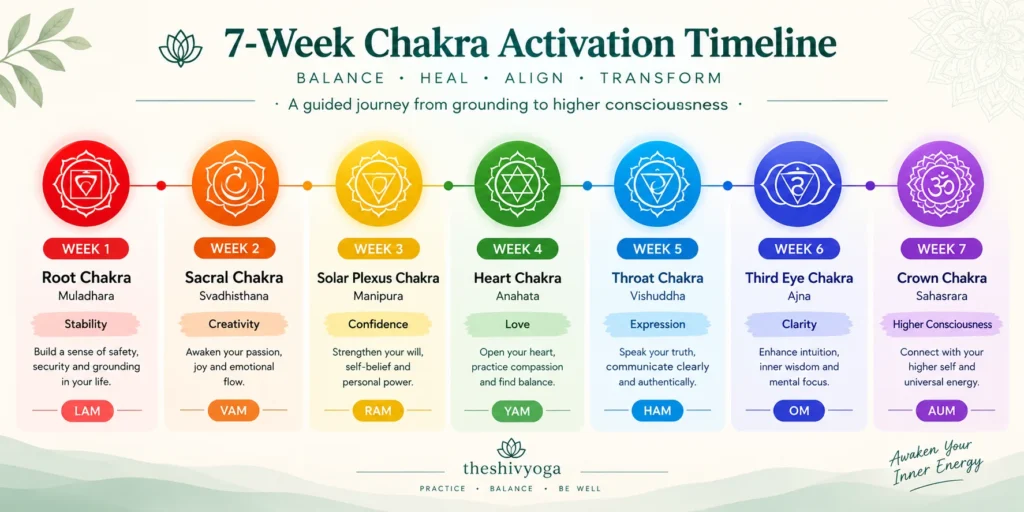
Chakra awakening follows a natural progression. Start at the root and move upward—rushing to higher chakras while lower ones remain blocked creates instability.
STEP 1: Prepare Your Foundation (Days 1-3)
Before beginning chakra work, establish a practice foundation.(2)
What to do:
Commit to 15-20 minutes daily practice (at same time each day if possible) Find a quiet, clean space (your bedroom, a yoga studio, or outdoor garden) Sit on a yoga mat or cushion facing a window or toward east (traditional) Turn off phone notifications Practice on an empty stomach or 2+ hours after eating Wear comfortable, loose clothing (avoid restrictive waistbands) Keep a journal to track experiences, sensations, and dreamsWhy this matters: Chakras respond to intention and consistency. A haphazard approach produces slow, inconsistent results. Daily practice for 21+ days creates new neural pathways that accelerate awakening.
STEP 2: Activate Root Chakra (Muladhara) – Week 1
The root chakra is your foundation. Neglect it and higher chakras remain unstable.
Daily practice (15 minutes):
Grounding meditation (5 minutes): Sit cross-legged or in child’s pose Close eyes Visualize red energy at base of spine Chant mantra “LAM” (sound rhymes with “palm”) for entire exhalation Perform 10 rounds of mantra per minute Focus on feeling rooted and grounded Yoga poses for root activation (7 minutes): Mountain Pose (Tadasana): 1 minute—feet hip-width apart, press all four corners of feet into ground Warrior I (Virabhadrasana I): 1 minute each side—root down through back foot Child’s Pose (Balasana): 2 minutes—forehead on ground, feeling supported Squat (Malasana): 2 minutes—heels on ground if possible (or use block under heels) Bridge Pose (Setu Bandha Sarvangasana): 1 minute—press feet down, lift hips Root chakra breathing (3 minutes): Inhale for 4 counts, hold for 4, exhale for 6 counts As you exhale, visualize energy roots growing from base of spine deep into earth Perform 10 rounds Mudra activation (closing): Touch thumb to index finger on both hands (Gyan Mudra) Rest hands on knees, palms down Chant “LAM” 7-21 timesTrack: Note any sensations—tingling at base of spine, heaviness, or grounding feeling.
STEP 3: Activate Sacral Chakra (Svadhisthana) – Week 2
Once root stabilizes (after 7 days), introduce sacral activation while maintaining root work.
Daily practice (20 minutes):
Root activation (from Step 2): 5 minutes (abbreviated) Mountain Pose: 30 seconds Squat: 1 minute Bridge Pose: 1 minute Root mantra “LAM”: 2 minutes Sacral meditation (5 minutes): Sit with legs extended forward Visualize orange energy 2 inches below navel Chant mantra “VAM” with full exhalations Feel creative, sensual, flowing energy Hip-opening poses (7 minutes): Bound Angle Pose (Baddha Konasana): 2 minutes—opens hips, stimulates sacral region Low Lunge (Anjaneyasana): 1 minute each side—creates hip opening Pigeon Pose (Eka Pada Rajakapotasana Prep): 2 minutes each side—deep hip opener Cat-Cow (Marjaryasana-Bitilasana): 1 minute—mobilizes lower abdomen Sacral breathing (2 minutes): Hip circles: Sit cross-legged, make slow circles with torso, 10 each direction Inhale-exhale “VAM” 7 times Focus on pleasure, flow, creativity Sacral mudra (1 minute): Touch thumb to pinky finger on both hands (Shakti Mudra) Rest hands on lower abdomen Chant “VAM” 7-21 timesSTEP 4: Activate Solar Plexus Chakra (Manipura) – Week 3
Solar plexus activation requires core engagement and personal power work.
Daily practice (20 minutes):
Root + Sacral maintenance (6 minutes): Mountain Pose + Squat: 2 minutes Hip opener (Bound Angle or Pigeon): 2 minutes Root + Sacral mantras combined: 2 minutes Solar plexus meditation (5 minutes): Sit upright, hands on stomach at navel level Visualize yellow/golden energy at solar plexus Chant “RAM” with powerful, confident exhalations Feel your personal power increasing Core and power poses (7 minutes): Boat Pose (Navasana): 1 minute (3 rounds of 20 seconds)—intense core activation Plank Pose: 1 minute (3 rounds)—builds core stability Warrior III (Virabhadrasana III): 1 minute each side—activates core and willpower Bow Pose (Dhanurasana): 1 minute—opens belly, activates fire element Triangle Pose (Trikonasana): 1 minute each side—engages core and digestion Solar plexus breathing (2 minutes): Breath of fire (Kapalabhati): 1 minute—40 rapid exhalations per minute Chant “RAM” 7 times with strong intention Solar plexus mudra (1 minute): Touch thumb to ring finger (Surya Mudra) Rest hands on solar plexus Chant “RAM” 7-21 timesSTEP 5: Activate Heart Chakra (Anahata) – Week 4
Heart chakra is the bridge between lower and upper chakras. Approach with gentleness and compassion.
Daily practice (25 minutes):
Lower chakra maintenance (8 minutes): Root, sacral, solar plexus shortened practice: 8 minutes Combine poses and mantras efficiently Heart meditation (6 minutes): Sit upright or in child’s pose with hands on heart center Visualize green/pink energy in center of chest Chant “YAM” with loving, gentle intention Set intention: “I am love. I am loved. I am worthy of love.” Feel your heart expanding with each breath Chest-opening poses (7 minutes): Cow Pose (Bitilasana): 1 minute—opens entire front body Sphinx Pose (Salamba Bhujangasana): 1.5 minutes—gentle chest opening Camel Pose (Ustrasana): 1.5 minutes (or supported variation)—deep heart opener Fish Pose (Matsyasana): 1.5 minutes—opens throat and chest simultaneously Supported Bridge with block under back: 1.5 minutes—passive chest opening Heart breathing (2 minutes): Hand on heart, feel heartbeat Breathe deeply into chest cavity Chant “YAM” 7 times with each exhalation Heart mudra (2 minutes): Anjali Mudra (prayer hands at heart) Chant “YAM” 21 times Repeat affirmation: “My heart is open, strong, and forgiving”STEP 6: Activate Throat Chakra (Vishuddha) – Week 5
Throat activation enables authentic communication and creative expression.
Daily practice (25 minutes):
Lower 4 chakra maintenance (9 minutes): Compress root, sacral, solar plexus, heart into 9-minute practice Throat meditation (6 minutes): Sit upright with shoulders back Visualize blue energy in throat center Chant “HAM” in a relaxed, natural voice (use full vocal range) Set intention: “I speak my truth. I am heard. My voice matters.” Feel vibrations in throat and neck Neck and throat poses (7 minutes): Shoulder rolls: 1 minute (10 forward, 10 backward)—release throat tension Neck stretches: 1.5 minutes (gentle forward fold bringing chin to chest, hold; then look right shoulder, hold; then look left shoulder, hold) Lion’s Breath (Simhasana): 1 minute—open throat fully, stick tongue out during exhalation Shoulderstand (Sarvangasana): 2 minutes or wall-supported version—inverts throat area Throat massage: 1.5 minutes (gently massage front and sides of neck, self-massage) Throat breathing + sound (2 minutes): Hum meditation: Inhale deeply, hum for entire exhalation, 5 rounds Chant “HAM” 7 times powerfully Throat mudra (1 minute): Interlace fingers, thumbs up (Cinmudra) Chant “HAM” 21 times Speak truth statement aloud: “I express myself authentically”STEP 7: Activate Third Eye Chakra (Ajna) – Week 6
Third eye activation opens intuition, insight, and inner knowing.
Daily practice (25 minutes):
Lower 5 chakra maintenance (9 minutes): Brief practice of all five lower chakras Third eye meditation (8 minutes): Sit upright or in easy pose Close eyes, focus attention at point between eyebrows Visualize indigo energy (or space) at third eye Chant “OM” (or “AUM”) 21 times—vibration goes straight to third eye Practice “So Hum” breath: “So” on inhale, “Hum” on exhale for 5 minutes Open eyes slowly Forward bends and inversions (7 minutes): Child’s Pose with 3rd eye focus: 2 minutes—forehead to ground stimulates pineal gland Downward Dog with forehead focus: 1.5 minutes—mild inversion Seated Forward Fold (Paschimottanasana): 2 minutes—calming, introspective Legs Up Wall Pose: 1.5 minutes—gentle inversion for pineal stimulation Third eye breathing (1 minute): Alternate nostril breathing (Nadi Shodhana): 1 minute—balances left and right hemispheresSTEP 8: Activate Crown Chakra (Sahasrara) – Week 7 Onward
Crown awakening is the final step—a gradual process that deepens over months/years.
Daily practice (30 minutes):
All 6 lower chakras (10 minutes): Quick activation of all lower chakras Crown meditation (12 minutes): Sit comfortably, spine tall Focus on top of head Visualize violet/white light above and through crown Chant “OM” or remain in silence Practice gratitude meditation: mentally list things you’re grateful for (5 minutes) Extend awareness beyond individual self—sense connection to all beings Spinal work (5 minutes): Seated spinal twists (1 minute each side)—aligns energy channels Arm lifts: Reach arms overhead, palms meeting above crown (1 minute) Full body stretch with focus on vertical alignment (1 minute) Unified breath work (3 minutes): Single long “OM” chanted 7 times—whole body vibration Sit in silence for 2 minutesNote: Crown chakra awakening is ongoing. Some practitioners spend years opening it fully. Trust the natural unfolding.
MODIFICATIONS FOR DIFFERENT BODIES
Not all bodies experience chakra activation the same way. Adapt practices to your needs.
For Tight Hips (Blocks Sacral & Root)
Tight hips block energy flow to lower chakras. Modify:
Replace pigeon pose with: Happy baby pose (Ananda Balasana)—lie on back, grab outside edges of feet, knees toward armpits Replace deep squats with: Supported squat—use yoga block under sit bones or practice wall squats Add gentle hip circles: Sit cross-legged, make slow circles with torso before deeper hip work Practice 4-week progression: Week 1 light stretching, Week 2 moderate stretching, Week 3 deeper stretching, Week 4 active hip openingFor Lower Back Pain (Blocks Root)
Lower back issues prevent grounding. Modify:
Replace full bridge with: Glute bridge—lie on back, knees bent, lift hips 6 inches only, 30 seconds Replace deep forward folds with: Gentle seated forward fold or hamstring stretches with bent knees Replace unsupported shoulderstand with: Wall-supported shoulderstand or legs-up-wall pose Add: Cat-cow (Marjaryasana-Bitilasana) to mobilize lower back before chakra work Avoid: Deep backbends until lower back strengthens (2-3 weeks gentle practice)For Neck Tension (Blocks Throat)
Neck tension silences authentic expression. Modify:
Replace full shoulderstand with: Supported shoulderstand using wall or blanket roll Replace neck stretches (first time) with: Gentle shoulder shrugs (lift shoulders to ears, drop)—10 rounds Add neck massage: Self-massage front, sides, and back of neck for 2 minutes before chanting Replace Lion’s Breath with: Lion’s Breath variant—open mouth wide, stick out tongue, but keep neck neutral Practice: Gentle head tilts before deeper neck workFor Anxiety (Blocks Heart & Root)
Anxiety creates tension throughout chakra system. Modify:
Shorten practice: Start with 5-minute daily practice instead of 15 minutes Replace active poses with: Restorative poses (supported child’s pose, legs-up-wall, bolster-supported reclining butterfly) Add grounding visualization: Imagine roots growing from base of spine deep into earth Replace chanting with: Humming or silent visualization Practice morning instead of evening: Anxiety often worsens at night Add: 5-minute breathing practice before chakra work (4-count inhale, 6-count exhale)For Pregnant Bodies (All Chakras)
Pregnancy affects all chakras. Modify:
Root & Sacral: Replace deep squats with wall-supported squats; avoid deep hip openers after first trimester Solar Plexus: Avoid deep twists; replace with gentle spinal mobility Heart: Use supported chest openers (pillows under back) Throat: All throat poses okay if done gently Third Eye: Forward folds fine; avoid inversions Crown: All practices safe; avoid intense meditation Timeline: Practice 5-10 minutes daily instead of full practice Consult: Check with OBGYN before starting new chakra practiceFor Stiff Bodies (Blocks All Chakras)
Stiffness prevents energy flow. Modify:
Add warm-up: 5 minutes gentle stretching before chakra work Use props extensively: Blocks under hands in forward folds, blankets under knees, straps for stretches Shorten holds: Hold poses 20 seconds instead of 1-2 minutes; build time slowly over weeks Focus on one chakra: Practice 1-2 chakras deeply rather than rushing through all seven Progress gradually: Spend 2 weeks per chakra instead of 1 week Add yin yoga: 2-3 minute passive holds in restorative poses (sphinx, supported fish)For Energy Sensitivity (All Chakras)
Some people feel chakra activation intensely. Modify:
Shorten practice: 5-minute daily practice instead of 15-25 minutes Use softer sounds: Replace loud chanting with humming or whispering Ground frequently: Add earth element work—stand barefoot on grass, spend time in nature Practice outdoors: Nature amplifies yet stabilizes chakra work Add grounding mudra: Touch thumb to pinky finger (Shakti Mudra) during practice Space out chakras: Practice one chakra for 2-3 weeks instead of 1 week5 COMMON CHAKRA AWAKENING MISTAKES (And How to Fix Them)
Most people make predictable errors that slow or stall chakra activation. Avoid these.
MISTAKE 1: Skipping Root Chakra Work
The error: Jumping straight to crown chakra or heart chakra because those “sound more advanced.”
Why it backfires: Root chakra is your foundation. Skipping it creates an unstable structure. Imagine building a house without a foundation—upper floors collapse.
Science behind it: Neuroscience shows that grounding activates the parasympathetic nervous system (safety state). Without parasympathetic activation, higher chakras remain blocked.
The fix: Spend minimum 1 full week on root chakra. Don’t progress to sacral until:
You feel physically grounded Anxiety decreases noticeably You sleep more deeply Lower back feels supportedThis one-week investment saves 4-6 weeks of stalled progress later.
MISTAKE 2: Expecting Overnight Results
The error: Practicing chakra activation for 3 days, then quitting because you don’t feel different.
Why it backfires: Chakra awakening rewires neural pathways. Neuroplasticity requires 21-66 days of consistent practice. Three days creates zero change.
Real timeline: Most people notice subtle shifts week 1-2 (slightly better sleep, minor mood lift). Week 3-4 brings noticeable changes (more confidence, easier creativity). Week 5-8 shows significant transformation (emotional stability, life improvements).
The fix: Commit to minimum 30-day practice before evaluating results. Track experiences in a journal (this makes subtle shifts visible). If you quit after 3 days, you quit before neuroplasticity begins.
MISTAKE 3: Pushing Too Hard / Forcing Chakra Activation
The error: Doing extended chakra practices daily, holding poses too long, chanting mantras intensely for hours.
Why it backfires: Forcing chakra activation is like forcing a flower to bloom—it damages the petals. Excessive chakra work creates:
Energy fatigue (feeling exhausted despite sleep) Sensitivity overload (sounds/lights feel unbearable) Emotional overwhelm (crying unexpectedly, mood swings) Sleep disruption (insomnia or nightmares)This signals your nervous system is overstimulated, not awakened.
Science: Chakra activation should feel gentle, progressive. Forced activation triggers sympathetic nervous system (fight/flight), blocking higher chakra access.
The fix: Follow the graduated timeline (1 chakra per week). Practice 15-25 minutes daily, not 1-2 hours. If you feel wired, exhausted, or emotionally overwhelmed, reduce practice to 5-10 minutes. Gentleness accelerates awakening; force blocks it.
MISTAKE 4: Ignoring Lower Chakra Blocks
The error: Practicing throat and third eye activation while root chakra remains blocked.
Why it backfires: Blocked lower chakras are energetic dams. Trying to awaken upper chakras with lower dams in place creates backed-up energy. Result: No progress, or intense emotional releases that feel overwhelming.
Signs you have lower chakra blocks:
Root blocked: Persistent anxiety, financial stress, weak immunity Sacral blocked: Creative paralysis, sexual dysfunction, emotional numbness Solar Plexus blocked: Low self-esteem, digestive issues, victim mentalityThe fix: Before starting chakra work, do 1-2 weeks of grounding practice (root + sacral focus). If you notice blocks forming during practice, pause and return to lower chakra work. Unblock the dam, then proceed upward.
MISTAKE 5: Practicing Alone Without Knowledge of Contraindications
The error: Starting chakra awakening without understanding when to avoid certain practices.
Why it backfires: Some people shouldn’t practice certain chakra techniques. For example:
People with severe anxiety should avoid intense pranayama (breathing) People with psychiatric conditions should avoid extended meditation People with heart conditions should avoid shoulderstand Pregnant people should avoid deep twists and inversions People on blood pressure medication should avoid certain breathing techniquesIgnoring contraindications risks adverse effects (panic attacks, dissociation, physical strain).
The fix: Before starting, review the Contraindications section below. If you have any health conditions, check with a yoga teacher or healthcare provider. Chakra work is safe when practiced appropriately for your body.
WHEN TO PRACTICE CHAKRA AWAKENING
Timing affects how deeply chakras respond.
Best Times of Day
Morning (6-8 AM): Most effective for chakra work
Sun hasn’t fully heated environment yet (cooler creates mental clarity) Your nervous system is naturally calm Chakra activation sets intention for entire day Benefits carry throughout waking hoursLate afternoon (4-6 PM): Second-best option
Body is warm, poses flow more easily Mental fatigue from day creates less resistance Evening energy doesn’t interfere with sleepAvoid: Evening (after 7 PM)
Chakra activation energizes nervous system Can disrupt sleep (especially throat, third eye, crown work) Exception: If insomnia is your issue, gentle heart + root chakra work 1 hour before bed aids sleepDays of Week That Amplify Chakra Work
Monday (Moon): Enhances root + sacral chakra work (lunar energy supports creativity, intuition) Tuesday (Mars): Amplifies solar plexus + heart work (martial energy supports willpower, courage) Wednesday (Mercury): Best for throat chakra practice (Mercury rules communication) Friday (Venus): Strengthens heart chakra work (Venus rules love, connection) Sunday (Sun): Supports crown chakra meditation (solar energy supports enlightenment)Integrating Chakra Work Into Daily Routines
15-minute daily practice:
Minutes 0-3: Grounding (root focus) Minutes 3-6: Hip opening (sacral focus) Minutes 6-9: Core engagement (solar plexus focus) Minutes 9-12: Heart opening (chest expansion) Minutes 12-15: Throat + third eye (closing meditation)Weekly progression (7-week cycle):
Week 1: Root focus (but practice 15 min combining all chakras) Week 2: Sacral focus (but include root maintenance) Week 3: Solar plexus focus (with lower chakra maintenance) Week 4: Heart focus (with all lower chakra maintenance) Week 5: Throat focus (with lower 4 chakra maintenance) Week 6: Third eye focus (with lower 5 chakra maintenance) Week 7+: Crown focus + integrated practice of all 7Integration with existing routine:
If you practice yoga: Add chakra mantras + mudras to end of class If you meditate: Replace meditation with chakra-specific meditation If you exercise: Practice chakra work after exercise (when nervous system is already activated) If you work 9-5: Morning practice (10 min) + evening grounding (5 min)CONTRAINDICATIONS: WHEN TO MODIFY OR AVOID
Chakra awakening is safe for most people when done correctly. However, certain conditions require modification or avoidance.
Root Chakra Modifications
Avoid full squats if you have: Knee pain, knee arthritis, ACL injury
Modification: Wall squats (back against wall, slide down 6 inches) or supported squat (heels on block)Avoid intense grounding if you have: Obsessive-compulsive disorder, dissociative disorders
Modification: Gentle grounding (5 minutes instead of 10), outdoor practice only Reason: Excessive root work can trigger anxiety in trauma-sensitive nervous systemsSacral Chakra Modifications
Avoid deep hip openers if you have: Hip arthritis, sacroiliac joint pain, recent hip surgery
Modification: Gentle hip circles, supported pigeon, happy baby pose (legs at 45 degrees instead of 90)Avoid if you have: Recent reproductive surgery
Modification: Wait 6 weeks post-surgery, then start with gentle sacral work onlySolar Plexus Modifications
Avoid intense core work if you have: Diastasis recti (abdominal separation), recent C-section, hernia
Modification: Gentle core engagement (no Boat Pose or Plank), focus on breathing insteadAvoid breath of fire if you have: High blood pressure, anxiety disorder, glaucoma
Modification: Replace with gentle 4-6-8 breathing (4 count inhale, 6 count hold, 8 count exhale) Reason: Rapid breathing can spike cortisol in sensitive nervous systemsHeart Chakra Modifications
Avoid deep backbends if you have: Thoracic spine pain, herniated disc in upper back, heart conditions
Modification: Gentle chest openers (cow pose) instead of camel or wheelAvoid if you have: Recent heart surgery or cardiac event
Modification: Wait 12 weeks post-event, start with gentle heart meditation onlyThroat Chakra Modifications
Avoid shoulderstand if you have: Neck pain, cervical spine issues, high blood pressure, glaucoma
Modification: Wall-supported shoulderstand or legs-up-wall poseAvoid intense chanting if you have: Laryngitis, vocal strain, thyroid conditions
Modification: Silent chanting or humming instead of vocal chantingThird Eye Modifications
Avoid extended meditation if you have: History of dissociation, depersonalization, psychosis
Modification: Short meditations (3-5 minutes), grounding practice before/after, practice with partnerAvoid forward bends if you have: Severe anxiety disorder (can trigger panic)
Modification: Upright meditation instead of forward foldsCrown Chakra Modifications
Avoid intense crown work if you have: Bipolar disorder, schizophrenia, spiritual emergency history
Modification: Crown work only under guidance of experienced yoga teacher and mental health providerAvoid if you have: Recent trauma
Modification: Wait 3+ months post-trauma, practice with trauma-informed yoga teacherWhen to Consult a Professional
Speak with a yoga teacher or healthcare provider BEFORE starting chakra work if you have:
Any psychiatric condition Cardiac condition or history of heart issues Neurological condition (epilepsy, etc.) Recent surgery Chronic pain condition History of trauma or PTSD Currently taking psychotropic medicationA trauma-informed yoga teacher can modify practices specifically for your needs.
KEY TAKEAWAYS
The seven chakras (Muladhara, Svadhisthana, Manipura, Anahata, Vishuddha, Ajna, Sahasrara) are energy centers running along your spine, each governing specific physical, emotional, and spiritual functions. Chakra awakening is a neurobiological process—meditation and yoga physically rewire your brain, breath work shifts your nervous system state, and consistent practice activates new neural pathways. Root chakra must be awakened first. Skipping root work creates instability in higher chakras—like building a house on sand instead of solid foundation. Follow a 7-week progression: one week per chakra, starting at root and moving toward crown. This graduated approach prevents nervous system overload and ensures stable activation. Daily practice is non-negotiable. 15-25 minutes of consistent practice works; three days of practice produces zero measurable change. Commit to minimum 30 days before evaluating results. Best practice time is early morning (6-8 AM) when your nervous system is naturally calm and your mind is clear. Avoid evening practice after 7 PM (can disrupt sleep). Yoga poses, mantras, mudras, and breathing techniques (pranayama) all activate chakras. A complete practice includes all four elements—yoga alone is insufficient. Fully awakened chakras create effortless flow: grounded root enables fearless action; open heart enables genuine love; clear throat enables authentic communication; activated third eye enables intuition. Common mistakes that stall progress: skipping root work, expecting overnight results, forcing intense practice, ignoring blockages, practicing alone without knowledge of contraindications. Chakra awakening may trigger intense emotional releases, vivid dreams, energy surges, or temporary emotional overwhelm. These are signs of opening—not harmful effects. Reduce practice intensity if overwhelmed. Crown chakra awakening is an ongoing process lasting months or years. Most people spend weeks on lower chakras, weeks to months on upper chakras, and years deepening crown awakening. Chakra work is safe when practiced appropriately for your body. Consult a yoga teacher or healthcare provider if you have psychiatric conditions, cardiac issues, or trauma history.FAQ SECTION
Q 1: How long does it take to awaken all seven chakras?
Timeline depends on consistency and starting point. Most people experience measurable progress in 4-6 weeks with daily 15-minute practice. Full, stable awakening of all seven chakras typically takes 6-12 months of dedicated practice. Some practitioners spend years deepening crown chakra awakening.
Q 2: What does a “fully awakened” chakra feel like?
A fully awakened chakra feels like effortless flow in that energy center’s domain. Root awakened = deep groundedness and physical stability. Heart awakened = natural compassion and love. Throat awakened = authentic communication. Third eye awakened = clear intuition. Crown awakened = connection to something larger than self.
Q 3: Can chakras awaken spontaneously without practice?
Rare spontaneous awakening occurs with trauma, meditation retreat, or spiritual crisis—but uncontrolled awakening often creates psychological instability. Intentional, gradual chakra activation through practice is safer because it stabilizes each chakra as it opens. Think: voluntary acceleration versus unplanned free-fall.
Q 4: Is it dangerous to awaken chakras too quickly?
Rushing chakra activation risks energy overload—insomnia, hypersensitivity, emotional overwhelm, dissociation. This isn’t permanent damage but signals your nervous system needs slower progression. Solution: reduce practice time from 20 minutes to 5-10 minutes daily. Gentleness accelerates lasting awakening; forcing creates instability.
Q 5: Can I practice chakra work alongside other spiritual traditions?
Yes. Chakra work complements most spiritual practices—Christianity, Buddhism, atheism, etc. Chakras are energy anatomy, not religious doctrine. However, if your tradition forbids “energy work,” discuss concerns with your spiritual teacher before starting. Respect your own values and beliefs.
CONCLUSION
Your body contains an ancient energy system that governs physical health, emotional stability, and spiritual connection. This system—the seven chakras—has been understood by yoga masters for thousands of years. Modern science now validates what ancient yogis always knew: chakra work creates measurable changes in your nervous system, brain structure, and psychological wellbeing.
Awakening your seven chakras isn’t mystical. It’s a systematic, neurobiologically-grounded process. When you practice yoga poses that stimulate specific chakras, your nervous system activates those energy centers. When you chant mantras, sound vibrations resonate with those frequencies. When you breathe deeply, oxygen floods your brain and parasympathetic nervous system engages. Each element—yoga, mantras, breathing—is a verified mechanism of change.
The seven-week progression outlined in this guide (one chakra per week, from root to crown) is designed around neuroscience principles. Your brain takes 21+ days to form new neural pathways. Your nervous system stabilizes gradually, not instantly. Rushing chakra awakening creates instability; gentleness accelerates lasting transformation.
Starting today, you can begin awakening your root chakra. One week of consistent 15-minute daily practice creates noticeable shifts. Four weeks produces measurable changes (better sleep, deeper calm, stronger presence). Twelve weeks creates significant life transformation (confidence, authenticity, emotional resilience, spiritual connection).
The chakra system isn’t separate from your physical body. It’s integral to your health. Blocked chakras create blocked energy, which manifests as physical tension, emotional numbness, creative paralysis, or spiritual disconnection. Awakened chakras create flowing energy, which manifests as health, vitality, authenticity, and aliveness.
This is your invitation to wake up your body’s hidden power. Download the free 7-Chakra Activation Guide, begin with Step 1 today, and begin your transformation. Your awakened, vital, authentic self is already inside you—waiting to emerge.
Start now. Your chakras are ready.