Instagram Plus Stories Features, User-Controlled Algorithms, and Episodic Reels: What Marketers Need to Know
Do you know which new Instagram features change how your content gets discovered and who it reaches? Wondering how Reels could do more for your business? In this article, you’ll discover four new Instagram features that could reshape your...
 KickT
KickT
Do you know which new Instagram features change how your content gets discovered and who it reaches? Wondering how Reels could do more for your business?
In this article, you’ll discover four new Instagram features that could reshape your marketing.
This article was co-created by Chelsea Peitz with Michael Stelzner and Jerry Potter. For more about Chelsea, scroll to the end of this article.
#1: Instagram Plus Subscription and Stories Features
Instagram has launched Instagram Plus, a $3.99/month optional subscription that adds premium features while keeping the core platform free. The subscription sits alongside Meta Verified and Meta AI as yet another paid tier, and Instagram has been clear that the platform itself isn't going behind a paywall.
Most of the features center on Stories. Story Spotlight moves a subscriber's story to the front of their followers' story lineup. Story Extend keeps a story visible for 48 hours instead of the standard 24. Multiple Story Audiences lets users segment their story viewers into lists. The subscription also includes custom fonts for story creation.
Chelsea Peitz, a personal branding strategist who teaches sales professionals how to use social media to generate leads, sees Instagram Plus as a niche offering, most useful for personal brands with deep community engagement in Stories. Adoption of premium social media subscriptions tends to stay in the single-digit percentages across platforms, and many creators already pay $14/month for Meta Verified. Adding another subscription, even at $3.99, stacks up. At roughly $50/year, the cost isn't prohibitive, but the value proposition needs to match a specific use case.
Story Spotlight as a Soft Boost Strategy
Of the subscription features, Story Spotlight stands out as the most interesting for marketers. Chelsea explains that most users open Instagram and tap the first story they see rather than scrolling through the full lineup. There's no way to sort the stories bar by favorites, so placement matters. Getting to the front of the line functions as a soft reach boost, especially for brands that depend on Stories to nurture their community.
The catch is a saturation question: if a large number of subscribers all get Story Spotlight, the advantage dilutes. And Chelsea points out that no matter where a story is placed or how long it stays up, the content still needs to be good. Paying for placement doesn't fix weak storytelling.
Stories as Middle of Funnel
The broader strategic question is whether Stories still matter enough to justify investment. Chelsea argues they do, particularly for personal brands. Adam Mosseri has said publicly that users are shifting toward private engagement, spending more time in Stories and DMs and less time posting to the feed. The Reels feed functions more like television, where users watch passively. Stories, by contrast, are a choose-to-follow surface where engaged community members connect with creators they've deliberately decided to watch.
Chelsea adds that part of Stories' staying power is the low barrier to creation: no hook is needed, no editing is required, and the raw, unpolished format is exactly what makes people connect. That ease of production makes Stories sustainable in a way that polished Reels content often isn't.
That positions Stories as middle of funnel. Reels attract new audiences at the top. Stories nurture the people who already follow. For brands with strong top-of-funnel Reels performance but no middle-of-funnel strategy, investing in Stories, whether through Instagram Plus or simply by showing up consistently, could fill that gap.
Chelsea adds a practical note on Story Extend: marketers tracking metrics need to account for the doubled window. A 50% increase in story views looks impressive until the team remembers the story was live for twice as long. And in reality, reposting a story the next day achieves the same effect without a subscription.
Who Should Consider Instagram Plus
Chelsea sees Instagram Plus as most relevant for personal brands with deep community involvement in Stories, creators who want to play with features like custom fonts, and businesses with a marketing budget willing to test for $4/month. For the everyday marketer already paying for Meta Verified, adding another subscription feels like a harder sell. The features are optional and niche, not a must-have shift in how the platform works.
The larger concern for marketers is what happens if Meta continues layering subscription after subscription on top of a platform users have treated as free. Chelsea notes that every for-profit platform walks a line between creating new revenue streams and alienating users. As long as these features remain optional, the risk stays low. But if users start feeling nickel-and-dimed, engagement could erode, and that affects everyone posting on the platform.
#2: Instagram's Your Algorithm Feature and What It Means for Reach
Instagram has introduced a feature called Your Algorithm, a settings panel where users can view the topic categories Instagram has assigned to their interests and actively add or remove topics to shape what the platform recommends. The feature applies to Reels, Explore, and the main feed, but not Stories, since Stories are based on accounts a user follows rather than algorithmic recommendations.

Which AI Moves Actually Matter?
That's what every marketer is wrestling with now. New AI strategies, new tools, new takes every week — but no clarity. Most marketers and business owners are trying to figure out AI alone.
The AI Business Society is your trusted guide. Get expert-led training you can put to work immediately. Plus a community of marketers sharing what's actually working.
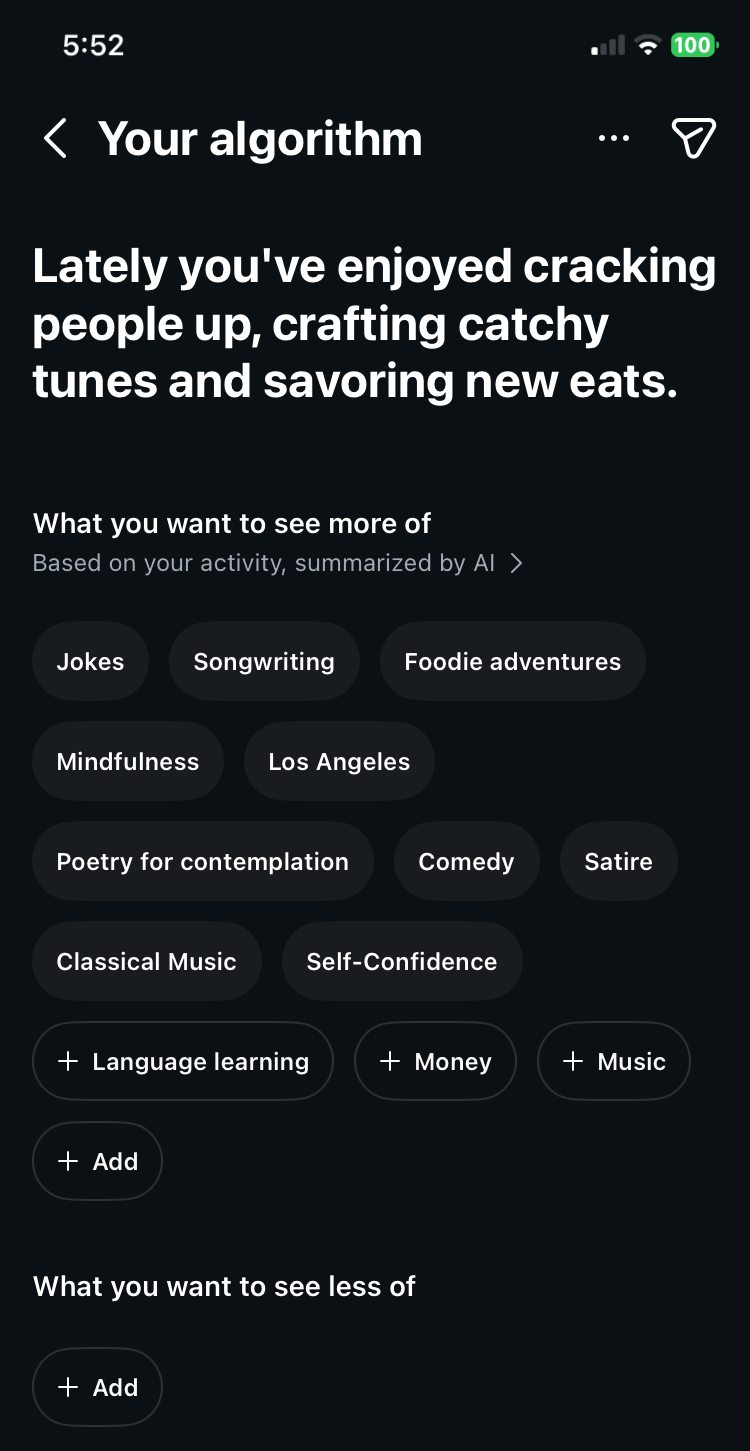
In the announcement, Adam Mosseri noted that Instagram was one of the last major platforms to move to a recommendation-based model, with TikTok launching that way and YouTube shifting years earlier. With users now seeing content from accounts they don't follow, Your Algorithm gives them a way to steer what gets recommended.
Chelsea went in and used the feature when it first rolled out for Reels. The topic suggestions were largely accurate to her interests. She added some, removed others, and noticed immediate changes in the content she was served. Then she never went back. The feature worked, but it wasn't something she felt the need to revisit regularly. She also found that the topic search only works at a broad level; when she tried to add narrow or specific topics, no results appeared. The system uses broad categories rather than granular niches.
That pattern is likely to repeat across most users. Chelsea points out that the average Instagram user probably doesn't know this feature exists. There's been no prominent in-app announcement pushing users to try it, and many people don't even know they can tap the three dots on a post and select “not interested.” Marketers will find it and use it. Most consumers won't.
How to Adapt an Instagram Content Strategy for User-Controlled Algorithms
Chelsea doesn't see Your Algorithm requiring any fundamental strategy changes. The conventional wisdom on Instagram has been to post about the same topic consistently, and accounts that become known for one thing tend to reach more new people through recommendations. That dynamic hasn't changed.
Her advice is to stay focused on audience pain points rather than trying to reverse-engineer Instagram's topic categories. Chelsea emphasizes that the goal isn't creating viral content; it's being viable for the people a brand can actually serve. That means knowing who the audience is, understanding their problems and emotions, and showing how a product or service solves those problems with firsthand experience and a distinct perspective. That approach predates algorithmic recommendations and will outlast any specific feature rollout.
Chelsea also raises an issue with how Instagram categorizes creator content. On her own posts, she's noticed a blue label at the bottom with a magnifying glass and sparkle icon that shows how Instagram's AI categorized the content. Sometimes it's accurate. Sometimes it's wildly wrong, such as labeling a post about personal branding as being about QR codes, despite no mention of QR codes in the video, text, or caption. She's tried using keywords, hashtags, and on-screen text to signal her topic, and the categorization still varies.
Adding to the picture, Chelsea recently noticed a new feature appearing on other people's Reels: a two-line icon that, when tapped, displays an AI-generated summary of what the content is about. She sees this as a signal that Instagram is investing further in automated content understanding, even if the accuracy isn't consistent yet.
This inconsistency suggests the system isn't reliable enough yet for creators to optimize around it. Chelsea recommends sticking with content pillars, talking about products, addressing specific audiences, and answering pain-point questions. If the content strategy is already built around a clear niche, there's no need to overhaul it because of Your Algorithm.
3 Days of World-Class Training—Zero Travel!

Couldn't make it to Social Media Marketing World and AI Business World this year? Get all of the great content at a fraction of the price with a Virtual ticket.
That’s full access to recordings of every keynote, workshop, and session—the ones people travel thousands of miles to see. Don't wait. Get your Virtual ticket and enjoy actionable content that you can watch anytime, anywhere.
For brands worried about niche topics being too narrow for the algorithm to recognize, Chelsea's advice is to keep going. Even if a topic doesn't appear in the algorithm's category list, the audience is still there, and the content still serves them.
#3: Instants: Instagram's Disappearing Photo Feature
Instagram has launched Instants, a real-time disappearing photo feature. Users take a photo in the moment, it posts immediately with no option to retake, and it disappears after someone views it. All Instants automatically expire after 24 hours. There's no uploading from the camera roll and no advanced editing tools. Instagram also has a dedicated standalone app called the Instants App.
Chelsea hasn't used the feature and says she likely won't. Her resistance is rooted in user experience, not the concept itself. When Instants first appeared, it cluttered her DM inbox with a large photo prompt. Every time she tried to open a message, she'd accidentally tap the Instant instead. She kept trying to swipe it away, and it kept opening. The placement has since moved further off-screen, suggesting Instagram received similar feedback from other users.
Setting aside the UX friction, Chelsea sees potential marketing applications. Flash sales, live event coverage, and in-the-moment behind-the-scenes content could work well in a format designed for urgency and authenticity. The feature also lives in the inbox, which Chelsea notes is one place people consistently check. That placement gives Instants a visibility advantage over Stories, which users might scroll past. There's also a bridge between the two formats: users can take a collection of their Instants and turn it into an Instagram Story, connecting the spontaneous format to the broader Stories strategy.
Why Instagram Instants Likely Isn't a Priority for Most Marketers
The landing page for Instagram's Instants announcement features exclusively young people, and the standalone app targets a younger demographic. Chelsea draws a comparison to BeReal, the app that prompted users to take unedited front-and-rear camera photos at a random time each day. BeReal surged in popularity, then faded for most users.
Instagram has tried disappearing content formats before with a separate app. Notes, another feature aimed at younger users, was pushed heavily but didn't catch on broadly. Chelsea predicts Instants will follow a similar trajectory. The platform already feels overwhelming with the number of surfaces and content types available, and adding another format doesn't simplify the experience for marketers or users.
Chelsea's verdict: Instants will probably stick around for a while, but she'd be surprised if it becomes a major marketing channel. The concept of unedited, in-the-moment content has proven appeal, but it hasn't translated to mass adoption on Instagram specifically. For marketers inclined to experiment, the early-adopter logic applies: new features have historically received algorithmic favor, and trying it costs nothing. But it shouldn't displace time spent on formats with proven results.
Users can delete an Instant after posting it, which addresses the concern about accidental posts. But the lack of a retake option means brands using Instants need to accept the raw, unpolished nature of the format as a feature rather than a limitation.
#4: Episodic Reels Series and the Power of Playlist-Style Content
Meta is testing a series feature that lets creators organize Reels into episodic collections on both Instagram and Facebook. Each Reel in a series becomes an episode within a dedicated hub on the creator's profile. Viewers who discover a single episode in their feed or the Reels tab can navigate to the full series and save it for later viewing. The feature is still rolling out to select creators and isn't universally available yet. Once live, series will appear as a dedicated section on the creator's profile, adding another tab alongside existing content views.
Chelsea says creators and marketers have wanted something like this since roughly 2017. Instagram has attempted similar functionality before. IGTV introduced series capability around 2019, but the experience was clunky. Guides offered another way to group content, but never gained traction. The current series feature, built around how users already consume Reels, feels like a more natural fit.
Series as a Conversion Tool
The Instagram content funnel framework that emerged throughout the discussion maps clearly onto this feature. Reels serve as top of funnel, attracting new audiences through the recommendation engine. Instagram Stories function as middle of funnel, nurturing followers through daily, unedited connection. Reels series adds a bottom-of-funnel layer, turning casual viewers into buyers.
Chelsea describes her own experience as a consumer watching a product-based creator's playlist on another platform. She went through all 32 episodes, researching the products, watching demonstrations, and reading through the creator's expertise before making a purchase. That behavior, binge-watching themed content before buying, is exactly what series enables on Instagram.
For product-based businesses, a series could function as an FAQ, with each episode overcoming a specific objection or demonstrating a use case. For service-based businesses, a how-to series establishes expertise and builds digital trust, the credibility that accumulates when a potential client sees the depth and consistency of someone's content.
How to Build an Instagram Reels Series From Existing Content
Brands don't need to create new content from scratch. Chelsea recommends looking at existing Reels for how-tos, reviews, comparisons, step-by-step processes, educational explainers, FAQs, and answers to questions customers should be asking. Existing content that fits a theme can be grouped into a playlist immediately once the feature becomes available.
Customer-generated content is another strong candidate. A series featuring multiple customers sharing their experiences with a product or service creates social proof in a binge-worthy format. Chelsea notes that she personally looks for this kind of content when making purchasing decisions and finds it more persuasive when she can see multiple perspectives in one place.
The watch-time implications are significant. On YouTube, Chelsea notes, a viewer might watch three 10-minute videos in a row and spend 30 minutes with a creator. Series brings that same potential to Instagram. Longer-form content is also being tested on the platform, and the series feature may be laying groundwork for that expansion. Instagram has been trying to make longer content work for years, and organizing it into bingeable collections could be the format that finally sticks.
Chelsea also notes the value of older content within a series. Watching how a creator's perspective on a topic evolved over months or years adds depth and demonstrates sustained expertise, something a single Reel can't convey.
Chelsea Peitz teaches sales professionals how to leverage social media and technology to build a personal brand and generate real leads. She is the host of The Chelsea Peitz Podcast and the author of What to Post. Follow her on Instagram.
Other Notes From This Episode
Connect with Michael Stelzner @Stelzner on Instagram and @Mike_Stelzner on X. Connect with Jerry Potter on LinkedIn and YouTube. Watch this interview and other exclusive content from Social Media Examiner on YouTube.Where to subscribe: Apple Podcasts | Spotify | YouTube Music | YouTube | Amazon Music | RSS
✋🏽 If you enjoyed this episode of the Social Media Marketing podcast, please head over to Apple Podcasts, leave a rating, write a review, and subscribe.
Stay Up-to-Date: Get New Marketing Articles Delivered to You!
Don't miss out on upcoming social media marketing insights and strategies! Sign up to receive notifications when we publish new articles on Social Media Examiner. Our expertly crafted content will help you stay ahead of the curve and drive results for your business. Click the link below to sign up now and receive our annual report!

Curious About How to Use AI?
Our newest show, AI Explored, might be just what you're looking for. It's for marketers, creators, and entrepreneurs who want to understand how to use AI in their business.
It's hosted by Michael Stelzner and explores this exciting new frontier in easy-to-understand terms.
Pull up your favorite podcast app and search for AI Explored. Or click the button below for more information.










_2.png)





.jpg&h=630&w=1200&q=100&v=7abd35f457&c=1)