Living Images
Inside a Cologne exhibition that treats devotional objects as unfinished until they’re used The post Living Images appeared first on Tricycle: The Buddhist Review.
 JimMin

An exhibition at the Museum of East Asian Art in Cologne makes a plain but pointed claim: These objects were never simply meant to be looked at. “Living Images,” curated by Petra Rösch, the museum’s curator of Korean and Buddhist art, gathers ritual paintings, sculptures, and calligraphy from China, Japan, and Korea, most of them medieval, to show what happens before and after a devotional object goes on view—the consecrations, offerings, and ceremonies that activate it as something more than just art.
 Gallery installation with facsimile an 18th-century Korean temple painting | Museum für Ostasiatische Kunst Köln
In Korean, the rite is called Bulbokjang Jakbeop, roughly “enshrining objects in a Buddhist image.” On May 17, 2025, Venerable Gyeongam—a Jogye Order monk recognized as an official successor in this ritual tradition, designated South Korea’s National Intangible Cultural Heritage No. 139—came to the museum with nine other monks. They consecrated a facsimile of the Sermon of Buddha Shakyamuni at Vulture Peak Mountain. The original, an anonymously painted hanging scroll of 1729, is housed at Haein-sa, one of Korea’s most important temples and home to the Tripitaka Koreana, the Buddhist canon carved onto more than 80,000 wooden blocks. The ceremony was part of the exhibition, staged in the museum’s final gallery.
The point of the ritual is to transform the image into an object of worship—to breathe religious life into it so that it can function as an official and sanctified focus of devotion, not merely a representation of one. Here, that image is a crowded celestial assembly, ranked in near-symmetry around a robed Buddha seated cross-legged at its center. To perform the ceremony, Gyeongam observed the five cardinal directions and placed medicines, fragrances, texts, and relics into a consecration bag, his own gift to the museum, now on display. Modest in size and nearly paper-thin, it hangs in a vitrine, its fabric dyed in violets, pinks, and yellows against a pattern of flowers and sky.
“Living Images” fills two adjoining galleries in the Museum of East Asian Art, housed in a building by architect Kunio Maekawa on Cologne’s inner-city lake, the Aachener Weiher, with a Japanese garden designed by sculptor Masayuki Nagare. Near the entrance, the silk gauze rakusu, of a Meiji-era (1868–1912) Zen Buddhist monk, recalls the Korean consecration bag: both spare and minimal, glimmering in their materials.
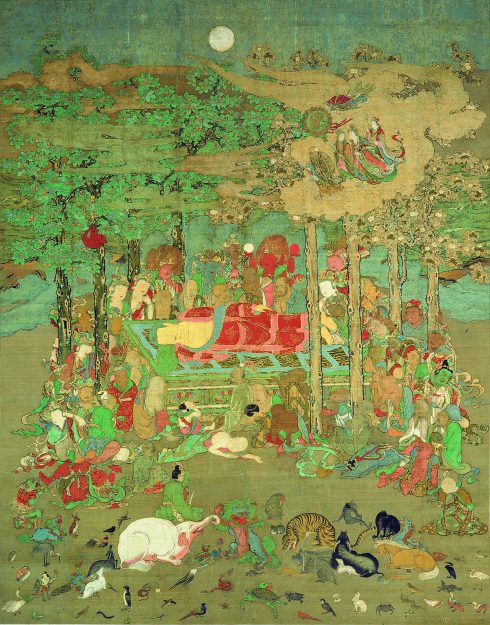 Buddha’s Entry into Complete Nirvana, hanging scroll. Ink and gold on silk, Japan, c. 1392. | Museum für Ostasiatische Kunst Köln
The exhibition opens with a hanging scroll, Buddha’s Entry into Complete Nirvana, a 1392 work from Japan’s Nanbokucho period (1336–1392), painted in ink, color, and gold on silk by an anonymous artist. Acquired by the museum’s founders, Adolf and Frieda Fischer, the painting depicts the death of the historical Buddha Shakyamuni: His reclining body is surrounded by grieving gods, humans, bodhisattvas, animals, hungry ghosts, and demons, while his mother, Maya, looks on from a cloud above withering sala trees. The scene recalls Byzantine depictions of the Dormition of the Virgin, its mourners caught in the same act of letting go that Buddhist teaching holds as a prerequisite to parinirvana.
Paintings of this type are themselves objects of ritual veneration in Japanese temples, displayed on the fifteenth day of the second lunar month to commemorate the Buddha’s death. That afterlife of meaning extends to the museum’s founders. Adolf Fischer died in 1914, only months after the museum opened. Frieda Fischer remarried a Jewish jurist in 1921, a marriage that endangered her under Nazism. In 1937, she was dismissed as museum director, one of the first women in Germany to hold such a position. She died in December 1945. Their names now appear together beneath most of the works on view in “Living Images.”
Rösch’s curation gives the artworks room to hold their own weight—steady and unhurried, the way a devotional object is meant to be approached. The show’s opening paintings give way to a series of figurative sculptures in wood and stone, their faces as lifelike as the ascetics they depict: practitioners who sat for long stretches, bound to the ground beneath them.
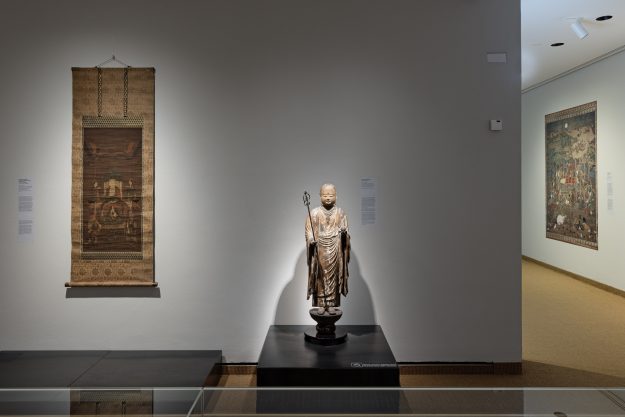 Gallery installation with standing Jizo | Museum für Ostasiatische Kunst Köln
The sculpture Bodhisattva Kshitigarbha (Jizo Bosatsu in Japanese) stands still as a sentinel, made by an anonymous artist c. 1300, during Japan’s Kamakura period (1185–1333). Its surface—hinoki wood, layered with coatings applied over time—has aged like skin: the scalp mottled, yet the figure’s gaze retains an unworn placidity. It looks straight ahead, into a gathering of seven wise men. The series of sculptures titled Seven of the Group of Eighteen Luohan carries the same quality of individualized presence, as if each face had been carved from life: fully expressed, largely unmarked by time, though made in China during the Song dynasty (960–1279).
Luohan is the Chinese term for arhat, a disciple of the Buddha who has reached liberation. In the dim light of Rösch’s installation, it is easy to imagine these sculptures once housed in a cave temple, not unlike the Feilai Feng grottos in Hangzhou, Zhejiang province. The faces retain a human, almost humorous quality even within their devotion: The figures clutch scrolls, their chests bare beneath flowing robes, ribs visible as a mark of the physical austerity of their path.
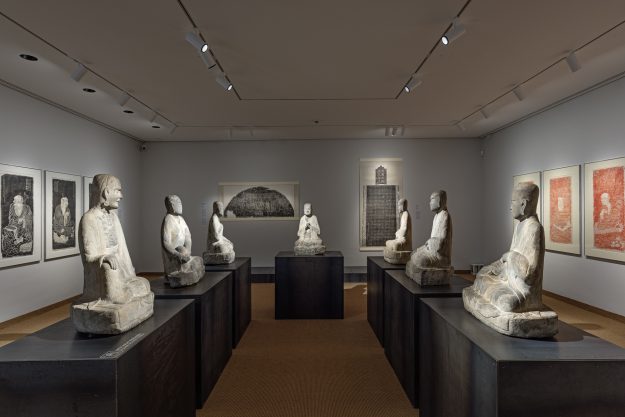 Gallery installation with arhats and stone rubbings | Museum für Ostasiatische Kunst Köln
Around the sculptures, a group of stone rubbings—monochrome inks on paper, some black, others vermilion-red—extends the same subject across a wider span of time, from the 18th century to the second half of the 20th. These aged, eccentric figures leap off the page: hair grown long, ears weighted by rings, eyebrows body-length, nails unclipped, canes in hand, seated on rocks, staring into their fate with the look of men humbled by wisdom.
This attention to ritual detail recurs across the exhibition: the placement of slippers on the floor, the fall of loose-fitting robes, the posture of a seated reader—small gestures understood as aids to mindfulness on the path to awakening. The artists, sculptors, and calligraphers who made these objects were plainly aware of that function. Under glass lies the copy of one chapter of the Great Sutra of Perfected Wisdom, a late-12th-century work from Chuson-ji, made during Japan’s Heian period. Anonymously scribed on blue-dyed paper in gold and silver, its symmetry is precise enough to reward close looking.
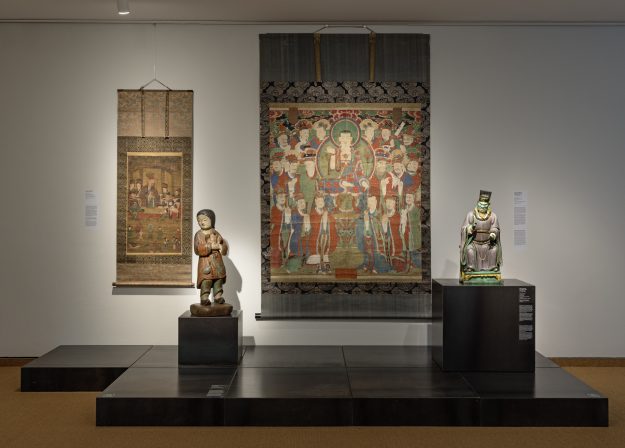 Gallery installation with Bodhisattva Kshitigarbha hanging scroll | Museum für Ostasiatische Kunst Köln
Throughout “Living Images” the human figure recurs—a reminder of the teaching that human birth is itself rare and precious, the one condition in which liberation is possible. Nowhere is this clearer than in a hanging scroll of Bodhisattva Kshitigarbha and the Ten Kings of Hell, a 1764 work from Korea’s Joseon dynasty, painted in ink and color on hemp and coarse silk by an anonymous artist. Kshitigarbha is enthroned at the center, encircled by a dense crowd of attendant figures and judges. The same idea holds in the Edo-period image of Hariti, the Mother of Demons, shown as both a wood sculpture and a hanging scroll. These images depict judgment in explicitly human terms: The stakes of practice are inseparable from the human birth that makes practice possible.
 Hariti (Jp.: Kishobojin), the Mother of Demons, Edo Period. Wood, colors and gold application, Japan, Edo Period (1603—1868). | Museum für Ostasiatische Kunst Köln
These final images return the viewer to where the exhibition began. The last gallery is given over to the Bulbokjang Jakbeop ceremony described above: An object, in the traditions “Living Images” surveys, is not finished when it is made. It becomes what it is through use—consecrated, offered to, and worshipped. Rösch’s curation makes the case, gallery after gallery, that this is the very nature of the art on view.