Scrunch vs Semrush comes down to one question: Do you need a dedicated AI visibility tool, or a full SEO suite that now tracks AI answers too? Scrunch is an AEO specialist built to monitor how your brand appears in AI-generated answers, while Semrush is a traditional SEO platform that added an AI Visibility Toolkit to a stack marketers already use for keyword research, rank tracking, and backlinks.

That gap, specialist versus suite, drives every practical difference that follows: what each costs, how many engines each tracks, how each moves a visibility insight toward published content, and which one fits your team’s size and maturity.
In this guide, I’ll compare both on pricing, monitoring coverage, optimization workflow, and content-delivery risk, then walk through a step-by-step way to choose based on your goals.
Table of Contents
Scrunch vs Semrush: What is the real difference?
Scrunch vs Semrush Pricing and Total Cost of Ownership
Scrunch vs Semrush Features: Monitoring, Auditing, and Optimization
Scrunch vs Semrush: Monitoring or Actionable Optimization
Scrunch vs Semrush: Content Delivery and AEO Risks
Scrunch vs Semrush: Who is each best for?
Scrunch vs Semrush: Alternatives to Consider
How to Structure Content for AI Visibility Without Risk
How to Choose Between Scrunch and Semrush Based on Your Goals
Frequently Asked Questions About Scrunch vs Semrush
Scrunch vs Semrush: What is the real difference?
Scrunch is an AEO-specific tool focused on how your brand appears in AI answers, while Semrush is a broader platform that covers traditional SEO and adds an AI Visibility Toolkit. In short, Scrunch has AEO features but not SEO features, while Semrush has both SEO and AEO features.
Source
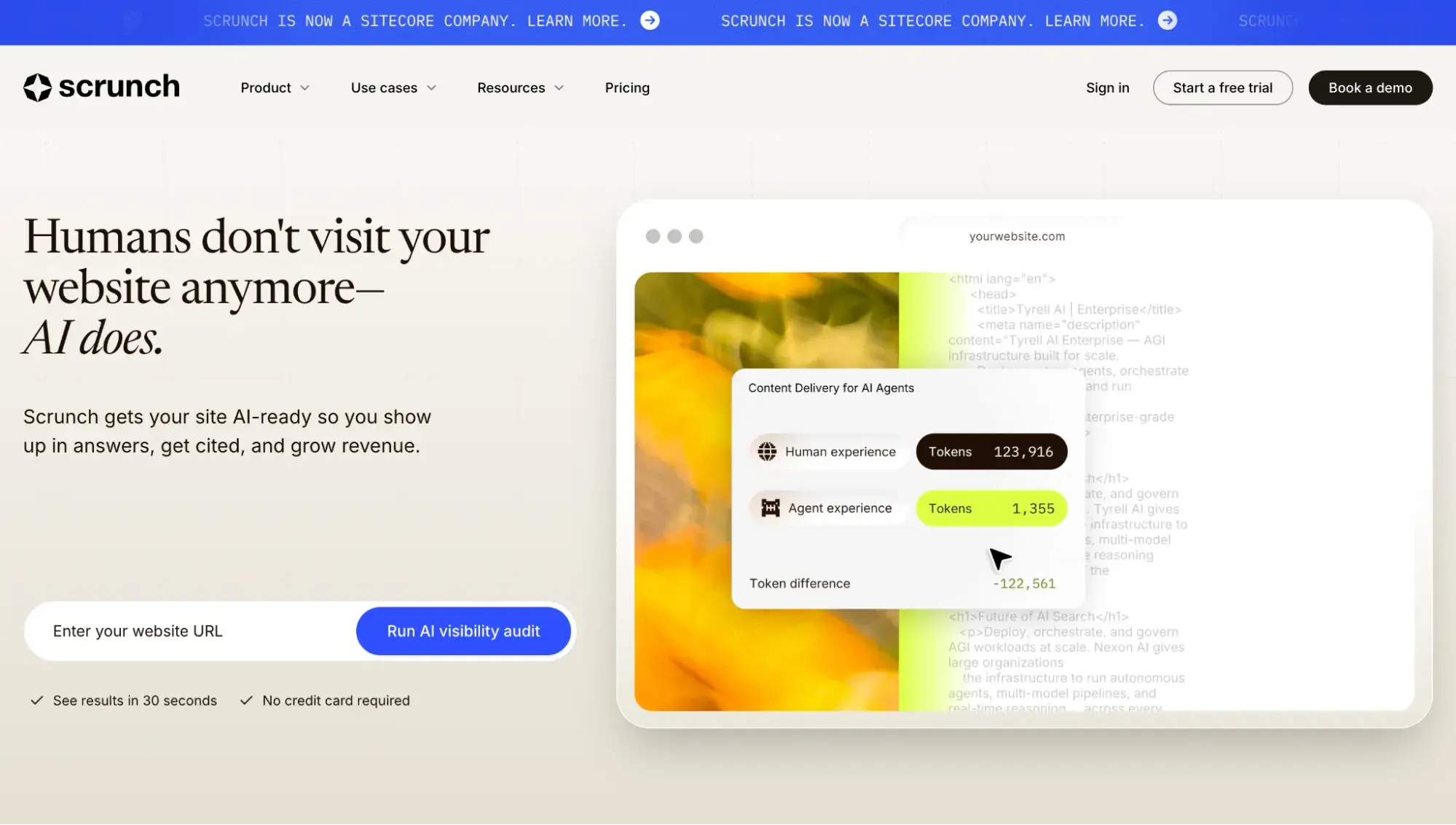
Scrunch dubs itself “The AI Customer Experience Platform.” Functionally, it’s an AI visibility platform that monitors brand presence, position, sentiment, citations, and share of voice across as many as nine answer engines on its Enterprise plan. Its self-serve Core and Agency Core plans track four: ChatGPT, Perplexity, Google AI Overviews, and Copilot.
Source
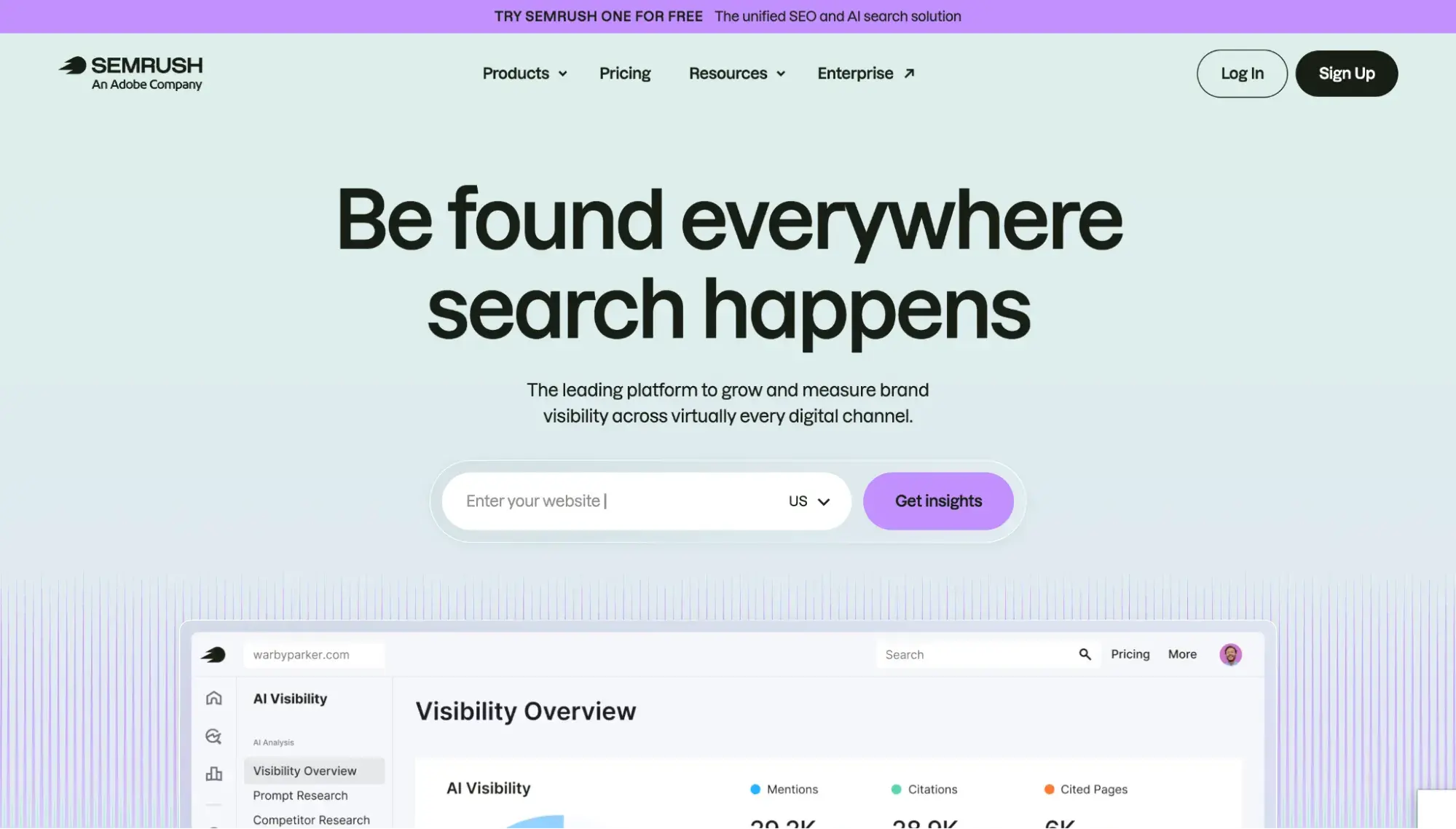
Semrush describes itself as a “brand visibility management platform“ spanning “SEO, AI search, content marketing, and paid media.” Most teams know it for traditional SEO features: keyword analysis, rank tracking, audits, and backlinks. Semrush’s AEO features live in a dedicated AI Visibility Toolkit that can be purchased as a standalone tool or bundled with the SEO Toolkit.
So the difference between Scrunch and Semrush comes down to specialization versus breadth. Notably, neither vendor frames AEO as a replacement for SEO.
Before committing to either, it helps to know where your brand stands in AI answers right now. HubSpot’s AEO Grader gives you a quick, free read on your AI search visibility so you can choose a tool against a real baseline instead of a guess.
| |
Scrunch
|
Semrush
|
|
Self-described category
|
"The AI Customer Experience Platform"
|
"Brand visibility management platform"
|
|
Primary focus
|
AI visibility/AEO
|
All-in-one suite with AI visibility built in
|
|
Traditional SEO depth
|
Complements SEO tools; does not have SEO features itself
|
Deep (rank tracking, audits, backlinks, keywords)
|
|
AI answer monitoring
|
Core product; nine engines tracked
|
One toolkit within the broader suite; five engines on self-serve plans (Google AI Overviews, AI Mode, ChatGPT, Perplexity, Gemini), expanding to nine on the custom Enterprise AIO tier (adds Claude, Copilot, Grok, DeepSeek)
|
|
Stance on SEO
|
Complements, does not replace
|
Adds to, does not replace
|
|
Best fit
|
Teams adding a dedicated AI-answer layer to an existing stack
|
Teams wanting SEO and AI visibility in one platform
|
|
Decision shorthand
|
AI visibility-first: Add alongside your SEO stack
|
SEO and AEO: One suite for both
|
Scrunch vs Semrush Pricing and Total Cost of Ownership
Scrunch sells AI visibility as a standalone subscription. Semrush sells SEO and offers AI visibility as an add-on or a bundle.
|
Plan
|
Monthly price
|
Seats
|
Brand workspaces
|
Prompts tracked
|
Engines
|
Free trial
|
|
Core
|
$250
|
5 licenses
|
1
|
125
|
4
|
7-day, self-serve
|
|
Agency Core
|
$500
|
Unlimited
|
3
|
250
|
4
|
—
|
|
Enterprise
|
Custom
|
Custom
|
Custom
|
Custom
|
9
|
Contact sales
|
|
Plan
|
Monthly price
|
Seats
|
Websites/domains
|
Prompts tracked
|
Engines
|
Free trial
|
|
AI Visibility Toolkit (add-on)
|
$99 + SEO Classic from $139.95
|
Main user (+$99/subuser)
|
1 domain (Brand Performance)
|
25 (+50 for $60/mo)
|
5
|
No trial on standalone add-on
|
|
Semrush One – Starter
|
$199
|
Main user (+$99/subuser)
|
5
|
50
|
5
|
7-day
|
|
Semrush One – Pro+
|
$299
|
Main user (+$99/subuser)
|
15
|
100
|
5
|
7-day
|
|
Semrush One – Advanced
|
$549
|
Main user (+$99/subuser)
|
40
|
200
|
5
|
7-day
|
|
Semrush for Enterprise
|
Custom
|
Custom
|
Custom
|
15,000
|
9
|
Contact sales
|
The $99 AI Visibility Toolkit is a standalone subscription covering AEO monitoring only, with no rank tracking or backlinks. To run SEO alongside it, add a separate SEO Toolkit subscription or move to Semrush One, which bundles both.
Budget factors to price out:
Seats: Scrunch Core includes 5; Semrush charges $99 per added subuser.
Domains: Scrunch Core covers 1 brand; Semrush adds Brand Performance domains at $99 each per month.
Prompts: The Semrush add-on tracks 25 prompts; 50 more cost $60/month.
Total cost depends on seats, domains, prompts, and engine needs, not list price alone.
Best for: For coverage beyond five engines, both vendors’ Enterprise tiers reach nine. Scrunch Enterprise is the only one that includes Meta AI; Semrush’s Enterprise AIO is the only one that includes DeepSeek.
Scrunch vs Semrush Features: Monitoring, Auditing, and Optimization
Monitoring Coverage: What Each Tool Tracks
Scrunch’s approach: Scrunch monitors up to nine answer engines on Enterprise (ChatGPT, Claude, Perplexity, Gemini, Meta AI, Google AI Mode, AI Overviews, Microsoft Copilot, Grok). It is prompt-native, estimating volume at the topic level, which it defines as clusters of related prompts. Scrunch refreshes new prompts daily for 14 days, then every 72 hours, with on-demand pulls. It benchmarks competitors on share of voice, gaps, and citations, and labels sentiment as positive, mixed, or negative.
Semrush’s approach: The AI Visibility Toolkit tracks five engines (Google AI Mode, AI Overviews, ChatGPT, Perplexity, and Gemini). Those five hold across its self-serve plans. The custom Enterprise tier expands coverage to nine engines, adding Claude, Microsoft Copilot, Grok, and DeepSeek, plus daily prompt tracking of up to 15,000.
Semrush frames the work as prompt and topic research, updates its core reports daily and Brand Performance weekly, benchmarks competitors on the same axes, and labels sentiment as favorable versus neutral. Like Scrunch, Semrush sizes AI search volume at the topic level rather than per prompt, with its Prompt Research report estimating demand for related topic clusters from a database of 289 million-plus AI queries.
Winner for engine coverage: Semrush, narrowly. At the entry tiers most buyers compare, Semrush tracks five engines to Scrunch’s four, including Gemini and Google AI Mode, which Scrunch’s Core and Agency Core plans skip. Scrunch’s lone entry-level edge there is Copilot. At the top end, the two converge: Both track nine engines, with Semrush’s Enterprise tier reaching ChatGPT, Gemini, Google AI Overviews, Google AI Mode, Perplexity, Claude, Copilot, Grok, and DeepSeek. The only engine Scrunch covers that Semrush does not, at any tier, is Meta AI; the only engine Semrush covers that Scrunch does not is DeepSeek.
Auditing and Optimization
Scrunch’s approach: Scrunch turns gaps into content briefs you hand to your team or paste into ChatGPT or Claude, and pushes data outward through a Data API, Looker Studio, GA4, and Adobe Analytics.
Semrush’s approach: Semrush keeps AI visibility inside Semrush One, where the toolkit shares projects, data, and reporting with the SEO Toolkit, so rank tracking, site audits, and AI visibility sit in one login. Its Prompt Research report can push a topic into the Content Toolkit in one click to start a draft, and its AI Search Site Audit brings SEO-style crawl checks into the AI workflow.
Whichever tool surfaces the brief, acting on it is often the hard part. Breeze Agents by HubSpot can generate blog titles, outlines, and full post drafts inside HubSpot, helping teams move flagged content gaps into production with less context-switching.
Winner for in-platform execution: Semrush. One-click drafting inside the suite beats Scrunch’s hand-off. But if you would rather route AEO data into an existing analytics and content stack, that’s where Scrunch’s open integrations win (for example, you can use Scrunch’s MCP to find citation gaps and then have it instruct Claude to generate blog posts based on that).
Scrunch vs Semrush: Monitoring or Actionable Optimization
Scrunch’s approach: Scrunch keeps a human in the loop. Its Content Gaps feature flags prompts where you’re absent, then hands the call back to you. As Scrunch frames it, “You decide what’s worth acting on.” You pick the format, Scrunch generates the brief, and you execute. To re-measure, Scrunch suggests checking back after 30 to 60 days to confirm that a citation gap has closed.
Semrush’s approach: Semrush leans toward automated recommendations. Its Brand Performance reports surface “AI Strategic Opportunities” and convert your data into a suggested action plan. To re-measure, its Prompt Tracking logs daily visibility changes, so you can tie a content update to a movement.
The execution loop runs the same regardless of tool: Audit the answers you’re cited in, find the gap, update or create content, then re-measure. Where both Scrunch and Semrush stop is publishing. Each gets you to a brief or draft, not a live, governed page. With HubSpot’s Content Hub, however, you can create, manage, and publish that content in one place.
Winner for turning insight into action: Semrush. Auto-generated recommendations and one-click drafting move faster, unless you want the final call on every gap, where Scrunch’s review-first model fits better.
Scrunch vs Semrush: Content Delivery and AEO Risks
Scrunch’s approach: Beyond monitoring, Scrunch’s Enterprise plan adds the Agent Experience Platform (AXP), a content-delivery layer that sits at your CDN and returns a separate, simplified version of each page to AI bots while human visitors see your normal site. In plain terms, you get two versions of a page: one for people, one for machines.
Note: This is not the same thing as llms.txt, which Scrunch says it does not use. Additionally, Scrunch does not serve the bot-friendly version of a page to Google crawlers, so it shouldn’t affect traditional search indexing.
Semrush’s approach: Semrush offers no equivalent bot-serving layer. Its optimization work happens on the live, user-facing page through the Content Toolkit and Site Audit, so the content people read is the content AI systems retrieve.
Personally, I can see how using Scrunch’s AXP would make a website owner nervous. Showing AI bots one version of a page and human visitors another resembles cloaking, the practice Google acts against when a site feeds its crawler different content than people see. The key distinction is which crawler is involved: AXP serves its alternate version to AI assistant crawlers, not to Googlebot, and Scrunch says it never serves the bot version to Google search crawlers. By that account, AXP falls outside Google’s cloaking rule, which governs Google’s own crawler, and shouldn’t change what Google indexes. Scrunch defends its approach directly, arguing it isn’t deceptive because the AI version “reflects the same intent” as the page people read.
The lower-risk path is to create one page for both audiences at once. Scrunch’s own citation guidance points in the same direction: Lead each page with a direct answer, use question-matching headers, and add factual specificity. Structured data, scannable formatting, and authoritative external links help machines parse a page without a parallel version. Content built this way stays legible to readers and extractable by AI, with no second layer required.
Winner for low-risk delivery: Semrush. It optimizes one page for every audience, avoiding the duplicate-content exposure AXP potentially introduces. Still, AXP is Enterprise-only and optional, so many Scrunch buyers never touch it.
Scrunch vs Semrush: Who is each best for?
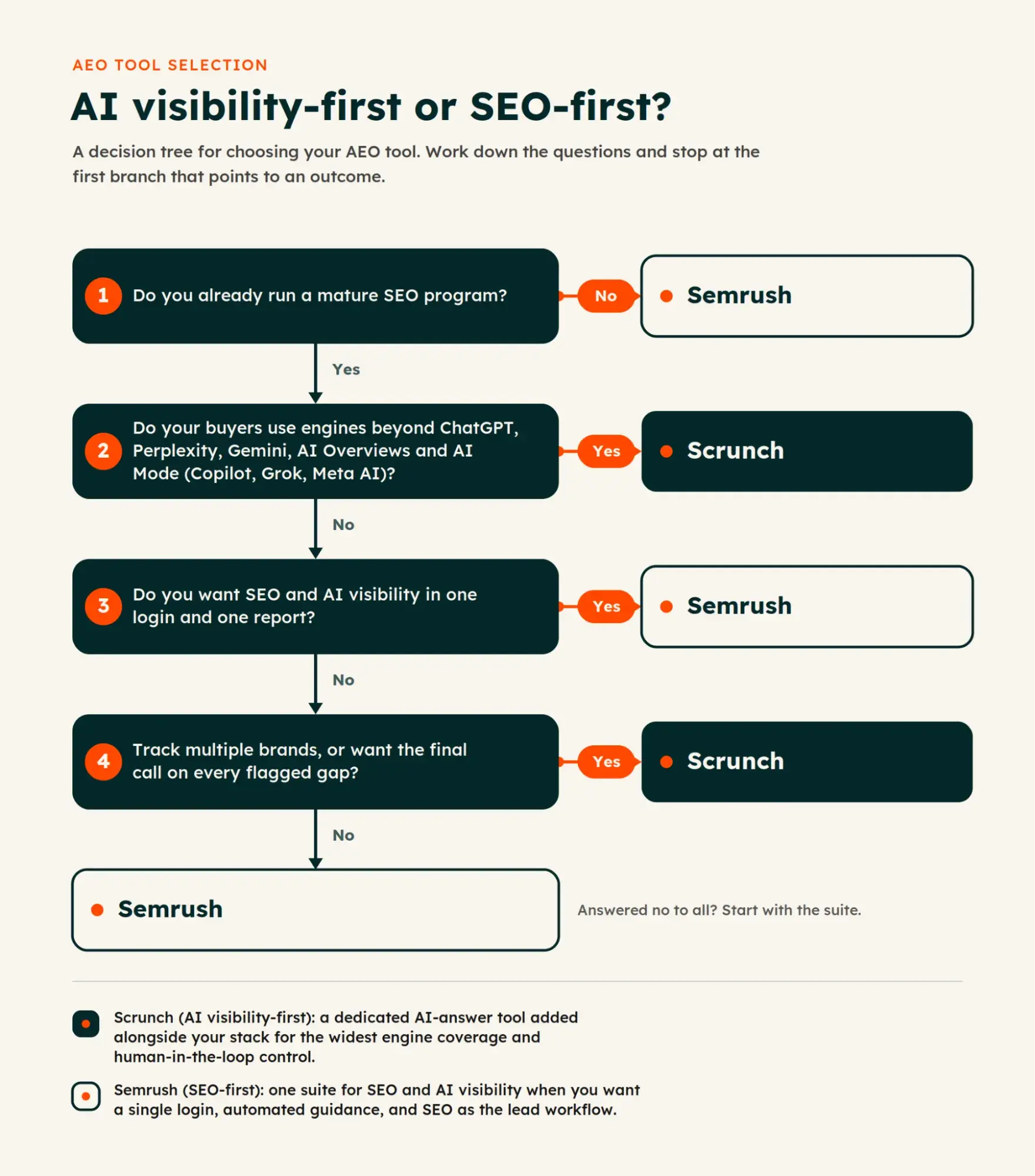
Three buyer profiles map cleanly to these tools: AI visibility-first teams, SEO suite-first teams, and teams that need both.
Best for Scrunch: Teams already running a mature SEO program who want to add a dedicated AI-answer layer without rebuilding their stack. Agencies fit here, too, since Agency Core covers multiple brand workspaces and unlimited seats. Scrunch also suits teams that prefer a human-in-the-loop model, where a person decides which gaps are worth acting on before anything moves into production, or that specifically need Meta AI tracking, the one engine Semrush doesn’t cover at any tier. Scrunch has an AI Referrals tab where you can track revenue and conversions from AI visibility if you connect your GA4 account.
Best for Semrush: Leaner teams that would rather run SEO and AI visibility from one login than manage two subscriptions. It fits teams that still lead with rank tracking, audits, and backlinks, and treat AI visibility as one report inside that workflow rather than the main event. Buyers who prefer automated recommendations over a review-first model land here as well. Semrush has a “My Reports” tool where you can connect your GA4 data and use the “AI Referral” Traffic Channel filter to see revenue data.
Use this decision matrix to match priorities to the better pick:
|
Your priority
|
Better pick
|
|
Most AI engines at entry-level pricing
|
Semrush
|
|
Meta AI tracking specifically
|
Scrunch
|
|
Rank tracking, audits, and keyword research
|
Semrush
|
|
Backlink analysis
|
Semrush
|
|
Content ops tied to AI insights
|
Semrush
|
|
SEO and AEO reporting in one platform
|
Semrush
|
|
Routing AI data into an existing analytics stack
|
Scrunch
|
|
Connecting AI visibility to revenue
|
Scrunch
|
Looking for a tool that strongly connects content to revenue? HubSpot’s Marketing Hub connects content performance to campaign automation, attribution, and reporting, so an AI visibility gain can be traced to the deals it influences rather than measured in citations alone.
Scrunch vs Semrush: Alternatives to Consider
Scrunch and Semrush are not the only tools for tracking AI visibility. If neither fits your budget, team, or focus, the strongest alternatives sort into three groups that differ depending on what you need most.
Enterprise AI Visibility Platforms
Profound monitors brand presence across ChatGPT, Gemini, Claude, Perplexity, and other engines, and targets large brands with dedicated marketing teams.
AthenaHQ calls itself “the command center for AEO and GEO,” tracking eight engines on every plan and pairing monitoring with prescriptive content recommendations.
Best for: Larger teams that need depth, governance, and the widest engine coverage
Focused, Reporting-First Trackers
Peec AI keeps its scope on AI search analytics and reporting, with a Looker Studio connector that feeds visibility data into existing dashboards.
Otterly AI centers on answer engine optimization, pairing daily citation monitoring with on-page audits that flag specific fixes.
Best for: Teams that want clean visibility data without a heavier suite
AEO Built Into Your Marketing Stack
HubSpot AEO starts at $50 per month and tracks brand visibility across ChatGPT, Gemini, and Perplexity. The same tooling is built into Marketing Hub Professional and Enterprise, where it draws on your CRM data to sharpen recommendations.
Best for: HubSpot users who want AEO tied to the content and customer data they already have
Whichever tool you shortlist, the visibility data is only as useful as what you publish next. The structural choices that make a page extractable matter regardless of the platform.
How to Structure Content for AI Visibility Without Risk
We talked about a lower-risk route earlier: optimizing one page for both readers and answer engines instead of serving bots a separate version. So let’s now cover how to structure content to be AEO-friendly.
Run flagged pages through this checklist before you republish:
Lead with the answer. Put the direct response to the target query in the opening line, not four paragraphs down.
Match headings to questions. Phrase H2s and H3s the way buyers ask the question, so an engine can map a query to a section and lift the passage beneath it.
Keep entity names consistent. Use one spelling for your brand, products, authors, and executives across your own site and your third-party profiles, so engines resolve every mention to the same entity.
State your sources. Attribute your data, name the study or document behind each claim, and link to it. Factual specificity gives an engine a reason to cite you over a vaguer competitor.
Write self-contained passages. Ensure each key paragraph can stand on its own if an engine extracts it apart from the surrounding page.
Built this way, a page stays legible to readers and extractable by AI with no parallel bot-only version, which avoids the duplicate-content exposure an AXP-style layer might introduce.
The measurement loop is the one named earlier: Audit the answers you’re cited in, find the gaps, update or create the content, then re-check after a refresh cycle. Getting a fix from brief to live page is usually the slow step. Marketers can use HubSpot’s content operations platform to draft, approve, and publish in one place to save time.
How to Choose Between Scrunch and Semrush Based on Your Goals
Before you structure a page for citations, you need to pick the tool that surfaces which pages to fix. Here’s how to choose based on your goals rather than starting from a feature list.
Assess where you stand today. Get a baseline before you compare anything. HubSpot’s free AEO Grader scores how answer engines currently represent your brand so you can check AI search visibility against real data instead of a hunch. Scrunch runs an AI visibility audit with no credit card required, and Semrush’s free plan shows where AI answers mention and cite your brand, plus an overall visibility score.
Define your goal, then read it from the matrix. Decide whether AI share of voice, traditional SEO depth, or both lead your priorities. The fit matrix earlier in this guide under “Scrunch vs Semrush: Who is each best for?” already maps each priority to the stronger pick, so revisit it if needed.
Confirm budget and seats. Price the entry point for your team, not the list price. Scrunch’s Core plan covers five seats for $250 per month; Semrush’s AI Visibility Toolkit starts at $99 per month as an add-on, with each extra seat billed separately. The cheaper option depends on how many people need access and how many brands you track, which the pricing breakdown earlier covers in full.
Trial, then validate. Scrunch’s self-serve Core plan comes with a 7-day free trial. Semrush’s standalone AI Visibility Toolkit has no free trial, though a free account can run a limited 7-day Semrush One trial. Use the window for one thing: Confirm the tool tracks the engines and prompts your buyers actually use before you pay.
Three fast paths:
Keep Semrush, add Scrunch. Best if your SEO program is mature and you want the widest engine coverage as a separate layer. The two run in parallel, since Scrunch complements an SEO suite rather than replacing it.
Use Semrush for both SEO and AI visibility. Best if you track a single brand and want both toolsets under one login. If you already pay for Semrush’s SEO Toolkit (from $139.95 per month), adding the AI Visibility Toolkit at $99 per month is the cheapest way to layer on AEO tracking. Bought on its own, that $99 toolkit covers AEO monitoring only, with no traditional SEO features, so a buyer starting from scratch who wants both should pick Semrush One, which bundles the two toolkits from $199 per month.
Lead with a specialized AI visibility tool. Best if AI answers are your primary channel and SEO is secondary. Start on Scrunch’s Core plan and layer in SEO tooling later.
Frequently Asked Questions About Scrunch vs Semrush
Do I need Scrunch if I already use Semrush?
Maybe not. Semrush’s AI Visibility Toolkit monitors five engines on its self-serve plans and shares data with your SEO workflow, so if your buyers stick to those engines, the toolkit may cover you. Its custom Enterprise tier closes most of the remaining gap, tracking nine engines that include Claude, Copilot, Grok, and DeepSeek. The one engine Scrunch covers that Semrush doesn’t, at any tier, is Meta AI. Scrunch still positions itself as a complement, not a replacement.
How do I measure AI visibility without changing my SEO stack?
Route the data out instead of switching tools. Both connect to Looker Studio, but through different paths: Scrunch via a Data Studio Community Connector on Enterprise, and Semrush via its own native Looker Studio connector on any paid plan. The two also handle GA4 differently. Scrunch reads your GA4 data in through an OAuth connection and displays AI-referred sessions and revenue inside its AI Referrals dashboard, rather than writing anything back to GA4. Semrush surfaces GA4 data in My Reports, its in-platform report builder, where an “AI Referral” filter isolates AI-driven sessions and conversions. Each also offers an API: Scrunch on Enterprise, Semrush on Business and above.
What are Scrunch AI competitors?
Scrunch competes with AEO tools rather than full SEO suites. Its closest alternatives include HubSpot AEO, Semrush’s AI Visibility Toolkit, Profound, AthenaHQ, Peec AI, and Otterly AI. Scrunch’s own materials don’t name competitors directly; it describes itself as “The AI Customer Experience Platform,” which sets it apart from rank-tracking suites.
When should I use Semrush’s AI Toolkit instead of a separate AI visibility platform?
Choose Semrush One when you want SEO and AI visibility in one login or if you already use Semrush for SEO. It shares projects and data with Position Tracking, Site Audit, and the Content Toolkit, so AI insights sit beside rank tracking and audits. Semrush builds it for SMBs, agencies, and mid-market teams that treat AI visibility as one report inside an existing SEO workflow rather than a standalone discipline.
How do I tie AI visibility gains to pipeline impact?
Connect AI visibility data to revenue reporting. Scrunch’s AI Referrals tab links to GA4 to track AI purchase revenue and conversion rates, and Semrush’s “My Reports” adds an “AI Referral” filter on any paid plan. Neither documents native pipeline or CRM reporting. AEO in HubSpot Marketing Hub connects citation data directly to CRM records, allowing teams to trace answer engine visibility from prompt to site visit to lead and pipeline.

 MikeTyes