
SEO Forecasting: How to Predict Your Traffic in an AI Era
Key Takeaways When it comes to SEO, forecasting can be a tricky concept. You’re trying to predict the future of your website’s traffic and it can be difficult to know which metrics to focus on. It can also be...
 Kass
Kass
Key Takeaways
SEO forecasting still matters, but the inputs and outputs have changed. AI Overviews and zero-click behavior are absorbing demand that used to produce clicks. Forecasts built on pre-AI assumptions will now overstate expected traffic. The modern forecasting model is probabilistic and scenario-based, not linear. Express outputs as ranges across conservative, expected, and aggressive cases. Influence metrics are the bridge that translate SEO visibility into business value. Examples of influence metrics include branded search demand growth, CTR behavior and conversion rates. A 90-180 day SEO forecast is only as accurate as its inputs. AI citations, branded search growth, and share of voice are the inputs that matter most.When it comes to SEO, forecasting can be a tricky concept.
You’re trying to predict the future of your website’s traffic and it can be difficult to know which metrics to focus on. It can also be difficult to know if the metrics you selected are giving you and your team a clear picture.
That picture has gotten harder to read. AI Overviews, zero-click behavior, and LLM-referred traffic have changed what SEO forecasts need to measure and how the results need to be presented.
This is why many SEO forecasts are starting to break down. Rankings may improve while clicks flatten. Traffic may increase without revenue following. And visibility may influence demand long before a user ever lands on your site. Modern SEO forecasting needs to explain that disconnect, not hide it.
In this article, we’ll discuss what SEO forecasting is, and where it is and isn’t effective. We’ll also look at the different types of forecasting you can use, as well as the pros and cons of each method. Finally, we’ll cover some of the overall limitations of SEO forecasting as a concept, and what you may want to consider instead.
Let’s start by discussing the potential value of SEO forecasting in the first place.
What Is SEO Forecasting and Why Does It Matter?
SEO forecasting is the practice of predicting and estimating changes in your website’s search engine visibility. This includes factors such as organic traffic, keyword rankings, and more. By trying to predict the future, you can plan ahead and make educated decisions about how to best optimize your website for search engine results pages (SERPs).
For example, let’s say you noticed that your website is losing traffic due to changes in the SERPs. In this case, you may try to use SEO forecasting to help you identify potential issues and strategize how to improve your website’s visibility.
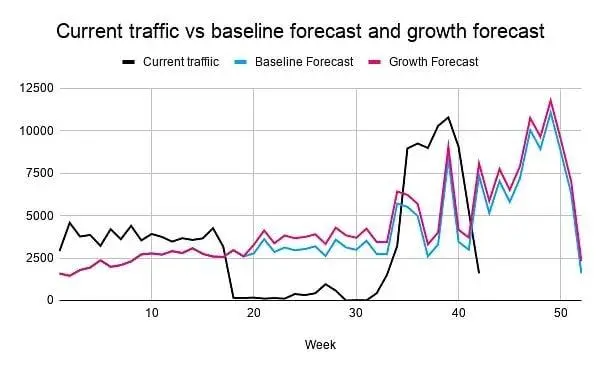
Knowing where your website stands in terms of SEO today is important, but understanding where it’s going in the future is even more critical. With SEO forecasting, in theory, you can identify potential problems and take action to address them before they become a reality. This could include creating content around specific topics or introducing new strategies like link building.
Source:
SimplilearnWhen used in the right context, SEO forecasting can help give you an idea of performance over time, so you can track progress and adjust as needed. It may also help you stay ahead of the competition and ensure your website is always optimized for success.
With that said, whenever someone asks my NP Digital team about forecasting, we always try to provide a clear picture of what forecasting can and can’t do.
An SEO forecast isn’t going to magically predict the entire future landscape for you. There are too many factors to consider, from seasonality to greater economic trends, that can affect your organic growth and won’t get tracked in any forecast.
So when we talk about SEO forecasting and its benefits, they are best served to help you make decisions, not be your sole source of truth. In addition, if you decide to use them, that needs to be done alongside general best practices like experience, expertise, authoritativeness, and trustworthiness (E-E-A-T), as well as your previous successes or struggles.
Remember, you can’t truly pinpoint search performance until after the fact, which applies to just about any marketing context, really.
The search landscape has also changed materially since most forecasting frameworks were built. AI Overviews, zero-click behavior, and LLM-referred traffic all affect how rankings translate to traffic and how traffic translates to revenue. A forecast that doesn’t account for these shifts will consistently overstate expected results.
Why Most SEO Forecasts Are Breaking Down Now
Most SEO forecasting models were built on assumptions that are no longer relevant. Sessions are often treated as equivalent to conversions. In practice, traffic and conversions have decoupled. AI Overviews are answering queries without producing clicks, which means impression counts can rise while visit counts fall. A model that treats session volume as a reliable conversion proxy will overstate business outcomes.
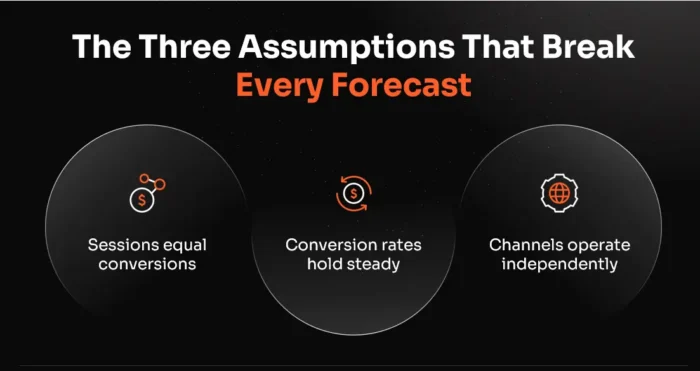
Conversion rates are often held constant, yet they shift with buyer intent, market conditions, and the competitive landscape. A model that holds conversion rate constant across changing conditions will produce projections that drift from reality the longer the forecast runs.
A growing share of searches now end without a click to any website, especially informational and navigational queries where AI-generated answers absorb demand before users reach organic listings. Lumping all query types together in a forecast produces misleading averages, because transactional and commercial queries retain click volume at higher rates.
The fix is not to abandon forecasting. It is to replace linear, single-number projections with probabilistic, scenario-based models that account for these variables from the start.
Types of SEO Forecasting
Modern SEO forecasting is not a single method applied uniformly. It runs across four distinct types, each answering a different business question. Used together, they give you a complete picture of what your SEO program is likely to produce and where the risk sits.
Visibility Forecasting
Visibility forecasting predicts whether your brand will be seen. The key metrics here are impressions, share of voice, and AI visibility across traditional search and AI-generated results.
The business question this type answers is: what will people see?
Visibility is the foundation on which all downstream demand and revenue forecasts are built. Without an accurate picture of how visible your brand will be, every estimate below it is working from an unreliable base. This has become more consequential as AI search and zero-click behavior change how often visibility actually converts into traffic. A brand can gain impressions and lose clicks simultaneously, and a forecast that only tracks one will misread the program’s performance.
Demand Forecasting
Demand forecasting predicts how users will respond after they see your brand. Key metrics include CTR behavior by query type, branded search demand, conversion rates by intent stage, and pipeline creation or online orders.
The business question this type answers is: what will people do?
Demand forecasting converts visibility into measurable business interest. It is where the forecast starts connecting to revenue, and where CTR assumptions by query type matter most. Informational queries produce fewer clicks per impression than transactional ones, particularly in categories where AI Overviews are active. A demand forecast that applies a single blended CTR across all query types will overstate expected traffic. Demand metrics also tend to surface earlier indicators than revenue results, which makes them useful for catching forecast drift before it compounds.
Revenue Forecasting
Revenue forecasting predicts business outcomes. Key metrics include Customer Acquisition Cost (CAC), pipeline velocity, revenue efficiency, and margin contribution.
The business question this type answers is: what will the business get?
Revenue forecasting connects marketing performance to financial outcomes. It is the type most SEO programs skip, and the one leadership cares about most. A program that can forecast CAC and pipeline contribution gives executives the metrics they actually use to evaluate channel investment. It also shifts the conversation from channel activity reporting to business impact, which is where SEO programs earn and maintain budget.
Scenario-Based Forecasting
Scenario-based forecasting predicts a range of outcomes rather than a single number. The standard framework covers a conservative case, an expected case, and an aggressive case.
This type does not replace the other three. It is the structure through which the other three are expressed. Every visibility, demand, and revenue forecast should be run across all scenarios rather than collapsed into a single projection.
Scenario-based forecasting enables risk management, creates more realistic performance expectations, and improves executive alignment. When assumptions shift mid-flight, whether from AI Overview expansion, a budget change, or competitive pressure on core keywords, a single-number forecast breaks. A scenario-based forecast gives leadership a plan for each outcome and a framework for understanding which assumption caused the deviation. It accounts for uncertainty rather than hiding it, which is what makes a forecast useful as a decision tool rather than just a prediction.
The Modern SEO Forecasting Framework: From Linear to Probabilistic
The old forecasting model was linear: more rankings produced more traffic, more traffic produced more conversions. That relationship has weakened. The modern model is probabilistic. It looks at a range of potential outcomes and assigns probabilities to each based on the assumptions most likely to affect performance.
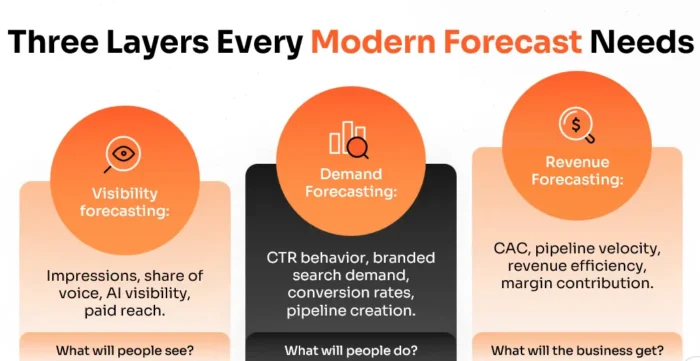
The four forecasting types we covered before are the building blocks. What makes them a framework is how they connect: visibility inputs feed demand estimates, demand estimates feed revenue projections, and all of it is expressed across scenario ranges rather than single numbers.
Every forecast should include a conservative case modeling what happens if AI Overviews expand further into your core query set, CTR drops, and demand softens. An expected case reflects the most likely outcome based on current trends and planned activity. An aggressive case reflects what is achievable if conditions hold and content performance exceeds benchmark.
Single-number forecasts create a single point of failure. When one assumption shifts, the whole forecast breaks. Scenario ranges give leadership a plan for each outcome and make the forecast useful as a decision tool rather than just a prediction.
The variables that create the largest swings and need to be explicitly modeled are AI Overview expansion into your query set, competitive pressure on core keywords, and conversion rate compression during economic slowdowns.
What Metrics Should You Track in Your SEO Forecast?
When it comes to SEO forecasting, every company has different goals. These are the metrics that connect forecasts to business outcomes in the current search environment.
Visibility by Intent Stage and Share of Search: Organic traffic volume alone overstates performance in zero-click environments, because impressions without clicks still influence purchase decisions through AI-generated answers. Track traffic as a range segmented by query intent (transactional, commercial, informational) and track share of search to understand how visible your brand is relative to category demand.
Branded Search Demand Growth and AI Citation Rate: Rankings still matter as an input signal, but they no longer predict traffic or revenue with the reliability they once had. Branded search demand growth tells you whether your content and authority-building efforts are translating to increased brand awareness. AI citation rate tells you how frequently your content is surfaced in AI-generated answers.
Backlinks: Backlinks refer to the links from other websites that point to your website. They are important because they signal to Google that other websites consider your content to be valuable and authoritative. In a forecasting context, domain authority, built in part through backlink acquisition, is one of the key inputs that determines how quickly rankings can be expected to move in a 90-180 day forecast window.
Returning Visitor Quality and Conversion Rate by Intent Source: Bounce rate is a page-level metric that does not connect to pipeline. Conversion rate by intent source tells you which traffic is actually generating revenue. Returning visitor rate tells you whether SEO-driven content is building the kind of ongoing engagement that leads to higher lifetime value.
The Inputs That Drive a 90-180 Day SEO Forecast
A 90-180 day SEO forecast is only as accurate as its inputs. The inputs that matter most are existing domain authority, content production velocity, historical ranking movement, internal linking health, backlink acquisition pace, and search demand trends in your category.
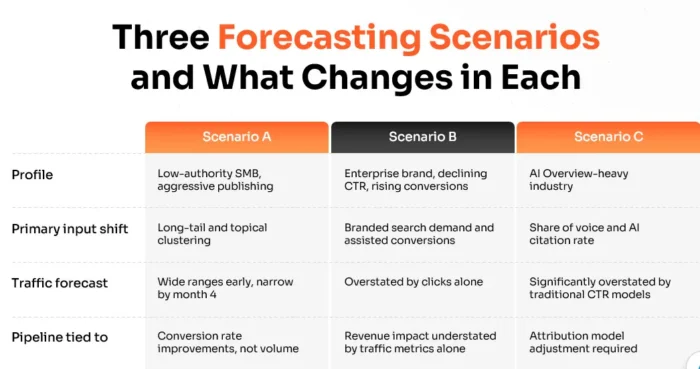
The outputs those inputs should produce are not single numbers. They are ranges: a visibility lift range, a traffic range, a conversion range, and a pipeline projection, each expressed across conservative, expected, and aggressive scenarios.
How those ranges look in practice depends on the starting position. For a low-authority small and medium-sized business with aggressive publishing plans, the ranges will be wide early and narrow by month four as ranking data accumulates. The forecast should be tied to conversion rate improvements rather than traffic volume, because the volume base is small. For an enterprise brand with declining CTR but rising conversions, traffic projections based on clicks alone understate revenue impact. The branded influence on assisted conversions needs to be explicitly modeled. For a brand in an AI Overview-heavy category, traditional CTR models significantly overstate traffic. An attribution model adjustment is required to avoid presenting projections that will consistently miss.
Ubersuggest’s predictive analytics can surface demand signals before they appear in rankings, making it a useful input at this stage for identifying where opportunity is building before it becomes visible in position data.
A 90-Day SEO Forecasting Action Plan
Day 1- 30: Clean your inputs. Audit attribution quality, SEO visibility reporting, CRM alignment where relevant, and any broken paths between traffic, conversions and revenue.
Day 31-60: Build your forecast model. Create visibility, traffic, conversion, and revenue ranges across conservative, expected and aggressive scenarios. Build out your ranges based on real-world scenario examples. For example, your conservative case may take into consideration when CPCs rise 20%, CTR drops and AI Overviews expand further into your core queries. Your expected case is based on current trends, historical performance and planned activity; while your aggressive case becomes what happens if conditions hold and demand accelerates.
Days 61-90: Make your forecast operational. Connect forecast reporting to the dashboard that leadership already uses and review forecast against actual performance monthly.
To keep track of all these important metrics in an accurate and organized way, you’re going to need help. Here are some of the most effective tools you can start with.
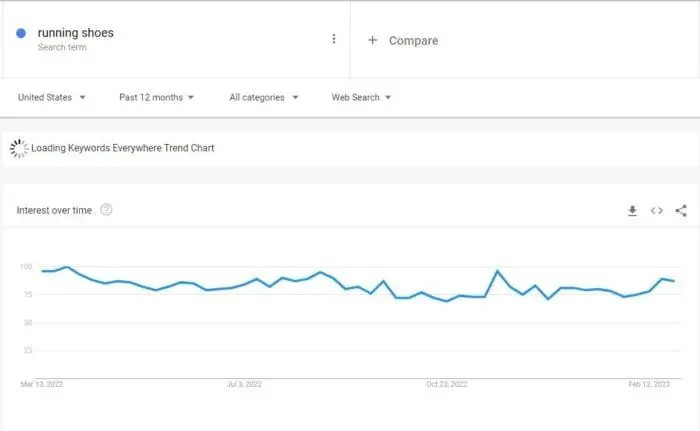
Google Trends: Google Trends is a powerful tool that allows you to track keyword/query popularity over time. By understanding how keywords are trending, you can identify any potential opportunities and adjust your strategy accordingly.
By entering the keyword “running shoes” into Google Trends, you can see how search interest for this term has changed over time. In this example, you notice that search interest for “running shoes” tends to spike during the months of March and April and again during the winter holidays, which suggests that these are peak months for the running shoe industry.
Armed with this knowledge, you could optimize your website’s content and marketing campaigns to capitalize on this seasonal trend and maximize your traffic and sales during these months.
In a modern forecasting model, Google Trends is most useful for surfacing demand signals before they peak, helping you calibrate the demand layer of your forecast rather than simply confirming what you already know.
Ubersuggest: Ubersuggest is a free keyword tool that provides detailed information about how keywords are performing in search. Utilize this tool as a way to identify demand signals before they appear in rankings or identify emerging opportunities.
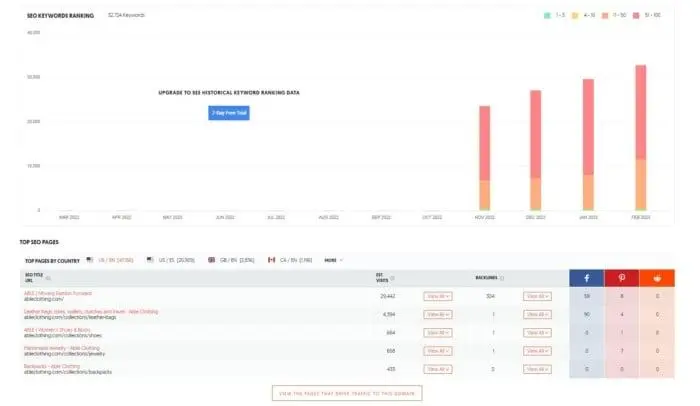
For example, let’s say you run an online clothing store that sells sustainable fashion. You could use Ubersuggest to analyze your website and identify keywords that are relevant to your business, such as “sustainable clothing” and “ethical fashion.” Ubersuggest would provide you with insights into the search volume for these keywords, as well as other related keywords that you may not have considered. You could then use this information to optimize your website content, such as product descriptions and blog posts, to better target these keywords and improve your search engine rankings.
Ubersuggest’s predictive analytics layer also surfaces content gaps and emerging demand signals before they appear in ranking data, making it a useful input for the 90-180 day forecast window this post covers.
For example, let’s say you run a website that sells organic skincare products. By entering your website’s URL into Ahrefs, you can see an overview of your website’s performance metrics, including its domain rating, organic traffic, and backlinks.|
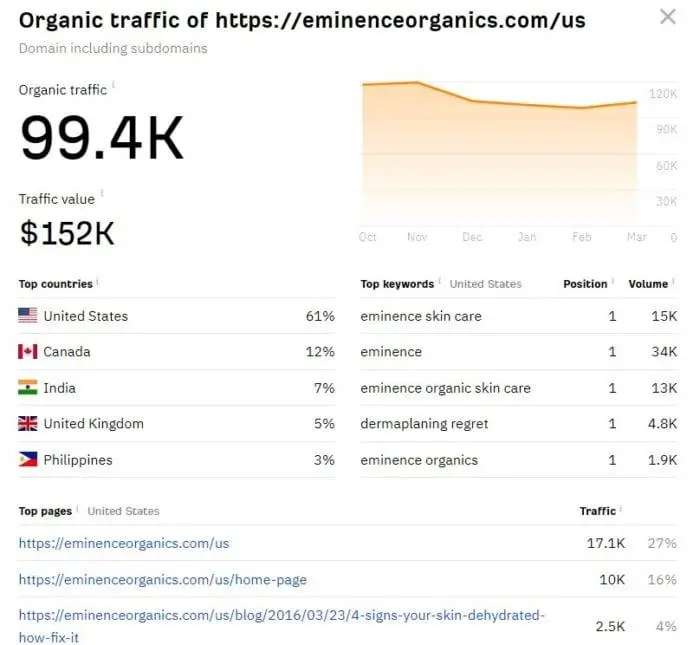
In a forecasting context, Ahrefs is most valuable as an authority benchmarking and competitive scenario input, helping you understand how domain authority and backlink acquisition pace affect the speed of ranking movement in a forecast window.
Building an SEO Forecast Leadership Will Actually Trust
Executives don’t want perfect forecasts. They want forecasts they can see through: a forecast where the assumptions are stated, the ranges are honest, and the connection to business impact is clear.
Most SEO forecasts report on sessions and rankings, yet these are inputs and not outcomes. These are not metrics that a CMO or CFO use to evaluate channel performance. Leadership measures marketing against revenue impact, pipeline creation, efficiency, and risk ranges. Aligning the forecast to those outputs changes the conversation from activity reporting to business impact.
What to state explicitly in an SEO forecast:
CTR assumptions by query type AI Visibility assumptions for queries where AI Overviews are active Conversion rate assumptions and what could compress or expand them Content production and implementation assumptions Authority inputs, including domain authority and backlink acquisition pace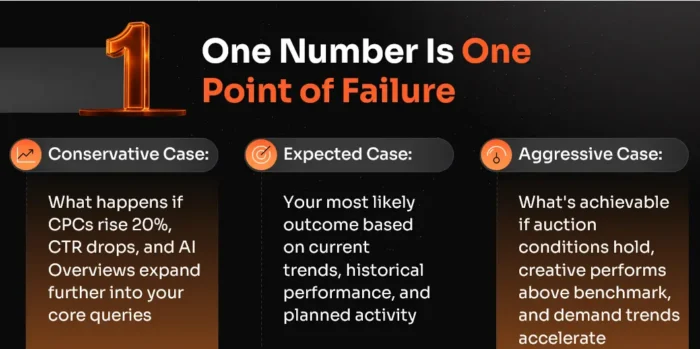
Forecasts that hide their assumptions lose credibility the first time they miss. Stating assumptions upfront sets realistic expectations and gives leadership a framework for understanding the cause when performance deviates.
Visualization formats that work for executive audiences include confidence bands around projections, waterfall charts showing the contribution of each input, pipeline progression visuals, and scenario overlays on a single chart. The goal is to connect the forecast directly to the dashboard leadership is already reading: pipeline, won revenue, and conversion rate in a single view. If the forecast and the reporting dashboard don’t share metrics, one of them needs to change.
FAQs
How do you forecast SEO growth?
Start by auditing your current AI visibility across the major platforms and identifying high-intent content gaps where competitors are being cited and you aren’t. Build your forecast across layered inputs covering visibility, demand, and revenue, and express outputs as scenario ranges rather than single numbers. The inputs that matter most for a 90-180 day window are domain authority, content production velocity, historical ranking movement, internal linking health, and backlink acquisition pace. Use Ubersuggest’s predictive analytics to surface demand signals before they appear in rankings.
Can you compare SEO forecasting tools?
The main tools for SEO forecasting each serve a different purpose. Google Trends is most useful for demand trend signals before they peak. Ubersuggest provides keyword demand data, content gap identification, and predictive signals. Ahrefs is strong for authority benchmarking, backlink tracking, and competitive scenario inputs. None of these tools produces a complete forecast on its own. They supply inputs to a model that must also account for AI visibility, CTR behavior by query type, and pipeline conversion rates.
How do you forecast SEO traffic?
Forecast SEO traffic as a range, not a single number, segmented by query intent. Transactional and commercial queries retain higher CTR even in AI Overview environments, while informational and navigational queries are losing clicks faster. Apply different CTR assumptions to each segment rather than using a blended average. Use share of search alongside traffic projections to capture visibility that produces brand influence even without a click.
What is an SEO forecast?
An SEO forecast is a model that estimates future changes in search visibility, traffic, and business outcomes based on historical data, planned inputs, and stated assumptions. A well-built SEO forecast expresses outputs as scenario ranges, connects to pipeline and revenue metrics rather than sessions alone, and states its assumptions explicitly so that when performance deviates from the model the cause is easier to isolate.
How do you present SEO forecasts to stakeholders?
Present scenario ranges rather than single numbers. State your assumptions explicitly for each scenario: CTR assumptions by query type, AI visibility assumptions, conversion rate assumptions, and content production rate assumptions. Use visualization formats that connect to the metrics leadership already tracks: pipeline, won revenue, and conversion rate. A confidence band chart showing the range of scenarios is more useful to an executive audience than a single traffic projection line.
How do you forecast AI search traffic?
AI search traffic requires a different input set than traditional organic traffic forecasting. Track your AI citation rate across ChatGPT, Gemini, Claude, Perplexity, and Google AI Overviews. Apply lower CTR assumptions to queries where AI Overviews are active, because these queries produce fewer clicks per impression than traditional rankings. Model AI-referred traffic separately from organic traffic. In some programs, AI-referred visitors may show stronger engagement or conversion quality than average organic visitors, but this should be measured separately rather than blended into a single organic traffic projection. Blending them into a single traffic projection may understate the revenue contribution and overstate the volume needed to hit pipeline targets.
Conclusion
SEO forecasting is a worthy exercise, but only if the inputs, outputs, and presentation reflect how search actually works today. Probabilistic, scenario-based forecasts tied to pipeline and revenue give leadership something they can actually plan around.
The teams building forecasting maturity now are making better budget decisions and earning more leadership trust over time. The framework covered in this post is available. The question is whether you apply it.
For readers building a blended channel forecast that covers both organic and paid, see our guide to paid media forecasting.



























.jpg&h=630&w=1200&q=100&v=7abd35f457&c=1)
