The Elephants in the Courtroom
Sri Lanka’s Supreme Court ruled that protecting Buddhism means protecting nature, so what happens when it doesn’t? The post The Elephants in the Courtroom appeared first on Tricycle: The Buddhist Review.
 Koichiko

On May 7, Sri Lanka’s Supreme Court sided with environmental advocates over a Buddhist head monk, ruling that he violated conservation laws and Buddhist principles by leasing temple lands for developments that damaged the local environment and disturbed herds of migratory elephants. The decision was a landmark one: The court held that harming nature in this way is illegal under Sri Lankan law and contrary to Buddhism itself, which the state is constitutionally obligated to protect and foster.
For environmentalists, including Buddhists, the ruling is a clear victory. But for anyone who has watched the Esala Perahera—the spectacular annual procession in Kandy in which dozens of captive elephants, most of them in leg chains, carry sacred relics through the streets—the court’s confident equation of Buddhism with environmental protection also raises a harder question: What happens when protecting Buddhism and protecting nature pull in opposite directions?
In and Out of the Forest
Perhaps no image better captures the shared values of Buddhism and environmentalism than the forest monastic living in harmony with nature. According to Prabhath Sirisena, a scholar and former forest monk, forest monasteries in Sri Lanka demonstrate a deep ecological ethic that binds together monastics with the living world around them—from the nearby plants and trees to forest animals, including birds and elephants.
For centuries, forest monks have inspired Buddhist practitioners, yet they have always been somewhat rare. Most monastics, today, as in the past, live not in the jungle but near human settlements, with whom they share the dharma and on whom they rely for food and material support. In larger population centers, where there are plenty of would-be donors, this symbiosis works well. In remote areas, with fewer people and less wealth, monasteries can struggle to survive.
Ensuring the survival of monastics—and the karmic merit that comes with it—is one reason that kings in Asia donated land to Buddhist temples and monasteries. These donations sometimes included entire villages of tenant farmers who would share their harvest, pay leases, or render essential services to resident monks. Donating lands, the thinking went, was a way to ensure monasteries had ongoing resources and support, even when times were tough. So extensive were these donations that, according to one 19th-century British official, temple endowments accounted for one-third of all rice fields in the central highlands of Sri Lanka.
In a perfect world, temple endowments and environmental protection would go hand in hand, and there are some good examples of this being the case. A 2024 study in Nature found that forest lands situated near Buddhist monasteries on the Tibetan plateau had higher biomass and more robust flora than other adjacent areas. This, the authors argued, suggested the positive influence of Buddhist monasteries on biodiversity and environmental vitality.
In other cases, however, the relationships between monasteries and wildlife are less perfect. Monasteries can be large, resource-intensive establishments, requiring services and infrastructure that have a sizable environmental impact. Monastery lands can also be misused or misappropriated. Whether out of desperation or deception, the head monks of monasteries and temples sometimes support development projects that enhance the resource base of the monastery at the expense of the surrounding ecosystem.
The petition that resulted in the May 7 ruling was brought by the Centre for Environmental Justice, a Colombo-based advocacy organization dedicated to protecting the environmental rights of people and the rights of nature. The complaint pertained to development activities undertaken near an ancient royal temple in a remote northwest province. The lands were claimed as endowments by the temple’s head monk (a fact that was contested in the case). Ostensibly seeking to increase the revenue of the temple, the head monk leased the lands to third-party operators to create quarries, engage in soil excavation, and construct a chicken-processing factory.
Caught in the middle were local residents, both humans and elephants. According to court records, erosion from the excavations damaged essential water supplies used by villagers for drinking and agriculture. Electric fences erected by the developers to protect their projects disturbed the herding patterns of migratory elephants, pushing them closer to human settlements and provoking a spike in human-elephant conflicts. While such conflicts are not new to Sri Lanka—the island is one of the most elephant-dense places in the world, with several thousand free-roaming pachyderms—the increased frequency of these events in recent years has made elephant-human violence a key concern for conservation groups.
Protecting Buddhism, Protecting the Environment
Sri Lanka’s legal infrastructure for protecting Buddhism—which has been central to multiple major decisions this year—is worth understanding in detail here. Like other constitutions in Southern Asia, Sri Lanka’s constitution awards special protections to Buddhism. Chapter Two of the country’s fundamental law gives Buddhism “the foremost place” and obligates the state to “protect and foster the Buddha Sasana” (the broader material, doctrinal, institutional, and ritual legacies of the Buddha), while also guaranteeing religious freedom for all citizens, including the island’s large communities of Christians, Muslims, and Hindus.
Duties to protect Buddhism are also visible in Sri Lankan statute law relating to temple properties, which permit the chief incumbent monks of temples to act as trustees and make decisions about how to use endowed lands. The terms of this arrangement are spelled out in the Buddhist Temporalities Ordinance, a law first introduced by the British that continues in an amended form to govern the use of Buddhist property on the island. Among the rules that chief incumbent monks must observe when using temple properties is a prohibition against utilizing land for “any purpose which is opposed to the principles of Buddhism.”
These kinds of duties concerning the use of temple property can be seen in ancient laws as well, including those cited in the case. Attempting to prove the wide scope of his temple’s endowments, the head monk produced before the court a 250-year-old sannasa, or inscribed copper plate used by Lankan kings as a kind of deed for gifting lands. Although the court did not consider the plate a valid legal source in this matter, the judgment nevertheless quoted the Sinhala words contained at the end of the deed as proof that modern laws concerning temple land use had ancient antecedents: “If a person takes even a small part of the Buddha’s possessions,” the Sinhala reads, “such as the grass, wood, flowers or fruit [from the temple], either for their own uses or for the uses of others, they will be reborn as a ghost.”
The Supreme Court’s decision in this case is a major win for environmental justice. In its decision and related declarations, the court not only canceled the development projects but also affirmed the principle of “polluter pays,” ordering those responsible for environmental harms to pay the costs of fixing them. Although it will be some time before the injuries to people, forests, and elephants are repaired, the firm action of the court constitutes an important step toward remediation.
Buddhist environmentalists, in particular, will find the decision noteworthy. Among the most significant aspects of the judgment was the court’s definitive stance that harm to the environment amounts to harm to Buddhism. In several places, the court expounds on the links between Buddhism and environmental protection. In one section, the court points to several suttas in the Sutta Pitaka to show that Buddhism “places a premium on the importance of the environment and emphasizes the need to protect and conserve its riches.” In another, the judgment classifies the development activities in question as not just ecologically harmful but contrary to Buddhist values, given that “the protection of the environment is a core value of Buddhism.”
Taking the judgment as a whole, the court suggests that the links between Buddhism and environmentalism are part of a broader spirit of environmental ethics visible in many other ancient canonical texts and religious teachings. To demonstrate this, the court pointed to passages from multiple other religious and historical sources, including a papal encyclical written by Pope Francis, a Hindu myth, the Institutes of Justinian, and a speech given by a Native American chief.
The Harder Question
As an environmentally minded scholar of Buddhism, I find much to admire about this decision. It is relatively rare to see such an unflinching and far-reaching defense of environmental justice by a higher court. Yet, as someone who spends much of his time thinking about the links between Buddhism and law, I cannot help but wonder about the implications.
In its decision, the court did more than affirm the connection between Buddhism and environmentalism. It invited future courts to take a more active posture toward protecting Buddhism. Citing its own 2023 determination in a case relating to proposed laws governing Ayurvedic medicine, the court stressed the active and positive nature of the government’s obligations to Buddhism. The state, it reiterated, must “take active steps to keep safe, defend and guard the Buddha Sasana against any harm, damages or injury from any source and take active steps to prevent its erosion from within and without.”
In this case, active protections for Buddhism aligned with outcomes favored by liberal environmentalists. The court ruled that protecting Buddhism also meant protecting trees from clear-cutting, protecting rural farmers from big business, and protecting elephants from electric fences. Ironically, protecting Buddhism also meant ruling against a Buddhist monk, one of the very figures the constitution was designed to protect.
But what happens when these strong protections for Buddhism come into conflict with environmental or liberal outcomes? Principles of law, after all, are imperfect tools, open to different interpretations and uses. Sri Lankan history offers no shortage of instances where constitutional provisions designed to protect Buddhism were used in conservative or chauvinistic ways, to fend off reform efforts within the tradition or to marginalize the rights of the country’s non-Buddhist minorities.
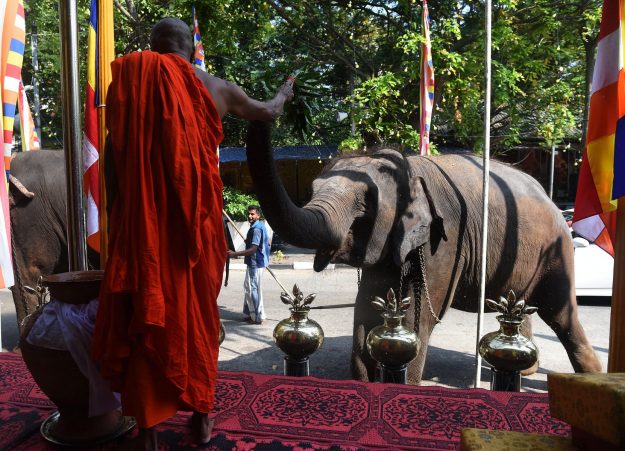 A monk feeds an elephant at the Gangaramaya Temple in Colombo, Sri Lanka as part of the annual Buddhist Navam procession. | Credit: A.HAPUARACHCHI/Xinhua/Alamy Live News
Nor is the alignment between Buddhism and environmentalism as seamless as one would like, especially when it comes to the island’s elephants. For centuries, elephants have been used in ritual processions centered on important Buddhist sites. Many activists condemn these practices as cruel, given the grueling nature of the work and the often poor conditions of captivity in which these “working elephants” are kept. Critics also point to the use of foot chains and the lack of water given to the animals to prevent them from urinating during the procession. In 2019, an international controversy broke out after photos emerged of an elephant used in the spectacular Esala Perahera in Kandy, gaunt and collapsed on the ground.
One wonders what would happen in a case like this, where constitutional obligations to protect and foster Buddhist ritual practices came into conflict with other constitutional and statutory obligations to protect nature. Under such circumstances, the courts might have to weigh obligations to safeguard Buddhism against obligations to conserve the environment.
In Sri Lanka, these two obligations may be equally valued, but they are not equal in law. While constitutional duties to protect and foster Buddhism place clear, unequivocal duties on the government, constitutional promises to “protect, preserve, and improve the environment for the benefit of the community” are only “directive principles,” guidance for legislators, rather than directly enforceable law. In a case like this, the court might be forced to choose between strong protections for Buddhism and comparatively weaker protections for the environment.
While this is a hypothetical case, it does point to a more general concern—another elephant in the room—that lingers in the background of discussions about Buddhism and environmental law: What does one do with instances of tension between Buddhist practices and the rights of nature?
As we celebrate this win for the elephants, harder cases lie ahead. Those who care about both Buddhism and the natural world will need to draw on the tradition’s deep reservoirs of compassion while acknowledging that the institutions created to support it are—like all things in samsara—imperfect.