Anicca AI & Insights on Agentic Workflows: Building an AI Operating System for Agencies
How Anicca is moving beyond individual AI tools to build connected systems that transform how businesses operate. “We’ve built an AI operating system designed for company AI, not individuals.” Ann Stanley, Founder & CTO at Anicca AI & Insights...
 FrankLin

How Anicca is moving beyond individual AI tools to build connected systems that transform how businesses operate.
“We’ve built an AI operating system designed for company AI, not individuals.”
For many businesses, AI adoption begins with a familiar first step: giving employees access to ChatGPT.
It’s an important milestone—but according to Anicca AI & Insights, it’s also where many organizations stop.
The agency believes the real transformation doesn’t happen when individuals start using AI. It happens when AI becomes embedded into the way an entire company operates. Rather than viewing AI as a collection of productivity tools, Anicca approaches it as organizational infrastructure—connecting workflows, systems, and teams through a shared operating model.
This shift from individual AI to company AI sits at the center of the agency’s vision for agentic workflows.
Agency Snapshot
🧠 Agentic Maturity
AI-first operations with company-wide automation embedded across internal workflows and client solutions.
⚙️ Primary Use Cases
Marketing operations, automated reporting, content production, and cross-platform workflow automation.
🌍 Industries
E-commerce & Retail, SaaS & Tech, B2B Services
🧩 Core Tech Stack
Claude Code, n8n, custom API-driven reporting platforms, and proprietary AI infrastructure built for company-wide deployment.
The Technology Behind Today’s Agentic Workflows

While many agencies rely on a mix of leading foundation models, Anicca extends this stack with workflow automation, custom reporting infrastructure, and an AI operating system designed to support entire organizations.
How Agentic Workflows Are Structured at Anicca
Anicca’s approach differs from traditional automation strategies because it focuses on connecting systems rather than individual tasks.
Instead of building isolated AI assistants, the agency has developed an AI operating system that orchestrates workflows across teams, internal platforms, and client operations. Much of this infrastructure is powered through form-initiated n8n workflows, allowing business processes to trigger automated sequences without requiring manual intervention.
Alongside these automations, the team works extensively with Claude Code, enabling developers and marketers to build more sophisticated AI-powered processes than conventional prompt-based workflows typically allow.
The result is an ecosystem where reporting, content generation, workflow automation, and operational tasks operate as connected components rather than separate tools.
For Anicca, agentic AI is less about adding another application to the stack and more about creating an operating layer that coordinates everything already in place.
Inside the Workflow: From Input to Output
Rather than treating each marketing activity as an isolated task, Anicca connects multiple AI agents into a continuous production pipeline.
A workflow may begin with a simple form submission that triggers an n8n automation. From there, specialized agents retrieve data, process information, generate content, and distribute outputs across multiple channels.
Because each step feeds the next, teams spend less time coordinating work between tools and more time refining strategy and reviewing outcomes.
This orchestration creates consistency across workflows while dramatically reducing manual effort.
Instead of employees moving information between platforms, the system does it automatically.
The Role of Human Oversight
Although Anicca embraces extensive automation, human expertise remains central to every workflow.
The agency views AI as an operational multiplier rather than a replacement for marketing expertise.
People define the objectives, design the systems, validate outputs, and continuously improve the workflows behind them.
As automation increases, the role of specialists evolves from executing individual tasks to managing, optimizing, and governing intelligent systems.
In this model, success depends less on writing better prompts—and more on designing better workflows.
A Real-World Use Case
One of Anicca’s most effective internal workflows powers its weekly AI marketing newsletter.
The process begins with an agent that monitors between 25 and 30 industry websites, continuously scraping new developments across the AI landscape. That information is automatically consolidated into a structured blog draft, complete with supporting imagery.
From there, another agent generates a LinkedIn post and, where appropriate, produces carousel creative. The workflow then supports the creation of an email newsletter before preparing additional social content for distribution.
What previously required approximately four hours of manual work is now completed in roughly one hour.
Beyond the time savings, the system ensures that every channel remains aligned while allowing the team to focus on editorial quality rather than repetitive production.
Key Advantages of Agentic Workflows
For Anicca, the greatest benefit of agentic AI lies in creating connected systems rather than isolated efficiencies.
By linking reporting, automation, content production, and distribution into a unified operating model, the agency reduces operational friction while improving consistency across marketing activities.
Instead of accelerating individual tasks, the system accelerates the organization itself.
This distinction reflects Anicca’s broader philosophy: businesses should stop thinking about AI as software and start treating it as infrastructure.
Challenges and Limitations
Despite rapid advances in AI, Anicca believes the biggest obstacle to adoption isn’t technological; it’s organizational.
Most businesses, the agency argues, are still experimenting with basic AI tools and have yet to establish structured approaches for training employees or integrating AI into everyday operations.
Without shared processes and internal education, organizations risk creating disconnected pockets of AI usage rather than scalable systems.
Moving from individual experimentation to company-wide AI adoption requires more than technology. It requires leadership, governance, and change management.
Where Agencies Are in Their Agentic AI Journey
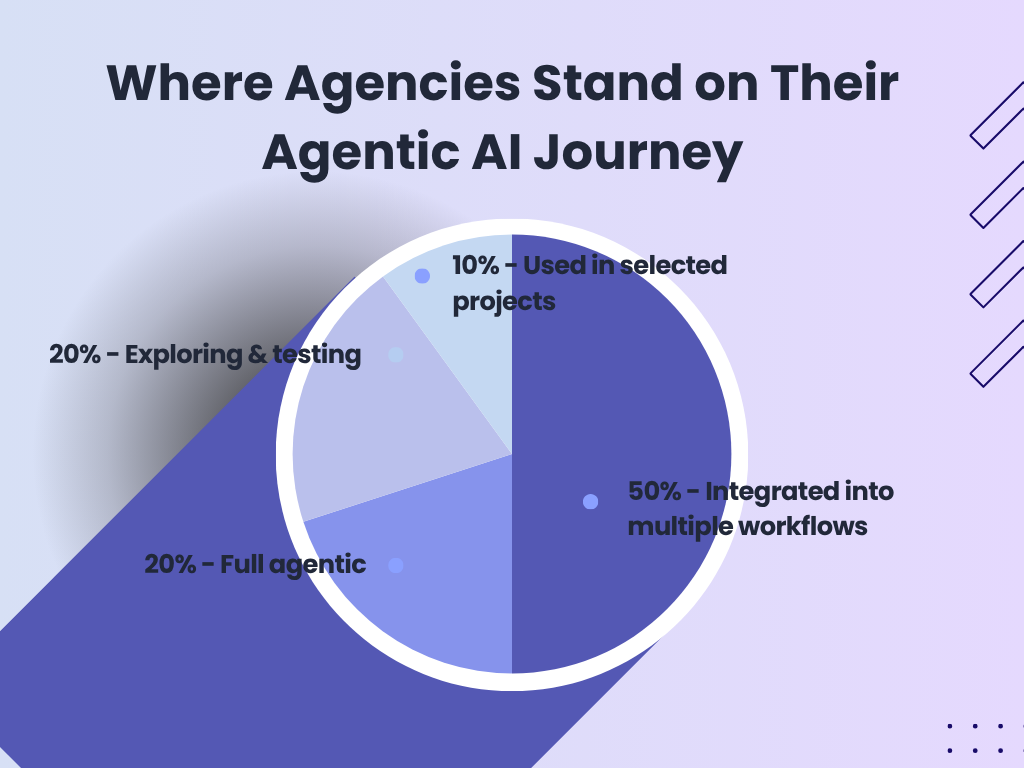
While AI adoption continues to accelerate, many organizations remain in the early stages of integrating agentic workflows into everyday operations—a gap Anicca believes represents one of the industry’s biggest opportunities.
How Agentic AI Is Reshaping Agency Models
Anicca believes the next phase of AI adoption will not be defined by better prompts or more powerful models. It will be defined by how effectively organizations redesign themselves around AI.
Today, many businesses still rely on individual employees experimenting with tools like ChatGPT. While this can improve personal productivity, it rarely transforms the organization as a whole.
The agencies that thrive in this environment will be those capable of helping businesses move beyond isolated AI usage toward structured, company-wide systems.
That means designing operating models, training teams, integrating workflows, and building governance frameworks that enable AI to become part of everyday business operations.
For Anicca, this is where agencies create their greatest long-term value—not by selling AI tools, but by helping organizations build Company AI.
Conclusion
Anicca’s vision of agentic AI extends well beyond automation.
Rather than asking how individual professionals can work faster, the agency asks how entire organizations can work differently.
By treating AI as an operating system instead of a standalone productivity tool, Anicca demonstrates that the future of agentic workflows is not simply about doing more with AI; it’s about redesigning how businesses function from the ground up.