Major Tom on Agentic Workflows: Building a Five-Agent Intelligence Hub
How Major Tom is transforming scattered market signals into a continuous intelligence system, helping teams move from reactive reporting to proactive decision-making. “ “We’re accountable for the output.” Victoria Samways, Marketing & Brand Manager at Major Tom Modern marketing...
 UsenB
UsenB
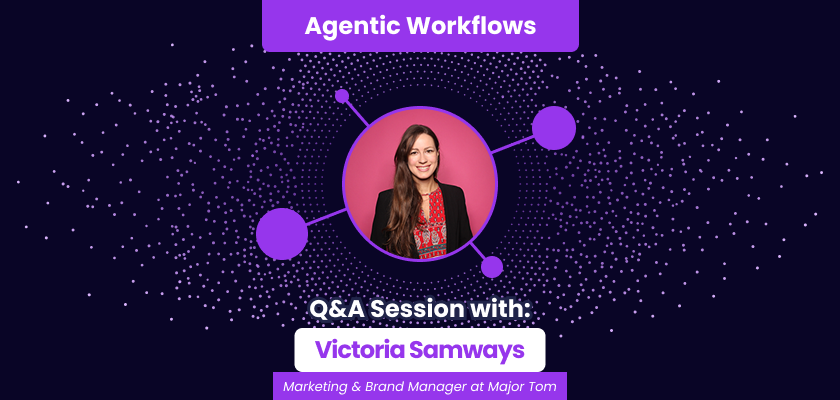
How Major Tom is transforming scattered market signals into a continuous intelligence system, helping teams move from reactive reporting to proactive decision-making.
“
“We’re accountable for the output.”
Victoria Samways, Marketing & Brand Manager at Major TomModern marketing teams have never had more data at their fingertips.
CRM platforms generate customer insights. Intent tools surface buying signals. Analytics dashboards reveal campaign performance. Market trends shift daily, while competitors continuously reshape the landscape.
The challenge isn’t collecting more information.
It’s knowing which signals matter and turning them into decisions before opportunities disappear.
That’s the problem Major Tom set out to solve.
Rather than using agentic AI simply to accelerate execution, the agency has built a structured intelligence workflow that continuously monitors, analyzes, and synthesizes business signals into a single, actionable view. The result isn’t just faster reporting—it’s a fundamentally different way of supporting strategic decision-making.
Agency Snapshot
🧠 Agentic Maturity
Human-guided sequential workflows with structured review gates embedded throughout every phase of execution.
⚙️ Primary Use Cases
Marketing intelligence, signal monitoring, strategic reporting, and pipeline analysis.
🌍 Industries
B2B Services
🧩 Core Tech Stack
OpenAI (GPT-4o, o1, etc.), Anthropic (Claude 3.5 Sonnet/Opus), Google (Gemini 1.5 Pro/Flash)
Where Agentic Workflows Deliver the Most Impact
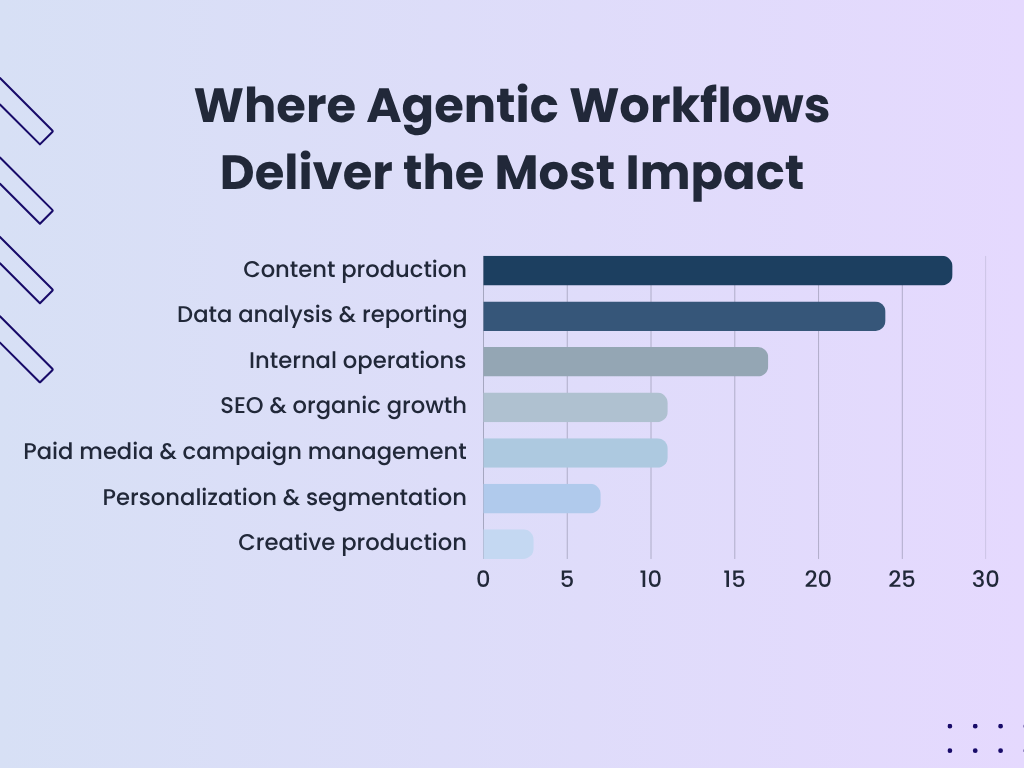
Across agencies, data analysis and internal operations continue to be among the areas where agentic workflows deliver the greatest measurable value—a pattern reflected in Major Tom’s intelligence-first approach.
How Agentic Workflows Are Structured at Major Tom
While many organizations experiment with parallel agent architectures, Major Tom has intentionally adopted a sequential workflow model.
Every process moves through clearly defined phases: research, generation, and output. Each stage must be completed before the next begins, ensuring that every layer builds on validated information rather than assumptions.
This deliberate sequencing reflects the agency’s broader philosophy around accountability.
Rather than optimizing purely for speed, Major Tom prioritizes confidence in the final outcome.
Human review is embedded at multiple checkpoints throughout the workflow, with an additional validation stage before anything reaches a client.
As the team explains,
“We’re accountable for the output.”
For Major Tom, agentic AI doesn’t remove responsibility, it reinforces it.
Inside the Workflow: From Input to Output
Every workflow begins by gathering signals from multiple sources.
Research agents collect information from internal systems, CRM platforms, external market sources, and campaign performance data. Once sufficient context has been assembled, generation agents organize findings into structured insights before producing reports designed to support strategic decisions.
Only after each phase has been reviewed does the workflow move forward.
This staged progression allows the agency to maintain both consistency and transparency, particularly when multiple datasets and business functions intersect.
Rather than generating isolated outputs, the workflow produces connected intelligence that teams can immediately act upon.
The Role of Human Oversight
For Major Tom, human oversight isn’t simply about checking for mistakes. It’s about protecting strategic integrity.
While agents excel at gathering information and identifying patterns, they cannot determine which business objectives deserve the greatest attention or why a particular market shift matters more than another.
Those decisions remain firmly in human hands.
Every review gate exists for a reason: to ensure recommendations reflect business priorities rather than statistical probability alone.
This balance allows the agency to scale intelligence without sacrificing accountability.
A Real-World Use Case
One of Major Tom’s most sophisticated implementations is its Marketing Intelligence Hub, a sequential workflow powered by five specialized AI agents that work together every two weeks to produce a comprehensive strategic digest.
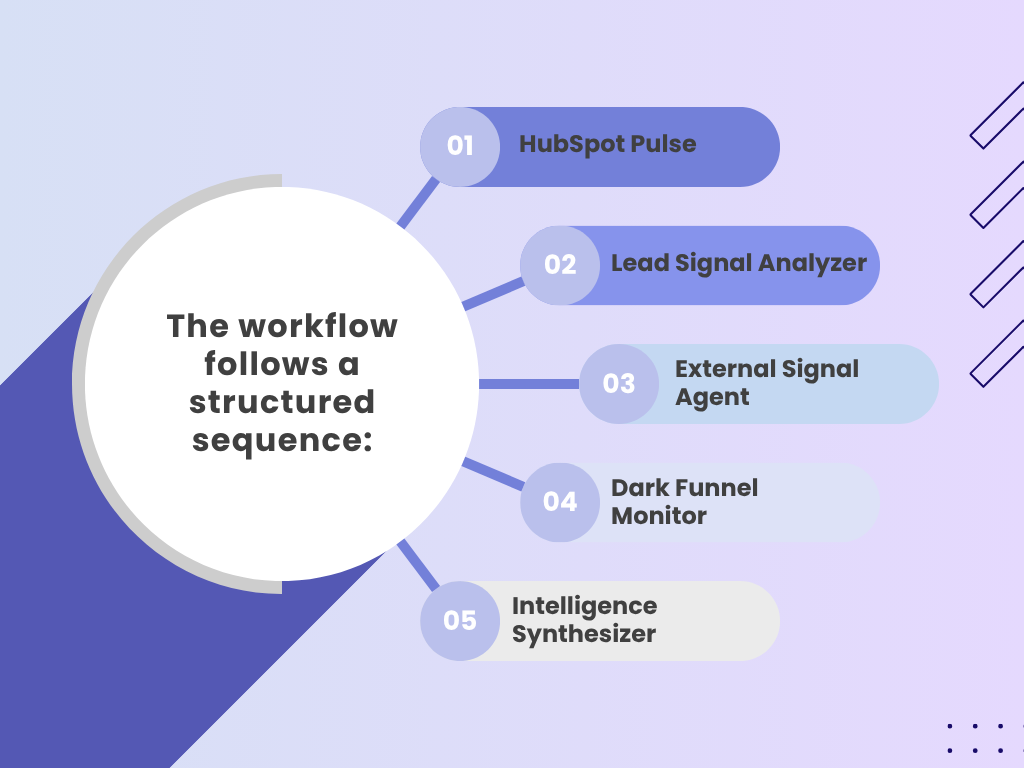
Before implementing this workflow, producing the same level of intelligence required more than a week of manual coordination across multiple teams.
Today, the process runs overnight.
By refreshing this analysis every two weeks, Major Tom ensures clients are making decisions based on current market conditions—not outdated reports created weeks or months earlier.
The result isn’t simply faster reporting.
It’s a continuous intelligence capability that keeps strategy aligned with what’s happening now.
Key Advantages of Agentic Workflows
Major Tom sees the greatest value of agentic AI in its ability to transform fragmented information into coordinated intelligence.
Instead of asking teams to manually gather updates from dozens of systems, specialized agents continuously collect, organize, and synthesize information into a single decision-ready view.
This reduces operational effort while allowing strategists to focus on interpreting insights rather than assembling them.
The outcome is not just greater efficiency, but greater clarity.
Challenges and Limitations
Despite these benefits, Major Tom believes automation should never come at the expense of accountability.
AI can surface patterns, summarize information, and accelerate production, but it cannot independently determine business priorities or fully understand organizational context.
For that reason, review checkpoints remain a permanent part of every workflow.
The objective isn’t to remove people from the process.
It’s to ensure people spend their time making the decisions that matter most.
The Biggest Wins and the Biggest Trade-Offs of Agentic Workflows

As agentic workflows become more sophisticated, agencies gain unprecedented scalability and speed, but also face new challenges around governance, orchestration, and maintaining trust in AI-generated outputs.
How Agentic AI Is Reshaping Agency Models
Major Tom believes the growing adoption of in-house AI will not diminish the role of agencies—it will redefine it.
As organizations build their own agentic capabilities, agencies become less valuable for producing deliverables and more valuable for helping businesses interpret complexity.
Technology can generate outputs.
Strategy determines which outputs actually matter.
The agency sees its future in helping clients define priorities, strengthen positioning, and build brands that resonate beyond what automation alone can achieve.
In that sense, the rise of AI increases the importance of experienced strategic partners.
Conclusion
For Major Tom, agentic AI isn’t about replacing marketers with intelligent systems.
It’s about giving those marketers a clearer understanding of the signals shaping their business.
By combining sequential AI workflows with structured human oversight, the agency has built an intelligence engine that transforms scattered information into meaningful action.
Because while AI can generate outputs, agencies remain accountable for outcomes.
And in the age of agentic AI, that distinction may become the industry’s greatest competitive advantage.