How to Build a Voice of Customer Program Without Enterprise Software
Voice of Customer programs have acquired an enterprise aura. The usual picture includes a dedicated customer experience team, a large software contract, complex dashboards, multiple research channels, and a quarterly presentation full of trends. That model can be valuable...
 Hollif
Voice of Customer programs have acquired an enterprise aura.
The usual picture includes a dedicated customer experience team, a large software contract, complex dashboards, multiple research channels, and a quarterly presentation full of trends. That model can be valuable when a company has the scale and organizational maturity to use it.
It is not the only way to listen to customers.
For many growing businesses, the raw material for a useful Voice of Customer program already exists. Customers explain what confuses them in support emails. They describe missing capabilities in chat. They reveal dissatisfaction while asking for help. They provide recommendation scores through NPS and explain those scores in survey comments.
The problem is rarely a total absence of feedback. The problem is that the feedback arrives in different formats, stays attached to individual conversations, and disappears before the right team can act on it.
A smaller company may not need an enterprise VoC suite yet. It needs a disciplined way to collect solicited and unsolicited feedback, classify it consistently, preserve the evidence, assign ownership, and close the loop.
Voice of Customer Is a Process, Not a Software Category
Voice of Customer, commonly shortened to VoC, is the continuous practice of collecting, analyzing, and acting on what customers say about a product, service, or experience.
The word “acting” matters.
A folder of survey exports is not a VoC program. Neither is a dashboard nobody reviews. A support inbox filled with useful complaints is not customer intelligence if the insight never leaves the queue.
SurveyMonkey’s guide to Voice of Customer programs describes VoC as an ongoing practice that brings together sources such as surveys, interviews, support tickets, online reviews, and social listening. It also distinguishes structured feedback, such as numerical survey responses, from unstructured feedback written in the customer’s own words.
Enterprise platforms are designed to connect many of those sources at scale. Qualtrics, for example, describes a full VoC platform as something that goes beyond surveys to include indirect and inferred signals such as contact center data, reviews, and social media, then turns those inputs into action across the business.
That is a meaningful standard. It also explains why a full enterprise platform can be unnecessary for a smaller organization whose most useful feedback comes from two places:
Customer conversations NPS and short surveysIf those two sources contain most of the evidence the company can realistically act on, building a reliable loop around them can create more value than collecting another dozen channels.
Why Companies Buy VoC Software Too Early
The appeal of a large VoC platform is understandable. Customer evidence becomes fragmented quickly.
Support owns tickets. Product keeps a feature request board. Success records account risks. Marketing runs surveys. Sales remembers objections from calls. Leadership receives summaries after the context has been compressed several times.
A centralized platform promises to solve the fragmentation. But installing a collection and analytics layer before defining the operating process often creates a more expensive version of the same problem.
The company collects more feedback, produces more charts, and still cannot answer basic questions:
Which customer signals matter? Who reviews each signal? What level of evidence justifies action? Can decision-makers inspect the original customer language? Who follows up with the customer? How will the company know whether the action helped?Software can support those decisions. It cannot make the organization care about them.
Before evaluating tools, a company should be able to describe its feedback loop in one sentence:
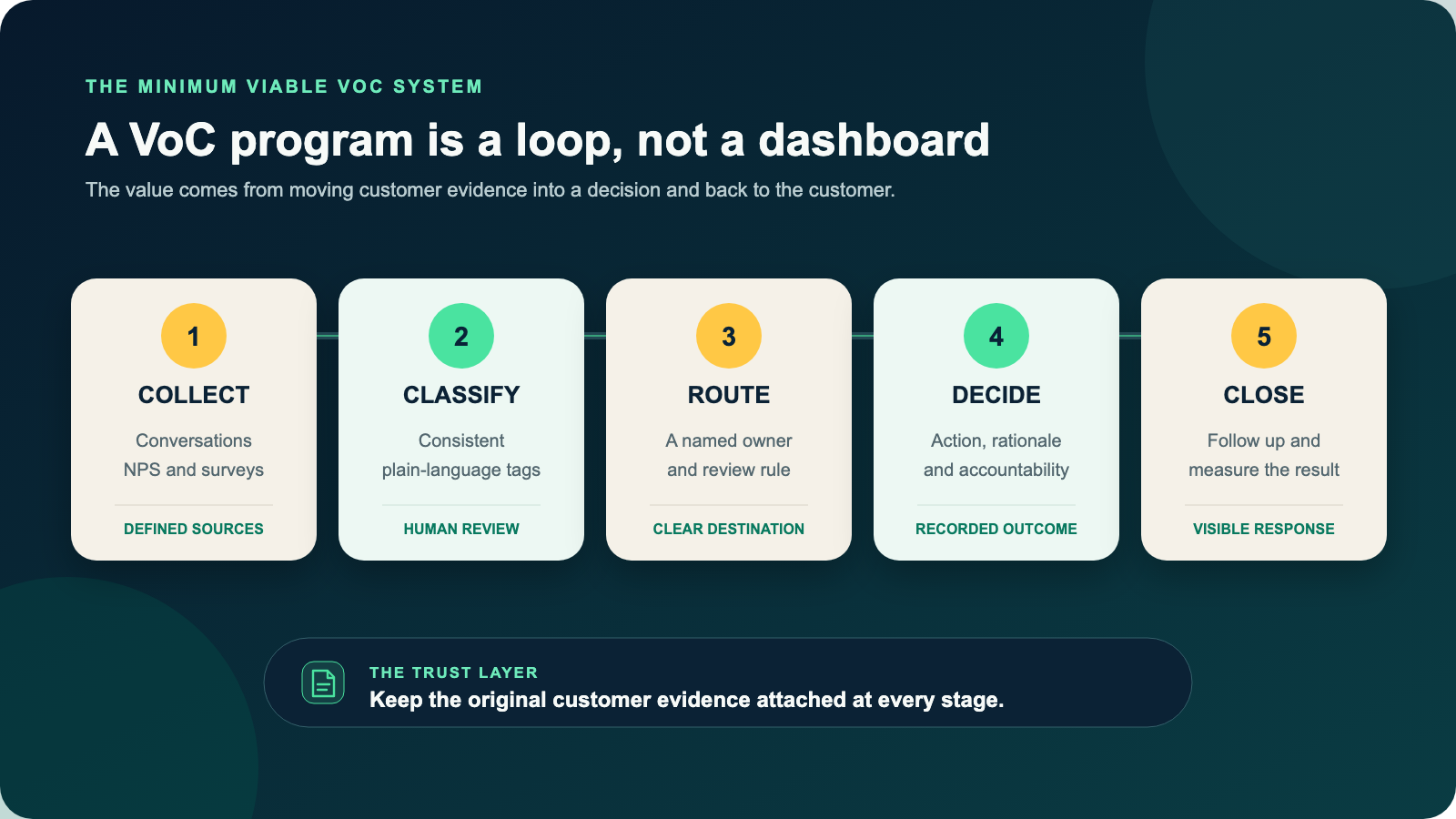
We collect customer evidence from defined sources, organize it consistently, send it to a named owner, record the decision, and follow up when appropriate.
If that sentence does not describe the current operation, buying a larger platform may simply make the gap more visible.
The Two Sides of a Practical VoC Program
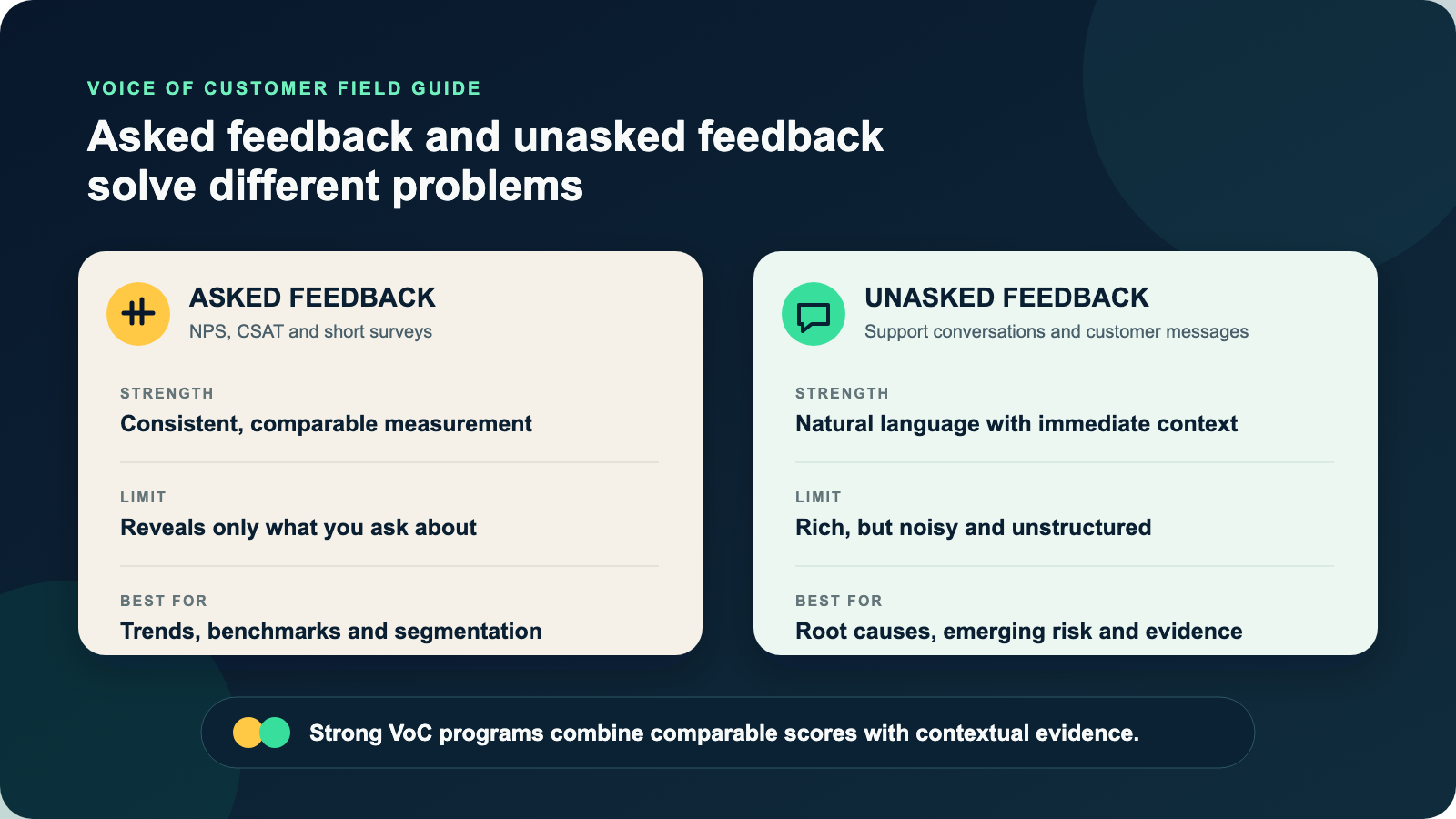
A lightweight Voice of Customer program becomes much stronger when it combines asked and unasked feedback.
Solicited feedback tells you what customers answer
NPS and surveys give the company a repeatable structure. The same question can be asked across customers and over time, making changes easier to observe.
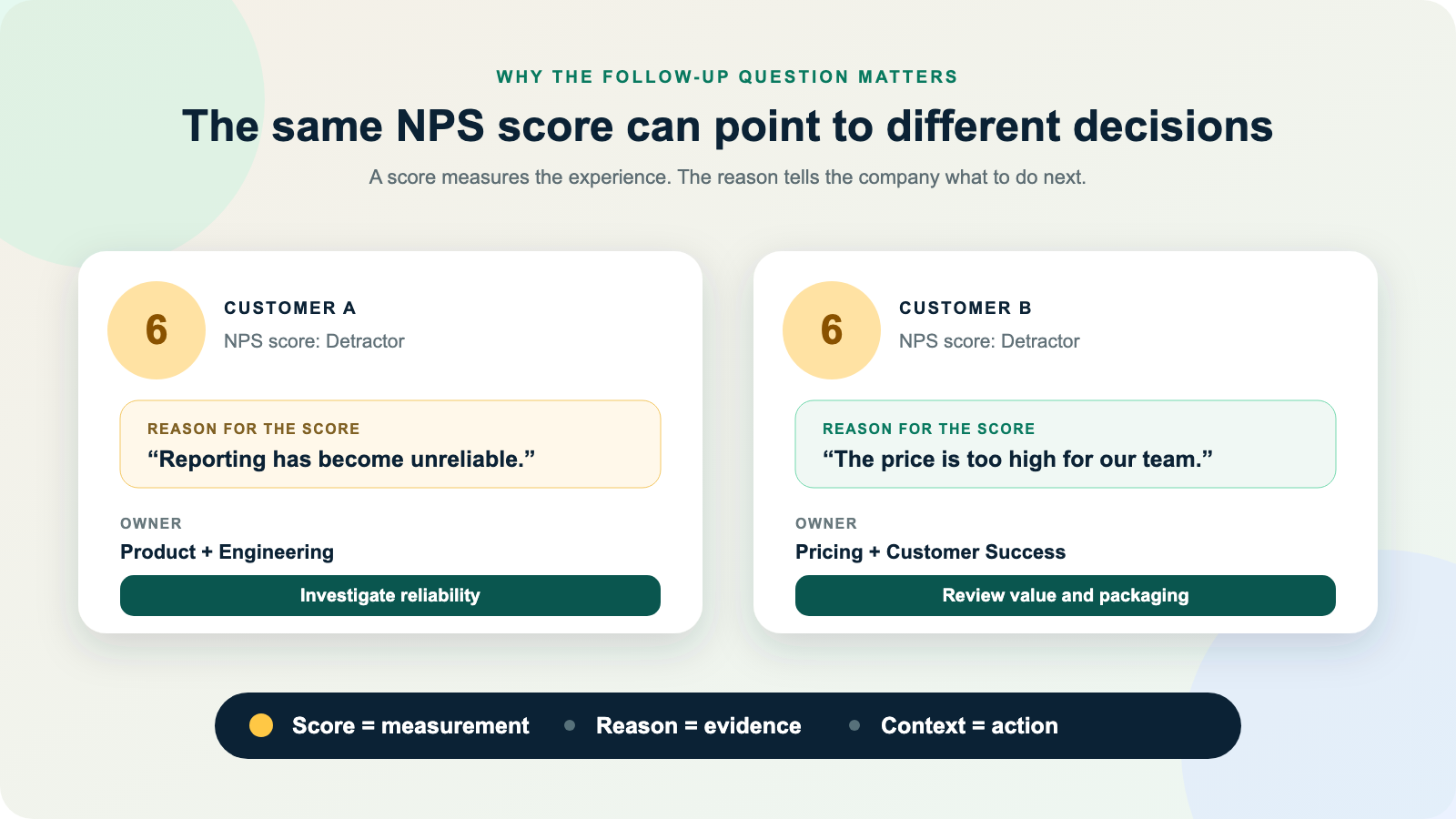
Bain’s Net Promoter System calculates NPS by subtracting the percentage of detractors, who score from 0 to 6, from the percentage of promoters, who score 9 or 10. Respondents who score 7 or 8 are treated as passives.
The score is useful, but the number alone is rarely enough to guide action.
A customer who selects 6 because reporting is unreliable requires a different response from a customer who selects 6 because the product is too expensive. The same numerical score can conceal very different causes, owners, and remedies.
That is why the follow-up question matters: What is the main reason for your score?
The explanation turns a measurement into evidence.
Unsolicited feedback tells you what customers cannot ignore
Support conversations have a different strength. Customers are not responding to a research prompt. They are describing a need that became important enough to contact the company about.
These conversations may contain:
Product friction Repeated feature requests Confusing policies Billing anxiety Cancellation risk Expansion interest Positive outcomes worth preserving Language customers naturally use to describe the productThis source is rich but difficult to summarize manually. A team may remember the loudest complaint while missing a quieter pattern repeated across several accounts. Useful signals are also mixed with password resets, routine questions, automated messages, and one-off issues.
AI classification can reduce that sorting burden, provided the original conversation remains available and humans can correct the result.
Build the Minimum Viable VoC Loop
A practical VoC program does not require every possible feedback channel on day one. It requires a loop that the organization can operate consistently.
1. Begin with decisions, not data
List the decisions customer evidence should improve.
For example:
Which product friction should be fixed first? Which accounts may need retention attention? Which repeated requests deserve product review? Which support articles are no longer adequate? Which customer outcomes could become advocacy opportunities?This prevents the program from becoming an exercise in collecting interesting comments with no destination.
2. Choose a small set of feedback sources
For a growing company, start with the sources already closest to action:
Support conversations An in-product or relationship NPS prompt A short survey after a meaningful interaction Optional customer interviews for deeper investigationMore channels can be added when the team has demonstrated that it can use the existing ones.
3. Create a taxonomy people can understand
Avoid starting with dozens of categories. A first taxonomy might contain:
Product issue Feature request Experience friction Retention risk Expansion signal Praise or advocacy Knowledge gapDefine each category in plain language and keep an example beside it. If two employees cannot classify the same message in roughly the same way, the category is probably too vague.
AI can perform an initial classification, but teams should review samples regularly and preserve an unclassified state when the evidence is insufficient.
4. Keep the original evidence attached
A label such as “feature request” is not enough for a product decision.
Decision-makers may need to know what the customer was trying to accomplish, which product they use, how urgent the need is, whether other customers asked for the same thing, and what wording appeared in the original conversation.
Summaries make review faster. Source evidence makes review trustworthy.
5. Assign owners and service levels
Every meaningful category needs a destination.
Retention risk may go to Customer Success Repeated product demand may go to Product Expansion interest may go to Sales or an account owner Knowledge gaps may go to Support Operations or Content Advocacy opportunities may go to MarketingNot every signal requires immediate action. It does require a rule describing who reviews it and how quickly.
6. Close the loop
Closing the loop can mean replying to one customer, updating an article, fixing a workflow, adding an item to product discovery, or explaining why a request will not be pursued.
The customer does not need to receive every internal detail. They should be able to see that speaking up can lead somewhere.
Where HelpRev Fits
HelpRev is one example of a focused approach to Voice of Customer for growing teams. It combines customer support operations with conversation intelligence, NPS, and survey feedback.
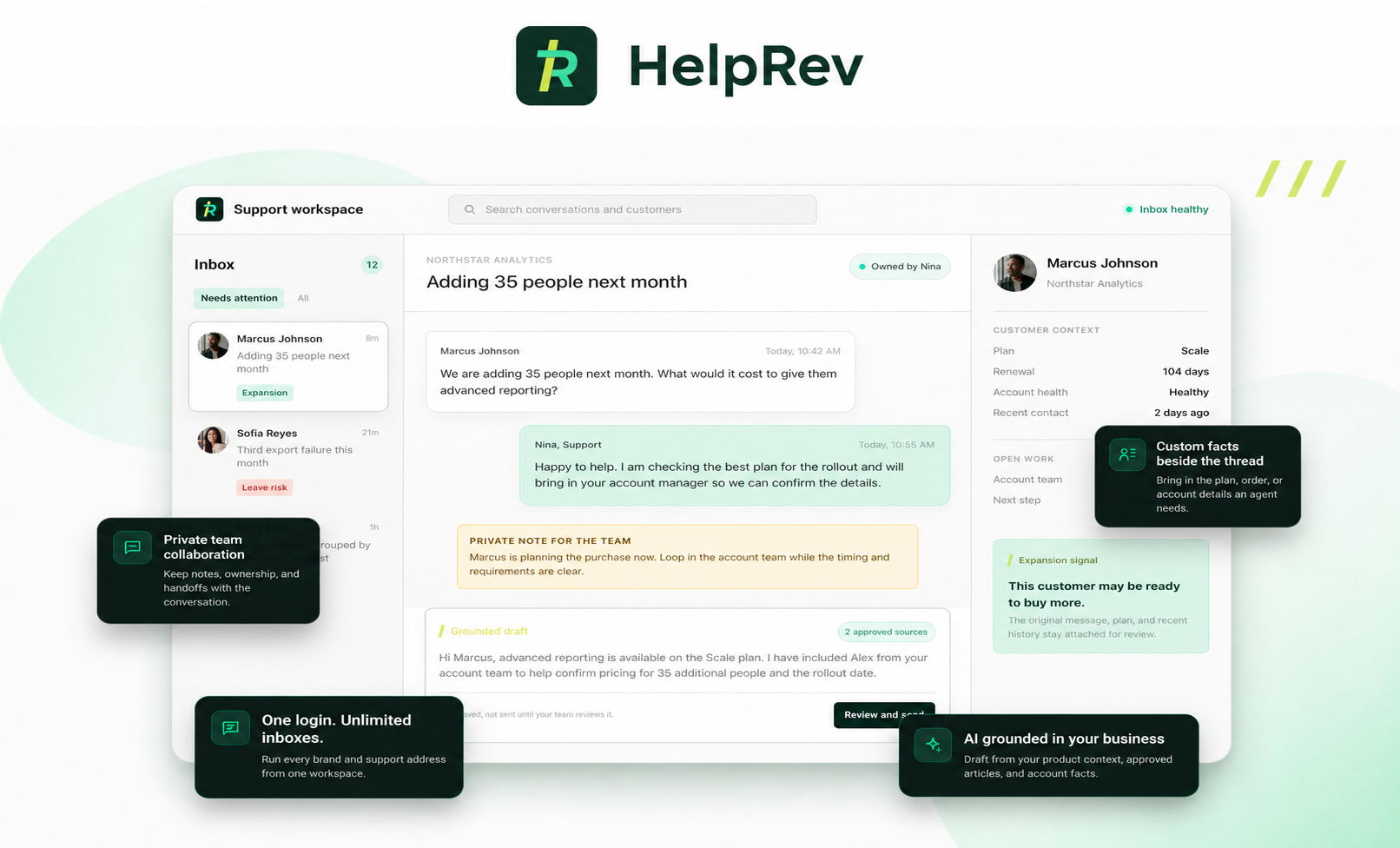
Its AI message understanding can analyze new customer messages for category, sentiment, urgency, product area, leave risk, business intent, recommended action, relevance, and a short summary. The classification considers recent conversation history and customer and product context, rather than relying only on isolated keywords.
The human boundary is important. Agents can filter and review the results, correct mistakes, and retain an explicit unclassified state when the AI does not have enough information.
HelpRev can also collect a configurable recommendation score through an in-app prompt or after a customer rates a support conversation. After the score, it asks for the main reason and allows an additional comment. This keeps qualitative context beside the numerical response.
Repeated feature-request evidence can then be grouped for review while keeping source conversations available. That helps Product distinguish an emerging pattern from a single loud request.
The advantage is not that HelpRev recreates every capability of an enterprise experience-management suite. It is that a smaller company can connect three practical jobs inside one operating flow:
Handle the customer conversation Understand and organize the feedback Route the evidence toward a human decisionThat makes it a credible option for companies that want more than a survey tool but do not yet need broad social listening, contact center analytics, research panels, or enterprise journey orchestration.
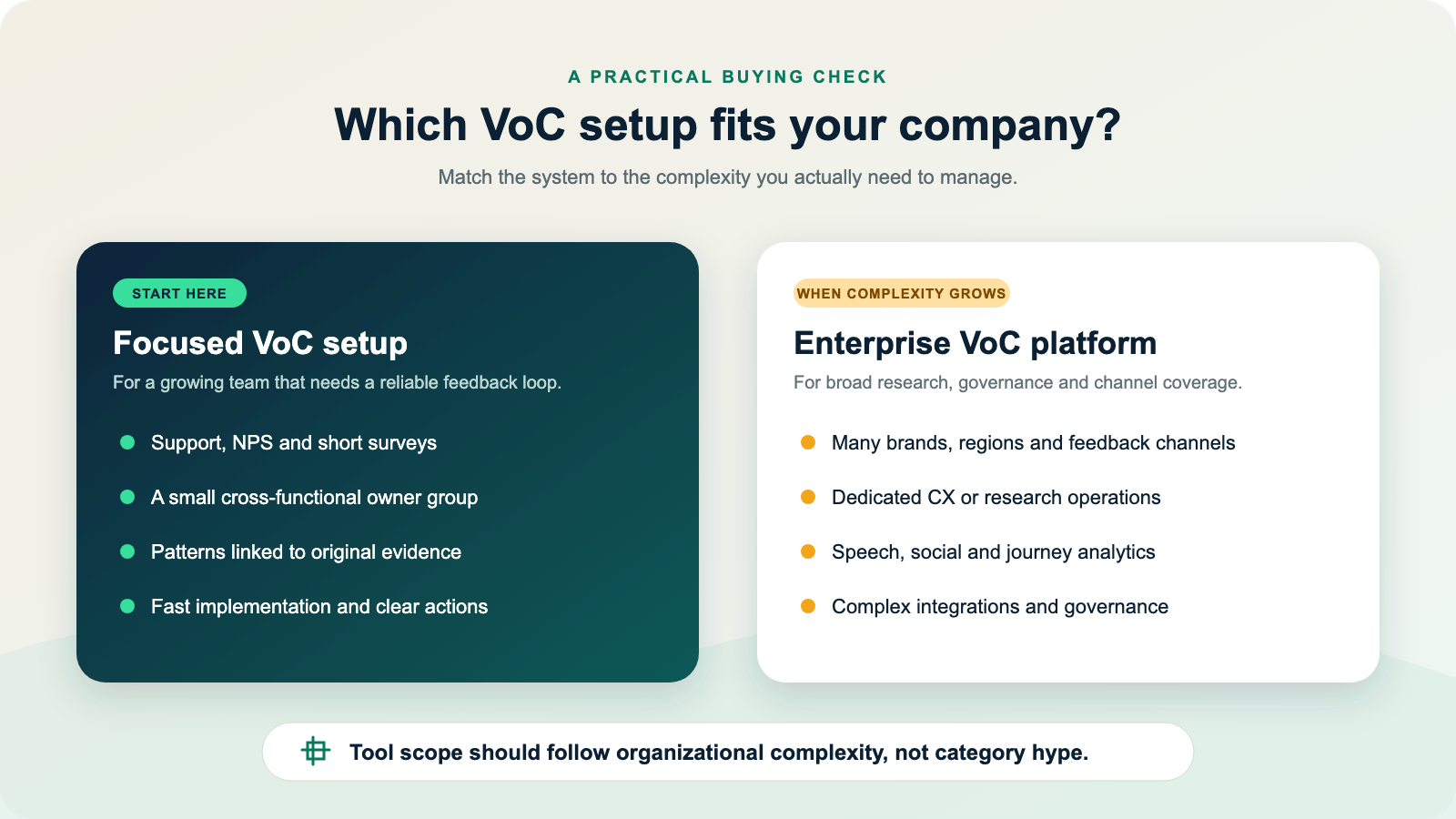
When a Focused VoC Tool Is Enough
A focused system may be enough when:
Most meaningful customer language already enters support The business wants to combine conversation analysis with NPS or surveys A small team needs clear ownership more than advanced research infrastructure Product and leadership want access to the conversations behind each pattern The company is still proving that it can act on feedback consistently Budget and implementation time matterThe phrase “enough” should not be treated as a compromise. A narrower system that employees actually use can create a better feedback loop than a sophisticated platform that becomes the responsibility of one analyst.
When Enterprise VoC Software Becomes Justified
Enterprise software earns its place when the problem is genuinely enterprise-sized.
That may include:
Feedback across many countries, languages, brands, and business units Large contact centers requiring speech analytics Social listening and review aggregation at scale Advanced survey sampling and audience management Complex customer journey orchestration Predictive models connecting experience signals to financial outcomes Formal research governance, privacy controls, and role-based access across large organizations Dedicated customer experience analysts who can maintain the programAt that stage, a focused support intelligence system may become one input into a broader VoC architecture rather than the entire program.
The right question is not, “Which platform has the longest feature list?”
It is, “Which level of infrastructure matches the decisions we can make today?”
A 30-Day VoC Starting Plan
A company can establish the first version of its feedback loop in one month.
Week 1: Define the decisions
Choose three to five business questions the program should answer. Name the team responsible for each one.
Week 2: Establish the inputs
Connect the relevant support conversations. Configure one NPS or survey prompt with a short qualitative follow-up. Avoid launching multiple overlapping surveys.
Week 3: Configure and test classification
Create the initial taxonomy. Review a sample of AI-classified conversations manually. Clarify definitions where reviewers disagree and allow uncertain messages to remain unclassified.
Week 4: Hold the first customer evidence review
Review patterns with Support, Product, Success, and another relevant team. Select a small number of actions, record the owners, and keep the supporting customer evidence attached.
The first review should produce decisions, not a perfect dashboard.
Measure the Loop, Not Only the Score
NPS can be part of the scorecard, but a useful VoC program should also measure whether feedback moves through the organization.
Consider tracking:
Percentage of relevant conversations successfully classified Agreement between human reviewers and AI classifications Time from signal detection to assignment Percentage of important signals reviewed by an owner Percentage of customer follow-ups completed Number of repeated requests supported by multiple conversations Changes in recurring issue volume after an intervention Survey response rate and the percentage that include a written reasonThese measures expose whether the program works as an operating system. A company can have a stable NPS while individual customers remain ignored, important patterns go unowned, or the same friction keeps generating support work.
Buy the Process Before You Buy the Platform
Enterprise Voice of Customer software solves a real problem. The mistake is assuming every company already has that problem.
A growing business often needs something more direct: listen to the conversations already happening, ask a small number of well-designed questions, organize the evidence, and give each meaningful signal somewhere to go.
Conversation AI tagging makes unstructured feedback easier to review. NPS and surveys add repeatable measurement. Customer context explains who is speaking and what happened. Ownership and follow-up turn those inputs into a functioning feedback loop.
That is already a Voice of Customer program.
The organization can add broader research channels and enterprise infrastructure when its scale, decisions, and team justify them. Until then, the best VoC system may be the one that helps the company act on the customer evidence it already has.
Disclosure: HelpRev is featured in this article as an example of a focused customer support and Voice of Customer platform. Product capabilities should be confirmed against the current HelpRev plan and documentation before publication.
Updated: 19 August 2026

About Aaron Jackson
Passionate about weaving words into engaging narratives, I am a blog and article writer dedicated to creating content that not only informs but also inspires dialogue and deepens understanding. Join me on a journey through compelling stories and insightful discussions. #Writer #ContentCreator










![9 Ecommerce Website Optimization Tactics [Expert Insights]](https://api.backlinko.com/app/uploads/2025/03/ecommerce-website-optimization-featured-image.png)